Monday, September 26, 2022

Workers Beware


(Above: Strikes everywhere: In July, NSW teachers joined the first combined state and independent school mass walkouts in nearly 20 years.)

Written by: Jed J. on 27 September 2022

Invited to sit around a table like one big happy family about to enjoy a meal, and hosted by the new Prime Minister Anthony Albanese, were representatives of many Australian interest groups including businesses and workers.

Called the “Jobs and Skills” summit the meeting was based on the premise that all these groups, especially those representing employers and employees, have common interests and by working together they could help build “a stronger economy and a stronger Australia”.

Businesses and their employees do have common interests, up to a point. Workers need jobs so they can earn a living and bosses need the labour power of workers to make profits.

However, when we look at how the wealth produced by this arrangement is distributed the idea of one big happy family ends. 

In reality, the interests of workers and bosses are diametrically opposed. Workers require increases in wages so that they can cope with the surge in the cost of living. 

They also need to have a say in the conditions under which they work and be free to struggle for better pay and conditions.

On the other hand, owners of businesses want to pay as little as possible and impose working conditions that lead to increased productivity in order to maximise profits.

Experience of what happened to wages, conditions and workers’ rights to struggle under the Accord should serve as a warning. 

Having a seat at the table is no guarantee that workers will be better off. In fact, they could be much worse off. 

One result of the Accord was that workers had to pay for their own wage increases through being more productive while the proceeds of the increase in productivity were gobbled up in the form of increased profits.
 
Unlike most meals, this get together has seen the sweets served up before the main course. Measures that may prove popular with sections of the population have been offered up as sweeteners. 

The main concern addressed so far is that enterprises have all the workers they are crying out for, both skilled and unskilled. 

The talks about what wages and conditions this enlarged workforce will work under have been put in the too hard basket. We will have to wait for these crucial talks to take place, and it’s not hard to see why. 

They would show up the fundamental differences between employer and employee when it comes to divvying up the wealth created in the workplace.

The new Labor Government has already indicated where they stand when it comes to workers’ wages and conditions. 

They have pledged to go ahead with the previous government’s tax cuts for the rich. 

That money would be better spent on alleviating conditions and paying wage increases to those working in essentials services like public schools and public hospitals. 

It’s as if the overcrowded classrooms and hospitals, extreme staff shortages and staff burnout are not as important to the government as tax cuts for the rich.

This does not auger well for the future talks to be held over the next 12 months and which are designed to (in the government’s own words) help shape the future of Australia’s labour market.

If the interests of workers are to prevail, they will have to learn the lessons of history and not put their faith in a parliamentary system which so clearly favours their adversaries.


Australia’s Head of State, the British Monarchy, Is Part Of British Capitalism

(Above: King Charles III, Australia's Head of State.      Source: Roy Morgan)

 Written by: Ned K. on 26 September, 2022

The death of Queen Elizabeth and resulting endless media coverage and ceremonies was played for all its worth by the ruling class to maintain the monarchy both in the UK and Australia. Throughout the period of official mourning of the Queen's death, the members of the Royal Family were portrayed as models of middle-class values and the best of a blissful British aristocratic tradition. 

Prime Minister Albanese seemingly threw himself in to this fantasy in a way that at times resembled former Prime Minister "Pig Iron Bob" Menzies’s antics at the mere mention of the British monarch and Queen Elizabeth in particular!
 
First Nations people in Australia were disgusted with all this and rightly so, and on Public Holiday Thursday 22 September they organized demonstrations against this whole fantasy of the British monarchy as some people-loving institution. They exposed the monarchy as the invaders of their lands and slaughtering of their peoples.
 
Many non-Indigenous Australians were also angry at the subservience of the Albanese Government to the British monarchy, especially the granting of the Public Holiday for mourning of a feudal monarch.
 
However, another important aspect of the monarchy hidden by the media portrayal has been well argued by Laura Clancy in her book, "Running the Family Firm" and in her media release in "Novara Media” on 9 September 2022.
 
Clancy reveals that, "Rather than an aristocratic relic of a pre-bourgeois era, the British monarchy has worked its traditional privileges into the heart of British capitalism".
 
She provides numerous examples of how the monarchy is part of the heart of British capitalism including:
 
• The Duchy of Lancaster - British sovereign's private estate has investments in two off-shore financial centres, the Cayman Islands and Bermuda
• The Crown is a common law corporation but is exempt from most taxation
• The "sovereign grant" from the UK government (the public purse) funds the monarchy's activities and is exempt from taxation
• The monarchy does not pay inheritance tax
• The Crown Estate, a land and property portfolio made a net profit of 269.3 million British Pounds in 2021 as an "independent commercial business"
• Much of the monarch's land ownership in the UK and abroad goes back to its feudal origins. However, in the current stage of imperialism the monarchy has diversified its portfolios. For example, it owns property in Regent Street in the centre of London, Eltham, Egham and Hampton, 14 retail parks and most of the UK's wind, wave and tidal power sites, as well as 336,000 acres of agricultural land and forestry in the UK.
• Through the "Prince's Trust Regional Awards" the monarchy has direct links with sponsors who represent the core of capitalism. These include HSBC, the Royal Bank of Scotland, Natwest, Dell, Delta Airlines, Tesco, G4S and BAE Systems.
 
The above examples are only the tip of the iceberg regarding the interconnection between the monarchy and British capitalism in its declining imperialist stage. As it did in the 18th Century through entities such as the East India Company, the monarchy has extensive financial and industrial interests in overseas countries, including those countries like Australia that have the British monarch as Head of State.
 
For the peoples of Australia, led by First Nations people, cutting ties completely with the British monarchy is long, long overdue. The ruling class in Australia is dominated by multinational corporations, financial institutions and media giants from the USA in particular. Some will be comfortable with an Australian government cutting all ties with the British monarchy while others will want to maintain the monarchy, seeing it as a useful political arm of imperialist rule in Australia.

After all, US imperialism is based in the USA, a country which cut constitutional ties with the British monarchy in the American War of Independence in 1776! Since that day it grew and expanded to be the number one imperialist power in the world, all in the name of a republic, not a monarchy.

In Australia, the day of the people having an Australian Head of State and cutting ties with the British monarchy is not too far away. The sentiment of the majority of the people will eventually be for a People's Republic of Australia, where the interests of the First Nations people and working people come first, rather than a republic USA style, where the interests of the First Nations and the working people of all colours came a very distant second.

Sunday, September 25, 2022

My name is Mahsa Amini!


(Above: Australian Iranians rally in Perth.     Source: ABC)

Written by: Nick G. on 25 September 2022

Thousands of Australian Iranians have taken to the streets in the week since the death of Iranian Kurdish woman Mahsa Amini, also known as Zhina.

The 22-year-old had spent three days in a coma after her arrest by the religious morality police, the Irshad, and died in custody after being beaten by a baton.

Visiting Teheran from one of Iran’s Kurdish regions, Amini had been arrested for wearing “unsuitable attire” after judging that her hijab was too loose.

All major Iranian cities have erupted in protests and at least 41 people are known to have been shot and killed by police in protest crackdowns. Iranians of all ethnicities and religious beliefs have united to fight the repressive regime. 

In Australia, protests began last week when hundreds of Australian Iranians and their supporters rallied outside the city’s largest library. As is the case in Iran, many men have come out in support of the freedom of women. A second Melbourne rally occurred this weekend at which a woman cut off her hair to chants from the crowd of “Freedom”!

Sydney has also seen rallies, Brisbane had one yesterday in King George Square, Canberra has had a rally, and Perth and Adelaide had rallies today attended by hundreds. 

Perth rally organiser Mehdi Ghatei said he had never seen such a large gathering of Iranians in Perth.

He said he organised the rally to help give a voice to the people in Iran, who are cut off from the world by their government.

Saturday, September 24, 2022

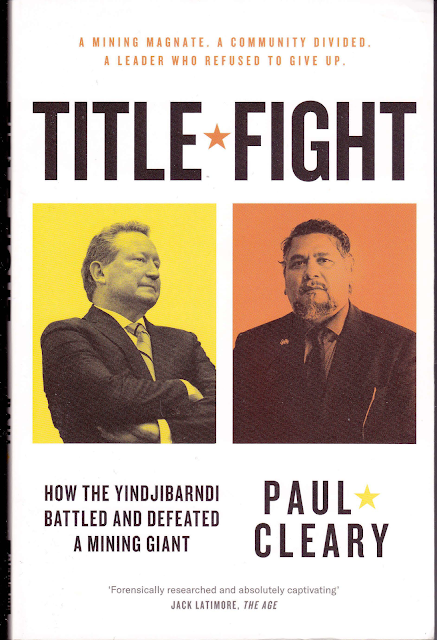
Book Review: TITLE FIGHT


Written by: Duncan B. on 22 September 2022

Andrew “Twiggy” Forrest is well-known to Australians as a self-made mining billionaire, philanthropist, environmentalist and friend of Indigenous people, or so his PR machine works overtime to convince us. The Yindjibarndi people of Western Australia’s Pilbara region have seen a different side of Forrest and his company Fortescue Metals Group. (FMG)

Andrew Forrest is Australia’s richest man with a personal fortune estimated at around $30 billion. (He is the second richest person in Australia after Gina Rinehart on $34 billion.)  Forrest has a 36% share in FMG which gives him a handy slice of the company’s $8-10 billion annual profit.  FMG is the fourth-largest iron ore producer in the world with assets of around $50 billion and holdings of over 87,000 sq. km in the Pilbara region. Some of the iron ore mines that have generated Forrest’s billions are on the land of the Yindjibarndi people.

TITLE FIGHT How The Yindjibarndi Battled and Defeated A Mining Giant by Paul Cleary tells the story of how the Yindjibarndi fought and won a thirteen-year battle against Andrew Forrest, FMG and their billions of dollars. 

In 2013, FMG started mining on Yindjibarndi land. FMG had state and federal government approval, but did not have the approval of the Yindjibarndi Aboriginal Corporation (YAC) which is the legal custodian of the rights and interests of the Yindjibarndi people of the area.

From 2008, FMG has tried to get unlimited access to Yindjibarndi land while offering minimal compensation. The Yindjibarndi resisted FMG’s attempts to take over their land and sought to gain title rights allowing them exclusive possession of their land. 

FMG used dirty tactics to oppose the Yindjibarndi. They tried to dispute the Yindjibarndi’s connection to their land and downplay the significance of the findings of archaeological surveys of sites on Yindjibarndi land. FMG sacked consultants who produced a report detailing a large number of sites which would have hindered FMG’s aims. FMG commissioned another report from another, more obedient, firm of consultants who produced a report more to FMG’s liking.

FMG subjected the YAC to multiple legal actions in a number of different courts, spending hundreds of thousands of dollars on high-powered lawyers against the poorly-resourced YAC.

FMG encouraged a breakaway group of Yindjibarndi people who were sympathetic to FMG. They were showered with millions of dollars in payments and backed and were financed in numerous court challenges to the YAC, in the hope of being declared the legal representatives of the Yindjibarndi. Unfortunately, playing off one group of Indigenous people against another is a tactic that is being used to advantage by other mining companies. 

The Yindjibarndi, led by Michael Woodley never gave up the struggle, until in 2017 the Federal Court of Australia granted them the right of exclusive possession over their land. It was not until 2020 that the High Court threw out FMG’s attempt to have the Federal Court’s decision overturned.

In another example of a victory by Indigenous people over a mining company, the Federal Court has just ordered Santos to stop drilling at its $6.3 billion gas project in the ocean about 120 km north of the Tiwi Islands, which lie 80 km north of Darwin. 

The Court found that the National Offshore Petroleum Safety and Environmental Management Authority (NOPSEMA) had approved Santos’ environmental plan without checking whether the company had carried out adequate consultation with all relevant parties, as required by law. The Tiwi Islanders claim that they were not properly consulted before NOPSEMA approved the plan.

Is not uncommon for the various regulatory bodies involved in dealing with the mining industry to look after the interests of mining companies rather than protecting the interests of Indigenous people and the environment.

Australia’s Indigenous people are showing us that victory is possible in struggle against multinational companies, using a variety of tactics, not just relying on the courts. TITLE FIGHT  is a must-read for everybody involved in the struggle for Australian Independence.


Saturday, September 17, 2022

One Team?


Written by: B.Bill on 15 September 2022

One team. One Metro. As far as Metro Trains internal corporate ‘ethos’ goes, it’s about as bland and as uninspiring as it goes, and as when most of these things come to the crunch, it’s bullshit.

Metro management has sent out an email to all staff asking them to volunteer, yes you read that correctly, volunteer their time to act in a customer service role during the Spring Racing Carnival.

The Spring Racing Carnival and the Royal Melbourne Show are two of the busiest times of the year on Metro’s network and extra staff are always needed to support local staff. The way that this has been managed since even before privatisation is that all extra shifts possible are allocated to local part timers. Any shifts remaining are then open to be filled from part timers all across the network. If a few happen to remain, full timers can be offered overtime. Finally, if all shifts still aren’t filled, labour hire can contracted to perform the most peripheral roles. This has never been required, however, due to the ever increasing part time culture of work at Metro, all hours are readily snapped up.

Spring Carnival work can be some of the most dangerous of the year for Station Staff due to the fact that packed and delayed trains and drunk and often drugged up customers are not a good mix, with staff caught in the crossfire. It is no place for a person without experience in this environment to be. Recognizing this, the Rail, Tram and Bus Union has immediately filed a dispute notice.

Metro management must be confident that they will be able to find the requisite amount of scabs (scab is not a word I ever use lightly, but doing work that someone else would be paid for is a scab), otherwise they would not have posted the ad. The question is, who would be interested in doing such a thing? 
Plenty in Metro’s bloated middle management section would be happy to do so, thinking that sticking their brown nose further up their bosses arse might get them a promotion.

Sadly, some part time station staff may be tempted as well, in a misguided thought that winning ‘brownie points’ could lead to the coveted full time position. They must be spoken to and have it explained the very serious effect scabbing will have on their reputation.

There are many theories as to why such a grubby course of action has been taken. It may just be an attempt by Metro to introduce and normalise such a practice. It could be an attempt to split the workforce. The most commonly discussed theory however, is that a certain manager’s bonus is linked to the amount of public holiday penalties are paid to staff per year, the lower the better for her. With an extra holiday being introduced to celebrate (whoops, sorry) commiserate the death of a Saxe-Coburg-Gotha who married her cousin, this certain manager may be clamoring to save her bonus. We may never know.

One thing is for certain. This grubby corporate behavior from a foreign multinational in charge of a vital public services demonstrates more than ever that our public transport must be just that again, public. Rip up the contracts and give the system back to the people!

Tuesday, September 13, 2022

The masses can do anything


Written by: Clarence C on 14 September 2022

Across Australia, more and more workers are joining the tremendous upsurge in working class struggle. Teachers and nurses, rail, airport, maritime and healthcare workers, and others will have to come to terms with a fundamental truth of capitalist Australia: the ALP administration is nothing more than a committee for the ruling class that will not reverse the skyrocketing inflation imposed by the multinational corporations.

Everywhere, more and more workers are realising that they can only rely on their collective struggle. Their honeymoon period with the ALP administration will be short, because living standards and access to fundamental needs of life such as housing, dental, healthcare, food is under an all-out attack.  

Only parasites attack the source of their lifeblood – the multi-national corporations are such a parasite. They feed on the wealth that the Australian working class creates, and then deny us our right to live.  

The energy of working people is limitless, potentially all-powerful. Teachers and nurses marching in defiance of the law know this well – rail workers, airport workers, maritime workers and healthcare workers are rightfully pushing the boundaries. The laws of the Fair Work Act aim to straitjacket and divert them, while the forceful apparatus of the police and army, designed as a suppress them, is held in reserve.  

Where force is not required, the ruling class will rely on their agents within the union movement to deny working people of their right to harness the only true power they have, which is in the hearts, mind, optimism, creativity and democratic will of their membership.  

All forums with a closed door are designed to control and suppress the power of the masses to do anything. The masses have the right to smash down closed doors. The ruling class has no right to deny working people the full profits that come from their labour. Struggle empowers workers – it is impossible to deny this when immersed in the energy of the teachers and nurses marching in defiance of the law. The power of truly standing by each other cannot be underestimated. 

We fight for socialism as fish in the sea of the masses. The masses are our teachers and have an endless experience of struggle. It only requires one spark for more sections of the working class to join us. The brave actions of nurses and teachers in particular leads to the questions amongst other workers ‘They’re doing it, they’re not putting up with it, why not us?’ 

The spark is lit, the fire is raging and ever-expanding. The collective fire is not only the natural response to skyrocketing inflation under ALP administration. The collective fire will destroy the capitalist system and rebuild it for all Australian people. We call that system for Australian people socialism.  

Profits, Wages and Conditions


Written by: Jed J. on 14 September 2022

Workers are increasingly finding it hard to make ends meet. The paltry rises in wages they receive do not compensate for the rising cost of living.  In reality workers are working more for less.

At the same time profits as a percentage of GNP has never been higher and continue to grow at a fast rate.

According to ABS date the share of national income going to corporate profits has grown from 18% in the early 1960s to 32 % now. This trend towards a greater share of the national economy going to profits has accelerated in recent years while wage increases have virtually remained stagnant or even declined in real terms.

If it wasn’t for the labour power supplied by workers there would be no economic growth and thus no profits. Yet workers’ share of the wealth their labour generates is minimal compared to the wealth amassed by their employers.

This is a defining feature of today’s capitalism which workers are chained to. In this system they have only their labour power to sell so that they can live and provide for themselves and their families. 

This imbalance between wages and profits is a feature of the capitalist economic system and is responsible for the widening of the gap between rich and poor.

Productivity and Inflation:

Productivity is measured by how much output a worker can achieve for each hour of work. Over the past three years productivity has increased 1.5% annually while inflation in that period has risen on average by 2.1%.

For wages to have kept up with the cost of living they should have risen by at least 3.6% over the past three years yet they have averaged only a 2% growth. The fact is that employers are paying less for labour that is more productive.

How are employers getting away with this? One reason is the influence capitalists have on governments. Through intense lobbying they have been able to get the kind of industrial relations laws that put profits ahead of people.

This has resulted in unions having to struggle for better wages and conditions for all workers in an industrial legal setting which clearly favours the employer.

Inflation and wages:

The business sector’s reaction to the recent decision of the Fair Work Commission to grant workers on the minimum wage an increase of 5.2% shows how little they care for the welfare of workers. 

The increase which brought the hourly rate up to $21.38 was in response to the rise in inflation and will result in those on the minimum wage taking home only $812.60 per week. This wouldn’t cover the private school education costs of many capitalists.

Yet according to the business sector the rise in the minimum wage will have a devastating effect on the economy. According to the capitalists it will result in higher inflation and many small businesses will go to the wall as a result. 

The mass media shows its support for this view by only occasionally interviewing striking workers. Instead, they frequently interview café owners who claim that the increase in the minimum wage may well result in them having to lay off workers. 

What the mass media doesn’t make known is that many small businesses will benefit from the lowest paid workers having more disposable income. The public would get a clearer picture of what the wage rise means if representatives of these small business owners are interviewed. 

The public would get an even clearer picture still if capitalists were interviewed as to the effect of this wage growth on their profit margin.

This fear mongering about higher wages leading to higher rates of inflation is simply not true. The 5.2% increase represents only a partial catch up of the rising cost of living which has already happened.
 
So, while profits are growing and wages falling behind the rate of inflation it would seem that businesses are actually profiting from inflation and are keeping the gains from higher productivity to themselves.

It is a good time for capitalists in Australia at present but many workers are finding it increasingly difficult to live on what they earn. 

Future Rises in Inflation:

In the recent past inflation has been low. However, this is fast changing. Now inflation is over 5% and is expected to rise further in the next year. This is bad news for those struggling on their current level of income. If wages go up more slowly than prices working people will be even worse off.

This rise in inflation is not caused by wage growth, but the increase in profits by big business. Wages can only lead to higher levels of inflation if they grow more than inflation and productivity combined. Wages can grow by 7% in the next year before they would have any effect on inflation.

This is because inflation is a measure of prices rises that have already occurred. Consequently, wages growth has fallen well behind the rise in prices over the past year. An increase in wages of 7% in the coming year will only cover the rise in the cost of living which has already occurred.

Consequences of Lack of Real Wage Increases:

Nurses, teachers and other workers in the public sector find they are struggling to make ends meet and are expected to work under deteriorating working conditions. 

Their volume of work has increased. As a result many are suffering from burnout and are leaving their professions which can only result in the situation becoming worse.

Australia’s energy, retail, transport, grocery and banking businesses are among the most profitable in the world. Increased government spending to cover real wage increases for workers in the public sector could be paid for from the profits businesses in these sectors are making. 

Some multinationals operating in Australia like Google and Facebook who pay virtually no tax could be levied on the profits they make in Australia. 
 Businesses in the resource sector could be told to pay a windfall profits tax. The super profit tax on the banking sector could be raised. 

The current boom in the mining sector requires fewer workers due to the introduction of much a greater use of automation. Businesses in this sector of the economy can now maintain their increased level of production with fewer workers. 

The increased level of profits enjoyed by this sector could easily bear the imposition of a windfall tax. The result being that part of the increased profits would flow through to the rest of the economy rather than to local and off shore shareholders

Such measures could be taken to raise government spending to fund wage increases for those working in essential services like education and health. 

Need for Changes in Industrial Relations:

For workers to get a fairer share of the wealth they create through their labour there would have to be a major restructure of the industrial relations system. Changes which would put employer and employee on a more equal footing. Everything now favours the bosses. That’s got to change.