Showing posts with label political economy. Show all posts

Friday, April 24, 2026

Financialisation: fictitious capital and its real impact


Financialisation: fictitious capital and its real impact

Written by: Nick G. on 24 April 2026


A new Party publication addresses the political economy of finance capital. 

Marx analysed the growing separation of capital from the productive economy, calling such investments “fictitious capital”.  Lenin analysed finance capital’s control over industrial capital and the export of capital as one of the characteristics of imperialism. The separation of finance capital from production in the imperialist era has seen a massive growth in fictitious capital in the new financial arenas of derivatives and cryptocurrencies. The publication analyses this and the damaging impact of finance capital in Australian conditions in respect of interest rates, housing and the privatised water market. It concludes that only independence and socialism will break the hold of imperialist finance capital.

The publication is available as a pdf here: Financialisation+2.pdf

Thursday, January 29, 2026

Three lies about value

Written by: Humphrey McQueen on 30 January 2026


To understand ‘capital-within-capitalism’ is to conceptualize ‘value,’ a coupling approached through a trio of questions and answers:
 
Q. What is capital within capitalism?
A. The accumulation of values.
Q. From where do those values come?
A. From our labour as wage-slaves.
Q. What happens to the values we add?
A. Some are accumulated to expand reproduction and exchange, while some maintain the personifications of capital and their agents. 
 
From these starting points, it is necessary to take a broader and deeper look into how Marx conceptualizes labour-value. This missile explodes three lies about his critical analysis of political economy. Their perpetrators serve as ‘teachers by negative example,’ to quote Mao. Their thinking is not ‘wrong’ from the standpoint of the needs of social capital, but expresses the daily doings of its personifications and agents in corporations and the state.
 
1. Mud pies
 
It would have no more importance for theoretical analysis than does the exchange of toys between two children in the nursery, an exchange which is fundamentally different in character from the purchases made by their fathers at the toy shop.
Rudolf Hilferding, Finance Capital (1910).  (1)
 
The first lie is about mud pies. Student comrades at the Australian National University report that this blather is taught in what passes for economics in academe. The mud-pie story is supposed to show how silly Marx is. It goes like this: a child makes mud pies in her backyard. To do so, she must expend labour. In doing that, she transfers her labour to the dirt and water. Mud pies, thereby, acquire an economic ‘value.’ 
 
One version stops here. Students are supposed to see how childish are Marx’s ideas. A more advanced version is that the mud pies will not have a price, which neo-Classical economists equate with value. Marx is again exposed as a fool.
 
Let’s not dwell on the ignorance and stupidity of the professors pushing this lie. Instead, let us turn to what Marx would have said if asked about mud pies.
 
First, he would accept that the child has added value to the dirt and water. She has made a use-value. Of what use is a mud-pie? The use is that it amuses its maker, fulfilling what Marx calls a ‘fancy,’ her need for play. We could go further and point out that her act of shaping the mud teaches her something about form. In addition, when the mud dries, its consistency will be different. In brief, her making mud pies has psychological and pedagogical uses. Another use, since she is bound to ingest some dirt, will be to strengthen her gut.
 
But use-value is not the same as exchange value. The presence of exchange-value is crucial to Marx’s concept of labour-value. In the case of a child’s making mud pies for fun, two essential exchanges are absent. First, she has not sold her capacity to make mud pies – i.e. her labour-power – for money wages, as some children are still forced to do to make bricks. Secondly, she has not exchanged the product of her labour for any other commodity. In short, her labour is not part of the capitalist mode of reproduction and exchange. Indeed, it is not part of any mode of production, as Hilferding has it. Her parents will have to be part of some mode of production in order to keep her alive so that she can play in the dirt.
 
The ANU academics dispose of Marx’s analysis of capitalism by making up an example from which capitalism is absent.
 
Before leaving these frauds behind, we might give the thumbscrew one more turn by relocating mud pies from backyards into the capitalism where mud is used as a cosmetic. The customer pays money to have mud applied to her face. The use-value is to improve the quality of the skin. The exchange-value is in the money she pays the Beauty Parlour to supply this service. The exchange-value is also present in the sale of labour-power by the persons who mix, apply and remove the mud. Finally, someone has had to earn the money that pays for the treatment.
 
Why not give the thumbscrew yet another twist? In The Wealth of Nations, Adam Smith writes of poor folk who collect and sell pebbles. Picking up pretty stones, is another form of child’s play. But, like the sale of mud-packs, the Scottish paupers performed that labour to earn money. The use-value to the people who buy the pebbles is to fulfill a fancy, not to fill their stomachs. We can bet Paris to a peanut that few of the mud-pie scholars will not have read beyond the first three chapters of The Wealth of Nations. Their ignorance extends beyond Marx to their own master-mind.  
 
2. Mona Lisa
 
At the other extreme is the labour of Leonardo. Should a child’s mud pie ever happen to have an exchange-value, its sale price would be no more than a dollar or two – unless recognised as a Work of Art, which is by no means impossible in an era when an artist’s faeces entered a state collection.
 
Mona Lisa on the other hand is deemed ‘priceless,’ which it is, in part, because it is in the Louvre and unlikely to come onto the market. Were it to be stolen again and enter the Dark Web, bidding would start at well above a billion Euros.
 
In the case of Leonardo, Marx’s critics do not deny that the artist added ‘value’ to the paints, canvas and brushes. Rather, their accusation is that the price that the masterpiece would fetch today bears no relation to the cost of the labour that went into its production. That qualification holds even when the cost of materials are added to the cost of the labour-power that went into making them. Hence, like the mud pie, the Mona Lisa refutes the concept of labour-value.
 
How would Marx respond? The first thing he might point out is the Mona Lisa was produced in 1500, more than 250 years before the capitalist mode of reproduction and exchange became dominant. The second point is that the price that Leonardo put on his creation had been related to the costs of its production at the time. The third, and more important point concerns the nature of those costs. 
 
Here, we need to spotlight a crucial element in Marx’s concept of labour-value: what is ‘socially necessary’?
 
Marx writes about a wage-slave selling her labour-power to this or that personification of capital. Such simplifying assumptions introduce how social capital exploits social labour. Hence, the concept of labour-value applies only to such products of labour as are reproducible. You cannot mass produce works of genius.  (2)
 
A fourth aspect makes that point clearer. Leonardo could have made an exact copy of the Mona Lisa. Many portrait painters did that after being commissioned to provide one for the family to keep, and the other to be sent to a suitor hundreds of miles away. An ocean separates copies by the artist from the mass production of postcards. The social labour of factory hands who produce millions of mementoes confirms Marx’s conceptualizing of labour-value in terms of the socially-necessary costs of its reproduction. The market-price of their product is also subject to competition. The demand for postcards of Mona Lisa has dropped off in an era when gallery-goers jostle each other out of the way to take selfies in front of masterpieces other than themselves.
  
3. The wealth of nature
 
A third fib about the concept of labour value afflicts some environmentalists. They overhear that Marx argues that only labour can add value. From this correct report, they conclude that he ‘devalues’ nature, a confusion which bedevils many a discussion.
 
The word ‘value’ has several connotations. We use it in a moral sense, in an aesthetic sense and in an economic sense. Only confusion can result from not distinguishing them. Marx fully recognises the value of nature in the ethical and aesthetic senses, but his concept of labour-value is not about our feelings.
 
In 1875, two factions of German socialists published a draft programme for a unity conference at Gotha. Marx sent his thoughts to his comrades about the first part of their Programme, which had proclaimed:
 
1.  Labour is the source of all wealth and all culture ….
 
He is scathing about a phrase which could be 
 
found in all children’s primers when one task of the labour movement is to enrich the understanding of working people: ‘But a socialist programme cannot allow such bourgeois phrases to pass over in silence the conditions that alone give them meaning.
 
He lays down the law about why the opening ten words in the Programme are misguided:
 
Labour is not the source of all wealth. Nature is just as much the source of use-values (and it is surely of such that material wealth consists!) as labour.
 
Nor was Marx happy with the use of the word ‘labour.’ The draft would still have been wrong had it said that labour and nature are the sources of all wealth and culture. Marx had put a lot of his brainpower into conceptualizing the difference between labour and labour-power. Labour ‘itself is only the manifestation of a force of nature, human labour-power.’ To correct these errors, the draft should read: ‘human labour-power and nature are the sources of all wealth and culture.’  (3)
 
A further distinction is telling. Marx did not confuse wealth with value. He demonstrates that labour-power, with or without tools or machines, is the source of all the values that could be added to nature. Nature will never add economic value – but neither can money nor machines.
 
These differences allow Marx to develop his concepts of surplus-value and the kind of exploitation peculiar to capitalism. His formulations are miles away from the Gotha Programme’s kindergarten belief that ‘labour is the source of all wealth and culture.’ 
 
To repeat, nature is ‘just as much the source’ of wealth as is labour.
 
Marx draws a line between wealth and value as economic categories. In short, only labour can add value to the wealth of the use-values supplied by or taken from nature. When he calls them a ‘free gift,’ he means that no labour has been expended on them – as with virgin forests. Solar power, however, requires outlays of labour-power at every step, from mine-sites to repairing panels. 
 
Corporates are in favour of putting a market-price on nature the better to exploit its wealth. They expect to be rewarded with subsidies, off-sets and tax-exemptions for doing their dirty business somewhere else and not fouling our nest.
 
Why must the hired-pens of capital peddle their porkies? The answer is as simple as it is complex. Marx’s concept of labour-value explains how the exploitation of wage-slaves is the life-blood of vampire capitalism. Scholars are paid to fail students who use naughty words like wage-slave or exploitation. Could Marx have had them in mind when he quipped that ‘conscience, honour’ can have their market-price but no value?  (4)
 
(1) Rudolf Hilferding, Finance Capital A study of the latest phase of capitalist development (London: Routledge, 1981), 28.
(2) Karl Marx, Capital, III (London: Penguin, 1981), 772.
(3) Karl Marx, “Critique of ‘The Gotha Programme’,” M-ECW, vol. 24 (London:  Lawrence & Wishart, 1989), 81-3.
(4) Karl Marx, Capital, 1 (London: Penguin, 1976), 197.

Saturday, April 19, 2025

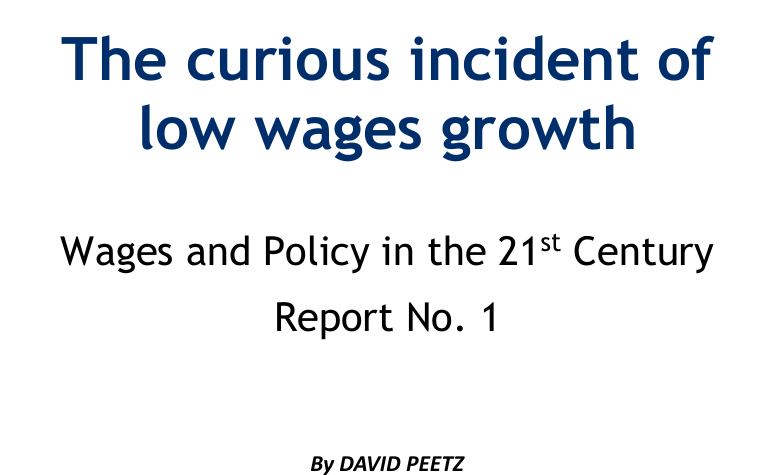
The Not-So Curious Incident of Low Wages Growth - Peetz report

Written by: Will Strike on 18 April 2025


(The full report by Peetz can be found here)

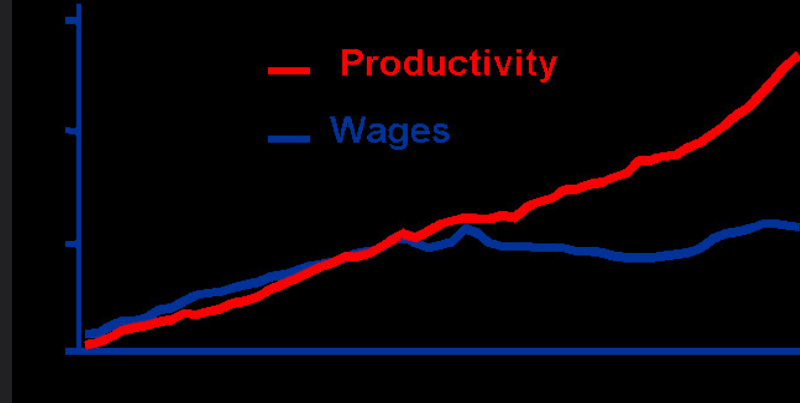
A recent report by David Peetz, published by the Carmichael Centre (The Australia Institute), exposes the systemic exploitation of Australia’s working class under contemporary capitalism. It highlights stagnant wages despite rising productivity, declining union power, and employer control of labour markets. While Labor’s post-2022 reforms offer minor relief and concessions for workers, the report demonstrates the limits of reform and trade-unionism, which confirms the necessity for militant class struggle towards the dismantling of wage slavery.

The report highlights the dramatic erosion of Australian workers’ power over the past half-century, with union membership collapsing from 50% in the 1970s to just 14% today. While real wages in late 2024 finally recovered to 2011 levels, workers still lost out on 15.1% in productivity gains that instead boosted profits. Capital has won so much ground over the past few decades, thanks to the passing of anti-union and anti-worker laws, rampant casualisation, and employer monopsony. Workers’ collective bargaining power has taken a huge hit—so much so that even with unemployment at historic lows, workers lack the leverage to secure fair wage growth against increased inflation. 

Peetz compares the current situation with that of the pre-Accord days of the 1970s, where union strength and industrial militancy was prevalent enough for workers to put up a substantial fight for increased wages in the face of high inflation. For example, it is noted that in 1974, 6.3 million working days were lost through industrial action, while in 2021, just 0.1 million working days were lost. In 1974-75, real wages grew by 10%. Real wages fell by more than 3% over 2021-22. 

Though recent ALP reforms and tight labour markets have helped wages rebound slightly without sparking inflation, the recovery remains incomplete (see for example, the table of pre- and post-2022 public policy reforms on pages 35-37). The report’s findings underscore how these modest gains are important but fragile without organised worker power. We know that only militant class struggle can reverse decades of entrenched inequality, as tinkering within capitalism's limits cannot restore what workers have lost—let alone deliver genuine economic justice and to establish proletarian power.

Economic Rationalism – an erroneous theory and a bourgeois tool

The report challenges economic rationalism’s interpretation of labour markets by exposing its neglect of power dynamics and structural inequalities, which fundamentally shape wage outcomes. Economic rationalism is said to assume that labour markets function under "perfect competition," while the report demonstrates how this does not conform to the real world. 

Flaws in Economic Rationalism’s Labor Market Assumptions  

 
a. ‘Monopsony’ Power and Market Imperfections  
 
Economic rationalism assumes labor markets are competitive, with wages adjusting to balance supply and demand. However, the report highlights monopsony power, where few employers dominate markets, leading to reduced job mobility and enabling wage suppression. Factors like non-compete clauses, limited job opportunities, and employer collusion contradict the neoclassical ideal of perfect competition. For instance, post-pandemic labour shortages did not trigger significant wage increases, disproving the market-clearing wage theory.  
 
b. Institutional Power and Wage Norms  
 
Wages are not solely market-driven but influenced by employer wage norms—informal standards of "appropriate" pay enforced through institutional power. Declining unionisation (from 50% to 14% since the 1970s) and the rise of casualised labour have eroded worker bargaining power, allowing employers to resist wage hikes despite productivity gains. The report argues that economic rationalism ignores these power dynamics, falsely portraying wages as neutral market outcomes.  
 
c. Policy Failures Due to Ignoring Power  
 
The Reserve Bank of Australia (RBA) repeatedly misapplied the NAIRU (non-accelerating inflation rate of unemployment) framework, assuming inflation was driven by wage pressures. Many workers have surely heard the bourgeois groan about the cost of living crisis supposedly being intensified because labour is too expensive. Peetz report shows that, in reality, post-2020 inflation was profit-led, with corporations raising prices without corresponding wage increases—a phenomenon unexplained by neoclassical, economic rationalist models. Economic rationalism’s focus on "market-clearing" wages led to policies (e.g., interest rate hikes) that harmed workers while ignoring corporate profiteering.  
 
How do we interpret report’s findings from a Marxist perspective?
 
a. Wages Reflect Exploitation, Not Equilibrium  
 
Marxism rejects the idea that wages are neutral market outcomes, instead framing them as a social relation where capitalists extract surplus value (profits) by paying workers less than their labour’s worth. The report supports this view, noting that none of Australia’s 15.1% productivity gains (2011–2024) translated into wage growth, highlighting systemic wage suppression.  
 
b. Structural Power Imbalances Under Capitalism  
 
Marxism emphasizes that employer dominance (e.g., monopsony, gig economy expansion) is inherent to capitalism. The report’s findings on declining union power and employer concentration align with this analysis, showing how capital’s structural dominance perpetuates low wages. Policies like multi-employer bargaining (post-2022) are not mere market corrections but concessions won through class struggle.  
 
c. Profit-Driven Inflation and Class Conflict  
 
While economic rationalism blamed inflation on labour market tightness, the report identifies employer profit-seeking as the real driver. Interest rate hikes, justified by economic rationalist models, protected profits at workers’ expense, reinforcing class-based inequalities.  
 
d. Historical Materialist Perspective  
 
Marxism contextualizes wage stagnation as a result of decades of neoliberal policies (e.g., anti-union laws, privatization). The report traces legislative changes (e.g., WorkChoices laws) that dismantled worker protections, illustrating how policy shifts systematically weakened labour’s bargaining power.  
 
Conclusion  
The report dismantles economic rationalism’s labor market assumptions, proving that wages in Australia are shaped by power imbalances (and struggles) between employers and employees, not just supply and demand. We shouldn’t be surprised by the finding that in reality “employers have discretion in wage offers, and employees can influence accepted wage rates through collective bargaining or political influence”. The report’s findings demonstrate that wages continue to be determined on the battleground of class conflict, where capital’s dominance ensures worker exploitation. Bourgeois policymaking that ignores these class dynamics—such as the RBA’s flawed inflation responses—reinforces inequality and perpetuate capitalism. The report ultimately validates the need for structural reforms that address employer power and restore worker collective bargaining strength.
 
While not a Marxist analysis, the report clearly exposes the class struggle shaping Australia's economy. It shows how Labor's workplace policies—though still operating within capitalism—have modestly boosted workers' power compared to the Coalition's attacks. Recent reforms have helped restart wage growth, but as the report notes: 
 
“On average, provisions to increase workers’ power have been far more common under Labor governments than under Coalition governments, and provisions to reduce workers’ power have been more common under Coalition governments. In the end, the one countervailing force in recent times has been public policy which, since 2022, has sought to increase workers’ power. Compared to the impact of the underlying economic and labour market forces that have reduced workers’ power, these legislative changes are small. Wider changes to the socio-economic order would be necessary to alter that. However, the changes that have been made have been enough to significantly increase the rate of nominal wages growth for both unionists and non-union workers, and sufficient to at least see a return to real wage growth in recent years.” 

Tuesday, April 23, 2024

Productivity Commission wonks still pushing discredited economic rationalism

Written by: (Contributed) on 24 April 2024

 

(Above: The designers of this Mambo t-shirt understood the link)

Commentary from right-wing economic figures about the failure of globalisation to provide sustainable growth have revealed their sense of denial about the main cause of the problem. 

Their failure to also provide a satisfactory explanation for the increasingly dysfunctional state of economic affairs has provided further insights into their peculiar mind-sets.

A serious of pronouncements from two right-wing figures with links to the Productivity Commission have revealed just how out-of-step they are with reliable economic criteria; their continued pushing of an economic rationalist agenda has been shown to not produce sustainability or growth. In fact, a recent IMF report has shown the advanced economies hover at below two per cent growth rates, with little sign of an upturn. (1)

Longer term projections have also shown a steady decline of GDP from the time of the global financial crisis in 2008 to a projection it will sink to zero toward the end of the present decade. (2)

It is, however, the pronouncements of those guiding or commenting of government policy which require scrutiny.

Michael Brennan, former head of the Productivity Commission, for example, has drawn attention to 'three decades of uninterrupted growth which followed the early 1990s recession'; it is not supported with reliable economic criteria or statistics. (3) The Commission is an official Australian government body, nevertheless, with extensive glitzy websites which have advisory capacities. It would appear to be truly stacked with right-wing coalition supporters and others of a similar ilk.   

The present economic debate has become increasingly focussed upon levels of government intervention to provide stable growth and a political division between those who continue to support economic rationalism and those who question its prolonged use.

The general implementation of economic rationalism grew out of right-wing think-tanks during the early 1980s which influenced international financial institutions controlled by the US and Wall Street. Earlier, the Chilean military coup in 1973, had established a test-tube for those linked to the Chicago School of Economics which had quietly pushed economic rationalism for decades, behind the scenes inside the corridors of power.

Economic rationalism was, however, only part of a much bigger picture to place the US at the centre of the global economy.

Submitting as report to US Congress on 21 July 1994 about the so-called New World Order, then President Clinton defined the three main elements of security policy: to enhance security by maintaining a strong defence capability and promoting co-operative security measures; to open foreign markets and spur economic growth; and to promote US-style democracy overseas.

The outcome was the wholesale implementation of economic rationalist policies which included three elements: de-regulation, privatisation, liberalisation.

Economic rationalism has been economic vogue thinking for nearly half a century; the present state of affairs has been the readily observable outcome. The floods of finance capital flung to the four corners of the globe has produced dysfunctional economies often leading to political instability and crisis. The vision of those in control of international financial institutions was akin to that of a casino, where risk-taking was commonplace. It also created the conditions for a drastically reduced manufacturing base in Australia, which subsequently led to revised GDP totals in an ever downward spiral.

An eighteen-month study conducted by the US National Security Council using independent economists found it unlikely globalisation 'would lead to general well-being … because the gap between rich and poor – both between countries and within them – is growing'. (4) The study, conducted around the start of the present century, was subsequently leaked to a Spanish language media outlet, although never publicised in English language outlets and was allowed to remain relatively hidden, for obvious reasons.

The distribution of income from globalisation remains noteworthy; in fact, it can be successfully argued economic rationalism was never intended to provide a sustainable model, only to enrich the already rich and powerful. It was a means to reduce the bargaining power of labour and hinder their political opposition in favour of the business-classes and their cronies overseas, thereby strengthening traditional class and state power.

Early studies of the model showed the income of the advanced countries rose from eleven times greater than the developing world, to 23 times larger by 2000. (5) Economic rationalism can therefore best be viewed as a form of neo-colonialism. Within countries the rapid emergence of billionaires has been well recorded. (6) The manner in which such people flout their wealth on the Forbes websites while paying their workforces well below CPI and inflation rates reveal a great deal about their mind-sets and limited vision of the world. They reside in a parallel world, devoid of the working-class. The fact the latter produce the wealth and the former acquire it, is an issue they never address.

Recent studies of the Australian economy have revealed massive differences between rich and poor. Average wealth of the top ten per cent of the population have recorded faster growth rates than the lowest sixty per cent since 2003. (7) The wealth of the top ten per cent also soared 84 per cent, from $2.8 million to $5.2 million, whereas the lowest sixty per cent only rose 55 per cent, from $220,000 to $343,000. (8) The poorest twenty per cent of Australians had a recorded average wealth of just $41,000, which is only seventeen per cent higher than it was in 2003. (9)

It was noted from a study conducted by the University of NSW and the Australian Council of Social Service that the average housing wealth for those in the lowest twenty per cent of the Australian population was zero. (10)

The wealth gap, for those under 35 years of age, is even more startling; it recorded the lowest sixty per cent accruing an increase in their wealth rising by only 39 per cent, from $68,000 in 2003 to $80,000 in 2022, while the highest ten per cent rose 126 per cent in the same period, from $928,000 to $2 million. (11)  

Despite the spurious motives for retaining economic rationalism, it can clearly be established to not have produced sustainable growth anywhere, or a betterment of life-styles
for the vast majority of people.

When challenged, however, right-wing economists continue to defend the model although they are inclined to offer furphies as additional factors. Those linked to the Productivity Commission, for example, have drawn attention to the failure of Australian entrepreneurs to register patents. Stating Australia is 'among the least innovative economies in the world', a report has recorded under ten per cent of registered patents are Australian-based as opposed to the US where more than seventy per cent are used by US businesses. (12)

The report does not refer to the fact that Australia only contributes 1.67 per cent of global GDP, whereas the US has a 25.3 per cent standing. (13)

Criticism from the Productivity Commission about recent government grants to support Australian manufacturing, likewise, has been revealing, with statements issued which have included reference to 'a return to old think industry protectionism', and not establishing a revival of a strong manufacturing base. (14)

The fact their economic model of choice has proved dysfunctional and created a state of affairs whereby an IMF projection for Australia's GDP being only 1.5 per cent this year, possibly increasing to two per cent in 2025, has, likewise, been conveniently ignored.   

The Productivity Commission and those linked to the organisation can best be regarded as benefiting from economic rationalism and therefore have no reason to change the model; they are quite content to languish in economic mediocrity.


1.     IMF warns on 'stalling' progress to reduce inflation, Australian, 17 April 2024.
2.     Economic decline, 'Goodbye good times, hello reality', Australian, 11 April 2024.
3.     Ibid.
4.     Hunger does not subside and slavery returns, Granma International (Havana), 24 June 2001.
5.     How globalisation fuels poverty, Socialist Campaign Group News (Westminster, London), July 2005.
6.     See: Survival of the Richest, OXFAM Report, 2000.
7.     'Disturbing' gap between haves and have nots, The New Daily, 18 April 2024.
8.     Ibid.
9.     Australian, op.cit., 11 April 2024.
10    Bonanza for rich leaves poor in their wake, Australian, 18 April 2024.
11.   Ibid.
12.   Ibid.
13.   World GDP, World Bank, 25 July 2023.
14.   Australian, op.cit., 11 April.


Saturday, May 20, 2023

Budget exposes myth of falling profitability and productivity


\(Source: Andy Pucko on Creative Commons Flickr)


Written by: (Contributed) on 18 May 2023

The 2023 Australian federal budget has a myriad of figures and technical detail amongst which are some that give the lie to claims of falling profitability and productivity.

In fact, if measured against the ability of companies to remain profitable in the face of regional competition from low-wage economies where millions of workers earn a few dollars a day, the Australian working class must rate amongst the most profitable and productive in the world. Here are current and projected figures as calculated from Budget projections:
 
                                                   COMPANY TAX RECEIPTS (1)


Year

Amount Paid ($bn)

Increase on 2021-22

% increase on 2021-22

2021-22

123.3


2022-23

138.4

15.1

12.25%

2023-24

167.7

29.3

21.17%

2022-23 to 2026-27

190.2

51.8

37.43%


In conclusion, the years of low-wage settlements for workers, cost-cutting and the race-to-the-bottom mentality of imperialist globalisation has systematically lowered the standard of living for the Australian working class. The business model is also in acceleration, with ever increasing returns for capitalists: widespread casualisation has been used to systematically undermine trade-unions with industrial relations.  Even their own statistics, from inside the corridors of power and the Australian Tax Office, the facts show the outcome of present-day employer's industrial relations techniques and lies about failing profitability and productivity.
 
For the record, Australian has a workforce of approximately 13 million, with a two-thirds participation rate reducing the figure to 8.5 million, of which well over a million are holders of temporary work visas.
 
Those in the latter category are particularly vulnerable to exploitation by employers, as a recent test case in Sydney revealed with a sponsored skilled worker on a 457 visa. (2) A federal court imposed $291,000 in penalties and back-payment orders on the owners of a Sydney hairdressing salon for exploiting a South Korean hairdresser. Over a four-year period, from 2015 to 2019, the worker was underpaid $49,000 and also required to repay $105,000 of wages and entitlements to the salon owner. The court also imposed a $100,000 penalty against the employer. The legal hearing included the worker stating they had not asked questions of their employer as they did not want to jeopardise their working opportunities in Australia, which, it would appear, is commonplace among temporary visa holders.  
 
The recent Australian Company Tax Receipts presented above, furthermore, should be viewed in the context of rampant tax avoidance procedures and 'creative accounting techniques', whereby companies only pay the bare minimum of what is expected. Multi-nations, based in Australia, for example, can use other countries as 'tax havens' by shifting their main assets elsewhere.
 
The true figure, relating to the productivity of the Australian working-class, is likely to be much higher!
 
 
1.     Tax bonanza but slower growth ahead, Australian Business Review, 10 May 2023.  
 
2.     Hairdresser ordered to pay worker $291k, Australian, 14 April 2023.

Sunday, April 23, 2023

Hard Times – Make the Rich Corporates Pay

(Above:5,000 construction workers marched through the Brisbane CBD, pushing for the abolition of the oppressive “Fair” Work. ABC News 5 Apr 2023.)

Written by: John G. on 20 April 2023 

Prices of groceries, power, petrol, rent and mortgages have gone through the roof. Home loan repayments have doubled for many. Rents are soaring.

Wages haven’t kept up with living costs. Buying-power we get to work has been going down for ages. Now it’s smacking head-on into raging inflation and pumped-up interest rates.

Workers reacted with waves of walkouts, stopworks, wildcat actions, strikes, street protests, big and little, local and statewide. People demand change. 

Its time wage workers had an economy that works for us to get what we need to live and thrive.

Bankers and governments have THEIR answer to hardships people face

They rub salt into the wound. 

The Reserve Bank says it’ll impose high interest rates for the next two and a half years. They’ll keep the screws on until there’s 5 or 6 percent unemployment while wages are kept a few percent behind inflation. 

The people who slave away making the country’s riches will suffer at least 400,000 people out of work, casuals losing shifts, wages way behind inflation, using up our savings, and mortgage and rent costs breaking households. They’ll keep going until sales drop and prices stop going up. 

The Reserve Bank, governments and business think they can shove the country through the bottom of the business cycle, scramble over broken lives of hundreds of thousands and hardships of millions, into blue skies of boom times beyond. 

Why do government, banks and business inflict this on people? 

It’s no big mystery. The big corporates want to get back to business making billions. 

Governments try to make the system work 

Governments try to make this broken system work. It doesn’t matter if its Liberal or Labor, National or Green, in and around government. Where the system works, it doesn’t work for us. The system, capitalism, works for business. 

That’s always at the core of governing, managing the system for the corporates to profit – not for us to live. Liberal/National are harsh and heartless. Labor and Greens tend to look for small things which people appreciate while keeping the system working.  

“Inflation still is the primary challenge in our economy, and that's what makes it the primary focus of our economic plan, and also the upcoming Budget in May.  … we're working around the clock to try and give people a little bit of relief from these cost‑of‑living pressures … ” Treasurer Jim Chalmers, ABC PM, 4 Apr 2023.

The bits of relief, a handout here and there, compromise the focus on inflation by cutting what we live on. That is their goal. The hardships remain. 
We’ve copped it from the Reserve Bank interest rate hikes. We’ll get it from the government’s coming budget.

A taste of government backsliding. The Federal Government abolished the union-bashing ABCC (Building Industry Commission) and the ROC (Registered Organisations Commission). They transferred the Commissions’ thugs to un-‘Fair’ Work where they keep persecuting workers and unions. A show of relief, but keep workers down. 

In Covid they found billions to get over that crisis.

In the Covid emergency, Australia’s Reserve Bank was ‘… seeking to play our full role in building that bridge to the time when the recovery takes place. By doing all that we can to lower funding costs in Australia and support the supply of credit to business, we will help our economy and financial system get through this difficult period’ P. Lowe, Governor, Reserve Bank of Australia 19 March 2020. 

What a contrast. In 2019, hundreds of billions of dollars were found and spent quickly to support business and the financial system, and help business keep their workforce. It kept profits up but drove us into crisis faster and deeper. Now more spending could provide some relief. 

People’s lives will be in tatters. Bankers, governments and big business essentially abandon us to hard times. 

There is another way – for people not profits.

Everything, all goods and services we use, are made by many people working together. The big profits are made by a tiny minority, owners of a few big corporate monopolies. There’s more on this in the article ‘Profits – a system of economic crises, hardships and war’.

In good times it’s a system of socialising the work, and privatising the profits. In troubled times, the work is socialised, but the big corporates try to socialise their private losses by forcing hard times on workers.

We need a system where things are produced because we need them, not for profit.

Its only people standing up, thousands organised and acting to get rid of the profit system and the core of its profiteers, rich corporate foreign monopolies, that can bring that about. 

Sentiment for change is rising onto the agenda.  

We’ve been left to stand up for ourselves

Can we?

It’s worth remembering the wave of public sector strikes and protests in the last year or so. 

Sparks of rebellion have been firing. Bushfires are sparked by the odd ember. With hardship hitting people and hanging around for a few years, frustration and rage will flare into conflagrations of rebellion and wider organisation.   

Damn them and their system. Through Covid, it became very clear. We make it all work. Where fire for change takes hold of working people, we’ll be more than they can handle.

Now’s a time to organise and act to make it work for us.

At present demands for relief, to make the rich monopolies pay, seizes the spirit of the times.

While we fight for relief for now, we have to keep our eyes on working for a future without these periodic crises, a future socialist society free of the rule of foreign multinational corporations and the destructive system of private profits.