Showing posts with label wages. Show all posts

Saturday, April 19, 2025

The Not-So Curious Incident of Low Wages Growth - Peetz report

Written by: Will Strike on 18 April 2025


(The full report by Peetz can be found here)

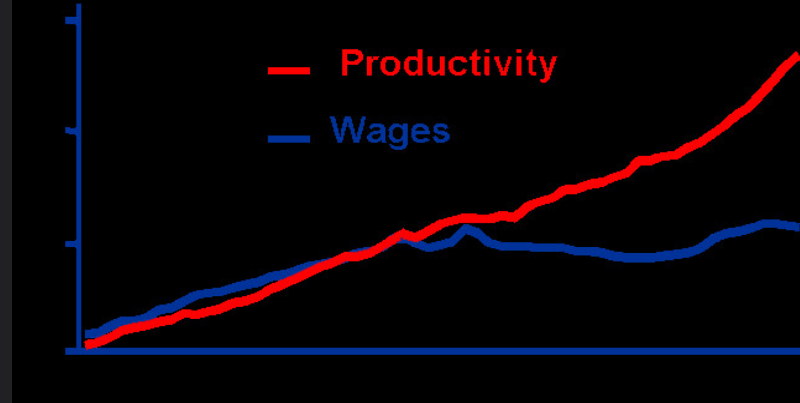
A recent report by David Peetz, published by the Carmichael Centre (The Australia Institute), exposes the systemic exploitation of Australia’s working class under contemporary capitalism. It highlights stagnant wages despite rising productivity, declining union power, and employer control of labour markets. While Labor’s post-2022 reforms offer minor relief and concessions for workers, the report demonstrates the limits of reform and trade-unionism, which confirms the necessity for militant class struggle towards the dismantling of wage slavery.

The report highlights the dramatic erosion of Australian workers’ power over the past half-century, with union membership collapsing from 50% in the 1970s to just 14% today. While real wages in late 2024 finally recovered to 2011 levels, workers still lost out on 15.1% in productivity gains that instead boosted profits. Capital has won so much ground over the past few decades, thanks to the passing of anti-union and anti-worker laws, rampant casualisation, and employer monopsony. Workers’ collective bargaining power has taken a huge hit—so much so that even with unemployment at historic lows, workers lack the leverage to secure fair wage growth against increased inflation. 

Peetz compares the current situation with that of the pre-Accord days of the 1970s, where union strength and industrial militancy was prevalent enough for workers to put up a substantial fight for increased wages in the face of high inflation. For example, it is noted that in 1974, 6.3 million working days were lost through industrial action, while in 2021, just 0.1 million working days were lost. In 1974-75, real wages grew by 10%. Real wages fell by more than 3% over 2021-22. 

Though recent ALP reforms and tight labour markets have helped wages rebound slightly without sparking inflation, the recovery remains incomplete (see for example, the table of pre- and post-2022 public policy reforms on pages 35-37). The report’s findings underscore how these modest gains are important but fragile without organised worker power. We know that only militant class struggle can reverse decades of entrenched inequality, as tinkering within capitalism's limits cannot restore what workers have lost—let alone deliver genuine economic justice and to establish proletarian power.

Economic Rationalism – an erroneous theory and a bourgeois tool

The report challenges economic rationalism’s interpretation of labour markets by exposing its neglect of power dynamics and structural inequalities, which fundamentally shape wage outcomes. Economic rationalism is said to assume that labour markets function under "perfect competition," while the report demonstrates how this does not conform to the real world. 

Flaws in Economic Rationalism’s Labor Market Assumptions  

 
a. ‘Monopsony’ Power and Market Imperfections  
 
Economic rationalism assumes labor markets are competitive, with wages adjusting to balance supply and demand. However, the report highlights monopsony power, where few employers dominate markets, leading to reduced job mobility and enabling wage suppression. Factors like non-compete clauses, limited job opportunities, and employer collusion contradict the neoclassical ideal of perfect competition. For instance, post-pandemic labour shortages did not trigger significant wage increases, disproving the market-clearing wage theory.  
 
b. Institutional Power and Wage Norms  
 
Wages are not solely market-driven but influenced by employer wage norms—informal standards of "appropriate" pay enforced through institutional power. Declining unionisation (from 50% to 14% since the 1970s) and the rise of casualised labour have eroded worker bargaining power, allowing employers to resist wage hikes despite productivity gains. The report argues that economic rationalism ignores these power dynamics, falsely portraying wages as neutral market outcomes.  
 
c. Policy Failures Due to Ignoring Power  
 
The Reserve Bank of Australia (RBA) repeatedly misapplied the NAIRU (non-accelerating inflation rate of unemployment) framework, assuming inflation was driven by wage pressures. Many workers have surely heard the bourgeois groan about the cost of living crisis supposedly being intensified because labour is too expensive. Peetz report shows that, in reality, post-2020 inflation was profit-led, with corporations raising prices without corresponding wage increases—a phenomenon unexplained by neoclassical, economic rationalist models. Economic rationalism’s focus on "market-clearing" wages led to policies (e.g., interest rate hikes) that harmed workers while ignoring corporate profiteering.  
 
How do we interpret report’s findings from a Marxist perspective?
 
a. Wages Reflect Exploitation, Not Equilibrium  
 
Marxism rejects the idea that wages are neutral market outcomes, instead framing them as a social relation where capitalists extract surplus value (profits) by paying workers less than their labour’s worth. The report supports this view, noting that none of Australia’s 15.1% productivity gains (2011–2024) translated into wage growth, highlighting systemic wage suppression.  
 
b. Structural Power Imbalances Under Capitalism  
 
Marxism emphasizes that employer dominance (e.g., monopsony, gig economy expansion) is inherent to capitalism. The report’s findings on declining union power and employer concentration align with this analysis, showing how capital’s structural dominance perpetuates low wages. Policies like multi-employer bargaining (post-2022) are not mere market corrections but concessions won through class struggle.  
 
c. Profit-Driven Inflation and Class Conflict  
 
While economic rationalism blamed inflation on labour market tightness, the report identifies employer profit-seeking as the real driver. Interest rate hikes, justified by economic rationalist models, protected profits at workers’ expense, reinforcing class-based inequalities.  
 
d. Historical Materialist Perspective  
 
Marxism contextualizes wage stagnation as a result of decades of neoliberal policies (e.g., anti-union laws, privatization). The report traces legislative changes (e.g., WorkChoices laws) that dismantled worker protections, illustrating how policy shifts systematically weakened labour’s bargaining power.  
 
Conclusion  
The report dismantles economic rationalism’s labor market assumptions, proving that wages in Australia are shaped by power imbalances (and struggles) between employers and employees, not just supply and demand. We shouldn’t be surprised by the finding that in reality “employers have discretion in wage offers, and employees can influence accepted wage rates through collective bargaining or political influence”. The report’s findings demonstrate that wages continue to be determined on the battleground of class conflict, where capital’s dominance ensures worker exploitation. Bourgeois policymaking that ignores these class dynamics—such as the RBA’s flawed inflation responses—reinforces inequality and perpetuate capitalism. The report ultimately validates the need for structural reforms that address employer power and restore worker collective bargaining strength.
 
While not a Marxist analysis, the report clearly exposes the class struggle shaping Australia's economy. It shows how Labor's workplace policies—though still operating within capitalism—have modestly boosted workers' power compared to the Coalition's attacks. Recent reforms have helped restart wage growth, but as the report notes: 
 
“On average, provisions to increase workers’ power have been far more common under Labor governments than under Coalition governments, and provisions to reduce workers’ power have been more common under Coalition governments. In the end, the one countervailing force in recent times has been public policy which, since 2022, has sought to increase workers’ power. Compared to the impact of the underlying economic and labour market forces that have reduced workers’ power, these legislative changes are small. Wider changes to the socio-economic order would be necessary to alter that. However, the changes that have been made have been enough to significantly increase the rate of nominal wages growth for both unionists and non-union workers, and sufficient to at least see a return to real wage growth in recent years.” 

Wednesday, June 21, 2023

Trickle-down economics: double standards, rigged rules


Written by: (Contributed) on 21 June, 2023,

A survey of business leaders' salaries has revealed recent increases of double the rate of inflation. Those concerned, however, have continued to campaign against increasing wage rates for their workforces even to much lower percentages. The contradictory behaviour is symptomatic of a power relationship based upon rampant exploitation by the business-classes, with double standards and rigged rules, devoid of any moral or ethical considerations for anyone else but themselves.

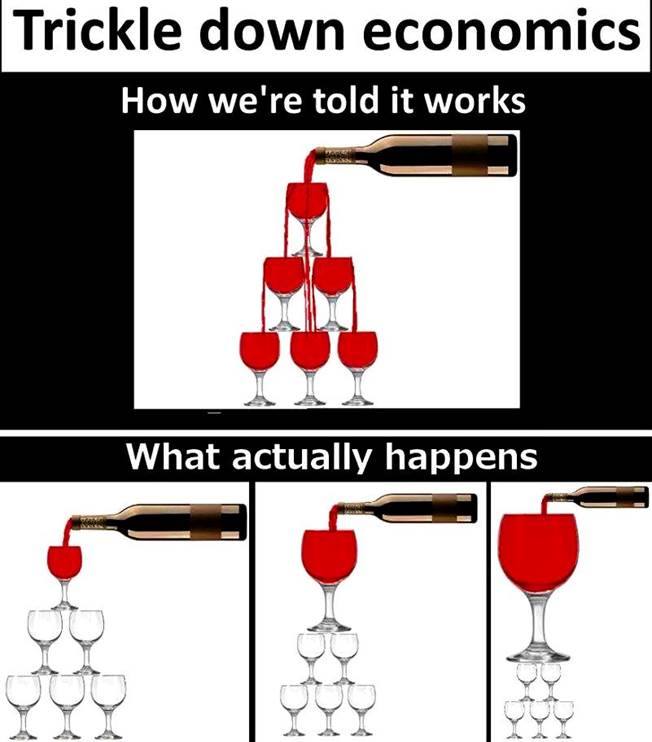
Economic rationalism has increased the exploitative relationship to new heights, with massive accumulation of wealth, which clearly does not trickle down to lower socio-economic groups.

In mid-June the Governance Institute of Australia issued their latest Board and Executive Remuneration Report, with details of how base salaries for managing directors had increased by an average of 14 per cent while CEO salaries had risen by 15 per cent. (1) The comprehensive survey, conducted in conjunction with McGuirk Management Consultants, included findings from 1167 boards in the public, private and not-for-profit sectors, including 226 listed companies. (2)

The study also found managing directors of 200 ASX-listed companies had recorded an average of 19 per cent salary increases. (3) The large salary increases, however, form only part of the economic relationship: 52 per cent of listed managing directors were also shown eligible for performance bonuses, with an average maximum bonus paid of 89 per cent. (4)
Of listed CEOs, a total of 51 per cent were eligible for performance bonuses, with an average maximum of 72 per cent. (6)

The fact the average fixed remuneration of an ASX-listed managing director is $1.58 million, clearly shows a massive discrepancy in spending power when compared with lower socio-economic groups. (7) The snouts of the top end of town were clearly in the trough.

While Governance Institute chief executive Megan Motto stated the large salary increases were 'an indication that a tight labour market and the rising cost of living was playing out at the executive level', those who benefited from the salary increases have tended to show little regard for lower socio-economic groups experiencing the same problem. (8) In fact, many have openly advocated small wage increases for workforces not even in line with CPI, despite drastically reduced living standards for lower socio-economic groups.

CPI, furthermore, is only part of the economic landscape, and not particularly accurate.

A recent study, for example, found employees were experiencing a 9.6 per cent percentage change in the cost of living. (9) The CPI, however, has remained at around 7 per cent, not accounting for interest rate increases and other criteria. (8) Food prices, meanwhile, have increased by 9.2 per cent, bread by 13.4 per cent, imported oils and fats by 20 per cent, electricity by 12 per cent, travel by 20 per cent. (10)

For the record, recent studies have concluded the average weekly wage in Australia currently stands at $1,376.60 per week, and $71,585.20 per year, with the new basic minimum wage recently being increased by Fair Work Australia to $882.80 per week. (11)

Lower socio-economic groups are likely to spend far more of their disposable income on basic essentials than higher socio-economic groups. The cost-of-living is a decisive factor.

The exploitative relationship between owners of businesses, their managers and workforces takes place within an environment shaped by the rich and powerful. They have made the most of the rules for self-benefit. Government departments, for example, frequently turn a blind eye to wage theft, unless prompted by trade unions to take the required action against employers. They have no wish to upset the business-classes, and fear their reaction.

Recent economic trends have also taken place amid a flood of business investment into Australia, showing returns remain sound. (12) Spending on equipment, plants and machinery, for example, has increased by 3.7 per cent to $17.1 billion, the largest increase in over two years. (13)

And at the top end of town, global wealth has continued to grow: reports from banking and financial institutions have revealed aggregate global wealth grew 12.7 per cent in 2021, despite the pandemic. (14) It was noted that it was 'the fastest annual rate ever recorded'. (15) In 2020, the richest one per cent of the world's population took two-thirds of the $42 trillion in new wealth, the remaining 99 per cent were left with the remainder; during the previous decade the richest one per cent and the other 99 per cent each acquired about half of all new wealth, pointing to the fact that inequality and the rate of inequality are both increasing. (16)   

While higher socio-economic groups monopolised the massive accumulation of wealth, none of it trickled down to the working class, who have experienced a rapid decline in their living standards. The trickle-down effect, incidentally, was always the claim of the advocates of economic rationalism, who used it to publicise their model for economic development. The opposite took place: 131 billionaires doubled their wealth during the pandemic. (17) But then, that is what double standards and rigged rules are about.

The fact many of the higher socio-economic groups which reside in Australia do not pay income tax also remains, furthermore, a matter of serious contention.

1.     Chief executives pocket an average 15 pc pay rise, Australian, 14 June 2023.
2.     CEOs in clover as pay soars by 15 pc., Australian, 14 June 2023.
3.     Chief executives, Australian, op.cit., 14 June 2023.
4.     CEOs in clover, Australian, op.cit., 14 June 2023.
5.     Ibid.
6.     Ibid.
7.     Chief executives, Australian, op.cit., 14 June 2023.
8.     Cost-of-living crunch, chart, Interest rates rises fuel cost-of-living crisis, Australian, 4 May 2023.
9.     Ibid.
10.   Average Weekly Wage – Australian Bureau of Statistics, 23 February 2023.
11.   Thinking about retirement? Rampant inflation means you'll need a bigger nest egg, Australian, 21 March 2023.
12.   See: Business investment jumps in early-2023, Australian, 2 June 2023.
13.   Ibid.
14.   See: Global Wealth Report, 2022, Credit Suisse; and, Global Wealth Report, 2022, The World Bank.
15.   World Bank, ibid.
16.   See: Survival of the Richest, Oxfam publication, 2020.
17.   See: Bloomberg Billionaires Index.


Friday, June 9, 2023

Annual wage review reveals declining living standards of the working class - sets the scene for big struggles ahead

 Written by: Ned K. on 10 June 2023


(Above: June 6 – Early childhood workers, members of the United Workers Union, are the first to apply for multi-employer bargaining at the Fair Work Commission.   Photo: UWU Twitter)

The Decision of the Full Bench of the Fair Work Commission is worth reading for the information it provides on the impact of the anarchy of the capitalist economy on the living standards of working class people.

Despite the 5.75% increase to pay rates in Awards, the Decision concludes, "Real wages have been in decline since the middle of 2020 and are forecast to fall further this calendar year, before slowly beginning to recover in 2024"

The lowest paid workers on Awards have "seen their wages rise by 7.8% since 2020 if working full time...or by 7.2% if on a higher Award classification rate. It is well established that National Minimum Wage and modern award-reliant workers spend a higher proportion of their income on goods and services such as food, housing, energy and healthcare. Prices for these non-discretionary items have risen faster than the 15.9% increase in prices as a whole since June 2020."

Some people may shrug this trend off, assuming that most workers are employed under above-Award collective agreements. The Annual Wage Review Decision includes "Method of Setting Pay" data. This shows that since 2012 there has been a decline in the percentage of the working class paid under collective agreements, an increase in the percentage paid under the minimum Award rates, and no change in the percentage paid under "individual arrangements".

In 2012 there were 16.1% paid under Awards, 42% under collective agreements and 41.9 % under individual arrangements. 

In 2021, there were 23% paid under Awards, 35.1 % under collective agreements, and 41.9% under individual arrangements.  

While many of those under "individual arrangements" include higher paid sections of the working class including the mining and resource industry, it also includes an underclass of workers paid less than the Award under the guise of individual contractors which, when examined, are nothing but a wage swindle to avoid minimum Award entitlements.

Under pressure from the organized working class and their allies, the Labor Party has introduced multi-employer collective agreement making into the Fair Work Act. This new legislation gives the appearance of providing workers on an industry basis to unite across employers to improve living standards. However, there are many hoops for the unions to jump through and loopholes for employers to frustrate workers’ hopes of gaining lost ground.

As throughout the history of capitalism, where workers unite in determined struggle under progressive leaders from their ranks, they will force concessions from the big capitalists in particular. 

One of the first group of workers to test out the new multi-employer collective agreement provisions of the Fair Work Act is Early Childhood Education workers. This sector consists of mainly women workers who have developed a strong collective culture. They will be determined to show that women workers hold up half the sky for the working class as a whole when it comes to the question of wages vs profits’ share and the struggle against the tendency of capitalism to impoverish the working class.

Saturday, June 3, 2023

“Decent Work” – Nice If You Can Find It


Written by: Ned K. on 4 June 2023

The Fair Work Commission handed down its National Wage Case Decision last week.

The minimum wage was increased by 8% and Award wages increased by 5.75%. The increases apply from July 2023. The increases were a higher percentage than the usual pittance. 

The higher increase was due to the struggle of the workers for a living wage. With the escalating cost of living increases reflected in the official rate of around 7% and rising interest rates, real wages continue to decline. This has resulted in more working-class families not having enough income for food and a roof over their heads. The more astute sections of the capitalists realize that workers need enough income to be able to remain fit and healthy to front up to work each day. 

A few days before the Fair Work Commission announced its National Wage Case Decision, employers, including government departments were complaining about high absenteeism and difficulty in finding workers to fill vacant positions.

However even the astute capitalists will be compelled to "recover the increase in operating costs" when the 5.75% wage increase kicks in from July this year. With Award minimum wages rising by 5.75%, there will be demands by workers employed under Enterprise Agreements to maintain their above Award wage rate margins as well.

Work Intensification:

One of the main ways capitalists seek to "recover increased costs" from increased wages is through work intensification. This is of course not a new phenomenon.  Work-intensification has increased alarmingly in the 21st Century.  This was noted by progressive researcher John Buchanan at a Festival of Ideas session in the early 2000s in Adelaide called "Decent Work - Nice If You Can Find It". His research found that the biggest issue by far and across the board was work intensification and understaffing. John said that "quiet time" had been squeezed out of most workplaces. There was no time for workers to pass on skills to new or younger workers.

He said that while wage increases are essential to keep workers heads above water, the struggle against work intensification and decent work was equally important for workers. 

He said that from earliest times, decent work had been a struggle by those performing the work. Aristotle described work as the "essence of existence through thoughtful activity".

John contrasted Aristotle's description of "work" with the word "labor" and pointed out that the word "labor" means "hard activity, punitive".

Under capitalism, decent work is a rarity while "labor" as defined above is the norm. 

John Buchanan saw the issue of work intensification and the struggle for decent work as an opportunity to mobilize workers around the ideas of decency, dignity, time to work, time to recover. 

He added one more important insight on the issue of decent work and the struggle of workers against work intensification.  He said that while the struggle for real wage increases is constant under capitalism, governments had stripped away workers’ rights to organize.

He asked the audience the following question.

"Is it any wonder that there is a shortage of good rank and file union delegates and an abundance of unorganized workplaces?  Who would be a delegate today? What legal rights have they got under current laws? Very few. They are not even mentioned in name in the Act!"

This question is still relevant today. Decent work will only be achieved where workers organize and win the right to representation on the job. The development of a well-organized mass movement within the working class is a pre-condition to free workers and the whole society from the control of the capitalists and their extensive state machine of which the Fair Work Commission is a part.

Saturday, May 20, 2023

Budget exposes myth of falling profitability and productivity


\(Source: Andy Pucko on Creative Commons Flickr)


Written by: (Contributed) on 18 May 2023

The 2023 Australian federal budget has a myriad of figures and technical detail amongst which are some that give the lie to claims of falling profitability and productivity.

In fact, if measured against the ability of companies to remain profitable in the face of regional competition from low-wage economies where millions of workers earn a few dollars a day, the Australian working class must rate amongst the most profitable and productive in the world. Here are current and projected figures as calculated from Budget projections:
 
                                                   COMPANY TAX RECEIPTS (1)


Year

Amount Paid ($bn)

Increase on 2021-22

% increase on 2021-22

2021-22

123.3


2022-23

138.4

15.1

12.25%

2023-24

167.7

29.3

21.17%

2022-23 to 2026-27

190.2

51.8

37.43%


In conclusion, the years of low-wage settlements for workers, cost-cutting and the race-to-the-bottom mentality of imperialist globalisation has systematically lowered the standard of living for the Australian working class. The business model is also in acceleration, with ever increasing returns for capitalists: widespread casualisation has been used to systematically undermine trade-unions with industrial relations.  Even their own statistics, from inside the corridors of power and the Australian Tax Office, the facts show the outcome of present-day employer's industrial relations techniques and lies about failing profitability and productivity.
 
For the record, Australian has a workforce of approximately 13 million, with a two-thirds participation rate reducing the figure to 8.5 million, of which well over a million are holders of temporary work visas.
 
Those in the latter category are particularly vulnerable to exploitation by employers, as a recent test case in Sydney revealed with a sponsored skilled worker on a 457 visa. (2) A federal court imposed $291,000 in penalties and back-payment orders on the owners of a Sydney hairdressing salon for exploiting a South Korean hairdresser. Over a four-year period, from 2015 to 2019, the worker was underpaid $49,000 and also required to repay $105,000 of wages and entitlements to the salon owner. The court also imposed a $100,000 penalty against the employer. The legal hearing included the worker stating they had not asked questions of their employer as they did not want to jeopardise their working opportunities in Australia, which, it would appear, is commonplace among temporary visa holders.  
 
The recent Australian Company Tax Receipts presented above, furthermore, should be viewed in the context of rampant tax avoidance procedures and 'creative accounting techniques', whereby companies only pay the bare minimum of what is expected. Multi-nations, based in Australia, for example, can use other countries as 'tax havens' by shifting their main assets elsewhere.
 
The true figure, relating to the productivity of the Australian working-class, is likely to be much higher!
 
 
1.     Tax bonanza but slower growth ahead, Australian Business Review, 10 May 2023.  
 
2.     Hairdresser ordered to pay worker $291k, Australian, 14 April 2023.

Tuesday, September 13, 2022

Profits, Wages and Conditions


Written by: Jed J. on 14 September 2022

Workers are increasingly finding it hard to make ends meet. The paltry rises in wages they receive do not compensate for the rising cost of living.  In reality workers are working more for less.

At the same time profits as a percentage of GNP has never been higher and continue to grow at a fast rate.

According to ABS date the share of national income going to corporate profits has grown from 18% in the early 1960s to 32 % now. This trend towards a greater share of the national economy going to profits has accelerated in recent years while wage increases have virtually remained stagnant or even declined in real terms.

If it wasn’t for the labour power supplied by workers there would be no economic growth and thus no profits. Yet workers’ share of the wealth their labour generates is minimal compared to the wealth amassed by their employers.

This is a defining feature of today’s capitalism which workers are chained to. In this system they have only their labour power to sell so that they can live and provide for themselves and their families. 

This imbalance between wages and profits is a feature of the capitalist economic system and is responsible for the widening of the gap between rich and poor.

Productivity and Inflation:

Productivity is measured by how much output a worker can achieve for each hour of work. Over the past three years productivity has increased 1.5% annually while inflation in that period has risen on average by 2.1%.

For wages to have kept up with the cost of living they should have risen by at least 3.6% over the past three years yet they have averaged only a 2% growth. The fact is that employers are paying less for labour that is more productive.

How are employers getting away with this? One reason is the influence capitalists have on governments. Through intense lobbying they have been able to get the kind of industrial relations laws that put profits ahead of people.

This has resulted in unions having to struggle for better wages and conditions for all workers in an industrial legal setting which clearly favours the employer.

Inflation and wages:

The business sector’s reaction to the recent decision of the Fair Work Commission to grant workers on the minimum wage an increase of 5.2% shows how little they care for the welfare of workers. 

The increase which brought the hourly rate up to $21.38 was in response to the rise in inflation and will result in those on the minimum wage taking home only $812.60 per week. This wouldn’t cover the private school education costs of many capitalists.

Yet according to the business sector the rise in the minimum wage will have a devastating effect on the economy. According to the capitalists it will result in higher inflation and many small businesses will go to the wall as a result. 

The mass media shows its support for this view by only occasionally interviewing striking workers. Instead, they frequently interview café owners who claim that the increase in the minimum wage may well result in them having to lay off workers. 

What the mass media doesn’t make known is that many small businesses will benefit from the lowest paid workers having more disposable income. The public would get a clearer picture of what the wage rise means if representatives of these small business owners are interviewed. 

The public would get an even clearer picture still if capitalists were interviewed as to the effect of this wage growth on their profit margin.

This fear mongering about higher wages leading to higher rates of inflation is simply not true. The 5.2% increase represents only a partial catch up of the rising cost of living which has already happened.
 
So, while profits are growing and wages falling behind the rate of inflation it would seem that businesses are actually profiting from inflation and are keeping the gains from higher productivity to themselves.

It is a good time for capitalists in Australia at present but many workers are finding it increasingly difficult to live on what they earn. 

Future Rises in Inflation:

In the recent past inflation has been low. However, this is fast changing. Now inflation is over 5% and is expected to rise further in the next year. This is bad news for those struggling on their current level of income. If wages go up more slowly than prices working people will be even worse off.

This rise in inflation is not caused by wage growth, but the increase in profits by big business. Wages can only lead to higher levels of inflation if they grow more than inflation and productivity combined. Wages can grow by 7% in the next year before they would have any effect on inflation.

This is because inflation is a measure of prices rises that have already occurred. Consequently, wages growth has fallen well behind the rise in prices over the past year. An increase in wages of 7% in the coming year will only cover the rise in the cost of living which has already occurred.

Consequences of Lack of Real Wage Increases:

Nurses, teachers and other workers in the public sector find they are struggling to make ends meet and are expected to work under deteriorating working conditions. 

Their volume of work has increased. As a result many are suffering from burnout and are leaving their professions which can only result in the situation becoming worse.

Australia’s energy, retail, transport, grocery and banking businesses are among the most profitable in the world. Increased government spending to cover real wage increases for workers in the public sector could be paid for from the profits businesses in these sectors are making. 

Some multinationals operating in Australia like Google and Facebook who pay virtually no tax could be levied on the profits they make in Australia. 
 Businesses in the resource sector could be told to pay a windfall profits tax. The super profit tax on the banking sector could be raised. 

The current boom in the mining sector requires fewer workers due to the introduction of much a greater use of automation. Businesses in this sector of the economy can now maintain their increased level of production with fewer workers. 

The increased level of profits enjoyed by this sector could easily bear the imposition of a windfall tax. The result being that part of the increased profits would flow through to the rest of the economy rather than to local and off shore shareholders

Such measures could be taken to raise government spending to fund wage increases for those working in essential services like education and health. 

Need for Changes in Industrial Relations:

For workers to get a fairer share of the wealth they create through their labour there would have to be a major restructure of the industrial relations system. Changes which would put employer and employee on a more equal footing. Everything now favours the bosses. That’s got to change. 


Thursday, May 5, 2022

Stagnant Wages - Big Business taking Billions

 Written by: John G. on 5 May 2022

In the election commentary, there’s a lot of discussion about how wages have been stagnant, locked down, held way below inflation for the last decade. They are actually losing value to inflation.


Where has that lost value been going? 

Workers are still beavering away, producing goods, selling them, loading them on and off trucks, organising all the accounts, ordering supplies and the rest that goes into the production and exchange of goods. Other wage earners have kept services being delivered, teaching kids, nursing and caring for people, waiting tables, cleaning floors and the rest.

While wages have been held back. their value eroded by price hikes, the money has been cycling along with business raking in the billions.  

A fair idea of what’s been happening can be gleaned from the results of some academic studies aired at a 2018 Seminar at Sydney Uni. The Centre for Future Work held the seminar to look into what had been happening long-term to the portion of the national output, the Gross Domestic Product, GDP, going to wage and salary earners.

Dr Jim Stanford, director of the Centre for Future Work, worked through Australian Bureau of Statistics data looking for answers. 

He found wage and salary earners portion of GDP had gone down from its 1975 level of 58.4 per cent to 47.1 per cent of GDP in 2018. 

That’s a huge amount, 11.3% of all the output of the Australian economy, that workers have lost since 1975. 

Jim Stanford went further into the figures. He found wage and salary earners were losing $210 billion a year in 2018, worth $16,800 extra a year to each worker. 

The trend of decline has persisted through a number of economic cycles over the last half century. It’s graphically portrayed on the accompanying poster on their website. 


Another academic at the seminar, Professor of Employment Relations at Griffith University, David Peetz, had worked out that the portion of the GDP going to enterprise profits increased by virtually the same portion workers had lost, 12 %. The benefit of the loss by Australian workers and other working people was captured in company profits, an extra $210 billion worth. 

Peetz dug a bit further. He found all that transfer of wealth didn’t go to companies across the board. 

He found the financial sector, banks and funds, increased their profits share of GDP by everything workers lost and a bit more. Even other companies lost ground to the banks and funds. 

Papers from the seminar were published in the Journal of Australian Political Economy No. 81 for those inspired to look into it. They are reproduced on the Future Work website here.:  

In the period since 1975, worker’s organisations have been weakened, round after round of attacks on unions have been experienced. Union membership has declined. In the struggle over who gets the benefits of improved productivity and economic expansion, worker’s fighting capacity has reduced. 

The outcome is that big business has feasted on workers’ weak organisation.

It’s always been so. The well-being of workers depends on the relative strength of the classes, the workers and big business, how much we are organised to fight or not. 

Politicians prattle on about money not growing on trees, that they need to grow a bigger economy to be able to afford what people need, that the government cupboard is bare when people ask for help to meet their needs. When that comes up just think of the billions the financial sector has taken from workers and other working people.

The riches don’t trickle down. It gushes up to the big banks, big funds, the monopoly and foreign imperialist financial corporates.  

They have targeted the working class for decades. 

These academics help us know who to target to return the favour.


Saturday, April 6, 2019

Marxism Today: The unfairness of a “fair day’s pay”

Danny O.

It has been the catchcry of the official trade union movement worldwide for 200 years. It’s a slogan so often heard in the labour movement that it is almost a cliché. Now we are told Australian workers have lost it and that we need to “change the rules” to get it back. It is of course “a fair day’s pay for a fair day’s work”.

On the surface, this seems like a reasonable demand. As workers we all have to work to survive and want to be suitably compensated for the work that we do. But when we take a closer look at workers’ wages and bosses’ profits and where they come from, a “fair day’s pay” just doesn’t seem as fair anymore.

What are wages?

As workers under capitalism, we have only one thing that allows us to survive – our ability or capacity to labour. That ability to labour, like almost everything under capitalism, is a commodity that is bought and sold. Karl Marx called it our ‘labour power’. We have to sell our labour power to a boss in exchange for a wage. 

A wage is really the price the boss pays to use your labour power for a certain amount of time i.e. a shift at work - maybe 4 hours, maybe 8 hours, maybe more or less. So, what determines your wage? Or in other words, what determines the price of your labour power?

Like all commodities, labour power has a value. Like all commodities, that value is determined by the average time and cost it takes to produce it. Since our labour power is inseparable from ourselves as living human beings, the cost of producing and reproducing our labour power is the cost required to keep us alive and functioning as workers for our entire life. This includes things like food, housing, clothes, transport, education etc. In other words, the basic cost of living. It also includes the cost of maintaining and raising our families and kids. The kids replace us as workers when we die, ensuring a supply of labour for the bosses well into the future. 

What makes up the basket of basic necessities needed to reproduce our labour power varies with the time, place, history and societal customs of where we live. For example, in Australia in 2019 it is fairly common for a family to need two cars, owning your own home by the time you retire is a pretty standard expectation, mobile phones are a necessity to work and function socially. All these things make up our basic living costs and so must be factored in when calculating the value of our labour power and therefore our wage. In comparison, a worker in a developing country will have lower basic living costs and so will require a different basket of basic necessities, and in turn, require a lower wage to live as a worker in their country.     
         
But there’s still a little more to it. At any given time and place, there are several important factors that impact exactly what your wage might be. One is the supply and demand of qualified workers in a given industry or field. The more workers available to do the job the lower your wage is likely to be, and vice versa. Another very important factor is the existence or non-existence of strong trade unions.

Unions reduce competition between individual workers and gives them the ability to force the boss to pay higher wages. In short, at any particular point in time, wages are determined by the relative strengths of the working class and the capitalist class in the marketplace. When the working class is in a strong position wages will tend to be higher, and when the capitalists are in a stronger position wages will tend to be lower.

But while wages may be higher or lower at any particular point in time and place, as a rule they will fluctuate around the value of our labour power as determined by the costs of the basket of basic necessities as described above. This rule applies to the working class in general, and not to any individual worker as such. This explains why it is that some workers may be a bit better off and some a bit worse off, but why it is impossible for the working class generally to ever become rich just from working.

What are profits?

Now that we understand wages, we can turn to the question of profits. When we sell our labour power to the boss, we agree to work for a certain amount of time in exchange for a wage that basically meets our cost of living, or in other words, is equal to the value of our labour power. For arguments sake, let’s say you are lucky enough to work full time in an ice-cream factory 8 hours a day, 5 days a week and receive a wage of $1,500 which you can live comfortably enough on. Presumably a fair day’s pay for a fair day’s work.

But, let’s say that over the course of the working week you make ice-cream valued at $2,500. Regardless, you still only get paid $1,500. So, what about the $1,000 difference? Well that’s value that you created by working but don’t get paid for. Karl Marx called it ‘surplus value’. Once all the ice-cream you produced is sold, the boss pockets your surplus value as his profit. 

As workers we produce all the value in society, but we only receive a portion of it back in the form of wages. The bosses take the rest as profits. How’s that for fair?

But what about…

But what if the ice-cream workers at the factory got together and demanded to be paid the full $2,500? Wouldn’t that be fair then? Well the boss would certainly be faced with a dilemma. If he agreed to pay it and kept everything else as it was before, then there wouldn’t be any surplus value and hence no profit. Bankruptcy could result which would mean that there would be no money to keep the ice-cream factory operating.

So, to stay in business the boss would be forced to come up with a way to extract surplus value from the workers to make a profit. In other words, the workers would need to produce even more ice-cream in the same amount of time. Perhaps by making the workers work harder, or with some new machines that can make ice-cream faster. Either way, the result is that workers would be producing value that they aren’t paid for (surplus value) and the boss would be pocketing the profit. Fair?

Can we change the rules for fairness?

he Australia Institute released a report in 2018 detailing the long-term decline of the labour share of Australia’s GDP. The report reveals the economic output in the Australian economy and how much of that output goes to paying workers. It was found that in March 2018, 47.1% of GDP went to workers incomes. That’s about 11% less than the historic high of 58.4% in 1975. And close to the lowest at any point in the last 70 years. This decline has been mirrored by a rise in the share going to corporate profits, which are once again nearing record highs after falling from their peak in the global financial crisis in 2008/9.

This trend is a reflection of the diminished strength of the trade union movement. Trade union strength has steadily declined since the introduction of neo-liberalism and the restructuring of Australia’s economy starting in the late 1970s and early 1980s. Draconian anti-union laws restrict the ability of workers to fight for wage increases, while companies are given free rein to make as much profit as they see fit. 

All of this means that Australia is experiencing some of the greatest inequality that it has ever seen. Profits are soaring and wages are declining. And the industrial laws are keeping it that way. It is this reality that provides fertile ground for the ACTU’s campaign to ‘change the rules’.

The campaign aims to change the rules to allow workers and unions to reverse the trend. It speaks of restoring balance and returning fairness to the system. But while it’s obvious that the system is less fair now than what it was in 1975, is it right to say that it was ever fair? To what point do the labour share and profit share of GDP have to get to make the system fair? If wages rose 11% and profits declined 11% would we have a “fair day’s pay” again?

The revolutionary alternative

The Marxist explanation of wages and profits outlined above shows that it is the workers producing value that they don’t get paid for which is the source of the bosses’ profits. No matter how high workers wages may be, as long as the boss is making a profit it means the workers are being exploited. Hence, there can never be a “fair day’s pay” under capitalism.

The trade union demand of a “fair day’s pay for a fair day’s work” blinds workers to the reality of the capitalist system. It misleads us into thinking that fairness for the workers can be achieved under capitalism. Indeed, this is the role of the trade unions under capitalism. They are great organisations for the defence of workers’ rights and wages against the bosses and must be supported, but ultimately, they confine workers’ struggle within the bounds of capitalism rather than for its revolutionary overthrow.

The bosses or capitalist class are like parasites that live off the unpaid labour of workers. They are redundant. The working class must overthrow them and start to rule society for themselves in a socialist system. Then the surplus value that workers produce would belong, not to the parasitic bosses, but to the working class as a whole, held in common to meet the needs of the great majority of the people. Only then can we ever really start to speak of a “fair day’s pay”.