
Written by: Nick G. on 2 October 2026
Around the world, revisionists claim that China remains a socialist country, that it cannot be imperialist, and proclaim it as the leader of an anti-hegemonic bloc opposing US imperialism.
This has an undoubted influence on some on the Left who naturally and emphatically oppose US imperialism and cannot wait to see it defeated once and for all.
One of those who sought to prove that China cannot be imperialist is Jason Hickel. We analysed his views in the Autumn 2026 issue of our theoretical journal Australian Communist. It can be accessed here with the relevant article on pages 3-6.
Central to Hickel’s thesis is the World Systems Theory division of nations into core, semi-periphery and periphery based on the unequal transfer of value. According to Hickel, the transfer of value from China to the West has allowed it to rise from the periphery to the semi-periphery, but prevents it from becoming a part of the imperialist core.
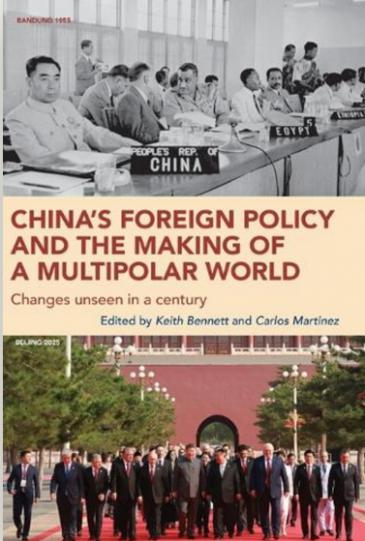
Now another revisionist-aligned academic, Carlos Martinez, has come out with a co-authored book titled “China’s Foreign Policy and the Making of a Multipolar World”. Accompany the book is an 18-minute video presentation (China isn’t imperialist – here’s the proof).
This person’s line is very similar to that of Jason Hickel. He quotes Lenin’s five characteristics of imperialism but then reverts to the core and periphery focus of Immanuel Wallerstein and his World Systems Theory, and says, like Hickel, that China can never become imperialist because it is subject to the core’s transfer of value from China, keeping it in a peripheral or semi-peripheral state.
Martinez bases his video and his book on the belief that “a multipolar world provides a way out of imperialism for everyone.” China is presented as a champion of multipolarity and as an anti-hegemonic force, and hence the appeal to those want to see the defeat of US imperialism.
However, China has its own hegemonic aspirations, and as a former socialist country still professing to implement Marxist principles, it cannot be expected to follow the same path to imperialism as the established Western imperialist powers. It is using its economic power to oust other imperialists from investment opportunities across the globe. Its strategy of “winning the war without fighting”, borrowed from the ancient Sun Zi, was also outlined by Chinese General Qiao Long who we quoted on pages 18-19 of “Explaining China…”
Martinez says that “the export of capital requires a state strong enough to intervene in every corner of the globe”. And that is what China has built. The mandate of the PLA (which includes the Air Force and the Navy) is to “safeguard China's security and interests in new domains” and to “safeguard the security of China's overseas interests”.
For those seeking to understand how China managed to raise itself from being a socialist member of the Third World, the Global South, to become a member of the imperialist core, the booklet “Explaining China…” refers to “Conditions under which capitalist restoration leads to social-imperialism” (p 13-20) and provides the basis for understanding the developments that allowed China to enter the core imperialist group.
Efforts must be made to counter views sympathetic to Chinese social-imperialism. We do not want the US to launch a war with China, but neither do we accept the view that China’s expansion is a n altruistic strategy designed to oppose US hegemonism. There should be no support for China as a leader of anti-hegemonic struggle when it is striving for hegemony itself.


No comments:
Post a Comment