Monday, October 28, 2013

More Australian agriculture in foreign hands

Vanguard November 2013 p. 5
Duncan B.

Billions of dollars of prime Australian farming land, totalling over 700,000 ha. and important agribusiness companies have passed into the hands of foreign investors in recent years. China, Singapore, Japan, the United Arab Emirates and Canada have been the major investors over the last five years.

In a recent development, the Indonesian Government has put forward a proposal to purchase one million ha. of land in northern Australia to raise beef cattle for the Indonesian market. An Indonesian government-owned firm has been given approval to buy land for this purpose.


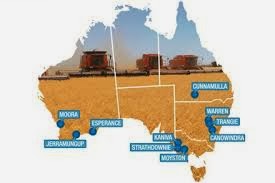
Foreign investment has been strongest in the dairy, grain, sugar, cotton, timber, sheep, horticulture and cattle industries. Qatar’s Hassad Foods has been especially active, buying 11 farms totalling over 250,000 ha. since 2010 (see map above).

Most of Australia’s grain handling industry is foreign-owned, and even more will fall into foreign hands if the proposed sale of Graincorp to the US company Archer Daniel Midland is allowed to go through.

Bad news for potato growers.

Food processing giant McCain’s has announced that it will close its potato processing plant in Penola (SA) by Christmas, leaving 59 workers without a job.

The company blames rising costs and the flood of cheap overseas-grown potatoes into Australia. Potato imports have gone from 10,000 tonnes in 2002 to 130,000 tonnes at the end of 2012.

Aus Veg which represents vegetable growers is concerned for the fate of the potato growers who supply the Penola plant.


Supermarket duopoly under fire

The“Big Two” of Australian supermarkets, Coles and Woolworths, continue to come under fire from suppliers over alleged tough practices in dealing with farmers and manufacturers.

Farm lobby groups from NSW, Vic, WA and QLD have set up a committee to push for a mandatory code of conduct for the supermarket giants to protect suppliers from price gouging.

Coles and Woolworths appear to be taking heed of the campaigns around their use of imported produce in their home brand products. Coles has announced that it is working towards sourcing all the vegetables for its home brand from Australian growers. Woolworths has signed a contract with SPC to supply fruit for its home brands, instead of overseas fruit being used.

These are small victories in the on-going struggle against the might of Coles and Woolworths. This is a struggle that has brought together consumers, farmers, manufacturers and small business people, all of whom are affected in some way by the predatory actions of Coles and Woolworths.


Dairy farmers gone missing

Vanguard November 2013 p. 5
Duncan B.

More than half of the dairy farmers in Victoria’s Goulburn Murray Irrigation District disappeared between 2006 and 2010, according to a report commissioned by the former Victorian Government.

The report found that dairy farm numbers fell 57% from 2721 to 1143 between 2006 and 2010. The total dairying area decreased from 235,548 ha. to 123,571 ha.

The report blamed the trend on drought and changes in water and planning policy. This is a reference to the Federal Government’s water buyback scheme which cost Goulburn Murray Irrigation District half its water and forced many dairy farmers off the land.

The scheme secured environmental water from irrigators but severely impacted on the ability of dairy farmers to produce enough milk to earn sufficient income to secure their equity position and ensure their future in dairying.


Imperialism shapes the Australian economy in its own interests - the people resist

Vanguard November 2013 p. 6
Ned K.

In October this year, Toyota announced sackings of 100 workers. The reason given was that its export orders to the Middle East have declined. Toyota is by far the largest exporter of vehicles from Australia compared to General Motors and Ford.

Only a week before the latest sackings in the car industry were announced, the new Liberal Government Minister Ian MacFarlane said that any further government assistance to the car manufacturers had to be on the condition that they can export a high percentage of the cars they produce here.

Allan Kohler in the Business Spectator section of The Australian on Thursday 17 October demonstrated that the Middle East is one of the few areas in the world where there are no tariffs in place on imported cars, and this is why so many companies like Toyota attempt to export cars there.

He points out that the growth markets for car sales are in the short to medium term in Asia, but this is where tariffs and barriers to imported cars are the highest, despite a variety of so-called ‘free trade’ arrangements.

So Ian MacFarlane’s condition of high export focus before any commitment to further funding of the car industry here is virtually the death of the industry here so long as the industry remains in the hands of the multinational car companies and large component suppliers.

Government pours in the dollars, car multinationals continue to cut jobs and destroy the locally based car industry

It is quite staggering the amount of government financial assistance to the car multinationals, even in recent years, let alone since they set up in Australia around World War 2 and after.

(And this has become part of a global pattern as the giant multinational car companies play national governments off against each other: at the end of September Ford succeeded in extorting $70.9 million from the Ontario provincial government, and $71.6 million from the Canadian federal government to upgrade its Oakville assembly plant.)
Gideon Haigh, better known for his writing on the imperialist originated game of cricket, has written an excellent book, End Of The Road? on the car industry in Australia which exposes the staggering amounts of money handed to these multinationals with no conditions of government control or ownership attached.
For example General Motors received the following amounts of money from the tax-payers between 1 January 2001 and 31 December 2012:

$2,174,947,531 under various restructuring schemes –

         Automotive Competitive and Investment Scheme (ACIS) - $1,503,038,035

         Automotive Transformation Scheme from 2011 - $150,008,171

        Green Car Innovation Fund (GCIF) FROM 2008 - $188,817,598

This year more money was thrown at General Motors and more promised by both federal and state governments as General Motors sacked 500 workers, forced reduction in real wages and conditions of workers in a new Enterprise Agreement and then arrogantly announced that its future commitment to manufacture cars in Australia was dependent on more government money!

Yet while crying out for government money during these years, what was happening to General Motors’ car production here and jobs?

In 2005 there were three production shifts per day and 900 cars produced per day at General Motors’ Elizabeth plant according to Haigh, and 60,000 a year were exported.

In 2012, 400 a day on one shift and only 14,100 exported.

However General Motors, Ford and Toyota reduced the range of cars made here at a time when people’s choice of cars to purchase skyrocketed. In 2012, there were sixty car brands and 360 models on sale in Australia from competing multinational car companies, including competition from General Motors, Ford and Toyota plants importing into Australia.

Sports Utility Vehicles (SUVs) are a case in point. There are seventy seven models available on the market in Australia and until recently only one (Ford Territory) made here.

The point is that the decision of what type of car is made in Australia is not made by the Australian government, Australian people or even the local management of these car multinationals. The decisions are made by the headquarters of these multinational companies based on their interests which are driven by profit maximisation on a world scale.

Australian car production represents 0.02% of world-wide car production and so we do not feature too highly in the car multinationals’ plans.

The people demand action

While approximately 90% of cars purchased in Australia are imported, this is not because the Australian people do not support an Australian based car industry. It is the fact that successive governments have allowed the car multinationals to dictate what is made here and what they can import that has led to the destruction of the industry and thousands of full time jobs.

The people in places like Geelong where Ford is based, and Elizabeth where General Motors is still a dominant employer with 1750 workers, make enormous sacrifices regarding reduced wage demands, and acceptance of job cuts in the hope of keeping the industry in their areas for their communities. But they are tired of such sacrifices being a one-way street.  Increasingly voices in the community demand a government takeover of the car industry in Australia. They support the building of environmentally sustainable cars for Australian conditions. They are ready to make them. They have demanded elected governments of the day make it happen.

SA Premier Weatherill at least had the decency to explain his opposition to a state government buyout of the car industry: the owners would not consent to the sale of the Australian operations and the consequent access by government to its global intellectual property and other business resources; acquiring and operating a company like General Motors would leave the government with insufficient funds for other social and economic investments; and it would expose the government to unnecessary risks.

Regrettably, such timidity is the best that can be expected through the parliamentary process.

It may be some way down the track but eventually the workers and their community allies will have to force the hand of government, seize the assets their labour has produced, and place their manufacturing capacity at the disposal of society.

We need not be shy about the type of social system needed to make this happen.

Melbourne action forces Woolworths to sign accord

Vanguard November 2013 p. 6
Greg C.

A small but vocal group of protestors gathered in the Melbourne Central Business District on Thursday October 17th, 2013, angered at retail giant Woolworth’s refusal to sign the Bangladesh Fire and Safety Accord.

The action was in response to yet the latest catastrophe inside a Bangladesh textile factory. On Tuesday October 8, seven workers were killed following a fire in the city of Dhaka.

Australian brands Woolworths, including its Big W subsidiary, along with Target and Kmart, source clothing from the Aswad Composite Mills, in which the inferno occurred.

Woolworths had originally promised to sign the Bangladesh Fire and Safety Building Accord in June this year following the collapse of the Rana Plaza (below) which claimed the lives of 1127 workers. Close to 2000 Bangladesh textile workers have lost their lives in factory fires over the last eight years.


The gallant band of protestors, consisting of representatives from the Textile Clothing Footwear Union of Australia, Victorian Trades Hall and the National Union of Workers assembled at the QV building, occupying the area in between the Woolworths and Big W retail outlets, and demanded Woolworths to sign the Accord.

Capturing the attention of the morning shoppers, the protestors chanted ‘Shame Woolworths Shame’ and ‘Human lives are not for profit!’

The action called on Woolworths to accept responsibility of the disaster and provide a safe working environment to workers who have played a pivotal role in the company’s most recent annual profit of $2.3 billion.

National Secretary of the Textile Union (TCFUA), Michele O’Neil, called on Woolworths to take responsibility stating; “How many lives will it take before Australian companies take responsibility for their supply chains – Shame!; it's your label, it's your product, it's your profit”

In response to the morning action, Woolworths accepted the demand, and just hours later signed the Bangladesh Fire and Safety Accord, becoming the 96th signatory. A victory for international solidarity.
...........................
Further reading:
 
We reprint an article from A World to Win News Service:
 
Bangladesh garment workers resist intolerable conditions
21 October 2013. A World to Win News Service.


Another killing fire broke out in a Bangladesh garment factory in early October. Ten people died and scores more injured when four buildings caught fire in a clothing manufacturing zone outside Dhaka. Just days earlier, in late September, as many as 200,000 angry workers closed down 300 factories for a day, set some on fire and clashed with police for three days demanding a minimum monthly salary of $100, while companies offered only $46. Police fired rubber bullets and tear gas at the demonstrators, injuring dozens in this overall volatile situation. Ongoing events bring forward actions by the garment workers as their anger continues to boil over.

The garment industry produces never-ending tragedies for workers, four million people, mainly women. It is the main industry, second in size only to China's clothing manufacture, in a country of 155 million. This on-the-job slaughter continues, despite the spotlight shown on the major international clothing retailers and their claims and vows to change working conditions after the Rana Plaza building collapse in April that killed 1,200 workers, The trail of blood leads to the imperialist towers of capital in New York, London and Paris, where brands like Carrefour, Walmart, H&M, Tesco, IKEA, C&A, Gap and Sainsbury intensely compete for market share.Extremely low wages, child labour, repression of the people, no building or safety codes, and corrupt and pliable local governments are in fact the necessary conditions for profitable imperialist investment.

The following is a slightly edited version of an article sent to A World to Win News Service from comrades in Bangladesh.

After the Rana Plaza incident, the high-intensity outbursts of the garment workers ended, but the movement continued on various levels, particularly around working conditions in the industry, concentrated on efforts to raise wages. The minimum wage has been 3,000 taka, or $38 per month ($1=80 BD taka) since 2010. With this wage, one person can barely survive. The new wage scale was not even close to sufficient, and at the same the cost of living rose. So, the new salary made very little change in living conditions.

A major portion of the salary goes to landlords. The workers are required to work at least two hours overtime, sometimes as much as five to ten hours. If they do so, they can earn 1-2,000 takas per month more and are thus able to survive and send money to their families in the villages. Not all workers receive the minimum entry wage. Expert workers get 4-6,000 takas as a basic salary plus overtime (which can be 1-3,000 takas more). Many of the woman garment workers are unmarried, divorced, widows or have husbands who are physically unable to work. Many married couples are in the workplace, so there are often several members of the family at work, including children. This is the only way they survive.

Even though life is very difficult, garment workers are not fully dissatisfied with this situation. In the villages where there are few jobs, especially for young girls or women, life is impossible. Women there basically do their household chores which are considered of no value.

In these circumstances, together the ruling class, the imperialists and the garment owners propagate that the garment industry saves the economy, creates many jobs, especially for women, and this is a great achievement of this system. With the exception of some progressive and Maoist organisations, all the other political forces think like this. The "left" among them wants to reform this situation and concentrate on raising wages and improving working conditions of the workers.

Now, after Tazreen [121 garment workers died and at least 200 were injured last November in a fire that spread rapidly throughout the Tazreen Fashions factory] and especially the Rana Plaza tragedy, the workers' movement was revitalized around the question of wages. After the Rana Plaza tragedy, the government and factory owners became very frightened and cautious. The pressure from Western NGOs, trade unions, and humanitarian organisations, etc., also gave them problems. Worker organisations (mainly some NGOs and some left and reformist trade unions) now demand a minimum wage of 8,000 takas. Due to upcoming elections the government is calling for a new wage scale. After a long time, the owners said they will raise wages to 3,600 takas. This created a furious reaction among the workers giving rise to the recent upsurge.


Due to the momentum of the workers' movement, the government and the factory owners complained that the workers are conspiring to crush the garment sector. The so-called secular government of Prime Minister Sheikh Hasina even propagated that fundamentalists Islamists or the Bangladesh Nationalist Party (BNP, the main bourgeoisie rival party) are behind the conspiracy. On the other hand, BNP is blaming the governing Awami League (AL) for ruining the garment sector. Everyone blames their opponents, in an effort to be in the best position for upcoming elections. The current situation will definitely influence the outcome.

Most of the factory owners are the hooligans of the ruling parties or ex-bureaucrats or other rich people. They might have some land in rural areas, but they are not large landowners. For example, Sohel Rana, the owner of Rana Plaza, was not a landlord but a mastan ["godfather", a leader of an organised crime syndicate in league with politicians who benefit from them financially and in turn protect them] of the AL party now in power. Through many means and with the help of those in power, he became the owner of Rana Plaza. Now he is a big, rich businessman. Feudal relationships are incorporated into this type of capitalism.

People do not support these bourgeois parties. They think they are all the same, they exist for the betterment of the rich and not for the poor. Yet they continue to participate in elections and in each election round, vote for one party, then in the next, change and vote for the other. During the last 23 years of "democracy", no party was elected for two successive terms. The opposition BNP party will benefit from this situation, because the workers and people blame the current ruling party for their misery.

The AL knows they will lose to the BNP in the coming election, so they are trying to gain control of the NGOs and revisionist trade unions. They already assigned Shajahan Khan, a notorious mastan and bourgeoisie trade union leader, to lead this organisation.

All these bourgeois and other forces claim that the garment industry has saved the country by creating so many jobs. They say that jobs have even made women self-sufficient, so the industry should not be destroyed and if the workers continue protesting, they themselves will be jobless and the women workers will be compelled to become prostitutes.

Many workers also think this. But paradoxically, they continue fighting against their low salaries and horrible working conditions. They attack the institutions of the state and the rich, including their industries. They practically want to attack the system, but do not know how to do this or what the alternate system would be.

All these issues are part of the cruel reality on the ground.

And hiding behind all this is the most important reality – the role of the capitalist-imperialists who really dominate the garment industry – the foreign buyers. The government, the bourgeoisie parties and the garment owners insist that the buyers will take their business to other countries if labour unrest continues. They say the workers must accept whatever is offered to them.

An article by Dr Muhammad Yunus exposed the imbalance in profits gained by the local producers and big company buyers like Walmart, Gap, etc. He concludes that the domestic factory owners get about $5 for a shirt. The price of this shirt in the U.S. is $25. The other costs for the imperialist corporate owners is not more than $10 per piece. Their profit is a minimum of $10 per shirt. [Yunus is a Bangladeshi economist who is a leading proponent of the need for capitalist economic development in the third world by means of a "micro-credit" system to encourage poor women to become small-scale entrepreneurs, a scheme for which he received a Nobel prize in 2006.]

Dr Yunus' exposure was not widely propagated. He did not want to disturb the local bourgeoisie nor the imperialist bourgeois buyers. Instead he appealed to Western consumers to pay 50 cents more for an item of clothing, providing this money be used to increase the wages and improve working conditions. This is all part of the discourse in Bangladesh.

All this avoids seeing imperialist penetration as the main issue. The garment industry is not a national industry. It is solely dependent on imperialism and is a feature of the globalised economy of imperialism. If you want revolution, and want to proceed towards socialism and communism, you must break with this economy, not try to reform it like Hugo Chavez and others.

To make this happen will be a very hard and complex process because workers and people generally are not thinking like this. You must propagate revolutionary politics and build a revolutionary organisation that shows them the road to liberation. It may be an easier task in the rural areas. At the same time most of the workers are rural people.

To break with this type of imperialist-dependent economy is not easy. Bangladesh is a small country with a huge population. There is not sufficient land to distribute among workers. At the same time, you cannot build the necessary number of industries overnight to solve the jobless condition of a huge population of this sector and other sectors like it. But that is what is needed. The economy also can and must be reconstructed through the process of protracted people's war. Many small industry and work-sectors must be created in villages, first in support of agriculture, and then meeting other important needs of the population.

Many things in the villages – the economy, class structure, culture, the environment, etc. are changing rapidly. And important changes are taking place in towns and cities also. There is a need to study the effects of all these things.

The capitalist system and its proponents and the revisionists hide Bangladesh's imperialist dependency. And as long as the economy is dependent on imperialism, you can do very little for the safety and welfare of the workers. The owners are the worst type of compradors, one of the main pillars of the ruling class, and the main beneficiary of this man(woman)-eating big economy. They are the main financiers of the ruling class parties.

The government and the ruling parties are trying to cool down the revolt of workers through suppression and phony "workers' leaders". With the elections ahead, the contradictions among the ruling class parties will intensify. At the same time, they are all in unity against the workers' movement.

A clear and present danger - the US alliance

Vanguard November 2013 p. 7
Bill F.


Thanks to the courageous whistle-blower Edward Snowden and other investigators, more information is coming out which reveals the extent of Australian government (whether Labor or Liberal) subservience to US imperialism.

For instance, heavily censored documents released under Freedom of Information laws show that the Labor government knew about the secretive US email spying system called PRISM at least two months before Snowden leaked information to the British paper, The Guardian.

Leaked documents published in the Washington Post reveal that PRISM collects email address books and ‘friends’ from Yahoo, Hotmail, Facebook and Gmail accounts from many countries and that this so-called ‘intelligence’ is shared with Australia’ Defence Signals Directorate, plus Britain, Canada and New Zealand – the other trusted ‘running dogs’ who always come when the master whistles.


The scale is mind-blowing: in a single day the NSA is reported to have scooped up 444,743 email address books from Yahoo, 105,068 from Hotmail, 82,857 from Facebook, 33,697 from Gmail and 22,881 from other providers. Analysis of address books and contact lists plots social and political connections and networks that can then be targeted.

The snooping doesn’t stop there. Most recently the French government (supposedly an ally?) went crook when it discovered that US intelligence agencies had secretly taped an incredible 70 million phone calls right across France within a month. It begs the question – what is happening here?!

Nuclear hypocrisy exposed

Documents obtained by the International Campaign to Abolish Nuclear Weapons (ICAN) have exposed the former Gillard government’s abandonment of the principle of nuclear disarmament when it refused to sign a statement at the Non-Proliferation Treaty meeting in Geneva in April. The statement, endorsed by some 80 other countries, included wording that referred to ''the incalculable human suffering associated with any use of nuclear weapons''. Our craven diplomats, huddled under the US nuclear umbrella, just squirmed in their seats.

ICAN Director Tim Wright said, “''Australia cannot credibly advocate nuclear disbarment while claiming that US nuclear weapons guarantee our security or prosperity. Not only is this a ludicrous notion, it is also a dangerous one because it signals to other nations that nuclear weapons are useful and necessary… These declassified exchanges between government officials clearly demonstrate that Australia's talk of nuclear disarmament has been insincere and hollow.''

Malcolm Fraser

In an article in the Melbourne Age on Monday 21, former Liberal Prime Minister Malcolm Fraser made strong points which demonstrate the very dangers to Australia by the policies of subservience to US imperialism.

“Anyone who has a sense of pride in Australia as an independent nation, as a nation that can make up its own mind, whose values are worth supporting, should be disheartened.

“We have followed the United States into three wars: Vietnam, Iraq and Afghanistan. Vietnam and Iraq were costly and tragic failures. Afghanistan is a failure in waiting. US policies have failed in the Middle East. As a consequence, that region is in greater turmoil and America's influence has greatly diminished.

“But if present US policies are pursued, there is a possibility of conflict ultimately between China and the US. If we are involved, our relationships with all countries of the region would be affected. A conflict could be begun by a newly militaristic Japan seeking to change the status of the Diaoyu/Senkaku islands. It could be caused by the Philippines, believing they would have American support and behaving aggressively as a consequence. While the Americans claim not to take sides in disputes in the East and South China seas, their statements, their dispositions and deployments, suggest they have sided with Japan.

“These events affect Australia deeply. We have little or no capacity for independent action or decisions. If America is involved in conflict, our hosting a powerful Marine air-ground taskforce in Darwin, capable of deploying power anywhere throughout the region, makes us complicit in whatever that taskforce may do. Australians have been deceived by statements in Australia, belittling the significance of that deployment, but outside Australia, US secretaries of defence have spoken more openly of its capacities.

“Perhaps more important, Pine Gap, whose initial purpose was to gather intelligence concerning the performance of Soviet missiles, now provides information, virtually in real time, that can be used by a variety of US weapons systems, including drones. Pine Gap is part of America's drone killing program. If targets are selected anywhere in east Asia or the western Pacific, we are complicit in such actions.

“In any conflict in the western Pacific, because of the Darwin taskforce and Pine Gap, it would be impossible to say that we are not involved. Therefore, if America goes to war in the western Pacific, we also will be at war. Washington will determine whether Australia goes to war or not, just as Britain and the empire did in days of old.

“We must find a way to reassert our own sovereignty.”

Indeed!

US debt default and Australia

Vanguard November 2013 p. 7
Jim H.

The Reserve Bank of Australia has admitted it was helpless in the face of the US government default crisis because it could not predict or properly prepare for how the drama would play out.

In the week before writing, the US Congress approved a late deal to increase the US borrowing authority for a few months and end a partial government shutdown. Of course this does nothing to resolve the American debt crisis except to buy a little more time.

It is telling though that the situation drove the Reserve Bank of Australia’s governor Glenn Stevens to publicly state that the result could have gone “very badly” for Australia. What he means is that a default would have pushed down the exchange value of the Australian dollar.

How could this be?  Because it is the flood of American dollars, mainly into government and private bonds and to some extent company takeovers that is keeping the high exchange rate.

It is the outcome of a high demand for Australian dollars. This is possible because of the close and subservient linkages between the Australian and American economies and the strength of mineral exports. The US is using this to export its crisis.

The Australian dollar is also being held higher than it would otherwise be by exports to China, which continue to grow in value. This remains a secondary factor however.

In the short term, a high value dollar makes the price of imports relatively cheap but provides few export opportunities. An American default would have an impact here through a fall in the Australian dollar due to less American demand. This is what Stevens is talking about.

From the longer perspective, an ongoing high value dollar is increasingly distorting the Australian economy. It is a major factor behind the fall of manufacturing and the over dominance of mining and the financial industry. Even more to the point, it is serving to strengthen the economic and therefore political and cultural domination of Australia by American interests. This is not good.

The US Congress decision immediately pushed up the Australian dollar to $US96.47 and share prices on the Australian stock market by 0.7%. It is telling.

The Reserve Bank is now under pressure to ease interest rates again, underlining the essential weakness of the Australian economy.

Australia needs to assert much less dependence on American interests. This cannot be realised unless their economic and political clout  is overcome. A government and institutional system that is based on dependency cannot do the job. Australians must, as a people, provide an answer to this by their own efforts.

Meanwhile the threat remains. It is important to prepare for the worst. Prepare for the possibility of a default actually occurring. Prepare for breaking the link that is bringing so much long term hurt to Australia and the people of this country.

The Martic Ferguson tale - the well-trodden path of a labour lieutenant of capitalism

Vanguard November 2013 p. 8
Max O.


The career path of many ALP politicos is well a known story of Machiavellian opportunism. Usually it starts out with a university graduate who had their political wheels bolted on through student activism in the Labor Club or Young Labor. If they seem promising they get a job as a staffer in a Labor politician's office or through the union movement.

Those in the union movement may eventually become leaders of a union but their career path is dependent on them sticking rigorously to the ideology of what is commonly termed, 'Social Democracy'. In actual fact the democracy part of the name is quite misleading. The descriptor, 'Social Opportunism' would be far more accurate.

For those that are particularly ambitious the union movement is only a half-way house. Their ultimate goal is to become a member of parliament, government minister and for those pretentious enough Prime Minister.

Bump me into parliament

Hence the expression of, "Bump me into parliament". Past examples of this creed were Bob Hawke (one time leader of the ACTU, then Labor Prime Minister) and Simon Crean (another former leader of the ACTU and later Federal Labor leader and government minister).

They preach the ALP gospel that they can benefit the people by effecting change only through legislation in parliament. Remember Bob Hawke's opportunistic promise that "No child will live in poverty"?

Nor should Simon Crean's clarion call for collaboration between labour and capital be forgotten: "The Labor Party has always operated most effectively when it has been inclusive, not when it has sought division, not when it has gone after class warfare."

However success doesn't stop there. Even though they have been well remunerated they want more. Both financially and to move socially within the ranks of the ruling class. Rarely do ex-Labor politicians not go into business as hired hands on company boards or join business consultancies.

Never have we seen ex-Labor politicians go back to serve the union movement. Some might think the above well-trodden path is one of 'selling out' the working class. However an honest assessment of their path is not of 'selling out', because they never 'bought in' to serving the working class in the first place!

The reality is that many union leaders and Labor politicians mislead, police and surrender the working class for the benefit of big corporations - labour lieutenants of capitalism! And this is the epithet of one Martin Ferguson.

Labor's business is big business!

Martin Ferguson's history reads like a Labor roll of honour board: Leader of the Miscellaneous Workers’ Union, President of the Australian Council of Trade Unions and finally Federal Labor government Minister for Resources and Energy.

However his record as a political functionary is anything but honourable for the working class and Indigenous Australians. Ferguson's role in championing the uranium, petroleum, gas and mining corporations is now legendary.


As Minister for Resources and Energy he was widely respected by the energy and mining moguls for arguing their case in parliament and legislating that their projects get the go ahead. Ferguson's pernicious role annihilated Indigenous sovereignty of their land and assisted wholesale exploitation of foreign (457 Visas) and local workers (FIFO) by the avaricious corporate giants.

Now that he has left parliament big business believes he has the credentials to join their ranks. And that is where Ferguson has gone.

In October this year he joined Kerry Stoke's investment company Seven Group Holdings as its head of natural resources, with his main focus being their Caterpillar operations, Wes Trac. This was soon followed by his appointment to the newly created position of Chairman of the Advisory Board for the Australian Petroleum Production and Exploration Association (APPEA). APPEA is the peak national body representing the interests of the oil and gas corporations, such as resource giants like BHP Billiton, Origin and Shell.

Ferguson's role for this group is to, in their own words, provide "strategic advice" and "skills and contacts". He hasn't taken long in getting started and is vigorously campaigning on behalf of the Coal Seam Gas (CSG) industry.

Ferguson's infamy

In particular Ferguson has been lobbying for and heralding the likes of Santo's Pilliga and AGL Energy's Gloucester CSG projects in NSW. The energy corporations want to do away with buffer zones around residential areas and vineyards and horse stud properties being off limits to them.

Ferguson advocates the Queensland Government's carte blanche approach towards the CSG companies, where there is a "template for regulation and co-existence". He pointed out at a recent onshore gas conference held in Adelaide by the APPEA that gas shortages will likely result in price hikes for households and manufacturers as a result of LNG reserves being mainly exported overseas and the restrictions on CSG drilling in NSW.

His alleged concern for consumers suffering price rises for gas is spurious. Likewise the environmental dangers of CSG exploration and mining are of no significance for Martin Ferguson. His bread and butter is capital's profitability!

Ferguson's service to capital will find only infamy in the memory of Australia's Indigenous Peoples and working class.