Showing posts with label Bangladesh. Show all posts

Friday, August 16, 2024

Bangladesh: Eradicate Hasina-Awami-Indian fascism completely and utterly.

Written by: Proletarian Party of Bangladesh on 13August 2024

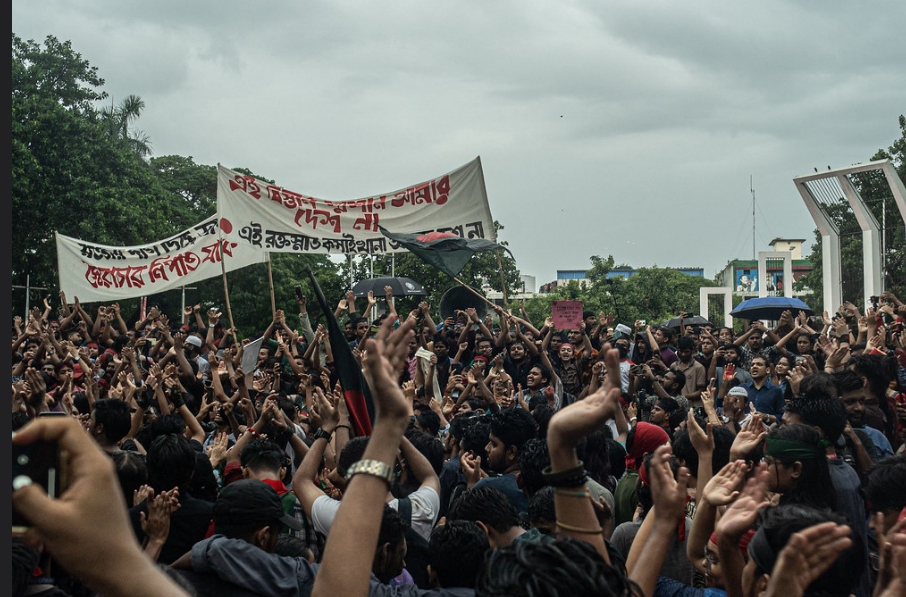
(Photo by Shaharik Istik Raz on Flickr.)

Bangladesh: Eradicate Hasina-Awami-Indian fascism completely and utterly.
Struggle for the Establishment of the Governance of the Struggling Students, Workers, Peasants, Poor, Middle class.

(August 5, 2024. Extended reprint: August 8, 2024)
-

The 15-year Hasina-Awami misrule has finally come to an end. The students have won a great victory in their fearless movement. To achieve this goal, many different political forces and masses have made immense sacrifices and conducted valiant armed and unarmed struggles for the past decade and a half. In this continuation, around 350 lives were lost to achieve this feat at the last minute. Several thousand people were injured. Over five hundred people lost their eyes. Many more have become permanently crippled. 15,000 or more people were taken into custody. In addition to that, thousands of political activists and common people have been killed, and millions of people have suffered oppression and unjust arrests in the past 15 years. False cases have been filed against hundreds of thousands of people.

However, this victory is not the end of the fight, rather it is just the beginning. There is still a long way to go. Because the oppressed cannot be liberated until the power or rule of the bona fide struggling masses is established. That has been experienced many times in the past—in '69, '71, '75, and '90. Even after shaking off the main enemy sitting on the neck, the puppets of the ruling elite bourgeoisie have seized power. To prevent this, the struggling masses must struggle for the right political agenda. Currently, an "interim government" has been formed under the initiative of the military and the bureaucrats. We shall rationally insist that the hopes of the oppressed students for emancipation from fascism be fulfilled. In light of this, we would like to draw attention to a few key points below.


1. To establish a provisional government composed of representatives of all anti-fascist classes, professions, communities, and democratic political forces instead of an externally imposed government led by pro-western ex-military, civilian bureaucrats, bourgeois intellectuals, professionals, and elite bourgeoisie representatives.
- Strongly oppose the imposition of martial law, so-called army-backed governments, or the imposition of a state of emergency.
- Complete repeal of the constitution that allows fascism.
- Promulgation of a new constitution and basic principles of a state system favourable to the democratic system.
- Abolition of the district council, sub-district, and UP formed on the blueprint of fascism.
- Formation of “mass committees” of farmers, workers, labourers, students, youth, middle class, religious and ethnic minorities, progressive and democratic intellectuals at all levels of society starting from village/neighborhood, and having the administrative work done by them. To form an armed “Mass Militia” under them to counter any anti-Mass threat and attack.
- Creating an environment for fair elections based on the elimination of fascism, the development of mass power, and the urgent demands of the anti-fascist democratic forces, especially the workers, peasants, students, and masses.


2. Arresting and punishing all Awami godfathers who are the main pillars of Hasina-India fascists and have dominated all spheres of state and society for the past 15 years.
- Hasina's fascist allies included cabinet members, parliamentarians, powerful bureaucrats, powerful military officers, tyrannical officers of Police-RAB-DB, big businessmen, media magnates, so-called student-youth terrorists, abominable and identified elites among judges, professionals, cultural leaders, etc. Publish a list of names of all these people and arrest them. Disarm them all.
- Immediate release of prisoners in "Aynaghar," a torture prison maintained by the Hasina-loyalist DGFI. Publish a white paper on this.
- Immediate abolition of the murderous RAB force.
- Publishing the list of public enemies involved in murder, disappearance, rape, and money laundering, and prosecuting them under the speedy trial law.
-Banning the Chhatra League, Jubo League, and Hasina-Awami League as terrorist and fascist organizations. Depriving them of their political rights.
- Confiscation of all properties of the above. Confiscation of all agricultural lands, wetlands, residential plots, and commercial plots occupied by Awami fascists. Free distribution of agricultural land to landless-poor farmers. Opening of reservoirs to fishermen.


3. The immediate release of all political leaders and activists of all political parties and struggling people who were tortured and imprisoned during the last 15 years of fascist rule, especially in the last July movement. The withdrawing of all cases brought against them.


4. Opening universities and educational institutions immediately. Lifting the curfew, sending the army back to the barracks. Deploying of BGB immediately to guard the borders. Having the university halls managed by student committees. De-fascistization and reformation of the administration of universities.


5. Publishing the list with the names, addresses, and ages of all those killed during the fascist regime, especially in recent movements. The state should provide compensation to the affected families. All injured should be provided with medical treatment at state’s expense. Those who have already undergone treatment at their own expense should be compensated. A white paper on the injured should be published. Those responsible should be punished severely.
- Listing the general police—Ansar—BGB and army personnel, and common people killed in various anarchic activities that followed the fall of Hasina and honoring them socially.


6. All anti-national agreements and understandings with foreign countries, especially with India, by the Hasina-Awami government in the last 15 years must be cancelled.
- The Rampal Power Plant destroying the Sundarbans should be stopped immediately.
- Immediate cessation of providing India with train and road corridors through Bangladesh, giving them the responsibility for the Teesta project, buying electricity from India at a high price etc.
- Announcing no new agreement or compromise with India until India publicly apologises for supporting Hasina's fascism.
- To be fully alert of subversive or potentially aggressive activities of Indian expansionists. Condemning their harbouring of Hasina/Awami fugitives in India and demanding their handover to Bangladesh.
- Strictly opposing all imperialist meddling and conspiracy, including those of America, China, and Russia, on internal matters of the country.


7. Immediate repeal of all black laws, including the Service Act, Digital Act, and Industrial Police.

8. Accepting the legitimate demands of workers, farmers, fishermen, poor and working urbanites, tenants, students, teachers, and musicians. Implement stringent measures immediately to break up syndicates and regulate commodity pricing. Taking strict measures to stop extortion and bribery by the Hasina-Awami Fascist bureaucrats and police regarding sidewalk traders, hawkers, transport workers, markets, buying and selling land, building houses, getting government jobs, etc. Strictly controlling the change of hands of extortion and of expropriation. Taking strict measures to prevent persecution and attacks on religious and ethnic minorities.

If the interim government is not formed and run in the above way, it will be a imperialist-comprador bourgeois government based on the existing fascist structure, which will not be able to fulfil the aspirations of the struggling masses.

The above demands are not a complete program. Rather, these are only some preliminary outlines for creating an anti-fascist environment and system. Hence many more amendments may be made to it, and specifications have to be made that can be finalised based on the opinion of the serious anti-fascist fighting forces.

-----------------------------------------------------------------------------------------------------------------
Our proletarian party has not only fought relentlessly against the recently expelled Hasina fascism but also outlined a genuine revolutionary program for real liberation from all imperialism, including that of America-China-Russia, Indian expansionism, and their crony elite bourgeoisie, semi-feudal exploitation-control. The party is thus conducting a continuous struggle for the real independence of the country and the empowerment of the masses of people, including the workers, peasants, and middle class, and the establishment of a truly democratic society. The ongoing anti-fascist struggle is a part of this. We are working to fight to the end and lead it to victory. The ultimate goal of the fight is to establish a society without exploitation in the country and move towards communism worldwide.

To advance that goal and to achieve a real revolution, the oppressed people must take up arms, build an army of their own, and build a rural-based people's war based on the program of agrarian revolution. All struggles should be conducted based on this aim and work. The advanced section of students and youth must be equipped with Marxism-Leninism-Maoism. They should be organized into a revolutionary party. Only then can their today's sacrifice and struggle progress towards success. 

-Central Committee, Proletarian Party of Purbo Bangla.


Sunday, August 4, 2024

The Proletarian Party of Purbo Bangla (Bangladesh) -statement on current crisis

 Written by: Proletarian Party of Bangladesh on 4 August 2024


(Above: Protests continue in Bangladesh on August 3.  Photo by Shaharik Istik Raz on Flickr.)

Intro:  We are reprinting this statement from the Proletarian Party of Purbo Bangla (PBSP)/Bangladesh. In the two weeks since this statement was released, more killings have occurred as protests continue against the government. We offer the following notes of explanation.

Sheikh Hasina is described by the Economist magazine as “Asia’s Iron Lady”. She was prime minister of Bangladesh from June 1996 to July 2001 and again since January 2009. She heads the Awami League, the oldest existing political party in the country. It played a large role in achieving Bangladeshi independence and relations with India through Awami League. The Awami League has close ties to India’s Modi government.

The quota system of the Bangladesh Civil Service reserves 30% of positions for descendants of the freedom fighters of Bangladesh’s war for independence from Pakistan. They are mainly loyal to the Awami League and students object to the system for denying their opportunity to win jobs on merit.

The Bangladesh Nationalist party (BNP) is the Awami League’s main rival for office on behalf of the Bangladesh ruling class. To try and discredit the student movement, the government has declared the Bangladesh Jamaat-e-Islami and all its affiliates banned for their alleged involvement in this and earlier anti-government movements. 

The Chhatra League is the student wing of the Awami League. It is a violent, fascist supporter of the government.

The 9-point demands are reformist demands advanced by sections of the current anti-government movement – eds.


A Call to Struggling Students-Mass People - Proletarian Party of Purbo Bangla(PBSP)/Bangladesh

The Quota Reform Movement may have been triumphant, but the blood debt has not been paid.
Fight to overthrow genocidal, murderous Hasina-fascism!

Over the span of five days from July 16 to 20, Hasina-Awami-Indian fascists drowned the student movement, which gradually turned into a mass people's uprising, in an ocean of blood to suppress it. However, they have also been forced to surrender to the fair demands of the students. As a result, a significant triumph has been achieved in this bloody struggle. At the same time, Hasina-fascism has survived, for the time being, due to the limitations of the movement. Thus, the movement failed to achieve real political success.

These fascists have taken nearly two hundred lives in this brief period. More than a thousand students and young people were wounded by bullets fired by the police, BGB, army, and League terrorists. Many of them are dying in hospitals. The killing frenzy is still going strong, involving the Chhatra League, terrorists of the Awami camp, the Police-RAB, and finally the army. The state apparatus has brutally suppressed this movement. The army deployed sound grenades, tear gas, and fired shots from helicopters to put an end to the student protests in the streets for the first time in the history of the country. They opened fire on the processions. Martyr Abu Saeed, who bravely bared his chest in front of the police's raised guns, was fatally shot by direct gunfire in Rangpur.

Fearing the loss of power, Hasina-Awami fascists have confined the movement with a curfew. They have continued their fascist, one-sided propaganda by blocking access to the internet and censoring the news that the media reports. They have tried to disunite the leaders of the movement. They have arrested and abducted the movement’s leaders and tried to repress them through intimidation. They have spoken of the bogeyman of BNP-Jamaat since the beginning. This is how they want to hide their defeat by the bravery and struggle of the students. They are trying to protect their fascist power by any means. Cases and attacks against the protesters have already been initiated. They are arresting any opposition. All these will increase in the future. Large-scale terrorist operations against the protesters have already begun as they attempt to bring the situation under their control.

However, this government is still trembling with the fear of its fall. The babbling of their leaders has decreased. Their mouths are dry. Many of them are keeping the way to escape abroad. Until now, they have maintained their power only with the support of India and the force from the weapons of the army and bureaucrats. But even they might reject Hasina and bring a "Third Power" to the throne if they see too much danger. On the other hand, all opposition political forces and individuals, except the Awami League and their few sycophants, are seeking the downfall of this government. It is evident to all that the hands and feet of this regime are red with the blood of the students and the masses. They are deceivers, hypocrites, and liars. They are enemies of all students and all people.

Why is this fascist government able to survive despite being so hated and excluded? One reason is that they control the state apparatus (the army, BGB, and police) and are directly supported by India's expansionist, Hindutva fascist Modi government, as well as foreign imperialists. Another reason is that the anti-quota movement so far has shown immense valor in the student movement, but it was devoid of any political aims. They themselves called it an “apolitical” movement. A fascist administration such as Hasina's cannot be overthrown by an apolitical movement. As a result, it was largely deprived of the participation of all the struggling classes of society, especially the large urban working class. If the working class of the city had joined the student movement, this government would have been thrown into the dustbin by now. The people would have crushed the barbarous fascist Awami leaders, including Hasina, beneath their feet.

However, the extremely angry students have added a new dimension to this movement. They have ousted the terrorist Chhatra League from many universities, even if temporarily. They have resisted armed attacks by these government-backed thugs and retaliated heavily against them. The Leaguers who carried out armed attacks on the street movement were driven away like dogs by the students. Much-hated leaders were beaten up; the PS of Gazipur's ex-mayor Jahangir, who fired at protestors' marches, was killed and hanged from a tree, and a policeman or two faced the same fate in some places. They attacked a number of police posts and stations and set them on fire. They even broke into the Narsingdi jail, freed all the prisoners, and looted hundreds of weapons from there. Even though there was no organized, centralized leadership behind these events, the entire ruling class was stunned by this spontaneous outburst of public outrage. They were rendered helpless in the face of mob power, albeit very temporarily.

This uprising temporarily immobilized the fascist regime in almost the entire country. This movement has demonstrated how brutally oppressive fascists can be. It was just a very rational, demand-oriented movement of the students. So it is easy to imagine how brutally they can deal with the struggle to overthrow the fascist regime.

The people's power has never been established in this nation's history through a mass movement or mass coup. Sometimes the government is forced to resign, and some of the demands of the people are forced to be accepted, but in the end, others of the ruling class take over, as happened in '69 or '90. The reason for this was that these movements were not equipped with a political program to capture state power by the people. The ruling class has weapons; they have various forces, which these political forces of the people did not have. That is why we from our proletarian party say with the utmost importance that the people must take up arms and build their own forces. This barbarous fascist power and their state apparatus must be defeated by violent means. It is not a crime to bear arms against the arms of the enemies of the people. Destroying the enemy's lair or killing the barbarous scoundrels among them is not something to be frowned upon. But it has to be planned and part of a political agenda. The people have every right to counter the barbaric terror of the ruling fascists with revolutionary terror.

The true freedom of the people lies in the growth of the people's war through rural-based guerilla warfare and the creation of a new democratic state composed of workers, peasants, and middle-class citizens. Mass movement and mass upheaval must be linked with rural-centric mass warfare. Only the urban-centric mass movement and mass upheaval, which will be built based on this people's war, will be able to establish people's power.

But it is a protracted struggle. Therefore, it is not possible to stop various types of mass movements, and neither will they stop. Besides, not only the workers and peasants but also the people of all levels of society and even the bourgeoisie are struggling against fascism. This is seen in this ongoing movement.
As a result, the mass movement that is currently underway needs to continue and be focused on the political goal of toppling fascism. The workers and peasants, especially the working class, must join the urban movement. Programs should be brought forward with the aim of building a real democratic society and state by eliminating fascism. All revolutionary, democratic, leftist, and progressive forces and political parties must unite in that cause today.

We call on the struggling students, the combatants on the front lines, to shake off the confusion of so-called “apolitical” gibberish. Awami fascism will not accept your 9-point demands yet. They have only taken a strategy to secure their throne by retreating a bit through quota reform. They will not spare the vanguard of the movement. They and their terror gang 'Chhatra League' are preparing weapons for revenge. You must also prepare your weapons. That weapon is the political agenda, the target of which now is to oust Hasina-Awami fascism. This is the way to fulfill the 9-point demands. To fulfill the dreams of martyrs. To fulfill your duty to the families of the martyrs.

- Long live Marxism-Leninism-Maoism!
- Establish a truly independent and democratic society free from imperialism, India, and foreign exploitation and control!
- Long live the agrarian revolution!
- Long live the People's War!

Monday, October 28, 2013

Melbourne action forces Woolworths to sign accord

Vanguard November 2013 p. 6
Greg C.

A small but vocal group of protestors gathered in the Melbourne Central Business District on Thursday October 17th, 2013, angered at retail giant Woolworth’s refusal to sign the Bangladesh Fire and Safety Accord.

The action was in response to yet the latest catastrophe inside a Bangladesh textile factory. On Tuesday October 8, seven workers were killed following a fire in the city of Dhaka.

Australian brands Woolworths, including its Big W subsidiary, along with Target and Kmart, source clothing from the Aswad Composite Mills, in which the inferno occurred.

Woolworths had originally promised to sign the Bangladesh Fire and Safety Building Accord in June this year following the collapse of the Rana Plaza (below) which claimed the lives of 1127 workers. Close to 2000 Bangladesh textile workers have lost their lives in factory fires over the last eight years.


The gallant band of protestors, consisting of representatives from the Textile Clothing Footwear Union of Australia, Victorian Trades Hall and the National Union of Workers assembled at the QV building, occupying the area in between the Woolworths and Big W retail outlets, and demanded Woolworths to sign the Accord.

Capturing the attention of the morning shoppers, the protestors chanted ‘Shame Woolworths Shame’ and ‘Human lives are not for profit!’

The action called on Woolworths to accept responsibility of the disaster and provide a safe working environment to workers who have played a pivotal role in the company’s most recent annual profit of $2.3 billion.

National Secretary of the Textile Union (TCFUA), Michele O’Neil, called on Woolworths to take responsibility stating; “How many lives will it take before Australian companies take responsibility for their supply chains – Shame!; it's your label, it's your product, it's your profit”

In response to the morning action, Woolworths accepted the demand, and just hours later signed the Bangladesh Fire and Safety Accord, becoming the 96th signatory. A victory for international solidarity.
...........................
Further reading:
 
We reprint an article from A World to Win News Service:
 
Bangladesh garment workers resist intolerable conditions
21 October 2013. A World to Win News Service.


Another killing fire broke out in a Bangladesh garment factory in early October. Ten people died and scores more injured when four buildings caught fire in a clothing manufacturing zone outside Dhaka. Just days earlier, in late September, as many as 200,000 angry workers closed down 300 factories for a day, set some on fire and clashed with police for three days demanding a minimum monthly salary of $100, while companies offered only $46. Police fired rubber bullets and tear gas at the demonstrators, injuring dozens in this overall volatile situation. Ongoing events bring forward actions by the garment workers as their anger continues to boil over.

The garment industry produces never-ending tragedies for workers, four million people, mainly women. It is the main industry, second in size only to China's clothing manufacture, in a country of 155 million. This on-the-job slaughter continues, despite the spotlight shown on the major international clothing retailers and their claims and vows to change working conditions after the Rana Plaza building collapse in April that killed 1,200 workers, The trail of blood leads to the imperialist towers of capital in New York, London and Paris, where brands like Carrefour, Walmart, H&M, Tesco, IKEA, C&A, Gap and Sainsbury intensely compete for market share.Extremely low wages, child labour, repression of the people, no building or safety codes, and corrupt and pliable local governments are in fact the necessary conditions for profitable imperialist investment.

The following is a slightly edited version of an article sent to A World to Win News Service from comrades in Bangladesh.

After the Rana Plaza incident, the high-intensity outbursts of the garment workers ended, but the movement continued on various levels, particularly around working conditions in the industry, concentrated on efforts to raise wages. The minimum wage has been 3,000 taka, or $38 per month ($1=80 BD taka) since 2010. With this wage, one person can barely survive. The new wage scale was not even close to sufficient, and at the same the cost of living rose. So, the new salary made very little change in living conditions.

A major portion of the salary goes to landlords. The workers are required to work at least two hours overtime, sometimes as much as five to ten hours. If they do so, they can earn 1-2,000 takas per month more and are thus able to survive and send money to their families in the villages. Not all workers receive the minimum entry wage. Expert workers get 4-6,000 takas as a basic salary plus overtime (which can be 1-3,000 takas more). Many of the woman garment workers are unmarried, divorced, widows or have husbands who are physically unable to work. Many married couples are in the workplace, so there are often several members of the family at work, including children. This is the only way they survive.

Even though life is very difficult, garment workers are not fully dissatisfied with this situation. In the villages where there are few jobs, especially for young girls or women, life is impossible. Women there basically do their household chores which are considered of no value.

In these circumstances, together the ruling class, the imperialists and the garment owners propagate that the garment industry saves the economy, creates many jobs, especially for women, and this is a great achievement of this system. With the exception of some progressive and Maoist organisations, all the other political forces think like this. The "left" among them wants to reform this situation and concentrate on raising wages and improving working conditions of the workers.

Now, after Tazreen [121 garment workers died and at least 200 were injured last November in a fire that spread rapidly throughout the Tazreen Fashions factory] and especially the Rana Plaza tragedy, the workers' movement was revitalized around the question of wages. After the Rana Plaza tragedy, the government and factory owners became very frightened and cautious. The pressure from Western NGOs, trade unions, and humanitarian organisations, etc., also gave them problems. Worker organisations (mainly some NGOs and some left and reformist trade unions) now demand a minimum wage of 8,000 takas. Due to upcoming elections the government is calling for a new wage scale. After a long time, the owners said they will raise wages to 3,600 takas. This created a furious reaction among the workers giving rise to the recent upsurge.


Due to the momentum of the workers' movement, the government and the factory owners complained that the workers are conspiring to crush the garment sector. The so-called secular government of Prime Minister Sheikh Hasina even propagated that fundamentalists Islamists or the Bangladesh Nationalist Party (BNP, the main bourgeoisie rival party) are behind the conspiracy. On the other hand, BNP is blaming the governing Awami League (AL) for ruining the garment sector. Everyone blames their opponents, in an effort to be in the best position for upcoming elections. The current situation will definitely influence the outcome.

Most of the factory owners are the hooligans of the ruling parties or ex-bureaucrats or other rich people. They might have some land in rural areas, but they are not large landowners. For example, Sohel Rana, the owner of Rana Plaza, was not a landlord but a mastan ["godfather", a leader of an organised crime syndicate in league with politicians who benefit from them financially and in turn protect them] of the AL party now in power. Through many means and with the help of those in power, he became the owner of Rana Plaza. Now he is a big, rich businessman. Feudal relationships are incorporated into this type of capitalism.

People do not support these bourgeois parties. They think they are all the same, they exist for the betterment of the rich and not for the poor. Yet they continue to participate in elections and in each election round, vote for one party, then in the next, change and vote for the other. During the last 23 years of "democracy", no party was elected for two successive terms. The opposition BNP party will benefit from this situation, because the workers and people blame the current ruling party for their misery.

The AL knows they will lose to the BNP in the coming election, so they are trying to gain control of the NGOs and revisionist trade unions. They already assigned Shajahan Khan, a notorious mastan and bourgeoisie trade union leader, to lead this organisation.

All these bourgeois and other forces claim that the garment industry has saved the country by creating so many jobs. They say that jobs have even made women self-sufficient, so the industry should not be destroyed and if the workers continue protesting, they themselves will be jobless and the women workers will be compelled to become prostitutes.

Many workers also think this. But paradoxically, they continue fighting against their low salaries and horrible working conditions. They attack the institutions of the state and the rich, including their industries. They practically want to attack the system, but do not know how to do this or what the alternate system would be.

All these issues are part of the cruel reality on the ground.

And hiding behind all this is the most important reality – the role of the capitalist-imperialists who really dominate the garment industry – the foreign buyers. The government, the bourgeoisie parties and the garment owners insist that the buyers will take their business to other countries if labour unrest continues. They say the workers must accept whatever is offered to them.

An article by Dr Muhammad Yunus exposed the imbalance in profits gained by the local producers and big company buyers like Walmart, Gap, etc. He concludes that the domestic factory owners get about $5 for a shirt. The price of this shirt in the U.S. is $25. The other costs for the imperialist corporate owners is not more than $10 per piece. Their profit is a minimum of $10 per shirt. [Yunus is a Bangladeshi economist who is a leading proponent of the need for capitalist economic development in the third world by means of a "micro-credit" system to encourage poor women to become small-scale entrepreneurs, a scheme for which he received a Nobel prize in 2006.]

Dr Yunus' exposure was not widely propagated. He did not want to disturb the local bourgeoisie nor the imperialist bourgeois buyers. Instead he appealed to Western consumers to pay 50 cents more for an item of clothing, providing this money be used to increase the wages and improve working conditions. This is all part of the discourse in Bangladesh.

All this avoids seeing imperialist penetration as the main issue. The garment industry is not a national industry. It is solely dependent on imperialism and is a feature of the globalised economy of imperialism. If you want revolution, and want to proceed towards socialism and communism, you must break with this economy, not try to reform it like Hugo Chavez and others.

To make this happen will be a very hard and complex process because workers and people generally are not thinking like this. You must propagate revolutionary politics and build a revolutionary organisation that shows them the road to liberation. It may be an easier task in the rural areas. At the same time most of the workers are rural people.

To break with this type of imperialist-dependent economy is not easy. Bangladesh is a small country with a huge population. There is not sufficient land to distribute among workers. At the same time, you cannot build the necessary number of industries overnight to solve the jobless condition of a huge population of this sector and other sectors like it. But that is what is needed. The economy also can and must be reconstructed through the process of protracted people's war. Many small industry and work-sectors must be created in villages, first in support of agriculture, and then meeting other important needs of the population.

Many things in the villages – the economy, class structure, culture, the environment, etc. are changing rapidly. And important changes are taking place in towns and cities also. There is a need to study the effects of all these things.

The capitalist system and its proponents and the revisionists hide Bangladesh's imperialist dependency. And as long as the economy is dependent on imperialism, you can do very little for the safety and welfare of the workers. The owners are the worst type of compradors, one of the main pillars of the ruling class, and the main beneficiary of this man(woman)-eating big economy. They are the main financiers of the ruling class parties.

The government and the ruling parties are trying to cool down the revolt of workers through suppression and phony "workers' leaders". With the elections ahead, the contradictions among the ruling class parties will intensify. At the same time, they are all in unity against the workers' movement.