Tuesday, April 8, 2025

Multipolarism – the new Kautskyism

 Written by: Alan Jackson on 8 April 2025

 

It is extremely clear that US global hegemony is on the decline and sliding further into fascism as a reaction while economic formations the likes of BRICS and Imperialist powers Russia and China are growing in global dominance. 

The U.S., since the dissolution of the social-imperialist Soviet Union in 1991, has been the most powerful economic and military power globally with very little competition due to the destruction of its main contender, the aforementioned U.S.S.R. This led bourgeois journalists, think tanks, politicians, financiers and academia in their refusal to acknowledge imperialism and barbarism, to refer to the global relations situation and the supreme dominance of the U.S as one that was Unipolar. 
 
These same liberal bourgeois or modern day Kautskyites, are deducing that with the rise of contending economic powers (particularly China and Russia) we are on the road to a “Multipolar” world in which powerful states and their monopolies will keep each other in check. 
 
I would not bother myself writing an article against this modern day Kautskyism if it wasn’t for the influx of self-proclaimed “Marxist-Leninists” (particularly in the Anglosphere) that are picking this up as anti-Imperialist and genuine Marxist theory. 
 
Not only is this mischaracterisation erroneous and completely devoid of class analysis. The theory of Multipolarity is crippling if kept unchecked and is an exact reflection of the Ideology Lenin rallied against in “Imperialism the Highest Stage of Capitalism”. This was the capitulatory ideology of the renegade Kautsky and of the German Social-Imperialists who acted as radical Liberals by throwing internationalism in the dumpster for war credits on the eve of the First World War and threw ‘Red’ Rosa Luxembourg into the River Spree on the eves of the German Revolution.  If we wish to avoid these mistakes as well as revisionism and dogmatism this necromancy and resurrection of dead and thereby useless theory must be thrown to the dustbin of history. Thrown in again I must add since our forbearers had already done our work for us. Alas, different times call for different struggles, usually with the same old revisionism.
 
Why is Multipolarity a problem in the International Communist Movement and how does it relate to Kautskyism?
 
To answer the question of what Multipolarity is and how it relates to Kautskyism, we must first make the statement and analysis clear, that both China and Russia are Imperialist Countries by Lenin’s definition.  This analysis has already been undertaken by those much more articulate and studied than I so I will leave some works for further reading on this below. Now that we have established as a starting point that Russia and China are in fact Imperialist and not bastions of the Proletarian Revolution like many delusional and/or disingenuous “Marxist-Leninists” erroneously are stating, we can address the question of Multipolarity and its relation to Kautskyism with much more ease and lucidity. 
 
With the revisionist and ahistorical theory building quite a large following, we can find some of the biggest praises of Multipolarity through Ben Norton, a journalist and self-described Marxist-Leninist, and through the American “Communist” Party, a Communist Party by name but in practice a multi-level marketing scheme/cult that does share some unintentionally humorous work when it isn’t being racist or homophobic. Along with Gabriel Rockhill, Radhika Desai and many other liberal democrats and Thinktanks posing as communists around the globe (again particularly the Anglosphere but also notably India and China). 
 
There has also been some influence in Australia with the Communist Party of Australia publishing an article by Jesus Rojas in 2021 titled “Venezuela, Russia and China: the route to a Multipolar world”, and its 14th Congress in 2022 passing a resolution which included: “Most countries support the trend towards a multi-polar world and against hegemony. China’s framework of win/win diplomacy and community for a shared future are much better suited for the increasingly multipolar world.’’
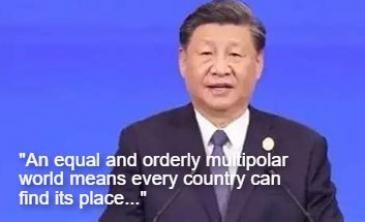
 
  
This large influence world-wide has led to many aspiring but uninspired Marxist-Leninists supporting Multipolarity as a genuine and viable solution to war and as a ‘Theory” for peace. This is ridiculous as military spending has only gone up since the rise of other imperialist states according to Al Jazeera “reaching all-time high of $2.24 trillion” (2). 
 
Aggression has also only gone up with war and genocide amping up in Palestine. A highly mechanized Genocide is continuing by the Fascist Israeli Government and Settlers; Ukraine is being invaded by Imperialist Russia and is being fuelled and fooled by the Imperialist super power the US; Myanmar, Yemen, Syria, Lebanon, Afghanistan, Congo, Sudan, Burkina Faso and the Guyana-Venezuela territorial dispute are further examples. 
 
Russia and China have been sinking their Imperialist teeth into African and Asian veins with loans as harsh as what the International Monetary Fund is infamous for, with one resulting in Sri Lanka forfeiting “the port and over 15,000 acres of land around it for 99 years” (3). 
 
It is clear the Imperialist and/or Capitalist countries will not “keep each other in check” but carry on as Imperialism and the Capitalist mode of production has scientifically destined it to carry on as, a blood-starved beast that will seek out Capital wherever it can, no matter the cost, no matter the consequences. Lenin taught us this already. But how does this relate to Kautskyism and Ultra-Imperialism? Let see. 
 
Kautsky presented his Ultra-Imperialism by saying “Cannot the present imperialist policy be supplanted by a new, ultra-imperialist policy, which will introduce the joint exploitation of the world by internationally united finance capital in place of the mutual rivalries of national finance capitals? Such a new phase of capitalism is at any rate conceivable.” (4). 
  
A new Ultra-Imperialist policy now emerges and presents imperialism as a desirable set of multiple poles (Multipolarity) with different aims but a common goal of achieving a peaceful environment for their ongoing exploitation and plunder.
 
Marx declared that ‘History repeats itself first, as tragedy, and second, as farce.’ And very farcical it is, watching the lows these subjective “MLs” but objective defenders of Capitalism and Imperialism will drop to in order to promote and defend their misguided analysis and warped ideology. 
 
It sounds just as ridiculous as the ultra-imperialism that Lenin opposed, writing: “From the purely economic point of view,” is “ultra-imperialism” possible, or is it ultra-nonsense?” (5) and going on further to say: 
 
“Therefore, in the realities of the capitalist system, and not in the banal philistine fantasies of English parsons, or of the German “Marxist,” Kautsky, “inter-imperialist” or “ultra-imperialist” alliances, no matter what form they may assume, whether of one imperialist coalition against another, or of a general alliance embracing all the imperialist powers, are inevitably nothing more than a “truce” in periods between wars. Peaceful alliances prepare the ground for wars, and in their turn grow out of wars; the one conditions the other, producing alternating forms of peaceful and non-peaceful struggle on one and the same basis of imperialist connections and relations within world economics and world politics. But in order to pacify the workers and reconcile them with the social-chauvinists who have deserted to the side of the bourgeoisie, wise Kautsky separates one link of a single chain from another, separates the present peaceful (and ultra-imperialist, nay, ultra-ultra-imperialist) alliance of all the powers for the “pacification” of China (remember the suppression of the Boxer Rebellion) from the non-peaceful conflict of tomorrow, which will prepare the ground for another “peaceful” general alliance for the partition, say, of Turkey, on the day after tomorrow, etc., etc. Instead of showing the living connection between periods of imperialist peace and periods of imperialist war, Kautsky presents the workers with a lifeless abstraction in order to reconcile them to their lifeless leaders.” (6). 
 
With everything so far, it is very clear that Multipolarity only means inter-Imperialist rivalry and inter-Imperialist rivalry only means war. In a “Multipolar” world that will only means World War. Capitalist exploitation will never become a joint productive and co-operative endeavour between the most powerful of states. 
 
It is clear and obvious the appearance of Multipolarity is only a rebranded and reskinned Kautskyite Ultra-Imperialism just like Kautsky’s Ultra-Imperialism was a rebranding and reskinning of Hobson’s Super-Imperialism which proclaimed  “Christendom thus laid out in a few great federal empires, each with a retinue of uncivilised dependencies, seems to many the most legitimate development of present tendencies, and one which would offer the best hope of permanent peace on an assured basis of inter-imperialism.” (7).  
 
Understanding that Multipolarity is only modern day Kautskyism, we can throw this crippling and dulling theory to the dustbin of history and carry on in our revolutionary practical and theoretical work. Like Lenin said, “Without revolutionary theory there can be no revolutionary movement.” (8) it is clear that Multipolarity is no revolutionary theory.
 
Sources – 
(4.) Kautsky - Die Neue Zeit, April 30, 1915, S. 144.
(5.) Lenin – Imperialism the Highest stage of Capitalism (Chapter 7)
(6.) Lenin – Imperialism the Highest stage of Capitalism (Chapter9)
(7.) quoted in Lenin – Imperialism the Highest stage of Capitalism (Chapter 9)
(8.) Lenin – What is to be Done?
 
 
Resources on Chinese Imperialism – 
 

Sunday, April 6, 2025

Palestinian cultural day in SA

Written by: Ned K. on 7 April 2025


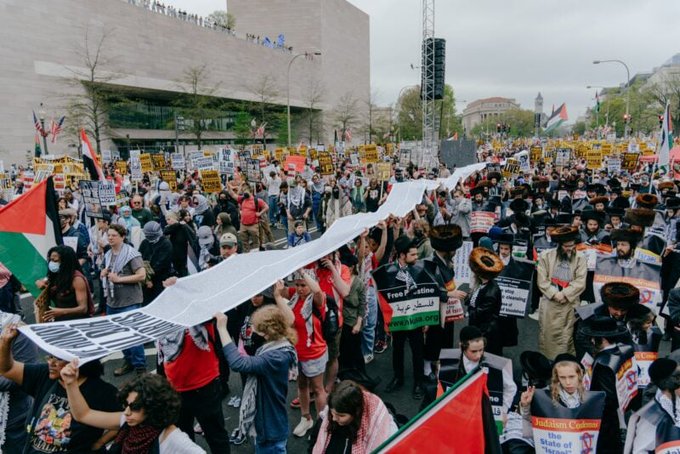
Above: Just days ago, Torah Jews and other anti-Zionnists in the US rolled out a scroll containing the names of 50,000 Palestinians killed by genocidal Israeli Occupation Forces.   Photo source: ILPS)

On Sunday 6 April, the Palestinian community in Adelaide held their annual Palestinian Cultural Day organized by Palestinian Australians at the suburban beachfront of Semaphore. Hundreds of people attended the Cultural Day. There were activities for children, Palestinian live bands and solo artists, and plenty of Palestinian food. 

Notable political attendees were one state ALP Upper House MP, the first Moslem MP in SA Parliament, a Greens Party MP and an Australia's Voice Senate candidate for South Australia, Jordan Shane. Australia's Voice is the Party started up by Senator Fatima Payman from Western Australia. 

There were also several organizations supporting the Day, including AFOPA and Health Workers for Palestine.

Australia is home to First Nations Peoples on whose land many people from many different backgrounds and cultures have come to start a new life. Cultural events are held by many of these diverse communities.

What made this Palestinian Cultural Day of 6 April 2025 so special was that it expressed values of solidarity, optimism and determination by Palestinians despite the continued attempts by the US backed Zionist regime to destroy all remnants of Palestinian culture and Palestinian life itself.


Support for the people’s war in India

 Written by: Nick G. on 7 April 2025


Today, April 7, marks the beginning of an international week of solidarity with, and support for, the Indian revolutionary movement and the people’s war led by the Communist Party of India (Maoist).

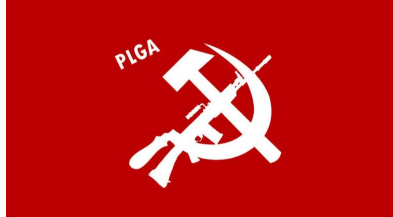
The CPI (M) and its armed forces, the People’s Liberation Guerilla Army (PLGA), have waged armed struggle for years against the Indian ruling class and established a zone of conflict often referred to as the “Red Corridor”.

They have based their mass work on the “untouchable” Dalit villagers and on the tribal peoples, the Adivasis, of the forests and jungles who, despite certain Constitutional rights, have been threatened with dispossession and forced exile so that the big corporations that have state power on their side, can move in and exploit the timber and mineral resources on Adivasi lands.

The key to corporate conquest of Adivasi lands is the crushing of the Maoist insurgency,

It was tried and failed during Operation Greenhunt, which began a decades-long campaign of extra-judicial killings, faked surrenders, forced displacement and attacks on civil liberties.

Now, the fascist Modi government has switched to an even more murderous assault, known as Operation Kagar, deploying more than one hundred thousand paramilitary forces, backed by drones, helicopters and satellite surveillance.

The CPI (M) claims that more than 400 people, including Party leaders, members of the PLGA and local Adivasis, have been killed over the past 15 months.
In response to the increased repression by the Modi government on behalf of Indian finance capital including Adani, Ambani and the big landlords of India, the CPI (M) has offered to join the government in a ceasefire providing it calls off Operation Kagar.

CPI (Maoist) Central Committee spokesperson Comrade Abhay said on April 2, “We welcome the round table organized by the ‘Peace Talks Committee’ in Hyderabad on March 24 on the topic – the Union Government and the CPI (Maoist) should announce unconditional ceasefire and hold peace talks, in the present scenario.”

“We are always ready for peace talks keeping in view people’s interests. Hence, putting forward these proposals to the Central and State governments to create a conducive atmosphere for peace talks. If the Central and State governments positively respond to these proposals, we will immediately announce a ceasefire,” Comrade Abhay said in the statement.

Comrade Abhay further declared in the statement, “The Hindutva fascist BJP-led regime at the Centre launched a military offensive against its own people in the name of Operation Kagaar undermining the lives of tribal people and fundamental constitutional provisions. This brutal offensive is aimed at crushing the revolutionary movement for Jal, Jangle, Zameen rights of Adivasis, promoting corporate interests to allow plunder of the natural resources, eventually decimate the federal system in the country and establish an autocratic unitary State.”

The Communist Party of Australia (Marxist-Leninist) salutes our Indian comrades, and calls on all Australians, including the Indian diaspora here in our country, irrespective of caste or religious identity, to support the call for an end to Operation Kagar and for a ceasefire on the terms offered by the CPI (Maoist). 


Thursday, April 3, 2025

Only a genuinely anti-imperialist independence will protect our people.

Written by: Nick G. on 4 April 2025


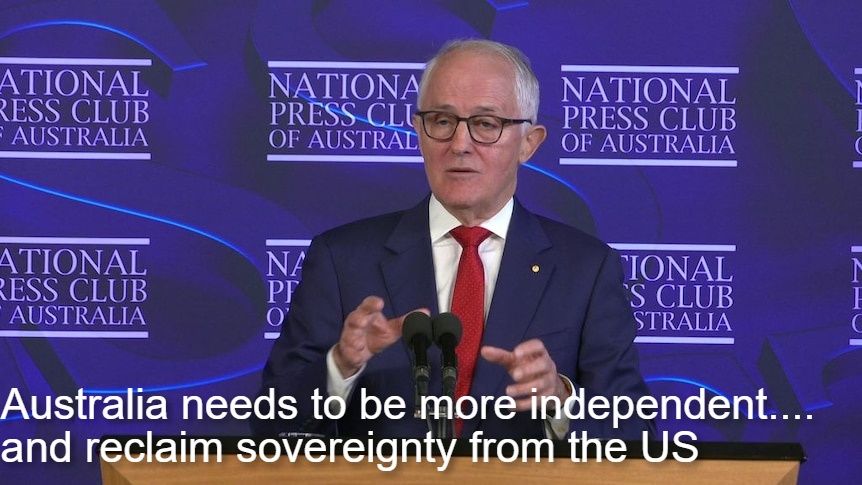
Former Prime Minister Malcolm Turnbull’s recent address to the National Press Club, in which he called for Australian politicians to “get up off your knees and stand up for Australia,” represents a further strengthening of the movement for Australian independence.

Turnbull said that there should be a retaliation against Trump’s imposition of tariffs on Australian exports to the US, and that the Albanese government “could start with the $3bn or the $2.5bn left being handed over to support the US submarine industrial base.”

Attacking the AUKUS arrangements, he said “Australia was unlikely to ever receive submarines from the US given production challenges in America’s shipyards and there was a bipartisan lack of transparency about the risks to Australian sovereignty and defence capacity from the deal.”

He also said the government should consider withdrawing American access to naval bases in Perth.

He called on both Labor and the Coalition to stop being so timid and deferential, and said that “Australia needed to be more independent in the new world of brute power politics and reclaim sovereignty from the US.”

Of course, there will be some on the Left who will reject Turnbull and remind everyone of his role as Coalition PM between 2015 and 2018 when he did nothing to reclaim our sovereignty from the US, or make any reference to the need for Australian independence. 

He was then, and is now, a supporter of the so-called US-Australia “alliance”.

A person’s background and political record must not be forgotten, but whether their change of heart occurs sooner or later, the important thing is that it does occur.

The same may be said of former Prime Minister Malcolm Fraser who was the beneficiary of a US-managed parliamentary coup. Whitlam had ruffled US imperialist feathers by talking of revealing the CIA role in Pine Gap, so hatchet man Marshall Green was despatched as US Ambassador to Australia to lay the ground for Whitlam’s dismissal.  Fraser secured the Australian state within the hold of US imperialism and launched attacks on the working class.

Yet in his later years, he had his own “road to Damascus” awakening and wrote the book “Dangerous Allies” in which he criticised the US hold on this country, warned about US plans to make us take Virginia class submarines, and called for the closure of Pine Gap.

Some on the Left extend their rejection of new-found allies on the Right to those progressive persons who try to establish an alternative to the US stranglehold.

The various Trotskyite groups, for example, have blasted the Greens for proposing a defence policy based on rejection of ties to the US and the development of a policy of armed neutrality, limiting Australian armed forces to the defence of Australia’s territorial integrity.

One Trotskyite organisation pilloried the Greens for “suddenly positioning themselves as defenders of the realm against an undefined enemy”.  The organisation conceded that the Greens had called for the scrapping of AUKUS, but criticised them because the demand “is not particularly progressive”.  It accused the Greens of “floating with the tide when every left-wing organisation ought to be swimming against the current.”

Another group which emerged out of the Trotskyites went further, slamming the Greens as “imperialism’s left-wing”.  

This group aimed its attack at the independence movement, in which it lumped the Greens, saying “Support for an “independent Australia” policy is not anti-imperialist in practice. Rather, it seeks to facilitate an independent Australian imperialism, liberated from its sub-imperial status under the American nuclear umbrella… An independent Australia would simply be an imperialist Australia.”

As long-time supporters of an independent Australia, we know that the question of Australian independence is fundamentally a class question.

Which class will win the right to lead the movement for independence will determine whether it moves in a genuinely anti-imperialist and socialist direction, or whether it suffers defeat and the strengthening of the grip of imperialism and reaction.

We are implacably opposed to bourgeois nationalism. But we are not opposed to strengthening and widening the anti-US movement and do not support sectarian rejection of allies who, whatever their shortcomings as firm anti-imperialists, are nevertheless welcome participants in the movement in which we are trying to establish a proletarian revolutionary main force.

Tuesday, April 1, 2025

Kiribati and China deepen ties

Written by: (Contributed) on 2 April 2025


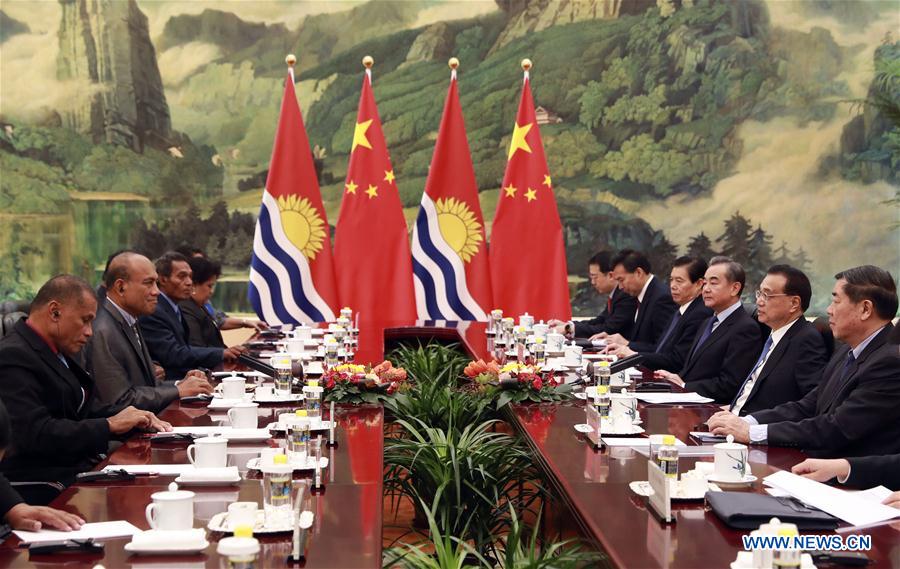
(Above: Chinese and Kiribati leaders in Beijing in 2020   Source Xinhua)

Moves by Kiribati to negotiate a deep-sea mining deal with China have closely followed similar moves by the Cook Islands. The moves have taken place against a backcloth of underlying trends in the global economy and a changing balance of forces, with far-reaching implications for US hegemony. The two tiny Pacific Island countries have, for example, geo-strategic significance for US-led regional military and security provision.

In mid-March, Kiribati, a tiny Pacific island with 130,000 residents, announced it had initiated high-level diplomatic talks with China about securing a deep-sea mining partnership of a vast area surrounding the country. (1) The seabed deposits of cobalt, nickel and copper are regarded as 'key minerals for the global battery industry'. (2)

Kiribati, furthermore, has a huge Exclusive Economic Zone (EEZ) covering 3,437,132 square kms, in comparison to its total landmass of only 811 square kms, ensuring the former is 4,238 times larger than the latter. (3)

In fact, concerns have been expressed in US-led commentary that by switching their diplomatic allegiance to China from Taiwan, small Pacific Island states have provided China with diplomatic access to about 80 per cent of the Pacific Ocean. (4)

Many of the small islands also have a significant role in US-led regional defence and security provision; the Pentagon began a six year and $27.4 billion upgrading plan in 2021 to establish a network of precision-strike missiles along island chains in what was described as the 'Indo-Pacific theatre'. (5) The US-led military plan has also included provision for a 'fielding of an Integrated Joint Force with precision-strike networks … and integrated air missile defence'. (6)

The fact that Kiribati is half-way between Pine Gap and the US Indo-Pacific Command in Hawaii reveals its sensitive geo-strategic position. (7) The Cook Islands, likewise, rests on similar sensitive arcs between US military facilities.

Decades of relative neglect during the previous Cold War by the US toward the Pacific sland nations and neo-colonial relations, however, assured they were 'sovereign and independent in appearance only'. (8) It was the golden age of US imperialism; in fact, the official position of the US during the period was stated clearly by John Foster Dulles, US Secretary of State, 1953-59, as 'there are two ways of conquering a foreign nation. One is to gain control of its people by force of arms; the other is to gain control of its economy by financial means'. (9) That US hegemonic regional position has now become history.

The rise of China, particularly in the Pacific region has already seriously challenged US hegemony; even US analysts in Washington have concluded that the US is no longer the dominant power in the Pacific. (10) The US have been quietly pushed aside.

The changing balance of forces has been verified with economic data from within the corporate world itself; figures quoted by the World Economic Forum (WEF) in 2008 noted that while the US held about one-third of the world's financial assets with $56.1 trillion and the emerging market economies held $23.6 trillion, the latter were growing at twice the rate of the former. (11) The economic growth of the latter has also taken place with a multiplier effect.

Trade bodies, including the BRICs, have emerged as strong contenders in the global economy, particularly as they expand their membership into other areas of the world, including the Middle East. Studies of the expansion have concluded the emerging markets were collectively averaging nearly six per cent growth rates, with China and India together with 28 other countries, leading the way. (12) ASEAN, likewise, has also emerged as an influential trade bloc, with strong collective growth rates.

The US, however, has failed to reach the same growth rates; in fact, following a high-spot in the mid-1960s, their economy has hovered around two per cent growth rates for decades. (13) The problem has become a major factor behind the recent political turmoil surrounding the Trump administration and their financial advisers; they are in panic mode and frantic to deal with China, by whatever means they regard as warranted, including real-war scenarios.

The move by Kiribati to foster stronger links with China, therefore, is best assessed in the context of a subsequent changing balance of forces away from traditional US hegemonic positions. Chinese social-imperialism, in pursuing a policy promoted as supporting mutually beneficial trade and financial support, has presented a credible challenge to US diplomatic positions with tiny, and seemingly, forgotten countries, previously assessed by Washington as barely significant.

As a result of Kiribati pursuing closer links with China, its link with regional partners, Australia and New Zealand, have been noted to 'have become strained … there has been a … tectonic shift in the region'. (14) The fact that Australia's aid budget for developmental assistance has now dropped from 1.2 per cent of the federal budget to a mere 0.68 per cent remains a factor when studying the Pacific Island countries. (15)

Governments across the Pacific are now clearly looking at alternatives to traditional US-led support. More are likely to follow the lead of both Kiribati and the Cook Islands.

It is important to note that moves by the Kiribati government have also fostered some economic development in favour of the more vulnerable sectors of society in recent times. A recent government study noted poverty rates amongst the elderly, unemployed and disabled had been slashed by seventy per cent. (16)

1.     See: Kiribati floats Chinese deep-sea mining deal, Australian, 19 march 2025.
2.     Kiribati explores deep-sea mining deal with China amid global regulatory talks, The Investing News Network, 20 March 2025.
3.     China now controls 80% of the Pacific EEZ; US v. China, Japan Forward: Politics and Security, Rieko Hayakawa and Jennifer L. Anson, 14 February 2020.
4.     Ibid.
5.     US to build anti-China missile network along first island chain, Nikkei, 5 March 2021.
6.     US Indo-Pacific Command proposes new missile capabilities to deter China, RFA., 5 March 2021.
7.     See: Peters Projection, World Map, Actual Size.
8.     See: The plunder of the poor nations, Why are they poor? in The Enemy – Notes on Imperialism and Revolution, Felix Greene, (London, 1970), Chapter 4, pp. 135-151.
9.     Quoted, ibid., page 139.
10.   Study: US no longer dominant power in the Pacific, Paul D. Shinkman, Information Clearing House, 22 August 2019.
11.   Davos salutes SWFs in a celebration of global capitalism, Australian, 29 January 2008.
12.   'Nearly 6% growth', The Economic Times, 25 April 2024.
13.   US GDP growth rate, 1961-2025, Macrotrends.
14.   Pacific nation of Kiribati explores deep-sea mining deal with China, Radio Free Asia, 17 March 2025.
15.   Marles' $1bn snub for Trump, Australian, 25 March 2025.
16.   Kiribati's targeted support slashes poverty by 70%, The Tarawa Times, 19 March 2025.

More on Imperialism and Religion

Written by: Duncan B. on 1 April 2025


In 2022, during a Papal visit to Canada, Pope Francis apologised many times for the abuse that Indigenous children suffered at Catholic-run residential schools, as well as for the Church’s adoption of policies that stripped away Indigenous culture. He said that “taking away the children, changing the culture and mentality, and erasing an entire culture was effectively a genocide.”

Indigenous Australians would welcome similar apologies from the heads of the Catholic, Anglican and all the other denominations that did the same thing in Australia, for their part in helping to destroy Indigenous culture and languages.

In Canada, as in Australia, Africa and everywhere else in the world conquered by imperialism, the invaders had a firm belief in the superiority of Christianity as a religion over all other religions. With their strong racist views, they believed that the indigenous inhabitants were members of an inferior race with inferior cultures and religion.

In Australia these racist views made them blind to the fact that they were dealing with a people who were deeply religious, with a culture profoundly influenced by their spiritual beliefs. The invaders could not comprehend the strong ties the Indigenous people had with their Country. The invaders believed that their actions were ordained by God and therefore justifiable. They saw themselves as the rightful inheritors of the land and were entitled to take it from a lower form of man which was destined to die out anyway.

Indigenous leaders are calling for churches to go beyond merely apologising for the harm caused by their past actions, but to deliver justice to Indigenous Australians. Some have called for the churches to pay reparations. Among these is Professor Anne Pattel-Gray. Professor Pattel-Gray is an Australian Aboriginal theologian and author.  She is a Bidjara/Kari Kari woman from Queensland, and the first Indigenous person to obtain a PhD from the University of Sydney. Her books include The Great White Flood: Racism in Australia. 

In 2023 Professor Pattel-Gray wrote, “Reparations are another critical part of decolonising the church, as this is where Indigenous land is given back, or Indigenous peoples are compensated for its theft. Colonial invaders stole this land from the Indigenous peoples and the collusion between the Australian government and churches has given churches  great wealth, power and privilege. It is not enough to say “Sorry”. It is important for Australian churches to act on delivering justice to Indigenous Christians. Now is the time for “Voice”, “Truth-telling” and “Treaty.” And now is the time for churches to atone for the sins of their forebears and pay reparations to the Indigenous churches and nations for the theft of land, for slavery, cultural genocide and the stolen generations.”

The call for reparations is a just one which should be supported. However, given the way churches have used every legal trick that they can to try and avoid paying reparations to the victims of sexual assault by priests, there is not much hope of the churches ever paying one cent in reparations to Indigenous people without a struggle.


VALE Wallace McKitrick: cultural fighter (1950-2025)

Written by: Nick G. on 1 April 2025


Wallace McKitrick, perhaps still known by some by his birth name, Peter Hicks, was an advocate for, and creative artist of, progressive Australian culture.

Wallace worked for most of his life in community-based artistic and cultural activities.

He began writing poetry while at high school, enrolled for a short time at Flinders University. He then worked at odd jobs while helping to develop a street theatre collective with Margot Nash. Wallace wrote many of its scripts and performed them alongside Margot and others, not just at rallies against conscription and at Moratoriums, but also outside car plants, other large factories and schools.

Wallace was arrested in 1968 during an anti-conscription sit-in at the Department of Labour and National Service offices in Adelaide, and created an uproar in July 1969 when he announced his intention to burn a dog to show people who were not awakened to the horror of the US use of napalm against Vietnamese civilians just what was involved. “Student to burn dog as protest” was splashed across the newspaper front page, and although it was just a media stunt and never intended to do harm to the dog, Plato, it resulted in death threats for the Flinders student.

Wallace chose not to apply for conscientious objector status, and refused to register for the conscription ballot. When police summonsed him to appear on charges related to the offence, he went to New Zealand for a year and subsequently to the Spanish Canary Islands, returning to Australia when his mother sent him news of Whitlam’s election and the end of conscription.

He worked at various labouring jobs and then re-enrolled at Flinders, having heard of the Politics and Arts course offered by the Philosophy Department as part of the Marxist-Leninist course offered by Prof. Brian Medlin and Greg O’Hair. Wallace had known Medlin since the Moratorium days when Medlin was its leader.

At that time 1973, Wallace was working at the Botanic Gardens, mowing lawns, for almost a year and then was awarded a six-month Commonwealth Literary Fellowship on the basis of his record as a poet. That was the first issue of Commonwealth literary grants in Australia by the new Whitlam Government.

Then in 1975, he was appointed as the inaugural Arts Officer with the Trades and Labour Council of South Australia. That involved organising lunchtime shows in factories and building sites – musical shows or very short dramas, theatrical shows or exhibitions or films. This time he collaborated with singer Robin Archer who wrote songs about working class immigration, and sang them to workers in Greek and Italian.

Three years had elapsed between the street theatre and his forced departure from Australia.

It was following his return to Australia that Wallace joined the Worker-Student Alliance and the Communist Party of Australia (Marxist-Leninist). Asked in a 2022 oral history interview whether he had joined the Party, Wallace, who always strictly observed our “iceberg” organisational principle, laughed and said “If I had joined the Marxist-Leninist Party, I couldn't tell you.”

He now turned his attention to setting up the Progressive Art Movement (PAM) with Annie Newmarch and Pam Harris. It was intended to bring together working class issues and the movement for Australian independence across a multimedia collaboration which focussed largely on screenprints created by Annie and others.

In 2024, Wakefield Press published “If you don’t fight…you lose: Politics, Posters and PAM” as an illustrated retrospective on the Progressive Art Movement. In their chapter on the history of PAM, Catherine Speck and Jude Adams write: “PAM, like the Worker-Student Alliance, was a front organisation for the Communist Party of Australia (CPA M-L) which had several agendas operating. One was a campaign against foreign bases in Australia, another was against a car industry run by American companies, yet another was supporting (and joining) the Australian Independence Movement. Within this political mix, cultural workers became involved in rank-and-file operations and in the class struggle at the two major car manufacturing plants, GMH ad Chrysler.”

Another area of involvement for Wallace was the leading of the Creative Writing Workshops in Yatala Prison, which he initiated with friend and fellow poet John Healey, in 1974. It kept going for four years, initially fortnightly, and for a period of time weekly. It meant a great deal to Wallace to work with the inmates who, despite a policy of “rehabilitation”, felt they were regarded as society’s “rubbish”, but who blossomed as creative writers and artists when they felt they were treated as humans for the first time.

Wallace was also involved with the Assemblers folk group which included some of the Rank and File organisation at Chryslers. He wrote various songs and some pieces for The Independent Australian magazine. He wrote a song called 'Ballad of a Bloody Worker,' about Chrysler worker Wil Heidt's arrest and imprisonment. 

When the folk-rock group Redgum was formed by students of Medlin’s course, inspired by Mao Zedong’s Talks at the Yan’an Forum on Literature and Art, Wallace contributed the song Red Raggin’ to their first album. The song declared the wearing of the anti-Communist “red raggers” badge to be an act of defiant pride. The album cover, by George Aldridge, depicted a gigantic Aussie worker about to put an axe through the US spy base at Pine Gap. The back cover featured photos by Anne Newmarch. Its title was the militant union call, “If you don’t fight, you lose”.

Wallace was a founding member of the Community Arts Network of South Australia in 1979 or ‘80. In 1980 he became employed by the Arts Council of South Australia, which was a regionally-based organisation. He conducted workshops and supported community artists and writers across Eyre Peninsula at Ceduna, Port Lincoln, Tumby Bay, Port Neill and Whyalla. He also did a lot of the same work in SA’s South-East. 

In 1988, with the struggle between Patricks and the Maritime Union in full swing, he had his poem “The Slimy Patrick’s Scab” printed in Overland magazine.

Wallace was a great supporter of Indigenous cultural work and was a reference committee member (Klynton Wanganeen, Wallace McKitrick, Bill Wilson, Crystal Murray) for iDreamingTV (originally called Yaitya Makkitura), created in 1998 by the SA Aboriginal community interested in establishing an Indigenous screen and multi-media organisation. 

Wallace spent ten years representing a federal funding agency concerned with cultural initiatives in Indigenous communities.  He was Senior Policy and Program Officer, Indigenous Culture Branch, Ministry for the Arts, Australian Government 2004-14; Senior Policy Adviser, ATSIC; recipient of 1987 Ros Bower Award (then under his name as Peter Hicks).

Wallace worked with the Aboriginal and Torres Strait Islander Commission (ATSIC) from 2001, where he was increasingly aware of the political importance of the Aboriginal self-determination movement. He was in Port Augusta with ATSIC for two years, and had been in Port Augusta already for almost two years before that, with a community development programme based in local government. And then he came to work for the State Policy Centre of ATSIC in Adelaide in 2003.

In 2012-13, Wallace was Senior Policy Officer for the Indigenous Languages Support scheme and its Australia-wide Master-Apprentice Language and Learning Workshop (MALLP) providing support for the revival and teaching of Indigenous languages. 

In 2012 at a Spirit of Eureka commemoration for Eureka Day on the SA Parliament House steps, Wallace heard a talk by Italian-Australian Don Longo on Eureka participant and historian Rafaello Carboni.  He mentioned it again in 2022 when interviewed by Don and Lyn Longo for the Days of Wrath oral history project. He was particularly impressed by Don’s emphasis on the multicultural nature of the 1854 Eureka Rebellion.

Following the death of his friend and comrade Brian Medlin, Wallace contributed to a book published in 2021 titled “The Level-Headed Revolutionary”, a collection of writings by and about Medlin.

Then, when his friend and collaborator from the Progressive Art Movement, Anne Newmarch, died in 2022, he wrote a moving testament to her political commitment titled “Remembering Ann Newmarch – vital contributor to an independent Australian culture”, published on the Spirit of Eureka website.

When Australia was embroiled in controversy over the referendum on Constitutional recognition of Aboriginal and Torres Strait Islanders, Wallace wrote a three-part series on Aboriginal sovereignty for Spirit of Eureka under the heading “Indigenous Sovereignty movement is indestructible”.

In August 2024, despite illness, he wrote a review of the film Ḻuku Ngärra: the Law of the Land. The film was made by the YolÅ‹u people of the NT and focuses on the life of law custodian the Reverend Doctor D. Gondarra. Wallace said of Dr Gondarra’s analysis that it “deftly connects historical British imperialism, Australian settler-colonialism, and modern imperialism’s intensified exploitative practices, while sketching some essential ingredients of a people’s liberation movement.” The review is also on the Spirit of Eureka website.

When Wallace died on the morning of March 14, he had on his desk a copy of Carboni’s book on Eureka, placed on top of his copy of Don Longo’s Eureka Day speech. 

He had said during his interview with Don and Lyn Longo “Reading your 2012 Eureka Day speech, in fact brought back home to me, the absolute critical importance of that dimension. And that's what has to be brought forward. The multi-cultural fact, the diversity of backgrounds and political persuasions in other respects, all with revolutionary intent. This is a microcosm of what's possible.”

Wallace had told family members he intended to write a three-part cycle on Eureka, and kept his unfinished dream of using Eureka to show what is possible in terms of revolutionary intent beside him as he passed away.

Wallace’s passing is a sad loss for wife Sarah and his children and grandchildren.  We extend our sincere condolences to them.

But we rejoice in this comrade’s unblemished record of whole-of-life contributions to Australian anti-imperialist, democratic and socialist cultural work.