Showing posts with label India. Show all posts

Thursday, November 20, 2025

Indian Maoists reject capitulation and surrender

Written by: Nick G. on 20 November 2025


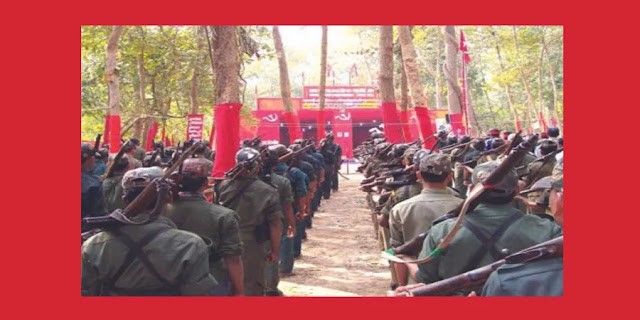
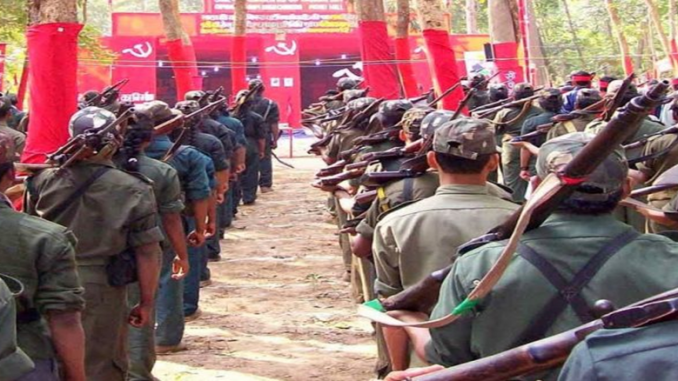
(Above: an assembly of People's Liberation Guerilla Army fighters)

Roughly three months ago, several leaders of the Communist Party of India (Maoist) issued a statement calling on their guerilla units to lay down their arms and accept a ceasefire with the Modi and several state governments.

Sonu, a member of the Central Committee and Politburo of the Communist Party of India (Maoist), and Satish, who is a member of the Dandakaranyam Special Zonal Committee (SZC), created a faction that argued that in the face of “changed conditions”, the party needed to adjust its strategy and participate in legal, above-ground politics.

Those “changed conditions” included the success of the government’s Operation Kagar (“Black Forest”), launched in April 2025 in guerilla-controlled areas between the states of Chhattisgarh and Telangana in central and central-southern India. Kagar is a murderous operation by security forces and has had considerable success in eliminating Party leaders and its followers among the masses.

The Sonu faction also argued that the development of capitalism in India had changed the basis for people’s war as the characteristic form of class struggle in India.

“When the enemy advances, we retreat” – Mao

People’s war follows the law of uneven development. It has successes and defeats. It attacks the enemy with arms, and in turn, is attacked by the enemy with arms. When it is attacked, the people’s army withdraws. It does not capitulate and surrender.

That is the difference between the Sonu faction and those continuing to wage armed struggle.

In early November, the Central Committee of the Communist Party of India (Maoist) issued a statement refuting the capitulationist line.  It reads in part:

“The Central Committee, which discussed the changes in the country’s circumstances, prepared the document ‘Changes in the relations of production in India – Our Political Program’ in 2021. It made it clear that although feudalism has weakened to some extent in the country, feudalism is still the main contradiction. It also explained that although there have been some changes in capitalist relations compared to the past, the majority of the people depend on agriculture and that the land issue is fundamental, and therefore the long-term line of people’s war should be continued. 

“It discussed in detail the changes brought about by imperialist globalization in the country in the past decades and formulated changes in strategies. It provided guidance on how to take action in each area depending on the specific circumstances. It answered the questions raised on this document. 

“Neither Sonu nor Satish disagreed with this document. Now they are openly expressing their views contrary to the document. In fact, it would have been useful for the party if they had studied the country's situation and given appropriate suggestions and advice. It would have been healthy if the internal discussion had continued in the party. But, they misled the cadres by using their responsible positions and the weakness in political studies among the cadres. They acted irresponsibly and violated their duties.”

Our Party will act together with other Marxist-Leninist and Maoist parties to campaign in defence of the CPI (Maoist) and people’s war in India. 

Smash Operation Kagar!

The CPI (Maoist) and the people’s war under its leadership is certain to prevail!

Sunday, April 6, 2025

Support for the people’s war in India

 Written by: Nick G. on 7 April 2025


Today, April 7, marks the beginning of an international week of solidarity with, and support for, the Indian revolutionary movement and the people’s war led by the Communist Party of India (Maoist).

The CPI (M) and its armed forces, the People’s Liberation Guerilla Army (PLGA), have waged armed struggle for years against the Indian ruling class and established a zone of conflict often referred to as the “Red Corridor”.

They have based their mass work on the “untouchable” Dalit villagers and on the tribal peoples, the Adivasis, of the forests and jungles who, despite certain Constitutional rights, have been threatened with dispossession and forced exile so that the big corporations that have state power on their side, can move in and exploit the timber and mineral resources on Adivasi lands.

The key to corporate conquest of Adivasi lands is the crushing of the Maoist insurgency,

It was tried and failed during Operation Greenhunt, which began a decades-long campaign of extra-judicial killings, faked surrenders, forced displacement and attacks on civil liberties.

Now, the fascist Modi government has switched to an even more murderous assault, known as Operation Kagar, deploying more than one hundred thousand paramilitary forces, backed by drones, helicopters and satellite surveillance.

The CPI (M) claims that more than 400 people, including Party leaders, members of the PLGA and local Adivasis, have been killed over the past 15 months.
In response to the increased repression by the Modi government on behalf of Indian finance capital including Adani, Ambani and the big landlords of India, the CPI (M) has offered to join the government in a ceasefire providing it calls off Operation Kagar.

CPI (Maoist) Central Committee spokesperson Comrade Abhay said on April 2, “We welcome the round table organized by the ‘Peace Talks Committee’ in Hyderabad on March 24 on the topic – the Union Government and the CPI (Maoist) should announce unconditional ceasefire and hold peace talks, in the present scenario.”

“We are always ready for peace talks keeping in view people’s interests. Hence, putting forward these proposals to the Central and State governments to create a conducive atmosphere for peace talks. If the Central and State governments positively respond to these proposals, we will immediately announce a ceasefire,” Comrade Abhay said in the statement.

Comrade Abhay further declared in the statement, “The Hindutva fascist BJP-led regime at the Centre launched a military offensive against its own people in the name of Operation Kagaar undermining the lives of tribal people and fundamental constitutional provisions. This brutal offensive is aimed at crushing the revolutionary movement for Jal, Jangle, Zameen rights of Adivasis, promoting corporate interests to allow plunder of the natural resources, eventually decimate the federal system in the country and establish an autocratic unitary State.”

The Communist Party of Australia (Marxist-Leninist) salutes our Indian comrades, and calls on all Australians, including the Indian diaspora here in our country, irrespective of caste or religious identity, to support the call for an end to Operation Kagar and for a ceasefire on the terms offered by the CPI (Maoist). 


Sunday, October 13, 2024

On the death of Dr G.N. Saibaba, fighter for freedom.

Written by: CPA (M-L) on 14 October 2024


The Communist Party of Australia (Marxist-Leninist) joins comrades around the word in mourning the death of Comrade Dr. G. N. Saibaba, an outstanding fighter for the liberation of the Indian people.

The wheelchair-bound Saibaba, who was 90% disabled due to a childhood bout with polio, was undergoing treatment at Nizam’s Institute of Medical Sciences in Telangana’s Hyderabad district, where he was admitted 10 days ago due to ill health. His aides said he suffered a heart attack around 8 pm and was declared dead by doctors at the hospital at 8:30 pm.

Dr. Saibaba, who had been employed at Delhi University and had long campaigned for the rights of the poor and working masses of India, was arrested on May 9, 2014 for alleged ties to the Communist Party of India (Maoist) and involvement in activities deemed as waging war against the nation. His arrest came under the Unlawful Activities (Prevention) Act.

At that time, Dr. Saibaba was convenor of the ‘Forum Against War On People’ against Operation Green Hunt, the military campaign against the armed fighters of the Maoist Party.

Dr Saibaba was acquitted by the Nagpur Bench of the Bombay High Court on March 5 of this year, nearly 10 years after he was first arrested. The Bombay High Court found that the prosecution had not proved its case beyond reasonable doubt. Of course, the real cause for his acquittal was the campaign, Indian and international, that had been waged for his release.

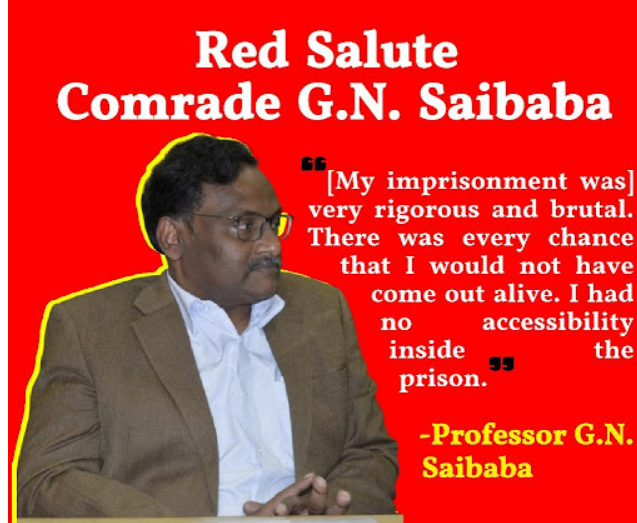
Speaking of his ten years in gaol, Dr. Saibaba said: “Prison is a microcosm of the external world, where all the societal evils are even more pronounced than outside.” 

“Caste-based discrimination is rampant in prison, and works are assigned based on the caste of inmates. In fact, assignment of jobs based on caste is mentioned in the jail manual too,” Dr Saibaba said.

The amended Prisons Act 1894 allows ‘mild bodily torture’ as a means to control and discipline prisoners. While there is no way one can protest against such a system except through a hunger strike, even that would yield no result unless amplified by voices outside the prison.

Under the pretext of mild torture, all prisoners are beaten up upon arrival without reason. The only exceptions are gangsters, politicians of repute and ‘Naxal cases’, Dr Saibaba said.

We express our deepest condolences to the family, friends and comrades of the outstanding fighter for freedom, Dr Saibaba.

Tuesday, June 18, 2024

India: Hands off Arundhati Roy!

Written by: Nick G. on 19 June 2024


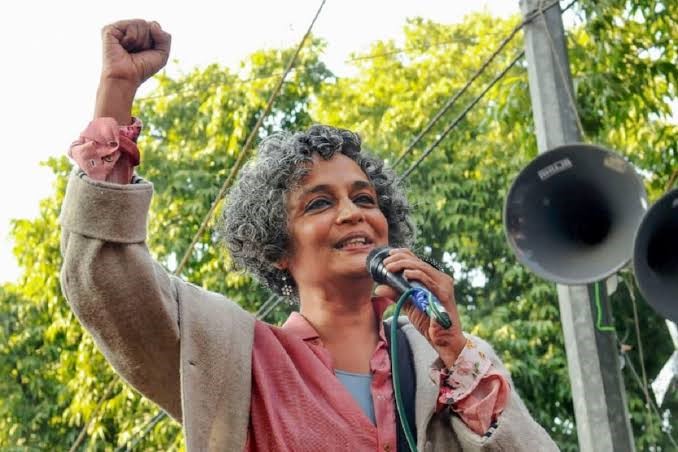
Arundhati Roy was the youngest winner of the prestigious Booker Prize for Fiction in 1997 for The God of Small Things. Then aged 36, she emerged as an activist campaigning on behalf of India’s poor and marginalised, the same people whose lives she had written about in her novel.

They are also the same people largely responsible for Indian Prime Minister Narendra Modi’s humiliating failure to win outright victory in a promised electoral landslide. 

The Indian parliament, the Lok Sabha has 543 seats. Modi, whose BJP party held 303 seats prior to the 2024 general election, boasted that the BJP would break through the 400-seat ceiling and sweep to victory. However, the BJP lost seats, winning only 240 and losing its ability to govern in its own right. It has entered a coalition, but lost face at home and abroad.

The main areas where the BJP lost votes were those populated by the Dalits (Untouchables) and adivasis (tribal peoples who have been the main support base for the people’s war led by the Communist Party of India (Maoist)). 

How better to punish these people than to criminalise their fiercest champion, Arundhati Roy.

So, last week, 14 years after complaints about her references to Kashmir, Delhi's most senior official granted permission for Roy to be prosecuted under India’s stringent anti-terror laws. The Unlawful Activities (Prevention) Act (UAPA) is notorious for making it exceptionally challenging to get bail, often resulting in years of detention until the completion of trial.

Roy was hated by the far-right Hindu nationalists for whom Prime Minister Narendra Modi speaks. She also made an enemy of the revisionist Communist Party of India (Marxist), whose hold on state power in West Bengal and Kerala saw it serving the bourgeoisie and landlords, when she criticised their behaviours and lifestyles in her novel.

She has written one other novel, but mainly she has published collections of political essays and an account of her travels in 2010 through Communist Party of India (Maoist) liberated zones in the forests of Chhattisgarh with fighters of the Peoples Liberation Guerilla Army.

In October, 2010, at a conference in Delhi, organised by the Committee for the Release of Political Prisoners, she enraged the far right by declaring that Kashmir “has never been an integral part of India.” Her opponents demanded that she be tried for treason. But she remained defiant.

In 2019 she delivered a lecture to an audience in New York just months after Modi suspended Kashmir’s autonomy and imposed a lockdown on Kashmir that included the withdrawal of mobile phone and internet services, and a curfew that saw thousands imprisoned. She said:

The horror that Kashmiris have endured over the last few months comes on top of the trauma of a thirty-year old armed conflict that has already taken seventy thousand lives and covered their valley with graves. They have held out while everything was thrown at them – war, money, torture, mass disappearance, an army of more than half a million soldiers, and a smear campaign in which an entire population has been portrayed as murderous fundamentalists. 

India is not the model democracy so beloved of people like Albanese and Wong.

Assassinations of Sikh supporters of an independent Khalistan have reached as far as Canada and the United States. Pogroms by right-wing Hindu mobs have seen hundreds of Muslims beaten to death and lynched in the streets. The disgusting caste system remains firmly entrenched.

Indian novelist and journalist Siddhartha Deb, who has also championed India’s poor, place the prosecution of Roy in context. Interviewed on Democracy Now on June 17, he said:

But the point isn’t really about Kashmir. The point is really about the fact that the Hindu right don’t want anyone like Arundhati critiquing the government, critiquing its policies, not just on Kashmir, but that it is completely — it’s a fascist political party. It is against all minorities. It is against women. It is against the poor. And that is what Roy has been speaking up and writing about for over 30 years. And that’s what they’re against. And they want to shut down not just speech. They want to shut down thought. And that’s what this is about.

The CPA (M-L) calls on the Indian government to cease the prosecution of Arundhati Roy.

The CPA (M-L) calls on Prime Minister Albanese and Foreign Minister Wong to convey to the Indian Government their support for the human rights of Arundhati Roy.

We encourage people to write to the Indian Embassy and to Albanese and Wong, in support of Arundhati Roy.


Wednesday, May 29, 2024

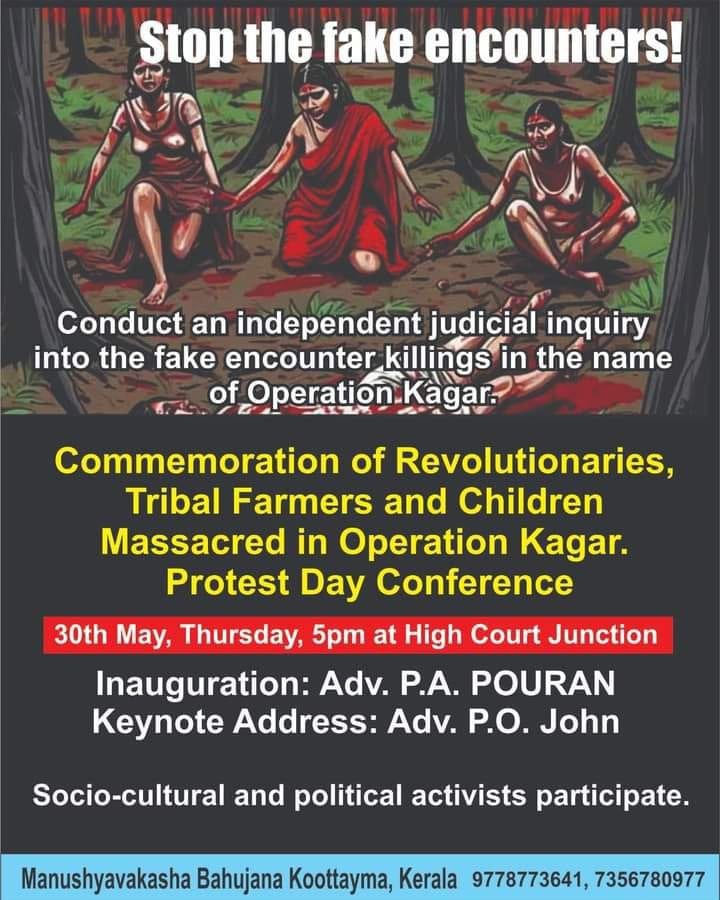
Protest Modi government’s genocidal killing of tribal peoples

Written by: Nick G. on 30 May 2024


Today, May 30, 2024, is a day of protest in India against the fascist Modi government’s war on tribal communities and fighters of the Communist Party of India (Maoist)’s Peoples Liberation Guerilla Army.

Since 1st January 2024, the Indian state has rapidly mobilised more and more paramilitary personnel into the 6 military camps established in the Abujmarh region of Chhattisgarh, a land-locked state in Central India, under a new Operation Kagar.

This region, home to the Gond, Muria, Abujmarhia and Halbaas tribes also falls in the area which contains 700 million tonnes of India’s iron ore reserves, along with graphite ore, limestone and even uranium deposits. With the onset of Operation Kagar, for every 7 Adivasi persons (members of tribal communities) in Abujmarh, there are now 3 paramilitary personnel in the hills. 

On New Years Day, the security forces attacked Muddum village, near Gangalur, in the Bijapur district, and killed a toddler- Mangli- in the lap of her mother while she was being breastfed. Relentless attacks have been regular, and killings have become routine. On April 2, 13 Maoists were killed in an encounter at Korcholi in Bijapur district. All of them were Adivasis, if not Maoists. Four months into this year, 80 Adivasis and revolutionaries have been shot dead in the name of encounters. Aerial bombing was also carried out for the fifth time on January 13 as a continuation of the aerial attacks carried out by the previous Congress government.

In the last month, three fake encounters have resulted in the deaths of 29 people in Kankar district. On May 10, 2024, 12 tribal farmers were shot dead by the army in Bijapur district. Indian paramilitary forces killed five people from Pedia village and seven from Etawar village in a fake encounter.

The villagers, out to collect 'Tendu' leaves, fled in fear at the sight of the security forces. The forces shot them as they tried to escape. Many villagers were dragged from their homes and shot dead.

This hidden war is a genocide of tribal farmers under the guise of neutralizing Maoists. A wide range of weapons, including airstrikes by Israeli-made drones, have been used in the area. 

Operation Kagar strips away from the “rock star” Modi’s fascist Hindutva government its veneer of “democracy” which is killing the tribal farmers of Bastar district who are protecting their land and water, celebrating harvest and cultivation on their soil, alongside the Maoist revolutionaries fighting against corporates, Brahminical Hindutva fascists, brokers, landlords, and mining mafias. 

The CPA (M-L) voices its solidarity with the protest day movement, and calls on the Indian diaspora in Australia to condemn the killing of tribal farmers labelled as Maoists. We call upon all democratically minded people to unite and condemn this genocide.


Thursday, April 11, 2024

CPI (Maoist) announces the immortalization of 50 people's fighters

Written by: Communist Party of India (Maoist) on 11 April 2024


The Communist Party of India (Maoist) has issued a statement commemorating the deaths of 50of the fighters of People’s Liberation Guerilla Army. The Maoists and other progressive forces are subjected to brutal attempts at elimination by the Modi saffron fascist regime. We salute their sacrifices-eds. 

....................

April 9, 2024

The Central Committee of the Communist Party of India (Maoist) issued a statement announcing the death of 50 guerrillas from January 1 and calling on the people to protest the massacres.

"WE TRUST THE POWER OF THE MASSES"

In its statement, the CPI (Maoist) said, "For the last 50 years, a revolutionary movement has been going on in our country under the leadership of the Communist Party of India (Maoist) with incredible sacrifices. The ruling classes are constantly conducting military operations to stop India's revolutionary movement at its very inception. The Government of India, which has declared our party as the only major threat to the internal security of the country, has been carrying out large-scale, long-term military pressure operations for the last 20 years," he said, noting that at least five thousand CPI (Maoist) guerrillas and people have been killed in 20 years.

"Despite this, our revolutionary movement for the democratization of the people in our country continues on its way with great devotion, determination in the face of many tides, with the support of fraternal movements, and by relying on the organized power of the broad masses," the statement continued.

"50 OF OUR COMRADES WERE MARTYRED"

From January 1, 2024, the reactionary Indian state has launched a new military operation called "Operation KAGAR". In a statement, the CPI (Maoist) announced that nearly 50 of its comrades were immortalized within the scope of this operation and summarized the details of the operations as follows:

"Six people were massacred in Chipurbatti, 13 in Korcheli, 3 in Pujari Kanker and 2 in Kerajhiri Dabri. We condemn these murders and commemorate all our heroic martyrs with respect. We will pledge to build a gender-equality, secular and democratic system without exploitation and caste for their unfulfilled dreams.

"For the past two decades, conflict zones across the country have been constantly populated by central and state armed governments, as well as police forces. Unprecedented military repression is being exerted in the conflict zones of Andhra Pradesh, Telangana, Odisha, Maharashtra states of the Central Region, Chhattisgarh and Chhattisgarh, which are the battlegrounds of Bihar-Jharkhand, West Bengal, Uttar Pradesh, Uttarakhand and Assam states in the Eastern Region, which have been identified by the predatory ruling classes as powerful states for the Maoist movement.

"Only modern weapons, anti-mine vehicles, drones and helicopters fly and shoot in the sky. Police are conducting a search operation in thousands of forests. They attack villages and kill people, especially young people, without even seeing the distinction between men and women and the elderly. They chase the revolutionaries, shoot bullets. In fact, seeing all this reminds us that a war is going on in enemy territory. The Indian government is waging a civil war against the citizens of India. The government's war against the people of India must be stopped immediately."

PRESSURE ON THE PUBLIC IS INCREASING

In the continuation of the statement, it was explained that the people were attacked in order to destroy the Maoists and information about these attacks was given: "The reactionary forces have decided to end the Maoist movement throughout the country in the next three years. They target all those who oppose their exploitative policies, anti-people governments, and divisive policies among the people in the country and carry out different kinds of attacks on them. All kinds of activities of citizens are monitored. Modern industry keeps an eye on this. For the last 10 years, the Hindutva dictatorship of the RSS-BJP forces has been going on in the country. By doing many things and abusing power to put a mask of parliamentary democracy on their administration, the 18th century, they hold their Lok Sabha elections.

"The entire village of Prabal is being crushed under the boots of the murderous police. Due to the constant intensive search operations of the police, the chances of survival of people in villages and forests are getting worse and worse. Today, in the forests, there is no guarantee of the safety of life and property of the tribal people, respect for women, protection of children and youth. The police brutally murder those caught in forests and villages, calling them Maoists and fabricating false and fabricated stories about the seizure of weapons and ammunition from them."

BANDH CALLED

The statement concluded: "Fraternal movements must be built in favour of the peoples who are struggling wherever possible for the survival of the Indigenous people against the fascist regime and to stand against the ongoing arbitrary attacks against them.

"Students, intellectuals, human rights activists, social workers, journalists and friends of the media, writers, artists and lawyers are working to establish peace in the forests. People in the Central Region (Telangana, Andhra Pradesh, Odisha, Maharashtra and Chhattisgarh), especially Indigenous people, protested against the harsh conditions faced by Indigenous people and condemned the ongoing attacks against them and demanded an immediate halt to the attacks."

The CPI (Maoist) called on the people to carry out propaganda and demonstrations from 13 to 15 p.m. and bandh on April 15.

(A bandh is a 24-hour strike)

Tuesday, February 14, 2023

Indian women in the fight against Modi fascism


Above: Anganwadi – rural childcare centre - women workers on indefinite strike, January 2023. Photo credit Communist Party of India (Marxist-Leninist) Red Star.

Written by: All-India Revolutionary Women's Organisation on 15 February 2023

This is the first of several report we will publish from a recently-held seminar on the United Front Against Imperialism and Fascism. The reports focus on women's issues in prepartion for the world-wide International Women's Day commemorations. This not just an overseas report - Indians corpise a growing section of the Australian population. Keeping abreast of issues in India will assist us to develop unity between Australian-Indians and other workers in this country - eds. 

Contribution to the United Front webinar on 12.2.2023 from Selvi Mano/AIRWO India.
 
Dear comrades,
 
Greetings to one and all. It is a great pleasure for All India Revolutionary Women organisation to participate in this discussion.
 
We are the women’s organisation working in around India. 
 
International discussion is very important for women's liberation. Because discrimination against women is not just here and there or in this country and other country. It is a global scenario. From poor countries to developed countries women are being oppressed. Even though the ratio of suppression varies, the treatment of women as second-class citizens is happening globally and these practices are interrelated.
 
Since time immemorial, India has been an extremely patriarchal society. The patriarchal setup in Indian society contributed to the fundamental inequality between women and men.
 
Especially in the second phase of the BJP government, oppression and discrimination against women is increasing. (1)
 
India is a growing country in the world. But India ranks 135 among a total of 146 countries in the Global Gender Gap Index 2022 and is the worst performer in the world in the “health and survival” sub-index where it is ranked 146.
 
BJP has been feeding on culture, they derive their support from the traditional patriarchal families and pander to them by mirroring their beliefs and incorporating it into the Government policy. They formulate a customary public opinion of right and wrong, and determine the direction the country has to steer in. These are culture bound, not constitutionally bound and thus a clear violation of the liberalism, freedom and democracy. It is also true that the cultural conditioning has eroded one’s personal judgements. 
 
Savitri Bhai Phule, India's first female teacher, started the first school for girls in 1848 along with her husband Jyotibhai Phule after a long struggle. Female education continued to grow little by little. But with this BJP government privatizing education, education for women is becoming questionable.
 
And more-over India is a caste-based society. The oppression of Dalit women (2) is incalculable. They make them naked in public places. Gang violence and gang rape are also happening in public places. We also see the actions of such criminals being celebrated.
 
In the southern parts of India, such oppressions are lesser than in the northern parts of India. Especially in the states of Tamil Nadu and Kerala, where the progress of women is comparatively noticeable. Great leaders like Thanthai (Father) Periyar, women leaders like Meenambal and many progressive movements fought for social justice and against these caste and gender oppressions from British India period itself . As a result of the struggle and massive propaganda many changes took place in the society. The government also brought various reform laws.
 
Dr. Babasaheb Ambedkar framed many laws in the constitution of India to generate equality for women. But the current corporate fascist government is trying to completely change the constitution. The previous Congress government also discriminated against women. Both the governments have not come forward to implement the 33% reservation for women in Parliament. In addition now the present BJP government is trying to legislate Manusmiruti (3) instead of the constitution. They are spreading hate politics all over India, even the Prime Minister and cabinet ministers are spreading ideas against religious minorities, Dalits and all women. BJP leaders are talking about bringing back the cruelly regressive practice of sati. (Sati or suttee is an ancient practice in which a widow belongs to upper caste gets herself burnt to ashes during her late husband’s funeral pyre. This, the widow would do by setting herself on fire while his corpse is being burnt.) It is said to be a practice to preserve the chastity of women. As the society grew civilized, laws were introduced to prohibit such reactionary practices.
 
Now such views of them against women drag the society back centuries.
 
The BJP government is making labor laws on behalf of corporates. We know it will definitely be against the workers. Female workers are already paid less than male workers. The revised Labor Act has drastically reduced the wages of women workers and stripped them of their hard-earned labor rights.
 
Oxfam India’s latest ‘India Discrimination Report 2022’ finds women in India despite their same educational qualification and work experience as men will be discriminated in the labour market due to societal and employers’ prejudices.
 
In today's environment of corporate interests, women and women workers are suffering tremendously all over the world. In countries with fascist regimes like India, women face even more oppressions.
 
Let's unite women around and across the world to get women's rights and a world of equality. Thank you for starting and continuing our journey as an effort for that.
 
(1)  The Bharatiya Janata Party (BJP), or Indian People’s Party, was elected in 2014 and continues to this day.  It is a right-wing party, and under Prime Minister Narendra Modi, has taken on an increasingly fascist character. Modi is feted by Australian politicians, but he had banned, in February, 2022, a documentary by BBC named, “Modi: The Man, The Myth, The Legend” for its focussing on Modi’s fierce way of handling the Kashmir conflict. This year he has banned a second BBC documentary “India: the Modi Question”. University students have been arrested and beaten for holding clandestine showings of the documentary.
(2) The Dalits, or “untouchables” form the lowest rung of the Indian caste system.
(3) Manusmiruti – Hindu religious law

Sunday, November 22, 2020

Goans protest coal rail line expansion


 Written by: Nick G. on 23 November 2020

Australia is not the only place where Indian coal giant Adani is facing opposition to its coal and railway expansion projects.

In the small former Portuguese colony of Goa, on India’s south western coastline, tens of thousands of Goans are fighting to stop an increase in coal imports, and their subsequent 350-kilometre transportation by train to steel plants in the neighbouring state of Karnakata (below).


Each day, an average of nine trains carrying 3800 tonnes of coal each, make the journey, the coal inadequately covered by blue tarpaulins. Coal dust settles on nearby villages and farm lands and contributes to acid rainfalls.

Currently, three importers – Jindal, Adani and Vedanta – bring in some 12 million tonnes of coal from South Africa and Australia. Now they want new infrastructure to enable them to handle up to 51 million tonnes by 2025.

Specifically, they want a new double-track rail line, new highways and the opening up of six rivers for coal-carrying barges.

Citizens and activists in Goa have for long protested against the increased coal movement and the pollution caused by coal dust. They have now banded together under two movements – Goa Against Coal, and Our River, Our Rights – to stop these projects. “We promise to continue and escalate our efforts until we defeat this attempt by a few corporations to destroy our rivers, lands and environment for transient profits,” the groups said. 

In early November, South Western Railway started laying tracks at a village in Goa. The anti-coal movement called for a midnight blockade of the rail line, and up to ten thousand people responded, sitting on the tracks and causing the cancellation of train movements. 

Christabelle Gomes, 22, stood with her friends. “I want to sit home and study. But so much disturbing information on social media that we are going to lose our biodiversity makes me angry. The government thinks we are foolish. I want to stand here. They need to take my consent, our consent.” When asked if she is scared of catching the Covid-19 virus, she replies, “I am not scared of the virus, I am scared of Coal. Why else will I be out at midnight by a railway track?”

Threats to biodiversity

Gomes’s concerns about biodiversity are widely shared. 

Goa, which is well known for its idyllic sandy beaches on the shores of the Arabian sea, is bound to its east by the densely wooded and biodiverse ranges called the Western Ghats. For coal to reach the steel factories from the coal port, it would have to traverse the Ghats.  This would entail takeover of 113.86 hectares of forest land and the felling of 18,451 trees. It would disrupt sensitive habitats, including the Bhagwan Mahavir Wildlife Sanctuary and the Dandeli-Anshi Tiger Reserve. The expansion of the highway connecting the port to the steel belt will cost another 12,000 trees. Also on the cards is an electrical transmission corridor along the same alignment.

Opposition growing


In Goa, the people’s movement is picking up pace.

Several of Goa’s parliamentary parties including the Goa Forward Party (GFP) and the Aam Aadmi Party (AAP), took part in the rail protest on November 3.

Another joined on November 18 when the opposition Nationalist Congress Party formally announced its opposition to the double tracking of the South Western Railway.

"We oppose the coal corridor 100 per cent. All people are against it. NCP is also against it," state president of the NCP Jose Phillip D'Souza told a press conference in Panaji.

Over the past few weeks, the panchayats or village councils in 54 of Goa’s 183 villages have passed resolutions opposing the movement of coal through their areas.

Abhijit Prabhudesai, founder of an environmental advocacy group called Rainbow Warriors, predicted that “If the government does not relent, the agitation is going to grow and take bolder steps.”


Sunday, November 8, 2020

The US-India Basic Exchange and Cooperation Agreement


Written by: (Contributed) on 9 November 2020

The US has sought to develop stronger diplomatic links with India as part of their Cold War position toward China.

The diplomacy, however, has rested upon the longer-term increase in sales of US military and intelligence equipment with a compliant government in New Delhi to enhance US military preparations.

India, therefore, can be seen to have been allocated a key strategic position for 'US interests' by military planners, due to it being:

*geographically close to China with long-standing diplomatic rivalries;
*a major player inside the British Commonwealth;
*a dominant player in the Indo-Pacific region;
*a country with numerous diplomatic links elsewhere in the developing world.

In October 2020, the US and India established a Basic Exchange and Co-operation Agreement (BECA) to 'allow for expanded geospatial-information sharing between our armed forces'. (1) Official media releases about the high-level diplomatic initiative also stated 'the pact would give India access to advanced US map and satellite imagery, enhancing the accuracy of automated weapons, drones and missiles'. (2)

India, increasingly, has been drawn closer to the triangular US-led regional diplomacy with Australia and Japan, and it is, therefore, important to note the BECA was developed at the recent meeting of the Quadrilateral Security Dialogue (QSD) in Tokyo in October as part of an expanded provision which now has included: defence and security provision, maritime security, infrastructure, investment technology, cyber affairs, supply-chains and public health. The QSD is, increasingly, resembling a regional out-station of the US/European-based NATO.

High-level diplomatic talks between US Secretary of State Mike Pompeo and his Indian counterparts noted the two countries were 'expanding America and India security co-operation', leading to the establishment of the BECA. (3) The signing of the BECA itself rested upon earlier agreements which included the so-called '2+2' dialogue established in 2018 where the US allowed India access to 'encrypted military intelligence' and an MOA where US personnel were allowed onto India's military facilities. (4)

The US has been keen during the past decade to include India in their regional military and security provision; in 2008, for example, co-operation between the two countries was marked with defence trade being virtually non-existent; it has subsequently grown to more than US$20 billion this year. (5) The defence sales have also been accompanied by India being included in numerous US-led regional military exercises.

Throughout the recent arms sales the listed function of 'interoperability' between the US and India, and moves to 'allow the transfer of high-end military platforms', has become commonplace. (6) The military relationship has also been accompanied with information relating to 'geo-spatial intelligence and real-time images', indicating extensive planning for drone intelligence-collection and warfare. (7)

The rise of China as a serious competitor has proved problematic for the US; their diplomacy has increasingly focussed upon developing regional agreements and alliances to encircle and contain China's rising influence. It is not difficult, therefore, to see why the US has drawn India diplomatically closer.

India's diplomatic relationship with China, historically, has also been problematic. The two countries regard each other as long-time rivals. On occasions hostilities have included military stand-offs over boundary disputes as in the recent case of their shared Himalayan borders in June. Further disputes of a similar nature are expected over nearby Kashmir following a decision recently taken by neighbouring Pakistan to formally integrate part of the area which is also claimed by India. (8)

Decisions by the US to include drawing India closer into the Five Eyes intelligence-sharing alliance have to be seen as an attempt to create another hub for 'US interests', working alongside Australia and Japan. (9) India's recent transition from a non-aligned country with strong diplomatic links with the former Soviet Union and Russian Federation to closely allied with the US, therefore, has led to the BECA marking a 'turning point away from its historical non-alignment policy, and re-mapping of its foreign policy priorities under right-wing nationalist Prime Minister Narendra Modi'. (10)

A number of important considerations have arisen.

The fact India is geographically close to China has provided the US with an added bonus: military facilities near border areas can be used for ground-control stations with sensitive surveillance and monitoring equipment for intelligence-collection.

Wider regional matters linked to geographical demarcation disputes were acknowledged by the US with the statement that they regarded India 'as a linchpin in its Indo-Pacific strategy', and that the BECA provided India with 'access to sensitive military satellite data … to track Chinese military movements on its Himalayan border'. (11) In addition, the Nepalese communists regard Indian expansionism as a serious threat.

Secondly, India has remained a long-standing player inside the British Commonwealth, a highly influential 54-member country body developed from the remnants of Empire. India was, in fact, regarded as the jewel in the crown of empire. Many of the countries in the British Commonwealth remain of high-level strategic value, as outlying centres of British influence and sensitive supply lines, which some historians have suggested were primarily concerned with protecting trade links with India.

The British Commonwealth also has the function of an overseas intelligence service for Whitehall, converging upon the Privy Council and acting head of state, Prince Charles. India, therefore, has access to the shadowy world of the corridors of power and influence.

Thirdly, India has maintained a long-time dominant role in the Indo-Pacific region with full diplomatic relations with 27 countries together with extensive trade relations. (12) Many of the countries concerned also host Indian expatriate professionals and workers.

Finally, India also retains strong diplomatic relations throughout the world, including active membership of the United Nations, Non-Aligned Movement and World Trade Organisation which provide ready access to international financial institutions controlled by the US. (13)  

It is, therefore, important to note that the US has been shown to favour 'security partnerships outside the alliance system', which are not clearly defined but left open to redefinition and flexibility at a later date, if required. (14) India, for example, can be used by the US for a wide variety of purposes to defend, secure and promote 'US interests' through Washington and the Pentagon accessing any of the above four listed criteria.

In conclusion, India has been drawn closer to US-led diplomatic positions in recent times, with the purpose of confronting China in specific sensitive areas including contested borders. As Australia is also part of the same US-led military planning we are increasingly entering a period whereby our standard military and security considerations can easily be replaced with real-war scenarios following an escalation of diplomatic hostilities in areas of the world far beyond our usual line of focus.

With that in mind: We need an independent foreign policy!


1.     US, India to sign military pact to counter China, Australian, 27 October 2020.
2.     Ibid.
3.     Pompeo renews charm offensive to keep China in check, Australian, 23 October 2020.
4.     Australian, op.cit., 27 October 2020.
5.     Ibid.
6.     India, US fall in line in bid to curb China aggression, Australian, 28 October 2020.
7.     Australian, op.cit., 27 October 2020.     
8.     Pakistan changes status of Kashmir, Australian, 5 November 2020.
9.     Australian, op.cit., 28 October 2020.
10.   Ibid.
11.   Ibid.
12.   Wikipedia: Foreign Relations of India.
13.   Ibid.

14.   Australian, op.cit., 28 October 2020. 

Tuesday, October 6, 2020

Himalayan conflicts serve US plans to confront China


Written by: Nick G. on 7 October 2020

Comrade Sanjay Singhvi, of the Asian Coordinating Group of the International Coordination of Revolutionary Parties and Organisations (ICOR) has circulated statements by two affiliated parties on a growing conflict between India and Nepal.

Although confined to a small area of disputed land, both the Nepal Communist Party (Mashal) and the Communist Party of India (Marxist-Leninist) Red Star have warned that the conflict is in danger of being internationalised, with US imperialism encouraging Indian expansionism in provocations which will intensify its current tensions with China.

The area in dispute includes Kalapani, a section of territory through which Indian Buddhist and Jain pilgrims access sacred Mt Kailash and Lake Mansarovar in the Tibet Autonomous Region of the People’s Republic of China.

British rulers recognised Nepal’s right to the region that fell to the east of the river Kali in the Treaty of Sugauli. This was signed between the Gurkha rulers of Kathmandu and the East India Company after the Gurkha War/Anglo-Nepal War (1814-16).

India disputes Nepal’s claims to the Kalapani region and issued a new political map on November 2nd, 2019, putting Nepal’s land of about 372.37 square kilometres inside India. This was followed by construction of a new road to Lipulekh, gateway to Kailash-Masarovar in Tibet.

Nepal claims that both India and China were in clear violation of Nepal’s sovereignty during the 2015 Lipulekh agreement that renewed India’s Mansarovar pilgrimage connection.  Neither side consulted Nepal or sought its opinion before that agreement that boosted pilgrimage and trade to Tibet.

Yet sections of the Indian military and government are claiming that China is behind Nepal’s protests about India’s actions.  

The Nepalese and Indian Parties share a common analysis of the implications of this conflict. 

According to the Nepal Communist Party (Mashal), “The strategic value of occupying Kalapani for India is in large part to gain an advantage against China. It is also notable that India and China in the past have entered a treaty over the use of Lipulekh for their trade route in the absence of Nepal. However, Nepal has categorically said that Lipulekh cannot be the junction between India and China without consent of Nepal.”

The CPI (M-L) Red Star points out: “(The Indian Army) has dragged China also in to this dispute, and as US hurriedly came forward supporting India and accusing China, these border skirmishes have given an international character to the dispute… Naturally, US exploit the situation, trying to provoke a proxy war between India and China, to settle its own contradictions with it. It shows how under Modi India is dragged in to a situation in which the Indian army may be used as cannon fodder in another conflict with China, to serve US interests.”

Whilst most fears of conflict leading to war in our region focus on the South China Seas, the 2017 border clash at Doklam between India and China, and the ongoing tensions between the two over the “Line of Actual Control” at Ladakh, show the potential for war in the Himalayas.  Adding the Indian-Nepal dispute does little to lessen those fears, particularly when US Secretary of State Mike Pompeo, speaking yesterday with his Japanese, Indian and Australian counterparts in Tokyo, said cooperation against Beijing was now more critical than ever.

It would clearly suit Pompeo and US imperialism to have one or more of the “Quad” partners provoke China into a military response that US imperialism can feed into without appearing to be its cause.

US imperialism is pushing Australia along a dangerous path. We should have none of it.

Smash US imperialism!

Anti-imperialist independence and socialism for Australia!