Showing posts with label comrades remembered. Show all posts

Wednesday, November 19, 2025

Vale Ron Owens

 Written by: Michael Williss on 14 November 2025


On November 3, 2025, the working class lost an outstanding leader, and our Party lost an outstanding member.

Comrade Ron Owens, 90, came to Adelaide from Broken Hill as a young man seeking work.  He already had eight years of experience working in the Broken Hill mines when he came to Adelaide. He started at a factory where conditions were terrible, left, and walked up to a construction site offering to do labouring.  He was taken on and stayed for six years, gaining experience as a rigger and as a pile-driving crane operator.  In that capacity, he was sent to Sydney to drive piles for the expansion of the new Sydney Airport runway out into sea water. While there, he had a brief discussion with Norm Gallagher about working in the Builders Labourers’ Federation (BLF)

When he returned to SA, he worked all over the state as a rigger and crane driver. Then, in the late 60s, when Les Robinson came to SA from NSW to lead the SA Branch of the BLF, he was taken on as its sole organiser. He and Les soon became a working class tag team in an ongoing wrestle with the boss class over union rights and workers’ gains.

The SA BLF had been very poorly run prior to Les Robinson’s arrival, and had only 300 members when Ron started organising.  Ron had to go as far as Ceduna on the West Coast, and down to the South-East, signing up members and collecting their membership fees.  By the time of the BLF’s joining other construction unions in the CFMEU, it had 4.500 labourers as members.

Cleaning up the industry included stopping the use of the hod, a wooden structure on a long shoulder pole, used to carry bricks or mortar up ladders. It was dangerous and backbreaking. Ron also put a stop to riding the hook, also very dangerous, although there was a certain bravado in being a “doggie” and riding the plank.

As Party members, Ron and Les worked closely with former Ironworkers SA State Secretary and Central Committee member Charlie McCaffrey, as well as welcoming and mentoring the growing numbers of left-wing students wanting to expand the Worker-Student Alliance and integrate with the working class.
In October 1969 they had shown their support for students protesting against the US War of Aggression Against Vietnam by defying a United Trades and Labour Council (UTLC) ban at the official Labour Day procession on the carrying of slogans attacking police brutality. They organised their members, and together with the students and other militant workers, they had marched as a large separate group. 

On another occasion, Ron and a group of BLF members present at a Vietnam Moratorium march repelled a group of Nazis who had tried to disrupt the anti-war demonstration. That is an example worth reflecting on today.

As a young uni student and a recently joined member of the Party, I was always welcomed at the BLF office, and looked after when I had holiday jobs in the industry. On one occasion, there were a couple of us working on digging foundation trenches at the Institute of Technology Levels campus, and I told Ron that we had no facilities on site.  We had to sit on our backsides in the dirt to eat our sandwiches. There was no shade. The next day, Ron pulled up in his car, and got out holding a handkerchief to his right eye, and looking quite distressed. He introduced himself to the site supervisor and asked him if he had anything for his eye.

“Yeah, I’ll have a look. What have you done to it?” said the supervisor.

“Me, nothing,” said Ron. “But there’s something bloody wrong with it, ‘cos I can’t see a lunch shed for those three blokes over there. Get one by tomorrow!”

And it was there the next day.

One of the other blokes on the job had done some work on the wharves in Melbourne.

“Did you ever come across Ted Bull?” I asked.  Ted was the WWF Victorian branch secretary.

“Hell yeah,” he laughed. “Only a thin, wiry bloke, but the toughest bastard I’ve ever met.”

Les Robinson was a small bloke, but also very tough.  When he and Ron went into a struggle, they went in to win.

In June 1970, the membership drive was in full swing. Les and Ron were both arrested on the new Modbury Hospital site, which they had entered to sign up members. There was no law against them doing so, and any penal provisions against unions had been smashed the previous year through the great struggle to free Clarrie O’Shea, so the police arrested them under laws never intended for use in an industrial dispute. Les was charged under the Road Traffic Act and Ron under the Police Offences Act and the Lottery and Gaming Act.

More significantly, both faced charges issued by the Chamber of Manufacturers of having breached orders made in the SA Industrial Commission that the union should stop hindering the business operations of certain building companies and three sub-contractors. This use of civil proceedings in an industrial dispute was a new ruling class tactic following the defeat of the penal powers of the Arbitration system in the O’Shea struggle. 

When the BLF officials sought the support of the UTLC, its acting secretary, J Calnan, wrote back denying that “the arrests were ordered by the construction companies…it cannot be said that the charges are in the nature of an industrial matter.” 

Ron later told 3CR’s Construction Gang radio interviewer that he had not been scared.

“The most frightened bloke was Hawke. He was a dog, that bloke, working behind the scenes...he was going to do wonders, but he did bloody nothing.”

His treachery was revealed when it was disclosed that the Australian Council of Trade Unions’ (ACTU) Bob Hawke had been in secret negotiations with the UTLC, Collaroy Constructions, the Chamber of Manufacturers and the Australian Labor Party (ALP)-led Plasterers’ Union (which claimed the labourers as their members), and had approved a strikebreaking proposal whereby a supervisor from the construction company would be enrolled as an FEDFA member (a union contesting coverage of crane drivers on construction sites) and placed on standby to operate the crane should the BLF member driving it walk off during a concrete pour.

When their court case resumed on September 9, the two refused, as trade union leaders, to recognise the authority of the bosses’ court and were fined and jailed for three weeks.

Bosses look for new penal powers 

The try-on in the capitalist courts emboldened the employers. They were desperate for new penal powers to replace those smashed in the O’Shea struggle in 1969. Again, they focused on the BLF. It was the most militant union in SA. After Les and Ron began recruiting members in 1967, they had grown the union from 300 to 3000 members. But the recruitment often involved picketing worksites and taking advantage of contradictions between competing employers and contractors.
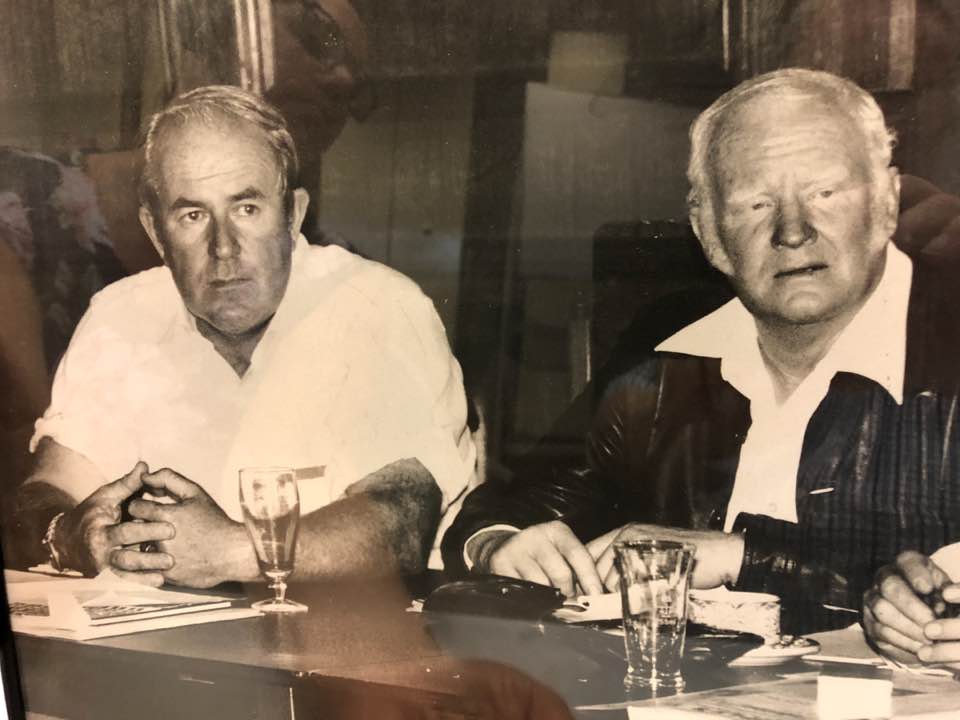

 
(Ron and SA BLF President Snowy Cameron, c. 1971)

In 1972, a dispute arose between the union and Adriatic Terrazzo and Foundation which went to the courts seeking an injunction against the union on the basis of another civil law, the law of torts. A tort is a harm or damage caused by the action of another person who, if found guilty, is liable to make good the harm or damage, typically by a payment to the successful claimant. It was intended to resolve matters between persons in the civil arena, not between unions and employers in the industrial arena. 

Les and Ron refused to appear to answer the charges and instead concentrated on reestablishing picket lines broken up by police the previous day and strengthening those at Adriatic sites. Concrete deliveries to Adriatic sites were blocked. This was despite a director of Adriatic, Mario Candeloro, admitting in the Supreme Court that he had threatened to blow Robinson's head off with a shot-gun if concrete deliveries to the firm were stopped or the men were forced to join the union.

Having defied the court, Les and Ron were arrested within days and jailed indefinitely for contempt of court. Les and Ron adopted an attitude of proletarian defiance and firm class resolve. "I will stay in as long as is necessary to win this dispute,” said Les. “I will not purge myself to the court unless it means we can win the dispute.”

"By winning, I mean that Adriatic Terrazzo & Foundations Pty. Ltd. agree to employ union labour. I will settle for nothing else." 

"This is the policy of our members and it is paramount that we uphold this policy, even if it means going to jail." 

Ron agreed. "Nobody likes the thought of going to jail,” he said. “However, I'm defending union principles and I'll stay inside indefinitely. I won't purge myself, either." 

Although sent to jail for an Indefinite period for contempt of the Supreme Court, Les and Ron were heartened by support from prison officers who, at a meeting the previous week, declared unanimously that they would not process any union official arrested under the tort law. Non-processing of prisoners meant that they would not be documented, escorted, locked in a cell or supervised by the officers. 

Further heartening support came from CPA (M-L) leaders Ted Hill, Clarrie O’Shea and Ted Bull, who sent a message of encouragement to them in jail. 
Ron was certainly heartened by the action of his wife Bev, who went to building sites to gain support for the two jailed officials.

The federal executive of the ABCEF (ie. BLF) also sent three Victorian comrades to assist the SA branch while Les and Ron were inside. Marco Masterson wrote in May 1973 that “1972 ended a year of great struggle by the Federation on many fronts: wages, and against the war in Vietnam, building Unionism and job improvements…But I feel our best effort was in South Australia.” 

With Les and Ron in jail, builders’ labourers decided at a strike meeting that, for every day the two officials were in jail, members of the union in SA would do no work. The workers were all the more incensed because of the arrest of 11 unionists who were picketing the job which was the source of the dispute. 

In the same week, about 40 key concrete batching operators stopped work indefinitely in protest at the jailing of the two officials. The batchers were members of the AWU, and the AWU secretary, Jim Dunford, said: "We are prepared to back any efforts to get the two union men out of jail. The company, Adriatic Terrazzo & Foundations Pty. Ltd., must be stopped from employing non-union labour."

While rank and file members kept up the struggle to free Les and Ron, the response from other sections of the union movement was less than satisfactory. Placing their hopes on an ALP win in the federal elections, they feared that the dispute would play into the hands of the conservatives. That hostility continued even after the Whitlam (ALP) win.

The so-called “progressive” Labor State Premier Don Dunstan led the attack. He claimed that Robinson was not prepared to negotiate and wanted to use his union to defeat a Labor Government, both State and Federally. The Premier's statement had no word of criticism of Adriatic. Angry labourers marched on Parliament house and confronted Dunstan over his statement.

It was only after eight days of jail time that the UTLC met and decided to support the BLF on the principle of opposition to the use of tort in industrial disputes. A unanimous vote banned all Adriatic Terrazzo and Housing Industry Association work until the tort action was dropped and, on that basis, Les and Ron agreed to purge their contempt and were then released from jail. Every member of the union in SA had been on strike, and a national stoppage by construction labourers was imminent. 

However, the promised support from the UTLC failed to materialise. Dunstan was facing a state election in March and worked to cool things down. That left Les and Ron vulnerable to further attacks by the capitalist builders, and they were back in court again on February 13, 1973 where their union (now the Australian Building and Construction Workers Federation) was slapped with a permanent order banning it from "interfering with or threatening by illegal means the business of Adriatic Terrazzo and Foundation". 

Industrial action had now been established as “illegal means”. 

Historian Humphrey McQueen concluded that the lack of action by the organised union movement in support of the ABCWF “opened the door for a strategic attack on the labour movement…What began as a try-on around Adelaide set a battle plan to disorganise labour” (McQueen, We Built This Country p. 226).

Ron’s commitment to socialism extended to his appreciation for what Chairman Mao and the Chinese Communist Party were doing in building New China and fighting revisionism. Ron was President of the SA Branch of the Australia-China Friendship Society for several years in the early 70s. 

Deregistration by the bosses

By 1973, the BLF was in the vanguard of union strength in the construction industry.  The bosses needed to destroy its influence and filed an application for its deregistration on 21 October 1973.  Deregistration was granted on 21 June 1974.  It had little effect. There were still 35,000 construction labourers loyal to the union. However, the NSW Branch leadership was hostile to Gallagher and its tactics provided some of the grounds for deregistration. The hostility was a two-way street, and Gallagher had the federal management Committee of the union decide on an intervention into the NSW Branch.

In 1975, Les was sent by the Federal Executive back to Sydney and appointed to lead the NSW Branch of the BLF. Ron was appointed acting state secretary of the SA Branch. Ron was part of a team of interstate BLF officials sent to facilitate the intervention. At one stage, a supporter of the removed Mundey team on a job Ron attended pulled a knife and threatened him.

A misconception fostered by some of Jack Mundey’s supporters was that “green bans” were only implemented by Mundey’s NSW Branch of the BLF. But the Victorian and SA branches were always prepared to stand with community members when they requested assistance to protect areas of cultural and heritage value.

A case in point was a SA government proposal to build police communication towers on mt Barker in the Adelaide Hills.  At the time of unsettlement in 1839, it was estimated that 600 Peramangk people lived around the Mt Barker area. Genocide had reduced their numbers by 1984, but surviving families objected to the police towers as their construction would drive away the mingka, a small bird that lived on Mount Barker, one of the most sacred places in the Hills area, and announced the approach of visitors and the imminent death of a loved one. They set up a protest camp at the top of Mt Barker and the BLF put a ban on the towers. 

Together with the Plasterers’ Union, the BLF put a stop to the destruction of heritage buildings in Mt Barker. The BLF also fought and saved the facade and part of building of the first women's creche by the Central Market, although it has since been demolished. Together with the BWIU, Ron ad the BLF fought and saved the last bit of natural sandhills by Escourt House, Tennyson that connect with the Semaphore Beach sand dunes, now a protected area.

Ron was always a straight talker and his word was his bond. Back in SA, in a conflict with one builder, the man complained to Ron, “You’re just a bloody stand-over merchant!” Quick with his reply, Ron said “That’s right mate, and I’m standing right over you. Get x, y and z fixed up or you’ll get squashed.”  They were fixed.

Of course, Ron was not a one-man band.  Shop stewards on jobs knew if they took action up to and including breaking concrete pours, that Ron and his organisers had their backs.

As its right to coverage within the industry grew, and to get around deregistration, the SA Branch of the BLF was rebadged as the Australian Building and Construction Workers Federation (ABCWF). When a new award was won in 1979 to bring SA wages in line with eastern states, the union agreed not to interrupt concrete pours with on-the-job action. The Arbitration Commission decision meant an extra $14 a week over the next two years for 7,000 workers.

Deregistration by Hawke and Labor

The argie-bargie continued in the industry with a spectacular campaign to win superannuation and increased workers’ compensation. By the mid-1980s, finance capitalists were demanding protection from the BLF by the Hawke Government. The Hawke government and the ACTU were threatened by the union’s opposition to their wage-cutting “Accord”. 

In 1985, Hawke announced that he and his government would “smash” the BLF. In 1986, the BLF was deregistered federally and in NSW, Victoria and the ACT, then its areas of largest membership. It would have been deregistered in SA as well but for Ron’s good relations with officials of the Australian Workers’ Union (AWU), the Plumbers’ Union and some other small unions in the Trade and Labour Council (TLC) and the ALP that stopped the SA government and the TLC from supporting Hawke.

Partly, those good relations had been built over time and through skilful handling of demarcation disputes with other unions. It also reflected the advantages that tradespersons’ unions had gained by not standing in the way of BLF action on the job over wages and conditions. These unions had learned, as Ron put it, to “keep their mouths shut’ when the BLs were blueing over wages, because any gain by the labourers would have to flow onto the higher paid skilled tradies to keep their relativities intact.  

The first deregistration had been initiated by the bosses; the second by the former head of the ACTU and a Labor PM.

Ron had never had any doubts about the treachery of the ALP.  He had stopped work at the Swanport Bridge, near Murray Bridge, when a worker had his hand caught and mangled in a pile-driving accident, and the SA Labor government took him to court over the stoppage. 

“We never had a lot of support from the Labor Party,” Ron said recently in an interview with the Concrete Gang on radio 3CR.

He knew where he stood with the Liberals, how they would attack and when. They openly served the construction bosses, whereas Labor had to pretend it was a working class party and disguise the nature and timing of its attacks.

“We didn’t get much out of the Labor Party; we were better off under the Liberals,” he told 3CR.

“Whatever we did we had to battle for.”

Federal President and acting general-secretary

In 1985, Gallagher was jailed on charges of having accepted corrupt payments from bosses. He was released after four months on appeal and a retrial was scheduled. With Gallagher in jail, Ron had been appointed acting general-secretary of the BLF. In July, he attacked Hawke’s proposed legislation to deregister the union, declaring that the proposed legislation put the trade union movement back more than 100 years.

When Gallagher was reconvicted and jailed again, Ron retained his position as the union’s national leader.

The NSW Branch was now led by Steve Black. In September 1986, Steve and Ron went into a building site run by Sabemo to sort out some problems with workers’ compo payments. Sabemo called in the cops, and Ron and Steve were arrested for trespass. They remained in Long Bay jail for refusing the bail condition that they undertake not to commit trespass at the Sabemo site.

They were kept in jail for a month on a charge that carried a maximum penalty of $50 before being released on the condition that they not “trespass” again at Sabemo. They had been brought into court handcuffed together, and were greeted by 50 union members.

By the early 90s, it was evident that the attacks on the BLF could only be defeated by a stronger and more extensive unity of workers, skilled and unskilled, in the construction industry.

It was generally agreed it would be wrong to seek re-registration or even appear to want it. Instead, calls were made for one industrial union of building workers, registered or unregistered.

This was supported by Ron and Victorian comrades led by John Cummins, but was opposed by Gallagher.

The union's Victorian branch removed Gallagher from the position of Victorian state secretary, and in a meeting of the union's federal council in Adelaide in May 1992, Ron, who was federal president of the BLF, was again appointed to replace him as acting general secretary.

Ron and Cummo knew that labourers and other construction workers needed each other’s strength, knew that it was time to move on from the BLF, and saw that through to the creation of the CFMEU.

Norm Gallagher was a great working class leader and a Communist of great distinction who defied the ruling class time and again.  But he was out of step with the need to find new ways of organising construction workers to ensure their survival as a fighting core within the whole working class. 

It did not surprise Ron that it was a Labor Government, with the connivance of the ACTU, that has launched the latest attack on the union, opting not for deregistration, but for placing the union under Administration and replacing fighting leaders with tame cat officials forced to do the bidding of the Administrator.

What great leaders were the comrades like Ron Owens, Gallagher at his best, Les Robinson, who died on April 3 2025, and the great John Cummins.

Their place in the history of the Australian working class will always be remembered.

Tuesday, April 1, 2025


VALE Wallace McKitrick: cultural fighter (1950-2025)

Written by: Nick G. on 1 April 2025


Wallace McKitrick, perhaps still known by some by his birth name, Peter Hicks, was an advocate for, and creative artist of, progressive Australian culture.

Wallace worked for most of his life in community-based artistic and cultural activities.

He began writing poetry while at high school, enrolled for a short time at Flinders University. He then worked at odd jobs while helping to develop a street theatre collective with Margot Nash. Wallace wrote many of its scripts and performed them alongside Margot and others, not just at rallies against conscription and at Moratoriums, but also outside car plants, other large factories and schools.

Wallace was arrested in 1968 during an anti-conscription sit-in at the Department of Labour and National Service offices in Adelaide, and created an uproar in July 1969 when he announced his intention to burn a dog to show people who were not awakened to the horror of the US use of napalm against Vietnamese civilians just what was involved. “Student to burn dog as protest” was splashed across the newspaper front page, and although it was just a media stunt and never intended to do harm to the dog, Plato, it resulted in death threats for the Flinders student.

Wallace chose not to apply for conscientious objector status, and refused to register for the conscription ballot. When police summonsed him to appear on charges related to the offence, he went to New Zealand for a year and subsequently to the Spanish Canary Islands, returning to Australia when his mother sent him news of Whitlam’s election and the end of conscription.

He worked at various labouring jobs and then re-enrolled at Flinders, having heard of the Politics and Arts course offered by the Philosophy Department as part of the Marxist-Leninist course offered by Prof. Brian Medlin and Greg O’Hair. Wallace had known Medlin since the Moratorium days when Medlin was its leader.

At that time 1973, Wallace was working at the Botanic Gardens, mowing lawns, for almost a year and then was awarded a six-month Commonwealth Literary Fellowship on the basis of his record as a poet. That was the first issue of Commonwealth literary grants in Australia by the new Whitlam Government.

Then in 1975, he was appointed as the inaugural Arts Officer with the Trades and Labour Council of South Australia. That involved organising lunchtime shows in factories and building sites – musical shows or very short dramas, theatrical shows or exhibitions or films. This time he collaborated with singer Robin Archer who wrote songs about working class immigration, and sang them to workers in Greek and Italian.

Three years had elapsed between the street theatre and his forced departure from Australia.

It was following his return to Australia that Wallace joined the Worker-Student Alliance and the Communist Party of Australia (Marxist-Leninist). Asked in a 2022 oral history interview whether he had joined the Party, Wallace, who always strictly observed our “iceberg” organisational principle, laughed and said “If I had joined the Marxist-Leninist Party, I couldn't tell you.”

He now turned his attention to setting up the Progressive Art Movement (PAM) with Annie Newmarch and Pam Harris. It was intended to bring together working class issues and the movement for Australian independence across a multimedia collaboration which focussed largely on screenprints created by Annie and others.

In 2024, Wakefield Press published “If you don’t fight…you lose: Politics, Posters and PAM” as an illustrated retrospective on the Progressive Art Movement. In their chapter on the history of PAM, Catherine Speck and Jude Adams write: “PAM, like the Worker-Student Alliance, was a front organisation for the Communist Party of Australia (CPA M-L) which had several agendas operating. One was a campaign against foreign bases in Australia, another was against a car industry run by American companies, yet another was supporting (and joining) the Australian Independence Movement. Within this political mix, cultural workers became involved in rank-and-file operations and in the class struggle at the two major car manufacturing plants, GMH ad Chrysler.”

Another area of involvement for Wallace was the leading of the Creative Writing Workshops in Yatala Prison, which he initiated with friend and fellow poet John Healey, in 1974. It kept going for four years, initially fortnightly, and for a period of time weekly. It meant a great deal to Wallace to work with the inmates who, despite a policy of “rehabilitation”, felt they were regarded as society’s “rubbish”, but who blossomed as creative writers and artists when they felt they were treated as humans for the first time.

Wallace was also involved with the Assemblers folk group which included some of the Rank and File organisation at Chryslers. He wrote various songs and some pieces for The Independent Australian magazine. He wrote a song called 'Ballad of a Bloody Worker,' about Chrysler worker Wil Heidt's arrest and imprisonment. 

When the folk-rock group Redgum was formed by students of Medlin’s course, inspired by Mao Zedong’s Talks at the Yan’an Forum on Literature and Art, Wallace contributed the song Red Raggin’ to their first album. The song declared the wearing of the anti-Communist “red raggers” badge to be an act of defiant pride. The album cover, by George Aldridge, depicted a gigantic Aussie worker about to put an axe through the US spy base at Pine Gap. The back cover featured photos by Anne Newmarch. Its title was the militant union call, “If you don’t fight, you lose”.

Wallace was a founding member of the Community Arts Network of South Australia in 1979 or ‘80. In 1980 he became employed by the Arts Council of South Australia, which was a regionally-based organisation. He conducted workshops and supported community artists and writers across Eyre Peninsula at Ceduna, Port Lincoln, Tumby Bay, Port Neill and Whyalla. He also did a lot of the same work in SA’s South-East. 

In 1988, with the struggle between Patricks and the Maritime Union in full swing, he had his poem “The Slimy Patrick’s Scab” printed in Overland magazine.

Wallace was a great supporter of Indigenous cultural work and was a reference committee member (Klynton Wanganeen, Wallace McKitrick, Bill Wilson, Crystal Murray) for iDreamingTV (originally called Yaitya Makkitura), created in 1998 by the SA Aboriginal community interested in establishing an Indigenous screen and multi-media organisation. 

Wallace spent ten years representing a federal funding agency concerned with cultural initiatives in Indigenous communities.  He was Senior Policy and Program Officer, Indigenous Culture Branch, Ministry for the Arts, Australian Government 2004-14; Senior Policy Adviser, ATSIC; recipient of 1987 Ros Bower Award (then under his name as Peter Hicks).

Wallace worked with the Aboriginal and Torres Strait Islander Commission (ATSIC) from 2001, where he was increasingly aware of the political importance of the Aboriginal self-determination movement. He was in Port Augusta with ATSIC for two years, and had been in Port Augusta already for almost two years before that, with a community development programme based in local government. And then he came to work for the State Policy Centre of ATSIC in Adelaide in 2003.

In 2012-13, Wallace was Senior Policy Officer for the Indigenous Languages Support scheme and its Australia-wide Master-Apprentice Language and Learning Workshop (MALLP) providing support for the revival and teaching of Indigenous languages. 

In 2012 at a Spirit of Eureka commemoration for Eureka Day on the SA Parliament House steps, Wallace heard a talk by Italian-Australian Don Longo on Eureka participant and historian Rafaello Carboni.  He mentioned it again in 2022 when interviewed by Don and Lyn Longo for the Days of Wrath oral history project. He was particularly impressed by Don’s emphasis on the multicultural nature of the 1854 Eureka Rebellion.

Following the death of his friend and comrade Brian Medlin, Wallace contributed to a book published in 2021 titled “The Level-Headed Revolutionary”, a collection of writings by and about Medlin.

Then, when his friend and collaborator from the Progressive Art Movement, Anne Newmarch, died in 2022, he wrote a moving testament to her political commitment titled “Remembering Ann Newmarch – vital contributor to an independent Australian culture”, published on the Spirit of Eureka website.

When Australia was embroiled in controversy over the referendum on Constitutional recognition of Aboriginal and Torres Strait Islanders, Wallace wrote a three-part series on Aboriginal sovereignty for Spirit of Eureka under the heading “Indigenous Sovereignty movement is indestructible”.

In August 2024, despite illness, he wrote a review of the film Ḻuku Ngärra: the Law of the Land. The film was made by the YolÅ‹u people of the NT and focuses on the life of law custodian the Reverend Doctor D. Gondarra. Wallace said of Dr Gondarra’s analysis that it “deftly connects historical British imperialism, Australian settler-colonialism, and modern imperialism’s intensified exploitative practices, while sketching some essential ingredients of a people’s liberation movement.” The review is also on the Spirit of Eureka website.

When Wallace died on the morning of March 14, he had on his desk a copy of Carboni’s book on Eureka, placed on top of his copy of Don Longo’s Eureka Day speech. 

He had said during his interview with Don and Lyn Longo “Reading your 2012 Eureka Day speech, in fact brought back home to me, the absolute critical importance of that dimension. And that's what has to be brought forward. The multi-cultural fact, the diversity of backgrounds and political persuasions in other respects, all with revolutionary intent. This is a microcosm of what's possible.”

Wallace had told family members he intended to write a three-part cycle on Eureka, and kept his unfinished dream of using Eureka to show what is possible in terms of revolutionary intent beside him as he passed away.

Wallace’s passing is a sad loss for wife Sarah and his children and grandchildren.  We extend our sincere condolences to them.

But we rejoice in this comrade’s unblemished record of whole-of-life contributions to Australian anti-imperialist, democratic and socialist cultural work. 

Monday, December 1, 2014

Our Comrades: Paddy Malone


Patrick “Paddy” Malone was a founding Vice-Chairperson of the CPA (M-L).  State Secretary of the Victorian Branch of the Builders Laborers Federation, and a member of the Central Committee of the former CPA, Malone was a widely-respected and much-loved leader of the working class.
We reprint here three articles on Malone.  The first is Comrade E. F. Hill’s funeral oration for Paddy Malone, the second an article on Malone by Marxist historian Humphrey McQueen, and the third the text of a letter sent by Malone to BLF members wishing him a speedy recovery from illness which, six months later, claimed his life.
…………………….
E.F. Hill’s funeral oration for Patrick Malone
 
Patrick Malone has left behind him a lasting monument. It is a monument of a man of the greatest single-minded integrity. That integrity came from his devotion and adherence to the cause of the liberation of the workers and all oppressed people.
At all times there are certain men in whom there are concentrated the real aspirations and hopes of the workers and oppressed, the poor, the small people as it once was said. This is because these men see further, understand more and are able to point the way ahead. Patrick Malone was such a person.
He had no mere sentimental devotion. Of course, he was a sensitive man – sensitive in the sense that he felt for the sufferings of his fellow man. But he based his approach to the problem of ending those sufferings on science – the science of what we call Marxism-Leninism-Mao Zedong Thought, the science of Communism.
That science shows that society is divided into antagonistic classes, in our country the working class and working people on the one hand and the great monopolies on the other. Their interests are irreconcilable. One struggles against the other. History shows that in the end the working class in bitter and armed struggle will seize political power from the monopoly capitalists. Then there will be the political rule of the vast majority over a tiny minority. Instead of the dictatorship of a tiny minority over the vast majority the reverse will be true. Socialism will be born.
Our comrade Malone was the most devoted socialist. For 29 years he led the builders’ labourers in this state and played a leading part amongst all the builders’ labourers in Australia. He was an exemplary leader of this most important and heroic section of workers precisely because he was a Communist.
There are those who say there must be no politics in the trade unions or who say the Communists are all right in the trade unions as long as they don't bring their Communism into them. But Patrick Malone understood that it was precisely because he understood Communism that he likewise understood the trade unions and the workers. Without Communism he would have been in danger of sinking to the level of those who wallow in the filth of trade union officialdom which sees the job as just a comfortable niche in life, as a means of climbing to a position of power and privilege on the backs of the workers, as a means of a comfortable parliamentary career or something of that kind.
Our comrade Malone could have done all those things. He repudiated them. He had a lofty contempt for that sort of thing. His contempt was part of his Communism. He was disciplined by service to the people. He had the spirit of absolute selflessness. Again his service to the people was not some vague notion of doing good but a precise notion that only waging the class struggle can solve the fundamental question of who rules whom. Communism teaches that "the right task, policy and style of work invariably conform with the demands of the masses at a given time and place and invariably strengthens ties with the masses, and the wrong task, policy and style of work invariably disagree with the demands of the masses at a given time and place and invariably alienate us from the masses", He pursued that approach in his work among the builders labourers and other workers.

Patrick Malone was deeply loved and respected not only by builders’ labourers but by all the workers. His name was a byword for integrity and courage. He enjoyed great mass standing. His interests were inseparable from the interests of the workers in Australia and throughout the world. Born in Ireland 66 years ago but spending his adult life in Australia he maintained a keen interest in the struggle of the Irish workers and peasants against the ruthless oppression of British imperialism. Of all their struggles, including their present struggles, he had a vast knowledge. He gave his full support to the Irish people's struggles.
He knew the problems of the Australian workers intimately. He had worked in the hardest forms of work not only as builders’ labourer but on the Queensland cane fields. As a rank and file worker he participated in many struggles. With the Victorian builders' labourers he waged a great struggle against the sort of union the Labor party leaders would impose on the workers. In the thirties he led the struggle against the then officials of the union, people who were simply gangsters, politically and personally corrupt, users of violence and intimidation against their own class brethren so that they could use the union apparatus for their own selfish ends.

Malone as a leader of the builders' labourers steadily built up their strength so that recently they have waged a historic battle against the bosses. Every form of violence, repression, court injunctions, police, were thrown against them. But they replied in kind, waged a tit for tat struggle, and won great victory for builders' labourers and all other workers. Without the work of the past, without Malone and the wonderful people he has influenced and trained, and without his own wise counsel over the last few months given from a bed of acute pain and very serious illness, this would not have been possible. Truly he served the people. This great struggle broke from the bounds that the capitalist class would put on the trade unions of confining them to mere economic demands and "peaceful" struggle. It showed that trade unions must be fighting organisations of the workers who and which utterly reject all attempts to make them into tamecats, to adapt them to capitalism.
Whether they use soft or hard tactics the capitalists maintain utter ruthlessness, force and violence. They never depart from it. Malone understood this and understood that the workers must prosecute their own struggle to the end never conceding an inch. We may look back still further. In the great penal powers struggle he was already very ill. But he played an important part by his wise counsel. One of Clarrie O'Shea's first actions on his release from gaol was to go to see Malone in the Melbourne Hospital so much do we Communists support each other. Still further we go back to the great depression struggles of the thirties, the struggles of the workers in the post-World War II years, there too we find Malone in the thick of the storm and stress of struggle. He faced struggle with joy.
In 1948, he played a leading part in the huge struggle against and defeat of the Essential Services Act, an Act aimed at the heart of the workers; then against the provocation around the informer Sharpley, against the Communist Party Dissolution Act, the Petrov conspiracy. In short, in every struggle over the last 40 years Malone was a leading figure.
Throughout it all, he maintained his simplicity, his modesty. He never forgot that Communists must be pupils first, always willing to learn, to accept criticism on the basis that if "we have shortcomings, we are not afraid to have them pointed out and criticised, because we serve the people".
No one could ever accuse him of being pretentious or superior. Of course the enemy, I refer to the class enemy, tried in every way to win Malone over. We are all too familiar in our country with the trade union official and trade union that have simply become adapted to capitalism. Malone was subject to immense pressure to that end. It failed. Attempted bribery, flattery, intimidation, violence, all were wrecked on the rock of his revolutionary integrity.
We who have worked with him for almost 40 years learned to love and respect him. He embraced Communism and together we sought the path to Australia's real independence and socialism. All the struggles of which I have spoken were part of it. We sought together. We made many mistakes. Together with other workers we won great victories.
Within the Communist movement those pressures to conform, to adapt to capitalism, operated strongly. In 1960-1-2 the question became whether to maintain the revolutionary essence of Communism or to desert it. Almost all the old leaders of Communism in Australia and the so-called Western world deserted. We call them revisionists. They seek to revise the revolutionary heart out of Communism – an impossibility.
From the beginning Malone stood up against it all and was literally counted. He was subject to intensified abuse, intimidation, flattery, attempted bribery. He carried his opposition to revisionism through to his closing breath. Today the revisionists are revealed as disgraceful traitors. Malone's stand has been more than vindicated, And he propagated the revolutionary essence of Communism. He rejoiced that the world revolutionary movement has produced the great genius and leader, Mao Zedong, who has lifted up revolutionary theory to an entirely new and higher stage. Malone studied, wrote and spoke about it all so as to equip the people the better to fight against their oppressors.
He understood the great importance of every working person knowing revolutionary theory. On the basis of scientific analysis he understood that Australia's main enemy is U.S. imperialism which inspires everything reactionary, props up everything reactionary and he understood that all opposed to this No. I enemy and its Australian collaborators, the traitor monopoly class, must unite in determined struggle.

He lived to see the great fruits of this line in Australia and throughout the world. He rejoiced in the revolt of the young people against reactionaries. He supported them with all his might. Not for him the cry "It is terrible" but for him the cry "It is fine". 

In keeping with all this and from the very beginning, he occupied with honour the position of Vice-Chairman of the Communist Party of Australia (Marxist-Leninist).

He spurned parliamentary politics as the sham and not the reality of politics. He spurned the idea of trade union politics as the solution of social problems. He embraced only revolutionary politics, the politics of class struggle. Not for him an easy parliamentary career nor an easy trade union career as a kept hireling of capitalism, a labour lieutenant of capital. He was a giant.

Comrade Malone suffered for many many years from a serious illness. It was much worse in the last two years. He suffered pain and discomfort. None of it ever quenched or even dampened his service to the people. Through it all his wife Dorry played a wonderful part. Nothing was ever too much trouble for her. She gave of her all as all workers do to each other in adversity, I speak for everyone in extending to her, heartfelt sympathy and offering her the great support of the workers.

Comrade Malone has left us. He has inspired many by his work and example. He has died. But his work lives. The cause of socialism that he served so well and so nobly and in which he had calm and supreme confidence is triumphing. 

Its victory is assured.
..................................................
Paddy Malone by Humphrey McQueen


Paddy Malone learnt to struggle during the war for Irish independence. In 1917, his father sent the thirteen-year old to work on a farm in his native county of Tyrone. Immigrating to Melbourne in 1927, he laboured for the State Rivers Commission where the AWU enriched his education. Out of a job by 1929, he tramped the countryside, making his way to Cairns. The cane-cutters and small growers there were at the mercy of the monopoly Colonial Sugar Refinery, with its allies in the AWU and the State Labor government.

Malone drifted back to Melbourne in 1934 to find work on a building site, and married in 1938. He linked up with BLF militants, though his name was not prominent. From the start, he was a quiet achiever, his manner matching his lilt. He topped the ballot for the committee to investigate the branch in July 1939, and came onto the executive later that year after the defeat of the old gang. However, he lost a ballot early in 1940. Next April, he attended his first ACTU Congress. From there, his rise was rapid. After a branch meeting chose him as acting organiser, he learnt to ride a motor cycle. He became State secretary early in 1941, about the time he joined the then illegal Communist Party.
Shortly afterwards, he pointed out that his Italian members ‘were in some instances better unionists than Britishers’. After the war, union policy was a blanket objection to immigrants as labourers, ‘irrespective of what he might think himself’. Again, his Communism kept him apart from ethnic prejudices against the Displaced Persons (‘Balts’). However, he had to convince his rank-and-file. He could lead, but not over-ride.
Malone played a key role in defeating the 1948 Essential Services Act which had aimed at the right to strike. Next year, before the Royal Commission into Communism, he protected his comrades by claiming that his union duties had stopped his attending any Communist gatherings. If he had ever been to one, he could not remember who else was there.
Prime Minister Menzies named Malone in 1950 as one of the ‘traitorous minority’ determined to damage ‘this great and beloved country’. Labourers did not share this view since Malone was re-elected with ever larger majorities. In 1952, he won by 819 to 165. In 1958, he was ahead by 816 to sixty-one.
Malone kept the branch safe from the Industrial Groupers and the gangsters who grabbed control in all the other States. Those Federal officials were after any excuse to intervene in Victoria. When they told him to pull out of one strike, he did as told. But his comrades in the Plumbers stopped the job until the employer settled with the BLF. Without Malone’s steadying hand, the Federation might have ceased to exist. Keeping Victoria on the Left was an anchor for the defeat of the Right in NSW.
Having served as secretary of Eureka Day Committee in 1948, Malone was keen to mark its centenary in1954. When the BLF joined the commemorations, he called on members to recapture Eureka’s fighting spirit in their current struggles. To that end, he had spelt out ‘a course of action’ to steer the union through a period when capital had the upper hand. The union, he advised, had to ‘impose the minimum hardship on our members and of such a nature as to condition the Master Builders’.


Malone guided all Victorian building workers in their struggle for the Building Industry Agreements from 1956, which broke out of the arbitration system. He knew ‘from experience, our members would require all of their allies possible, therefore maximum unity amongst all building workers on the jobs must be worked for’.

His fighting the boss kept him safe from the fantasies of a peaceful transition to socialism or peaceful coexistence with the imperialists. He, therefore, accepted the position of vice-chairman of the CPA (M-L) from its formation in 1964.
Paddy saw every penny of union dues as a trust for his members and his class. After the 1960 Federal Conference elected him as treasurer, he worried about spending £40 on a Conference dinner for the delegates. He also suggested that Conferences be held every two or three years to cut costs. In 1965, he convinced the officials that the Federation could not afford a dinner. Norm Gallagher had owed his start as an organiser in 1952 to Malone, just as his success as Federal secretary from 1961 drew on Paddy’s guidance.
Paddy needed time off in the 1950s and again in the 1960s because of a cancer. Although his energies were failing, he retained office until a few days before his death on 14 October 1970, aged 66.
Party chairman E F Hill opened his funeral oration by pointing out that Malone had bequeathed ‘a monument of man of the greatest single-minded integrity. That integrity came from his devotion and adherence to the cause of the liberation of the workers and all oppressed people’. The service spilt onto the steps of the Trades Hall from the BLF office which was a nerve centre of the campaign to expose the murder for profit behind the collapse of the Westgate bridge on the day after Malone’s death. His farewell was one more action for a life-long militant.
...............................................................


 Paddy Malone’s letter to building workers

In 1970 as he lay ill in bed, Paddy Malone received a letter from Builders’ Labourers Federation (BLF) members on the Costain-Dillingham site on Bourke Street, Melbourne.  The letter was written out of concern for Malone by rank-and-file members of the BLF.  There is not an ounce of self-pity in Malone’s reply.  Instead, he speaks directly to the workers as a Communist, using his declining strength to educate them in the reality of struggle against capitalism and for socialism.  Malone died six months later.  The text of his letter follows:


"Dear Comrades,

"I have just received your very warm and friendly message expressing your concern about my ill-health due to a rather long and painful illness, and also wishing me a speedy recovery so that I can once again help to lead in your day to day struggles.
"I want to tell you that your message came as a great and pleasant surprise, especially as it was signed by 37 members on your job.
"I regret having to inform you that my present illness is a severe one with the result that my recovery is not as speedy as I would like it to be; however your very kind message is an excellent stimulant to my morale and does strengthen my will to fight back to health.
"Your day to day struggles referred to are never ending due to the present cruel system of capitalist exploitation. The constant drive for profit by employers and especially by the big monopolies intensifies with each passing month and therefore the living standards of you and your family are continually being depressed.
"Because of this we must continue to build strong organisation on the job so that we can effectively fight to maintain and improve our living standards; but still more important is the need to begin in a more conscious way than ever before to strike blows at the root cause of our day to day problems, and that means to challenge the social system of capitalism itself.
"Only by doing so and by taking part in the wider working class struggle to establish working class political power shall we be able to have things organised for the benefit of the people and not for a few billionaire organisations.
"I want to thank you one and all for your very kind message which I appreciated very much and to wish you every success in your day to day struggles".