Showing posts with label South Pacific. Show all posts

Thursday, September 18, 2025

Tuvalu: global warming forces diplomatic reappraisal

 Written by: (Contributed) on 18 September 2025
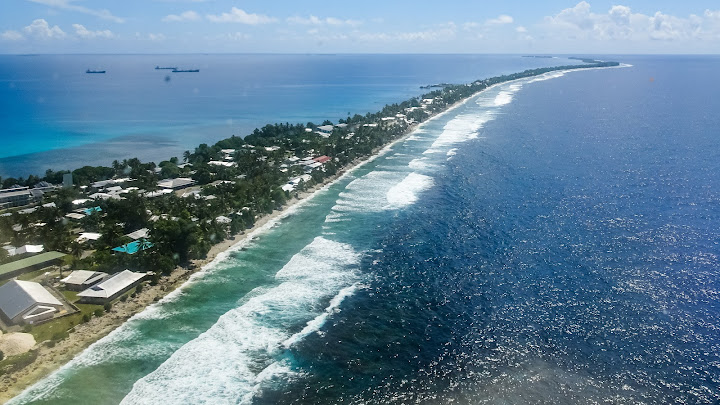
 

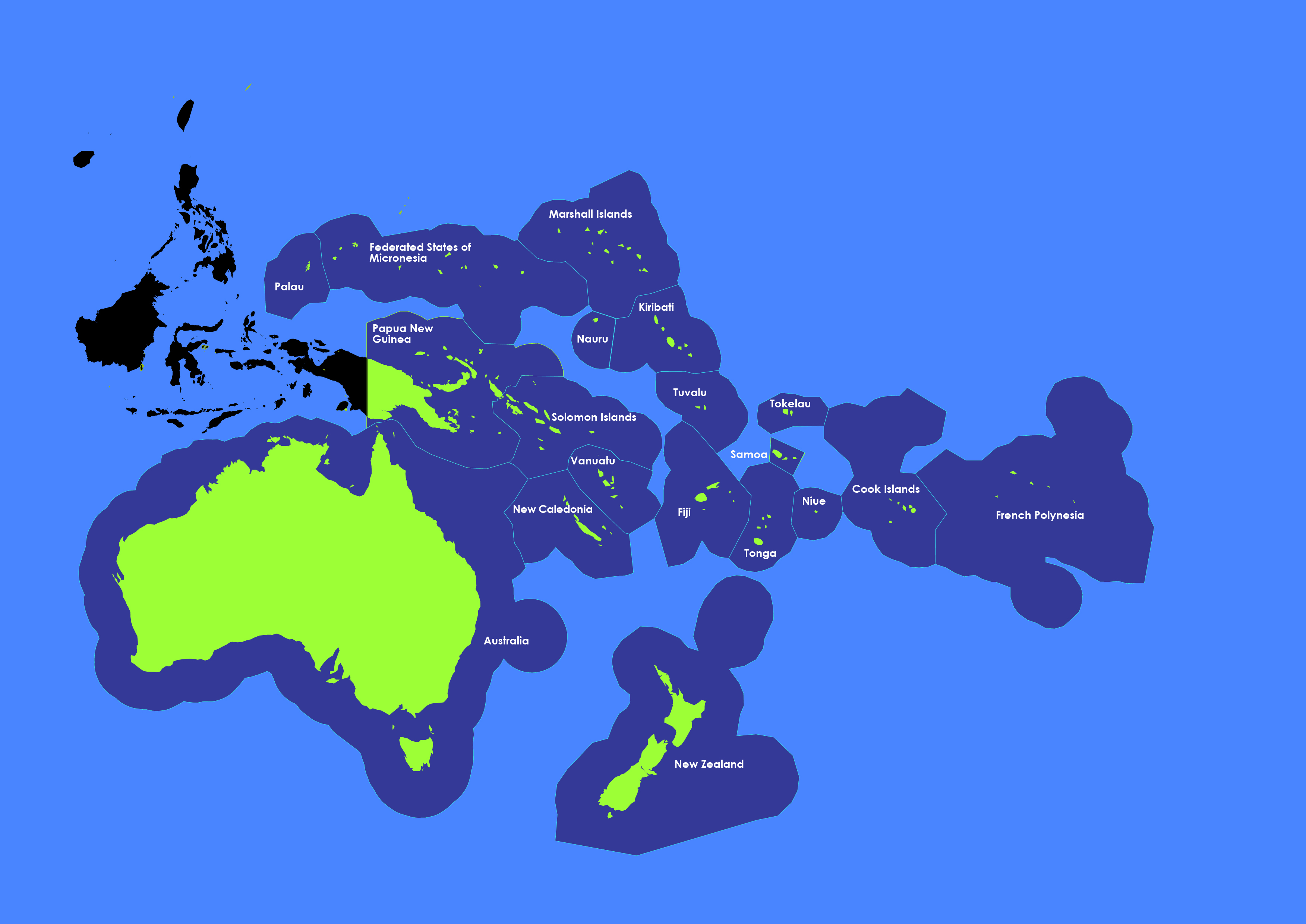
(Above: Tuvalu and Funafuti.  Credit: www.travelsvenue.com)

A major diplomatic statement from the Pacific Island country of Tuvalu has highlighted serious concerns for US-led foreign policy in the Indo-Pacific region, with implications for Australia. It also casts a long shadow on recent high-level diplomatic meetings between Australia and Japan. The recent diplomatic statement, concerning the inevitability of Tuvalu eventually switching its allegiance to China and away from Taiwan, has shown how the egional balance of forces is turning away from traditional US-led hegemonic positions; the very real threat of 'real-war scenarios' is quite apparent.

In early September, former Tuvalu three-time prime minister, Bikenibeu Paeniu, issued a high-level diplomatic statement concerning the country's allegiance to Taiwan. As a former Tuvalu ambassador to Taipei, the statement can be regarded as the outcome of a serious assessment and highly credible. Issued on the eve of the recent Pacific Islands Forum (PIF) it obviously caused raised eyebrows, particularly as it stated the 'tiny country had suffered from its increasingly isolated diplomatic position, and should not be expected to maintain its stance when the rest of the world had fallen into line on the issue'. (1) Taiwan's diplomatic stance, in the face of the universally accepted One China policy at the United Nations, has placed the country alongside only ten other countries; most are virtually insignificant.

Tuvalu, composed of three reef islands and six atolls, nevertheless, remains of huge strategic importance to US-led defence and security provision in Oceania and the wider Indo-Pacific region. Placed midway between Pine Gap, in Central Australia, and the US Indo-Pacific Command in Hawaii, it has been noted as 'an essential player in regional security initiatives … near critical trade routes'. (2) Tuvalu, however, has become increasingly encircled by neighbouring Pacific Island countries (PICs) with strong diplomatic links with Beijing in recent times; the problem has been assessed by the intelligence services as being of medium to high-level alerts for Chinese involvement inside foreign political systems. (3)

Since gaining its independence in October, 1978, Tuvalu has been an active member of the British Commonwealth, with strong diplomatic links to Canberra. In fact, the recent Falepili (Good Neighbour) Union Treaty between the two countries, has enabled citizens of Tuvalu to settle in Australia. (4)

The issue which has come to dominate Tuvalu's political dialogues in recent times has been the ever-pressing problem of global warming and rising sea-levels: its estimated 11,000 citizens have already experienced two islets disappearing beneath the sea, with more to follow in due course. (5) With official government commentary noting that 'our islands are only 3-4 metres above sea-level', the situation has become increasingly fraught. Reliable estimates have established, for example, that by 2050 about half of the capital, Funafuti, home to more than half the country's population, will 'be flooded by tidal waters'. (6)

Tuvalu is, therefore, faced with a desperate race against time, while decision-makers in Canberra and elsewhere remain in a state of denial about climate change and global warming. For those concerned, the issue is nothing other than a political football, pursued without serious and wider considerations, as in the case of Tuvalu.

Tuvalu, in recent times, for example, has received an offer from China to build sea-wall fortifications around the country to prevent rising sea-levels claiming more of the landmass, in exchange for a diplomatic switch to Beijing from Taipei. China has already gained a wealth of experience, elsewhere in the South China Seas, with similar programs; they are regarded by the US as a serious challenge to regional hegemonic positions.

The recent high-level diplomatic meetings between Australia and Japan, had questions surrounding the fate of Tuvalu, and other PICs lurking in the shadows; it was not, however, an official agenda item. While the US-Japan alliance has been upgraded to that of a global alliance, Japan in recent times has been seriously affected by economic and political uncertainty. (7) Its economy has remained stagnant for decades, and while the ruling Liberal Democratic Party (LDP) has virtually ruled the country since 1955, it has recently been forced into a minority government position in both parliamentary houses; its prime minister, Shigeru Ishiba, was forced to recently resign 'in order to avoid splitting the long dominant LPD'. (8) The writing would appear on the wall for Japan.  

In fact, it was not coincidental, therefore, that Ishiba resigned immediately following what was regarded as a successful high-level diplomatic meeting between Australia and Japan with defence and foreign ministers. (9) An official diplomatic statement following the meeting noted 'Japan and China faced geopolitical challenges in the Pacific region'. (10)

Japan, nevertheless, has become increasingly unstable and faces the rise of a far-right Sanseito Party, which has surged to third place by running a popularist Japanese First platform with all the hallmarks of a US-type MAGA campaign. It will, ultimately, lead to an increased political polarisation in Japanese society with far-reaching implications for the LDP and its allies.  In fact, a recent US high-level diplomatic statement has already noted that 'it was up to Australia, New Zealand and the US to keep fighting to win hearts and minds in the region', without even paying reference to Japan. (11) Diplomatic silence?

The Trump presidential administration and the Pentagon appear to have already planned and foisted greater diplomatic and military responsibilities upon Australia:

                                         We need an independent foreign policy!  

1.     'Inevitable' Tuvalu will switch from Taiwan to China, Australian, 11 September 2025.
2.     Tuvalu and its strategic military significance, Website: mexicohistorico.com; and, Map of the World, Peter Projection, Actual Size.
3.     Winded, dined and hectored on Xi's diplomatic conveyor belt, The Weekend Australian, 13-14 September 2024.
4.     See: Australian visa a bittersweet golden ticket to Tuvaluans, Australian, 1 October 2025.
5.     Ibid.
6.     Ibid.
7.     The reasons behind Washington's push for GSOMIA., Hankyoreh, 12 November 2019.
8.     Japanese PM quits after just 11 months, Australian, 8 September 2025.
9.     Ministers' meeting reinforces ties and friendship with Japan, The Weekend Australian, 6-7 September 2025.
10.   Ibid.
11.   'Relentless' China to 'use all avenues', Australian, 17 September 2025.


Tuesday, September 2, 2025

Superpower rivalry and the Pacific Islands Forum

 Written by: (Contributed) on September 2 , 2025


High level diplomatic controversy surrounding the forthcoming Pacific Islands Forum (PIF) in Honiara is best viewed in the context of rivalries taking place with the present Cold War.

The US imperialists are also experiencing serious diplomatic problems with a steadily changing balance of forces across the Pacific with far-reaching hegemonic considerations. Chinese social-imperialism is gaining leverage. Other players, likewise, have been hovering in the wings of the controversy, seeking to side with the US, with stated and non-stated agendas.

On the eve of the forthcoming PIF meeting in the Solomon Islands, a request by China for the regional body to amend a 1992 diplomatic communique concerning the status of Taiwan as a 'development partner', has revealed the changing balance of forces across the Pacific in recent decades. (1) It has followed a controversial decision taken by the PIF last year to delete references to Taiwan in the official 2024 Summit communique. (2)

China, in 1992, was still in the early stages of dramatic capitalist economic development and PIF members were keen to draw the country into their diplomatic spheres. After three decades of economic development, however, China has become the regional economic powerhouse; as a serious competitor to US hegemony, the present Cold War is not ambiguous. It has led to an official diplomatic statement from PIF members, for example, that 'there is no denying that China is trying to extend its footprint in the Pacific and so is the US'. (3)

In fact, an official US congressional study of the rivalry nearly a decade ago concluded that the US were no longer the dominant power in the Pacific. (4) The study noted that 'US military superiority is no longer assured and the implications for American interests and American security are severe … China has also extended its soft power influence in the region … the US and partner countries consider a pincer movement around territory Beijing wishes to control'. (5) Taking GDP growth rates as a yardstick, China's influence grows.

While the Pentagon has extended its Indo-Pacific Strategy with the Pacific being enclosed in its boundaries, China's regional diplomacy has enabled it to already gain access to eighty per cent of the region's Exclusive Economic Zones. (6) While the development has thrown a long shadow on the prospects for deep-water mining for rare earth minerals, it has also raised US concerns about the longer-term security of sensitive regional facilities, including their defence hub based on Guam, linked to Pine Gap, central Australia, and Diego Garcia in the Indian Ocean. (7)  
The balance of forces across the fourteen Pacific Island countries is not difficult to assess.

China, for example, now has embassies in ten Pacific countries and diplomatic recognition in an eleventh; it possesses a major diplomatic presence across the wider region. Taiwan, to the contrary, is struggling to retain even limited diplomatic presence. Only three countries in the region now recognise Taiwan: the Marshall Islands, Palau and Tuvalu.

Taiwan, nevertheless, remains strategic for US regional considerations; it is central to US defence and security policy with island chains. It is regarded by the Pentagon as under threat. Numerous, questionable, intelligence assessments about China's eventual intention to invade Taiwan, therefore, are issued on a daily basis as a cover for US-led militarisation.

Pentagon planning has also included increased military presence with troop rotations in Australia, endless streams of military exercises and the placing of missiles on remote islands along the first island chain. (8) The first island chain consists of groups of small and strategically sensitive landmasses from Taiwan, Okinawa and the Philippines. (9) The fortification of the chain is aimed at restricting China's access into the second island chain in the western Pacific, which runs from Japan to Guam and ends in the south of the region with Indonesia. It is, however, already creaking under the strain of China's competition.

As the Cold War rivalries escalate, the PIF have decided to exclude all 21 'dialogue partners' from the forthcoming Honiara meeting. It has been speculated that China 'was behind the decision to block partners from the forum', by using skilful diplomacy to exclude Taiwan. (10) The move, for example, has left the New Southbound Policy of ruling administrations in Taipei in tatters with its commitment to Taiwanese officials being invited to regional dialogues on the Indo-Pacific. (11)

While the controversy was quietly being discussed in diplomatic circles, a major move by Israel to send deputy foreign minister, Gideon Sa'ar on an official tour of PIF countries, including Papua New Guinea, Fiji, Nauru, Palau, Tuvalu and Tonga, has raised stakes in the US-led diplomatic conflict. (12) The high-level diplomacy was prepared ostensibly to prepare for key votes in the United Nations amongst countries usually backing Israel. The diplomatic tour was accompanied by an official media release which noted, for example, 'the Pacific Island states constitute an important focus of support for Israel across various international frameworks'. (13) Open diplomatic discourse has been a convenient cover.

A far more likely Israeli agenda item, however, will be the selling or upgrading of sophisticated weaponry used by the US in the region, including the fortification of island chains, particularly with radar, signals and intelligence facilities. While Gaza has been the recent testing ground for the Israeli defence sector, its close diplomatic links with the US have shown it a willing contributor to wider hegemonic positions elsewhere. The carefully worded media release, for example, also noted it was 'aimed at deepening and advancing Israel-Pacific relations in a wide range of bilateral, multilateral and strategic fields'. (14)

While Australia has been assured of a place in the PIF meeting it remains to be established what their contribution will be toward the wider diplomatic controversy and Israeli involvement in the Australian defence sector, linked to the latter being a major regional hub for 'US interests', particularly in the Pacific: We need an independent foreign policy!

1.     China's latest Pacific demand makes waves, Australian, 21 August 2025.
2.     Ibid.
3.     Ibid.
4.     Study: U.S. no longer dominant power in the Pacific, Information Clearing House, 22 August 2019.
5.     Ibid.
6.     The reasons behind Washington's push for GSOMIA., Hankyoreh, 12 November 2019; and, US v. China, Japan Forward: Politics and Security, Rieko Hayakawa and Jennifer L. Anson, 14 February 2020.
7.     US v. China, op.cit., 14 February 2020; and, US intensifies military presence in Indo-Pacific, The Global Times (Beijing), 24 July 2018.
8.     US to build anti-China missile network along first island chain, Nikkei, 5 March 2021; and, US Indo-Pacific Command proposes new missile capabilities to deter China, RFA., 5 March 2021.
9.     Ibid.
10.   Australian, op.cit., 21 August 2025.
11.   See: Beijing keeps a wary eye on new US Taipei outpost, Australian, 18 June 2018.
12.   PM 'forever tarnished', Israel looks to Pacific, Australian, 22 August 2025.
13.   Ibid.
14.   Ibid.


Monday, June 9, 2025

US to rely on military means of countering Chinese Pacific presence

 Written by: (Contributed) on 10 June 2025


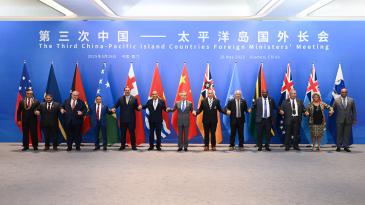
(Above: from China News Service)

Tensions and hostilities between the US and China are set to escalate following the announcement that Beijing hosted some high-level diplomatic meetings in late May. They included meetings with the Pacific Islands, ASEAN and the Gulf Co-operation Council.

The US response included movement of troop elsewhere in the region and claims by the US that China was preparing to invade Taiwan, assessed by the US as a threat to the whole Indo-Pacific region; information emerging from reliable sources has revealed Washington is reassessing various options to deal with the rising power of China.

The options have implications for US regional allies, especially Australia.

In late May the leaders of eleven Pacific Islands had high-level diplomatic talks hosted by Beijing in the eastern city of Xiamen. (1) China announced the regional summit was aimed at fostering closer ties with the Pacific; agenda items included discussions on 'comprehensive exchanges and co-operation … as well as international regional issues of common concern'. (2) China's foreign policy has remained based in mutually beneficial matters which has won increased support from diplomatic partners, with an emphasis upon 'jointly building a closer China-Pacific Island community with a shared future'. (3)

Examples of China's soft-style diplomacy has included a 'suite of new building's' as part of Vanuatu's presidential palace. (4) There are numerous other examples of similar standing:
China's diplomacy has won the country increased support across the Indo-Pacific region, presenting a credible challenge to traditional US hegemonic positions.

One noticeable addition to China's diplomatic moves has been the shift across the region of countries previously recognising Taiwan to China. In recent years Kiribati, the Solomon Islands and Nauru have switched diplomatic allegiance, thereby strengthening China's position at the United Nations. With Taiwan now being officially diplomatically recognised by only a handful of countries it has become increasingly vulnerable and, therefore, a major preoccupation with US regional diplomacy. The official US position is that China has already established plans to invade Taiwan by 2027. There is, however, little credible evidence available in the public domain. A far more likely assessment and scenario is that the US is using it as a pretext for a massive regional military expansion to appease Wall Street and the military-industrial complex.

It is not difficult to establish the hidden hands wringing their greasy mitts in glee behind the US defence department: Pentagon contractors were paid US$108 billion for services they provided in Afghanistan. (5)
  
Taiwan, furthermore, also marks the centre-point of sensitive island chains used by the US to restrict access and egress across the region, at present being enlarged into fourth and fifth chains across the Indian Ocean.

The Pacific Islands diplomatic meetings were quickly followed by a further round of similar meetings with the ten ASEAN countries which also included the Gulf Co-operation Council, composed of Bahrain, Kuwait, Oman, Qatar, Saudi Arabia and the United Arab Emirates.(6) An official diplomatic statement about the meeting noted 'these engagements reflect how ASEAN, the GCC and China can come together to advance their shared economic interests'. (7) It was also noted that ASEAN and the GCC 'were emerging economies in Asia, important members of the global south, and important partners in the Belt and Road co-operation'. (8) China's diplomatic influence can be seen to have moved into countries historically associated with US diplomatic hegemony, with relative ease.

Recent ASEAN diplomatic initiatives have also included moves toward incorporating both East Timor and PNG as full members; both countries have, historically, been closely associated with Australia as a regional hub for 'US interests'. (9)

The China-led diplomatic initiatives have shown their skilful nature toward dealing with the US, which has been increasingly forced out of similar initiatives. In fact, at a time when countries across the global south have proved both resilient and robust in the face of US-led challenges with the threat of tariffs, Washington has become increasingly isolationist while pushing its America First agenda. China has filled the vacuum.

The US response to these recent developments was two-fold: an announcement they were considering moving 4,500 troops from South Korea (ROK) to elsewhere in the Indo-Pacific and calling upon Australia to increase its defence budget while drawing attention to the vulnerability of Taiwan.

Both announcements are best viewed in the context of preparations for a US-led regional war.

The US has, historically, maintained troop numbers in the ROK at about 28,500. Many of the military personnel remain in the country for lengthy periods, indicating specialist positions in various capacities, including signals intelligence (SIGINT). Based in the interception and analysis of telecommunications, SIGINT has a long and secret history of espionage; shadowy spooky figures operating on the margins, monitoring the centres of societies. (10) Detailed studies of SIGINT operational inside the elite Five Eyes intelligence-sharing network, for example, reveal civil liberties for ordinary people have already largely disappeared with the introduction of hi-tech equipment by governments. (11)

It is not particularly difficult to establish where the US are considering placing their SIGINT specialists. Earlier in the decade the Pentagon established a Pacific Deterrence Initiative based on a 'network of precision-strike missiles along the so-called first island chain'. (12) The initiative is now well under-way, with additional 'integrated air missile defence on the second island chain'. (13)

The proposals, which have yet to be ratified by the White House, have included official statements from the Trump administration about their intention of 'bolstering the second island chain'. (14)

Secondly, US Defence Secretary Pete Hegseth, has called upon Canberra to drastically increase defence spending from the present 2.02 per cent of GDP to 3.5 per cent. No reason was forthcoming from the Pentagon about the magic number of 3.5 per cent of GDP, or how the extra funding should be allocated. It has, however, tended to follow a trend of frequent outbursts of speculative and erratic behaviour by the entire Trump administration, reflecting diplomatic behaviour falling well short of being regarded as professional and competent.

The US Defence Department, with a budget of nearly US$ 1 trillion, with 1.3 million active duty personnel and a further one million civilians, for example, has been described by informed and reliable observers as being both chaotic and dysfunctional. (15) It is not difficult to establish why the Pentagon is experiencing such problems; Hegseth is well known as an alcoholic. (16)

Australia, in fact, when compared to its four other partners inside the Five Eyes, already has an average defence budget:

                                               Defence Spending as % of GDP

                                                              US  -  3.4
                                                              UK  -  2.3
                                                     Australia  -  2.02
                                              New Zealand  -  1.31
                                                       Canada  -  1.3
                                                           Total  =  10.33
                           
                                          10.33 divided by 5 = 2.066  (17)

In conclusion, there is no need for Australia to increase its defence budget:

                                          We need an independent foreign policy!

*****
                                                                                           
1.     China to host Pacific leaders summit, Australian, 22 May 2025; and, China to host Pacific Islands leaders, seeking closer ties, AFP., 21 May 2025.
2.     Australian, ibid., 22 May 2025.
3.     Ibid.
4.     See: China builds a new presidential palace in Pacific's Vanuatu, AFP., 2 July 2024.
5.     Pentagon contractors in Afghanistan pocketed $108 billion over 20 years, change.org., 23 August 2022.
6.     Jakarta calls on ASEAN to make PNG a member, Australian, 28 May 2025; and, South-east Asian leaders meet to talk tariffs, truce and East Timor, Australian, 27 May 2025.
7.     Australian, ibid., 27 May 2025.
8.     Ibid.
9.     Australian, ibid., 27 May 2025; and, Australian, op.cit., 28 May 2025.
10.   Espionage, Spies and Secrets, Richard M. Bennett, (London, 2003), SIGINT, pp. 283-84.  
11.   See: Spyworld, How the C.S.E. spies on Canadians and the world, Mike Frost, as told to Michel Gratton, (Toronto, 1995).
12.   US to build anti-China missile network along first island chain, Nikkei/Asia, 5 March 2021.
13.   US Indo-Pacific Command proposes new missile capabilities to deter China, RFA., 5 March 2021.
14.   US bolsters 'second island chain', Nikkei/Asia, 1 April 2025.
15.   'Chaos' and 'dysfunctional' reign inside Pete Hegseth's Pentagon, ABC News, 22 April 2025.
16.   Pete Hegseth's Secret History, The New Yorker, 26 January 2025.
17.   Defence Spending as % of GDP., Stockholm International Peace Research Institute, 2024.


Tuesday, April 1, 2025

Kiribati and China deepen ties

Written by: (Contributed) on 2 April 2025


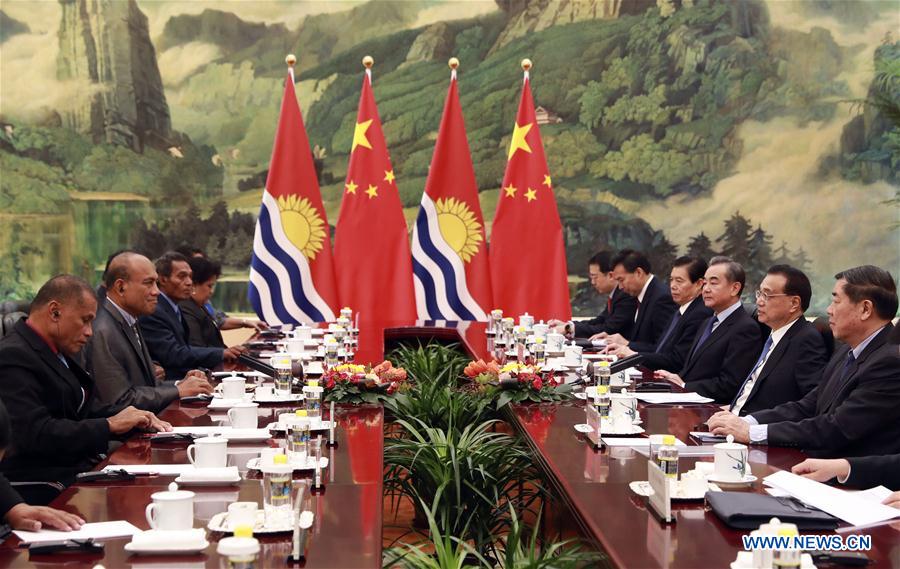
(Above: Chinese and Kiribati leaders in Beijing in 2020   Source Xinhua)

Moves by Kiribati to negotiate a deep-sea mining deal with China have closely followed similar moves by the Cook Islands. The moves have taken place against a backcloth of underlying trends in the global economy and a changing balance of forces, with far-reaching implications for US hegemony. The two tiny Pacific Island countries have, for example, geo-strategic significance for US-led regional military and security provision.

In mid-March, Kiribati, a tiny Pacific island with 130,000 residents, announced it had initiated high-level diplomatic talks with China about securing a deep-sea mining partnership of a vast area surrounding the country. (1) The seabed deposits of cobalt, nickel and copper are regarded as 'key minerals for the global battery industry'. (2)

Kiribati, furthermore, has a huge Exclusive Economic Zone (EEZ) covering 3,437,132 square kms, in comparison to its total landmass of only 811 square kms, ensuring the former is 4,238 times larger than the latter. (3)

In fact, concerns have been expressed in US-led commentary that by switching their diplomatic allegiance to China from Taiwan, small Pacific Island states have provided China with diplomatic access to about 80 per cent of the Pacific Ocean. (4)

Many of the small islands also have a significant role in US-led regional defence and security provision; the Pentagon began a six year and $27.4 billion upgrading plan in 2021 to establish a network of precision-strike missiles along island chains in what was described as the 'Indo-Pacific theatre'. (5) The US-led military plan has also included provision for a 'fielding of an Integrated Joint Force with precision-strike networks … and integrated air missile defence'. (6)

The fact that Kiribati is half-way between Pine Gap and the US Indo-Pacific Command in Hawaii reveals its sensitive geo-strategic position. (7) The Cook Islands, likewise, rests on similar sensitive arcs between US military facilities.

Decades of relative neglect during the previous Cold War by the US toward the Pacific sland nations and neo-colonial relations, however, assured they were 'sovereign and independent in appearance only'. (8) It was the golden age of US imperialism; in fact, the official position of the US during the period was stated clearly by John Foster Dulles, US Secretary of State, 1953-59, as 'there are two ways of conquering a foreign nation. One is to gain control of its people by force of arms; the other is to gain control of its economy by financial means'. (9) That US hegemonic regional position has now become history.

The rise of China, particularly in the Pacific region has already seriously challenged US hegemony; even US analysts in Washington have concluded that the US is no longer the dominant power in the Pacific. (10) The US have been quietly pushed aside.

The changing balance of forces has been verified with economic data from within the corporate world itself; figures quoted by the World Economic Forum (WEF) in 2008 noted that while the US held about one-third of the world's financial assets with $56.1 trillion and the emerging market economies held $23.6 trillion, the latter were growing at twice the rate of the former. (11) The economic growth of the latter has also taken place with a multiplier effect.

Trade bodies, including the BRICs, have emerged as strong contenders in the global economy, particularly as they expand their membership into other areas of the world, including the Middle East. Studies of the expansion have concluded the emerging markets were collectively averaging nearly six per cent growth rates, with China and India together with 28 other countries, leading the way. (12) ASEAN, likewise, has also emerged as an influential trade bloc, with strong collective growth rates.

The US, however, has failed to reach the same growth rates; in fact, following a high-spot in the mid-1960s, their economy has hovered around two per cent growth rates for decades. (13) The problem has become a major factor behind the recent political turmoil surrounding the Trump administration and their financial advisers; they are in panic mode and frantic to deal with China, by whatever means they regard as warranted, including real-war scenarios.

The move by Kiribati to foster stronger links with China, therefore, is best assessed in the context of a subsequent changing balance of forces away from traditional US hegemonic positions. Chinese social-imperialism, in pursuing a policy promoted as supporting mutually beneficial trade and financial support, has presented a credible challenge to US diplomatic positions with tiny, and seemingly, forgotten countries, previously assessed by Washington as barely significant.

As a result of Kiribati pursuing closer links with China, its link with regional partners, Australia and New Zealand, have been noted to 'have become strained … there has been a … tectonic shift in the region'. (14) The fact that Australia's aid budget for developmental assistance has now dropped from 1.2 per cent of the federal budget to a mere 0.68 per cent remains a factor when studying the Pacific Island countries. (15)

Governments across the Pacific are now clearly looking at alternatives to traditional US-led support. More are likely to follow the lead of both Kiribati and the Cook Islands.

It is important to note that moves by the Kiribati government have also fostered some economic development in favour of the more vulnerable sectors of society in recent times. A recent government study noted poverty rates amongst the elderly, unemployed and disabled had been slashed by seventy per cent. (16)

1.     See: Kiribati floats Chinese deep-sea mining deal, Australian, 19 march 2025.
2.     Kiribati explores deep-sea mining deal with China amid global regulatory talks, The Investing News Network, 20 March 2025.
3.     China now controls 80% of the Pacific EEZ; US v. China, Japan Forward: Politics and Security, Rieko Hayakawa and Jennifer L. Anson, 14 February 2020.
4.     Ibid.
5.     US to build anti-China missile network along first island chain, Nikkei, 5 March 2021.
6.     US Indo-Pacific Command proposes new missile capabilities to deter China, RFA., 5 March 2021.
7.     See: Peters Projection, World Map, Actual Size.
8.     See: The plunder of the poor nations, Why are they poor? in The Enemy – Notes on Imperialism and Revolution, Felix Greene, (London, 1970), Chapter 4, pp. 135-151.
9.     Quoted, ibid., page 139.
10.   Study: US no longer dominant power in the Pacific, Paul D. Shinkman, Information Clearing House, 22 August 2019.
11.   Davos salutes SWFs in a celebration of global capitalism, Australian, 29 January 2008.
12.   'Nearly 6% growth', The Economic Times, 25 April 2024.
13.   US GDP growth rate, 1961-2025, Macrotrends.
14.   Pacific nation of Kiribati explores deep-sea mining deal with China, Radio Free Asia, 17 March 2025.
15.   Marles' $1bn snub for Trump, Australian, 25 March 2025.
16.   Kiribati's targeted support slashes poverty by 70%, The Tarawa Times, 19 March 2025.

Monday, September 2, 2024

Pacific Islands Forum beset by problematic scenarios.

 Written by: (Contributed) on 3 September 2024


The officially stated agenda of the Pacific Island Forum (PIF), 2024, hosted by Tonga, was couched in various criteria and concerns relevant for their eighteen member countries. Other US-led considerations were not, however, openly publicised, and subject to official diplomatic silence.

Specific issues arising from a US-led agenda, nevertheless, proved difficult for them to hide amidst their regional Indo-Pacific defence and security provision and escalating diplomatic hostilities with China.

The 2024 PIF took place during the last week of August in a region racked with US-led diplomatic hostilities toward China. The influential Pacific body, nevertheless, issued briefly stated agenda items couched in language designed specifically to not create division within the organisation and a regional environment fraught with problems. (1) Recent developments have been important: the Pacific, historically, was regarded by the US as a backwater; a multitude of small islands and countries with low levels of economic development that did not attract much diplomatic attention from Washington and the Pentagon. (2) There was not much of an assessed threat to 'US interests' and hegemony.

The rise of China as a serious regional and global competitor to traditional US hegemonic positions, however, has resulted in the US increasing their defence and security provision following revelations from a US Congress commission in 2019, 'that the US is no longer clearly superior to the threats it faces around the world … and the US … would struggle to win a conflict against China'. (3)

The enlarged Indo-Pacific region has also been subdivided by the US into island chains planned to restrict China's access and egress across the wider region, with newer plans in place to add fourth and fifth chains across the vast Indian Ocean. 

The issue of Taiwan and its recognition by some PIF member countries has also remained a pressing and divisive consideration. Three Micronesian countries, Tuvalu, the Marshall Islands and Palau, officially recognise Taiwan, with full diplomatic links. Other PIF member countries across Polynesia and the South Pacific recognise China.

An attempt by the Solomon Islands to exclude Taiwan proved unsuccessful, although revealed deep divisions inside the PIF, which also have direct bearing upon US Island Chain Theory. Taiwan, which hosts a large clandestine US diplomatic presence, marks a central position with the first and second chains, restricting China's ability to openly access and have egress with Oceania. (4) The fact Oceania includes Australia and New Zealand, two member countries of the elite Five Eyes intelligence-sharing network, reveals the importance of ICT for the Pentagon's military planning.

Moves by the US to push the Philippines into a central role with hostilities toward China in the South China Seas, likewise, has some direct bearing upon the PIF. (5) About twenty per cent of Palau's tiny population are ethnic Filipinos. (6) Elsewhere, across the PIF member countries, large number of Philippine guest workers provide essential services. All PIF member countries have large Chinese ethnic minorities, some with several centuries of standing; the US-led Cold War has had serious implications for the Pacific.

The 2024 PIF, therefore, has taken place in a regional environment which can best be described as problematic. PIF member countries, for example, acknowledge climate change is an issue of central importance, and the UN secretary-general Antonio Guterres attended the forum 'to demand fresh efforts by the world's biggest carbon emitters to phase out fossil fuels … with outcomes including … extreme weather events from raging tropical cyclones to record ocean heat-waves'. (7) Guterres, in fact, used the PIF opening ceremony to propose a ' fossil fuel-free Pacific … as a … blue-print for the world. (8)

A diplomatic statement issued by Fiji in June contained a warning for PIF member countries with 'poly-crisis in which climate change, human security, trans-national crime, and geopolitical competition were reinforcing and exacerbating one another'. (9)  

The US, meanwhile, represented by Kurt Campbell, Deputy Secretary of State and well-known China hawk, did not even bother to openly discuss the PIF diplomatic statements; the US had other agenda considerations, 'as Washington moves to strengthen engagement with Pacific nations'. (10) While the US placed great emphasis upon diplomatic recognition of 'the centrality of the grouping to the region's future in recent AUSMIN talks in Washington'; the US position can hardly be regarded as diplomacy in good faith. (11) It is little other than an attempt by Washington and the Pentagon to maintain the Pacific as a region of 'US interests', marked by political interference and neo-colonial economic relations. The region is rich in natural resources and mineral deposits, including rare earths.

It is, however, the manner in which the US has pushed its Indo-Pacific Strategy (IPS) into the Pacific that has become a major diplomatic issue for PIF member countries. Silence has prevailed. The moves, however, have been accompanied by a massive US-led upgrade and build-up of their presence in northern Australia. 'Australia … it has been officially announced in Washington … has become the central base of operations for America's military … a recently announced boost to US bomber deployments to Australia's Top End bases would enable America to project power across the region'. (12) The moves have also been accompanied by proposals to upgrade US troop rotations in northern Australia from the existing 2,500 a year, to a 'full expeditionary force of 16,000 personnel'. (13)

Marked by the elevation of Japan as a major global US alliance partner, the IPS rests upon the so-called 'Quad', consisting of the US, Japan, Australia and India; China has been effectively hemmed in from all sides. (14) The recent incorporation of the Philippines into the IPS on the basis of a lower-level partner was marked by references to military-to-military engagement and a 'defensive web of partners and allies'. (15)

PIF member countries have been watching these developments with a sense of unease; they stand to be drawn into escalating US-led diplomatic rivalries with China, which remains their largest and most important trading partner.

Recent developments in Palau, for example, reveal just how high the stakes have become for the US in the Pacific.

Palau, with a population of 18,000 spread across five hundred small islands and atolls, is directly linked into US diplomacy through the Compact of Free Association (CFA) together with the Marshal Islands and the Federated States of Micronesia. Palau has huge strategic significance for the Philippines, marking the boundaries of the Philippine Sea which are contested by China and patrolled by US marine forces responsible for security provision.

A recent decision by the US to use Palau for an 'over the horizon' radar system designed to be fully operational in 2026, has been accompanied by the upgrading of local airfields across the Pacific. (16) The $120 million system is composed of Receiver and Transmitter terminals, based in the northern part of Palau in Babeldaos and in the south at Angaur, at opposite ends of strategic island chains.(17)

The new Palau radar system also forms part of a matrix linked to Guam and the Northern Mariana Islands, two hubs for 'US interests'. The former is then linked directly to US intelligence facilities based in Pine Gap, Central Australia which swings on an arc to Diego Garcia in the Indian Ocean; Guam and Diego Garcia have been upgraded as hubs for military operations, Darwen, in northern Australia, is the support centre. (18)

All US defence and security 'hubs' are correspondingly linked to 'spokes', their formation extending the power of the US deeper into the Pacific and Indian Ocean, enhancing their IPS. (19) There is little ambiguity about the role of the IPS facilities based in Palau; it has already been noted it has been designed to boost the US role in the Pacific. (20)  

While it has been noted there has been political opposition to the new US facilities in Palau, it is also important to note Australia has provided a significant role for the establishment of US-led regionally controlled intelligence facilities, including the IPS:

                                       We need an independent foreign policy!


1.     See Website: Pacific Islands Forum, Release: 12 April 2024, Joint Media Release: Tonga, 10 April 2024; and, China proxy pushes Taiwan ban, Australian, 26 August 2024.
2.     See: Pacific Forum, The US Indo-Pacific Strategy, 23 February 2021.
3.     Study: US no longer dominant power in the Pacific, Information Clearing House, 22 August 2019.
4.     See: Beijing keeps a wary eye on new US Taipei outpost, Australian, 18 June 2018.
5.     South China Sea raises fear of a super-power war, Australian, 21 August 2024.
6.     Philippines vows to resolve maritime dispute with Palau, The Philippine Star, 24 September 2021.
7.     Australian, op.cit., 26 August 2024.
8.     ALP gas plan irks Pacific leaders, Australian, 28 August 2024.
9.     Australian, op.cit., 26 August 2024.
10.   Ibid.
11.   Ibid.
12.   Deterrence starts at the Top (End), The Weekend Australian, 17-18 August 2024.
13.   Call to boost US marines' presence in Top End, Australian, 7 August 2024.
14.   See: The reasons behind Washington's push for GSOMIA., Hankyoreh, 12 November 2019.
15.   Manila adds to its security network, Australian, 26 July 2024.
16.   See: US missile defence proposal, Reuters, 21 December 2023; and, US plans, RFA., 1 November 2023.
17.   A new radar installation in the Pacific, Popular Science, 5 January 2023; and, RFA., ibid., 1 November 2023.
18.   See: Peters Projection, World Map, Actual Size; and, US intensifies military presence in the Indo-Pacific, The Global Times (Beijing), 24 July 2018.
19.   Palau-based radar, Geo-Indo-Pacific, 27 July 2024.
20.   Reuters, ibid., 21 December 2023.


Tuesday, August 29, 2023

Vanuatu: Military Exercises and Real-Life Dramas


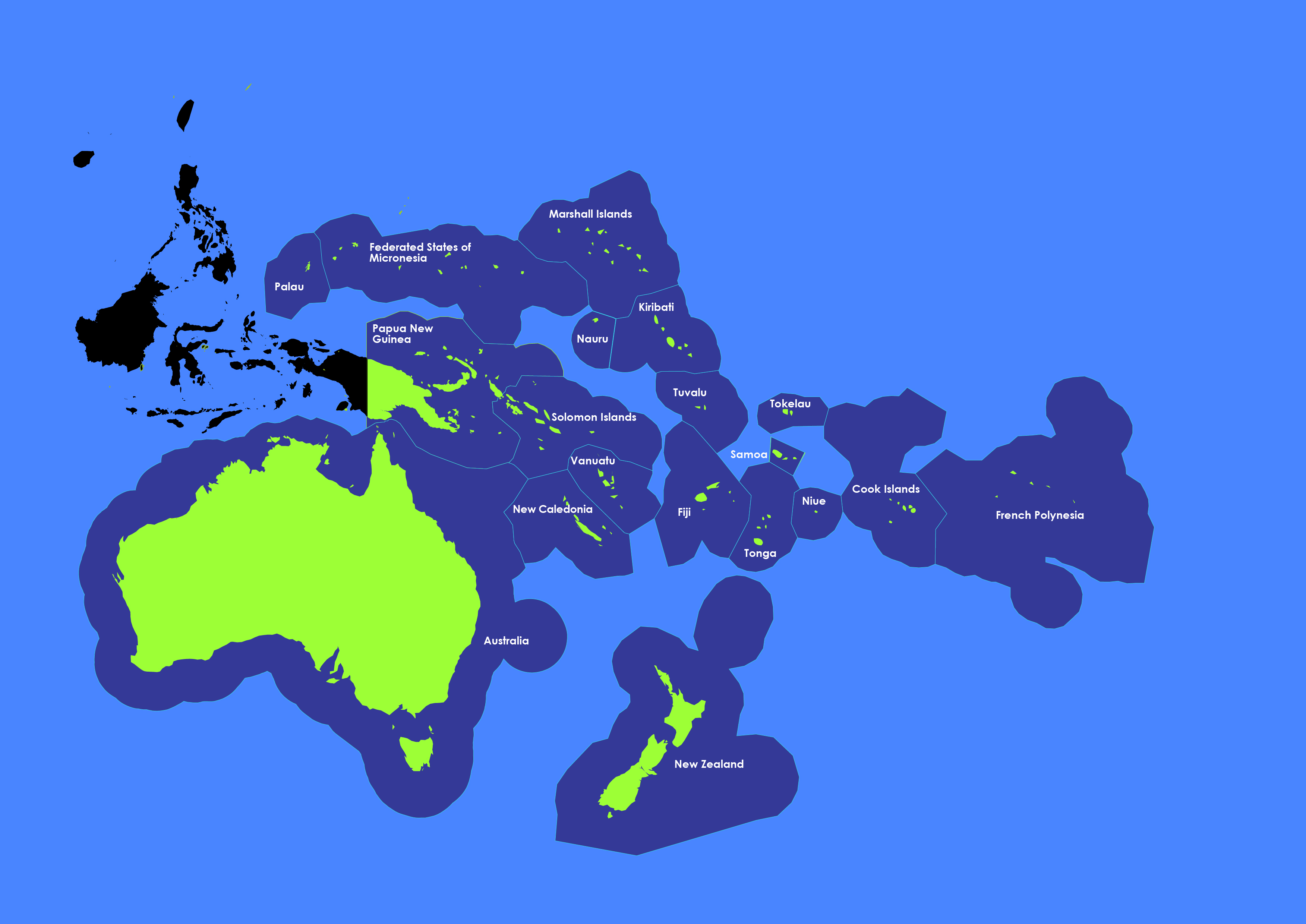
Google Maps/Christopher Woody


Written by: (Contributed) on 30 August 2023

While the recent Exercise Predators Run was under-way in the Northern Territories, a real-life drama was being played-out in Vanuatu. The exercise was planned to prepare countries allied with the US Indo-Pacific Strategy (IPS) for military conflict in Australia's immediate northern region: the political crisis in Vanuatu, likewise, provided a vivid example of how diplomatic tensions can, potentially, escalate into real-war scenarios at quick notice, with far-reaching implications. It has also showed how the US-IPS is a military plan and part of US foreign policy toward the vast region, which has little scope, or any intention, of respecting the sovereignty of other countries.

During late August the twelve day Exercise Predators Run began, with a bare minimum of publicity. In fact, it was only publicised following the deaths of three US military personnel on Melville Island, about seventy kilometres north of Darwin. The military exercise, however, has been noted as a large-scale war-game with more than 2,500 troops from countries which form part of the US IPS: the US, Australia, The Philippines, East Timor and Indonesia, with land, sea and air military personnel. (1)

The exercise followed the recent Exercise Talisman Sabre, which was widely publicised.

The latter exercise and military planning was specifically concentrated upon the area of the region to the immediate north of Australia, and would appear to have been regarded by the Pentagon as sensitive. (2) A brief official media release about the exercise noted, for example, 'it aims to replicate a joint allied response to amphibious conflict to Australia's immediate north. It is one of a growing number of military exercises to prepare the ADF and allies for potential conflict'. (3) The exercise would, nevertheless, appear an important component part of the wider US-IPS, in the southern area of the region where Australia has the designated role of a major hub for 'US interests'. (4)

Situated from about 115 degrees east, to about 155 degrees east, the northern approaches of Australia include: the countries of the South Pacific, Indonesia, The Philippines, the South China Seas, and sensitive areas of the wider Pacific including Guam, which in turn is linked to Diego Garcia in the Indian Ocean on an arc from US intelligence facilities based in Pine Gap. The northern part of Australia is also littered with numerous military facilities, including: 1st Combat Signals, Darwin; 1st Signals, Brisbane; 3rd Signals, Townsville; Electronic Warfare, Cabarlah, Queensland. (5) Australian Defence Force military facilities at the Lavarack Barracks, Townsville, also host the 141st Signals Squadron together with numerous other sensitive and training units which were expanded during the previous Cold War due to conflict in South-East Asia. (6)

The new US-led Cold War with China has drawn heavily upon regional frameworks established decades ago, including those in Australia.

Moves by the US to establish the new Cold War included the re-use of numerous military facilities across the region, which were largely abandoned decades before, following the end of the Vietnam War. The re-use, however, has not involved large-scale military facilities, but emphasis is placed upon countries hosting temporary US presence, on a rotational basis. (7)

It is important to note, therefore, that initial US troop rotations through Australian facilities amounted to about two hundred in 2011, to 2,500, at the present time. (8) Similar increases have taken place elsewhere across the Indo-Pacific, as part of waves of US-led militarism.

The beginning of Exercise Predators Run also coincided with a regional diplomatic summit hosted by Palau which included the signing of a security pact for PNG, the Solomon Islands, Vanuatu and Fiji, with Australia. There was, again, a minimum of official publicity although a Joint Communique issued by the Defence Department, did, nevertheless, note the pact included, 'co-ordination … amongst … regional security agencies … to address multi-dimensional security challenges'. (9) The economic use of language conveyed a certain type of diplomacy, aimed at being transparent as a matter of expedience, although circumspect.

But then, even the best made of plans taking place in relative secrecy, can go astray.

Within days of the signing of the pact, M.P.s in Vanuatu crossed to floor to side with opposition figures who subsequently won a vote of no confidence against Prime Minister Ishmael Kalsakau, following opposition leader Bob Loughman lodging a petition against the government, 'for signing a security pact with Australia … with the claim … the security pact with Australia compromised Vanuatu's neutral status'. (10)

DFAT here in Australia are keeping a very low profile about the whole matter.

The fact the successful vote of no confidence took place in the middle of a highly strategic US-led military exercise is evidence in itself of hidden hands in a troubled diplomatic environment.

While the matter rests with the Supreme Court in Port Vila, it has been noted that Vanuatu has become the 'centre of strategic rivalry between China and western countries'. (11)

And then the following day China deployed their police to Vanuatu to support counterparts: the deployment took place under a diplomatic provision established between Vanuatu and China last year, with a five-point agreement designed to 'deepen strategic co-ordination … and regional co-operation'. (12)

It remains highly significant to note the developments have taken place with the bare minimum of publicity, although present Australia with a major defence and security problem
in the South Pacific. Acting on behalf of the US and their IPS, Australia has also been seen to have been drawn into the very real likelihood of real-war scenarios and to have complied with the US line of little, or no, respect for the sovereignty of countries such as Vanuatu:  

                                         We need an independent foreign policy!

1.     The deadly cost of rising to challenge China aggression, Australian, 28 August 2023;  and, 3 US marines killed, Boston.com., 27 August 2023.
2.     Australian, ibid.
3.     Ibid.
4.     See: The reasons behind Washington's push for GSOMIA., Hankyoreh, 12 November 2019.
5.     Wikipedia.
6.     Ibid.
7.     See: US eyes return to south-east Asian bases, The Guardian Weekly (U.K.), 29 June 2012; and, US signs defence deal in Asia, The Guardian Weekly (U.K.), 2 May 2014.
8.     Australian, op.cit., 28 August 2023.
9.     Australian Government, Defence, Joint Communique, Meetings, 23-24 August 2023.
10.   China sends police experts to Vanuatu amid political crisis linked to Australian Pact, The New Daily, 27 August 2023.
11.   Ibid.
12.   China, Vanuatu reach five-point consensus, China.org.en., Xinhua, 2 June 2022; and, Chinese police experts, Radio New Zealand, 27 August 2023.


Tuesday, July 25, 2023

Superpowers court PNG, Solomon Islands as regional tensions intensify


Written by: (Contributed) on 26 July 2023

An announcement from Port Moresby that the PNG Defence Force were considering establishing an elite military grouping has raised concerns about wider issues arising in the South Pacific. The small area to the north of Australia remains riven with ethnic and inter-ethnic rivalries, exacerbated by fierce hostility with US-led regional operations directed toward perceived Chinese influences, particularly in the neighbouring Solomon Islands.

In mid-July the PNG government in Port Moresby announced it was seriously considering establishing a special operations force modelled on the British Gurkha regiment. (1) British defence officials had already had formal meetings with their PNGDF counterparts on the basis that PNG 'struggles to strengthen its armed forces at a time of increased tension in the region between China and the US'. (2) It was noted the 'South Pacific has become a theatre for strategic competition between the US and China' (3)

The Gurkhas, historically, have been associated with elite military traditions and jungle warfare; in May PNG signed a Defence Co-operation Agreement with the US, paving the way for US forces being exempt from taxes and criminal prosecution, unimpeded and rent-free access to bases in PNG, and stationing troops and equipment for deployment. (4) The move forms part of the stated intention of PNG to increase the size of the PNGDF from the present 3,650 personnel to 10,000 by 2030, together with a reservist force of an extra 3,000 personnel. (4)

The moves coincided with a bi-partisan diplomatic statement from the Biden administration that, 'NATO's expansion into the Asia-Pacific region … was … inevitable, arguing that the AUKUS security pact, of which Australia is a key member, is the first step into turning the growing military into a global bulwark against China and Russian power'. (5)

The moves, however, are far from straightforward: France, for example, vetoed a push by some NATO members in June to open a diplomatic office in Japan to increase liaison with Indo-Pacific nations. (6) While the reasons explaining France's diplomatic decision were merely noted as, 'a big mistake … amid concerns it could antagonise Beijing', a far more likely explanation was that France retains major diplomatic links with Vanuatu as a former part-colonial power, New Caledonia and the wider Polynesia. (7) The Macron presidential administration does not want outside interference in what they regard as essentially their French regional interests. 
 
The fact that Japan was chosen for the NATO office would also indicate the recent moves rest upon the US-led Indo-Pacific Strategy (IPS) whereby the US-Japan alliance has been upgraded to a global alliance, resting upon the so-called 'Quad' composed of the US, Australia, India and Japan. (8) The IPS also has lower-level partners, including South Korea, Taiwan, Singapore, Vietnam and others. (9) Whether PNG has now been included remains to be verified, although its defence agreement with the US in May would tend to indicate the decisions have already been taken with this goal in mind.

PNG has, historically, been the dominant player in the South Pacific due to its size and population: it has about 10 million people compared to the Solomon Islands 611,340, and Vanuatu only 307,815. PNG has also been a dominant player inside the British Commonwealth. Moves, by the US, to expand their IPS, have to be assessed in this light. And the fact the Solomon Islands does not even have its own defence force, likewise, is also an important consideration. The Solomon Islands relies upon its police force for defence and security provision, and outside assistance, if required.

Under these circumstances it is not particularly difficult to establish the fraught nature of Australia-Solomon Islands diplomacy. The Solomon Islands has been noted as of 'vital strategic importance to Australia'. (10) There is little doubt, however, that the US are pulling the strings as a puppet-master: while Sogavare was visiting Beijing, the US National Security Council raised the matter as a concern. (11) The Solomon Islands would appear to be regarded by the US intelligence services as a country of some considerable interest.  

The recent visit by Solomon Islands Prime Minister Manasseh Sogavare to Beijing, therefore, also saw diplomatic tension between Honiara and Canberra escalate: while in Beijing, Sogavare signed nine agreements with China, which Australia have requested are published immediately. It was noted with alarm, from Canberra in the meantime, that 'exact details are yet to be disclosed'. (12) Fears exist that while the Solomon Islands have discussed the prospect of creating their own army with Canberra, Honiara also has a defence agreement with China, which may complicate the matter. (13)

Those inside the corridors of power in Canberra would appear to have forgotten the Solomon Islands are a sovereign independent state, as ratified by the United Nations, not a neo-colonial outpost from yesteryear ruled by the Australian Colonial Administration. The continued response from Canberra has also been symptomatic of the colonial and Cold War politics of yesteryear, and has left little to the imagination: two editorials in Murdoch’s the Australian, for example, have portrayed Sogavare as seemingly an agent of influence; one was titled 'Sogavare kowtows to Beijing', and the other included references to 'Prime Minister Manasseh Sogavare has been singing from the Chinese Communist Party's anti-Australia songbook'. (14)

Such diplomacy and media comment would hardly qualify as professional or conducive to harmonious relations between Australia and the wider South Pacific. It would, to the contrary, be typically symptomatic of US-led Cold War positions, based upon neo-colonial relations.

                                        We need an independent foreign policy!

1.     PNG, UK discuss 'Gurkha' regiment, Australian, 14 July 2023.
2.     Ibid.
3.     Ibid.
4.     We won't be pawns in global game: PNG., Australian, 18 July 2023.
5.     PNG, UK discuss 'Gurkha' regiment, Australian, op.cit., 14 July 2023.
5.     NATO sets sights on Asia-Pacific, Australian, 18 July 2023.
6.     Ibid.
7.     Ibid.
8.     The reasons behind Washington's push for GSOMIA., Hankyoreh, 12 November 2019.
9.     Ibid.
10.   China-Solomons pact 'wake-up call', Australian, 17 July 2023.
11.   China, Solomon Islands sign policing pact in upgrade of ties, Reuters, US News, 10 July 2023.
12.   Sogavare hits Canberra over budget delay, Australian, 18 July 2023.
13.   Ibid.
14.   See: Sogavare kowtows to Beijing, Editorial, Australian, 13 July 2023; and, Sogavare rant is fooling no one, Editorial, Australian, 19 July 2023.