Friday, February 18, 2022

Commemorating 80th Anniversary of Japan’s Bombing of Darwin


Written by: Nick G. on 19 February 2022

February 19, 2022 marks the 80th anniversary of Japan's attack on the Australian city of Darwin. Hundreds were killed (see Darwin Maritime Union memorial, below), and ships in the harbour sunk. A second raid the same day targeted the nearby Air Force airfield.

The Japanese had resorted to war to seize from the major European powers – England, France and Holland – Asian and South-east Asian sources of raw materials, colonial labour-power, and markets. They challenged US imperialism for control of the Pacific as a major sphere of influence.

At the time, Japanese imperialism was still engaged in an attempted war of conquest against China where resistance forces led by the Communist Party were tying down millions of Japanese troops who would otherwise have been freed to fight Australians on Australian soil.

Following the initial bombing of Darwin, raids increased and the Japanese sought other targets. Two weeks later, Japanese planes attacked Broome, killing more than 70 people among whom were Dutch refugees who had just been evacuated by flying boat from the Dutch East Indies (later Indonesia). 

On 31 May 1942, three Japanese midget submarines entered Sydney Harbour. Twenty-one sailors died when the Japanese torpedoed the HMAS Kuttabul. In June 1942 a submarine shelled the eastern suburbs in Sydney and then Newcastle. 

By the end of September 1943, Japanese pilots had flown 97 air raids against towns and bases in northern Australia, including a further 63 attacks on Darwin and three on Townsville. 

Eighty years later, the drums of war are again beating, as Home Affairs Department Secretary Mike Pezzullo said on April 27 last year.

The drums of war theme has been beaten ever since by then Home Affairs, and now Defence, Minister, Peter Dutton. Echoes of Dutton’s championing of the US military presence in Australia and the larger region are heard across the bourgeois political spectrum, from Albanese to Bolt.

Now, it is all directed at our former WW2 ally China.  China, now clearly a capitalist economy, having abandoned socialism through Deng’s “reforms”, is also trying to secure access to raw materials, cheap labour-power, and markets. The difference is that at this point in time, it is doing so by financial, economic and diplomatic offensives and not by military means. However, it is not ignorant of the need for the gun to follow the dollar – or the yuan.  According to its 2015 White Paper on Chinese military strategy, the Peoples Liberation Army now looks outside country and its mission and strategic tasks now include:  “To safeguard China's security and interests in new domains; To safeguard the security of China's overseas interests”.

US imperialism’s response to Chinese economic expansion is to gird its military loins and prepare for aggressive war to secure its continued domination of our region and the globe. 

Japan, its enemy in WW2, has a vital role to play in this. 

Defeated in WW2, Japan had a “pacifist” Constitution imposed on it by US imperialism so that any revival of its militarist ambitions could never again challenge the US.  The US then established military bases all over Japan directed at the liberation movements that were sweeping Asia. The Japanese island of Okinawa was subjected to full-scale US military occupation. The US still operates 13 military bases on Okinawa . They cover 25% of the island.

The post-war “pacifist” Constitution now restricts the plans that US imperialism has for containing China by threat of war.  The last three Japanese governments have all tried to amend or replace the Constitution to free the Japanese militarists for full “interoperability” within the imperialist bloc led by the US and including India and Australia - the so-called Quad.


An artillery weapon is mounted on a balcony on the first floor of the RSL in Darwin.  It points directly to the North, originally as a reminder of Japan’s attacks on Australia, but now pointing to China as the enemy selected for us by US imperialism.

All imperialism is evil. We reject the rival imperialisms of Beijing and Washington. We reject the subservience of the Government and the “Opposition” to one of those imperialisms.

On the 80th anniversary of Japan’s bombing of Darwin, we resolve to intensify the fight for anti-imperialist independence and socialism. 

...........................

On the occasion of the 70th anniversary of the two Japanese bombing raids on Darwin, the Maritime Union erected this commemorative monument. The words inside the circle of the wheel read: "Annually the families of the deceased, as well as wharfies and seafarers, meet here to pay their respects and to remember the workers who were killed when the wharf was bombed on 19 February 1942. We will never forget the sacrifice waterside workers and their families have made for Australia. We will never forget the hundreds of merchant seamen who lost their lives working on the ships destroyed by mines, torpedoes, shelling and bombing while carrying cargo and troops for our country."

In the plaque at the bottom are listed the names of the 23 known Waterside Workers who lost their lives as a consequence of the two bombing raids.  


Wednesday, February 16, 2022

US set to review and expand its bases here


Written by: Nick G. on 17 February 2022

 Following on the heels of the recent Quad meeting in Melbourne, a senior US military overlord is set to review US bases in Australia.

Led by U.S. Indo-Pacific Command’s Director for Logistics and Engineering, Brigadier General Jered Helwig, a United States delegation will visit bases and facilities in Australia to progress the Australian-U.S. Ministerial Consultations (AUSMIN) 2021 commitments. Indo-Pacific Command’s senior logistician will meet with key Australian Defence counterparts to discuss the establishment of cooperative logistics, sustainment, and maintenance enterprises.

Helwig’s agenda is clearly to expand the number, nature and scope of US bases on Australian soil.

Australian Brigadier Jason Walk, Acting Commander Joint Logistics Command, is sponsoring the delegation. He said, “Aligning Australian and US understanding of the Northern Australian environment and the Defence logistics enterprise capabilities is central to achieving an effective AUSMIN outcome. The visit will focus on logistics opportunities and challenges in our Northern Region, our networks and infrastructure, and interoperability enhancement.”

With the enthusiastic support of Defence Minister Dutton, a cheerleader for the US military presence in Australia and the region, and an undoubted agent of US interference in Australia, Helwig’s imperial tour of observation will no doubt feed into the 2022 AUSMIN meeting with new measures to strengthen the US military presence here.

This is completely unacceptable.

Meanwhile, Commander of US Army Pacific General Charles Flynn has flown to Canberra to lay out his plans for greater influence (“interoperability”) over his Australian counterparts.

Meeting with Australia's Army Chief, Lieutenant General Rick Burr, he strongly supported the Australian purchase, for $3.5 billion, of more than 120 tanks and other armoured vehicles from the US.

Australian defence experts have questioned the need for the tanks, noting that the current generation of Abrams tanks bought in 2007, had never been used in conflict, and that no Australian tanks had been used in fighting since the Vietnam War half a century ago.

Purchase ambulances, not tanks!

On social media, many Australians have asked why we need tanks at a time when the Government cannot supply rapid antigen tests, and we don’t have enough ambulances and paramedics to prevent crisis-level ramping outside hospitals.

Flynn defended the purchase of the tanks (whenever has a seller criticised the sale?), saying “particularly in dense urban areas, you're gonna want armour forces, you're gonna need tanks”.  So, whose “dense urban areas” are we talking about?

US imperialism is desperately trying to keep its options open for control of the Indo-Pacific region, anticipating not only nation-to-nation fighting, but suppression of civilian uprisings in dense urban areas. 

US imperialism cannot define our “enemies” for us, it cannot lead us into yet more unwinnable wars of aggression, as a result of which those of our armed services personnel not killed or wounded on the battlefield become scarred for life mentally and psychologically, with suicide and self-harm as an enduring legacy.

This is not where our interests lie.

We must widen the fight for anti-imperialist independence and socialism, kick out all US bases, and use diplomacy and negotiation to build positive relations based on mutual respect and understanding with our neighbours and the international community. 

Resist imperialist war plans!


 Written by: Alice M. on 15 February 2022

There’s a saying; "Lifting a rock only to drop it on one’s feet". This is exactly what the US-created AUKUS (Australia, UK and US) and the QUAD (US, JAPAN, India, Australia) are unleashing in Australia and the Asia-Pacific region - reigniting the people’s anti-war movement. Still in its early stages, the people’s movement opposing war preparations, is gathering momentum across the country.

The capitalist economic crisis and intensified economic rivalries and competition between imperialist powers are pushing the world towards an imperialist war.  But war will only deepen the economic, political and social crises of capitalism and imperialism.  Imperialist war will galvanise people’s movements and unleash struggles that can only deepen anti-imperialist and socialist consciousness. 

The US/NATO and Russian military build-up around Ukraine has brought closer to home the reality of possible war in our own region. 

The US Pivot into Asia-Pacific announced in Australia jointly by the Obama administration and Julia Gillard’s Labor government in 2011 set a new high ground for expanding US imperialism in the region.  The announcement in September 2021 of the AUKUS military pact has given more impetus to the growing anti-war movement opposing the successive Australian governments’ servile compliance with US demands to protect the US sphere of influence in the Asia Pacific in its competition with China.  Australia is now deeply integrated into the military-industrial complex, buying and trading in weapons for monopoly weapons corporations.

Anti-war and peace organisations and groups are springing up. Many spontaneously initiated petitions are circulating around the country calling for peace, ending the US-Australia military alliance, removing Australia from AUKUS and the QUAD, calling on the government to direct people’s taxes to public health, education and the environment, not to wars of aggression.  Numerous on-line zoom meetings and webinars have been held over the past 2 years discussing Australia’s involvement in US-led wars, the US-Australia alliance, military spending and the global proliferation of weapons and militarism.  Recently, a national coalition of many organisations and individuals across the country, united in their opposition to AUKUS, has been formed and is in early stages of development.  

Blinken not welcome in Melbourne


A quickly organised protest rally was held on Thursday 10 February near the meeting venue of QUAD Foreign Ministers in Melbourne.  This was the first meeting of the revamped QUAD, led by US Secretary of State Antony Blinken and joined by the Foreign Ministers of Japan, India and Australia. The QUAD is designed to strengthen the US economic control in Asia-Pacific and tie the other 3 countries closer to US political interests in the region.

As Blinken and other foreign ministers arrived in their bullet-proof car cavalcade they were met with boos and loud chants Money for Health not for War! Go home Warmongers!   Speakers included the MUA Assistant State Secretary, Victoria, Australian Conservation Council,  Spirit of Eureka, Independent and Peaceful Australia,  Solidarity and CICD.

A representative from IPAN and Spirit of Eureka told the gathering: “The Morrison-Dutton government takes its orders from Washington and the US military-industrial complex.  It shows the urgency with which the US is shoring up support for its economic and military dominance in the region.
Hasn’t our government learned lessons from the disastrous 20 year US-led war on the people of Afghanistan?  Less than 6 months after withdrawing from Afghanistan we are being prepared to plunge into another US-led war, this time with China.  As always, our obsequious government is in lock step with the US war mongers.

QUAD and AUKUS sends a warning to people of Australia and Asia-Pacific that preparations for war with China are well underway. The US economic hegemony in this region and the world is being challenged by China’s economic rise and its own economic ambitions.  

The twin of QUAD is AUKUS – Australia, UK, and US military pact – instigated and led also by the US.

The AUKUS military pact will syphon off hundreds of billions of dollars from needs of the people in health, education, social services, aged care, environment and urgent action to mitigate climate change.   This is at a time of serious Covid epidemic, of our overworked and exhausted health workers, understaffed and underequipped public hospitals, understaffed and underfunded aged care facilities, shortages of rapid antigen tests.  We are in a major health crisis and yet we’re spending billions on imperialist wars that benefit only the big corporations and the military industrial complex who reap huge profits from wars and military build ups in preparations for wars.

We hear the constant government and opposition’s mantra that AUKUS and QUAD are necessary for the security of this country.  Well, we say it is not security and health of people and the environment that these profiteers have in mind.  What they really mean is the security and increase of profits for US and European weapons corporations, and other corporations, and protecting the US global economic, political and military hegemony."

A representative from the Australian Conservation Foundation made a powerful speech: "We have a key role to remind us of and highlight the human, cultural, environmental and economic costs of war and preparations for war.

It is not five months since PM Morrison suddenly surfaced with the surprise announcement of AUKUS.

A massive spend - locked in military inter-operability and relations - a profound loss of national sovereignty and the ability for Australia to independently position - the environmental risk of nuclear subs and the Trojan Horse this provides for those pushing a domestic nuclear industry.

At the time of the AUKUS announcement the head of the Australian Navy - Vice Admiral Michael Noonan - described this as a decision that “will no doubt change the shape of our nation”.

Those are high stakes - and we want a say.

We are citizens. We are not clients, we are not customers or consumers. We are citizens. And we want a direct say in the future shape of our nation.

It will be of little surprise to see the military and political drivers and beneficiaries of these massive new defence spends.This is just one example of the push for ever expanded militarisation and we need to challenge this increasing military spending and posturing.

Today on Planet earth we face a real crisis.
The Doomsday Clock - which measures humanity’s proximity to oblivion - is currently set at 100 seconds to midnight - as close at it has ever been.
This is because of the twin existential threats of unchecked climate change and nuclear weapons - and we urgently need to address, not worsen, both.

The economic cost of militarisation is enormous. Imagine the real human and environmental needs that could be met with even one such spend - the $100 billion nuclear subs plan.

Covid and the climate crisis have shown us how connected, precarious and dependent our world is. Today millions of Australians will buy Chinese goods in the supermarket and watch the Beijing Olympics. People do not want war with China. We need to build bridges, not arms.

Covid and the climate crisis also offer some clear lessons on the need for collective and shared responses in the global good - not in the isolated interest.
15 years ago here in Melbourne - in fact just up the road - ICAN was launched. It has gone on to grow global support for a ban on nuclear weapons.
This is the sort of role Australia can and should play - building a justice based peace, not preparing for a nuclear war.

It is not ok that the Prime Minister can chat with Minister Dutton and commit Australia to war - there needs to be real checks and balances and war powers reform.

Thanks for being here today and for all your efforts to push for debate, scrutiny, evidence and sanity. If our country is being shaped then we can and must do better shaping than the current ever increasing war fighting preparation and posturing. And - unlike war - peace won’t cost the Earth."

On February 15, the No Nuclear Subs SA held a rally outside the Adelaide Convention Centre where an AUKUS business lunch was being held. It was supported by IPAN, ICAN, Solidarity, Socialist Alliance and Socialist Alternative. As representatives of the masters of war, like Raytheon, arrived, they were greeted with chants of “Jobs Yes, Weapons No – AUKUS has got to go!”

Competing imperialist camps threaten imperialist war
Imperialism has divided the entire world between western imperialist powers, with the US the biggest and most powerful and belligerent imperialist power.  The economic rise of China is challenging US global hegemony.  A former socialist country, the Chinese government has embraced capitalism. To survive as a capitalist power China is compelled to expand and export its capital and invest in other countries for profit making.  The Belt and Road is one of China’s economic tools for the export of capital and expansion of its spheres of influence necessary for the creation of surplus value.  

The military build-up and tensions over Ukraine reveal the intensified geo-political competition between the US and Russia.  Russia as a capitalist power also has its own ambitions for defending and expanding its influence and power in the former Soviet Republics.  The rest of the capitalist world comprising smaller and economically less powerful nations are compelled to ally themselves with one or the other superpower.

AUKUS and the QUAD are revamped US military and economic pacts and alliances cobbled together to challenge China’s rising economic power and influence.  A NATO version in the Asia-Pacific. The US and UK chants for their “international rules based order” are simply to uphold the US-led western imperialists’ power and control of the world and their spheres of influence. China and Russia want to change this “international rules based order” for their own economic interests.   

War and imperialism are inseparable.  War is the heightened period of acute imperialist competition.  Capitalism is compelled to constantly expand; imperialism is the highest stage of capitalism with the redivision of the world’s resources, constant trade wars and ever present wars and preparation for wars.  Since the end of WW 2 a majority of the world’s resources and markets have been dominated by western imperialist powers.  Mainly the US, but also the remnants of the old colonial powers of Britain, Germany and France.  China is now challenging this global domination.  The Belt and Road is viewed by the western imperialist powers as threatening their hegemony.  

The US is desperate to protect and expand its global imperialist supremacy against China and Russia, its economic rivals. It is the US and other declining former imperialist powers (UK, Germany, France), dependent on US imperialism, who are ramping up military forces and threatening a world war.

Two distinct camps are forming. In the imperialist camp are divisions and competing interests and rivalries for spheres of influence and control of global resources and markets.  Divisions between the US and other European members of NATO have opened up over Ukraine.  As a QUAD member, India refused to be drawn into conflict over Ukraine.  Imperialist powers advance their own interests and ambitions for economic control. 

Independence from the superpowers!
Here in Australia, the monopoly ruling class is divided.  Imperialist war with China is vociferously supported by the monopoly ruling class puppets allied to US imperialism – Institute of Public Affairs, ASPI, Murdoch media.   Other sections of the monopoly ruling class are leaning towards China, recognising the decline of US economy and the more favourable economic opportunities China is offering for the creation of surplus value. Then there are sections of the ruling class who have planted their feet in both imperialist camps.   

On the other side are broad local and global people’s formations, alliances and popular opposition to war.  A united front resisting and pushing back imperialist war plans, demanding peace, economic security, justice for working people, climate action and independence from superpowers.  The basic things capitalism can never deliver.


A new year in Australian agriculture


 Written by: Duncan B. on 16 February 2022

It looks like being another busy year in Australian agriculture.

Gina Rinehart has dropped from her position as Australia’s biggest landholder to number three on the list, following the sale of four stations totalling 3.26 billion hectares to an Australian-owned company Crown Point Pastoral. She has sold other stations totalling about 500,000 hectares to other Australian buyers, while other stations totalling another 555,000 hectares are still on the market.

There have been many other large property sales reported lately. Australian buyers have purchased many of them.  There has been a recent trend to bundle up large numbers of properties into massive “aggregations.” The price asked for these has been well above the resources of ordinary Australian buyers, apart from companies, very wealthy individuals or organisations such as the Macquarie Bank.

Australian buyers have found a way to get a slice of the action. They are coming together to form “syndicates”, raising enough money to be able to bid on the large properties and have been successful in buying some of them.

Chinese companies have been selling off properties, including one in WA purchased by Andrew Forrest for $40 million. The Canadian superannuation fund PSP has been both selling and buying rural properties in Australia.

Workers in agriculture and agribusiness are coming under attack in 2022. Canadian-owned dairy processor Saputo has announced that it plans to cut back operations at its plant at Maffra (Vic) with a loss of 18 jobs. Saputo also plan to cut back operations at its plant at Cobram (Vic) with the loss of a further 26 jobs. 

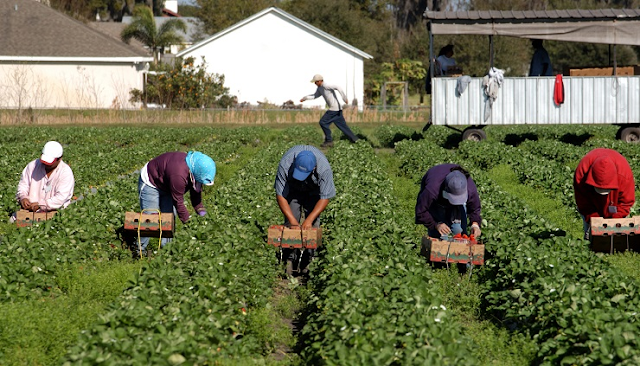
There has been a lot in the news lately about the plight of workers from Pacific Island countries brought to work on farms in Australia under the Seasonal Worker Programme. Some of the workers gave evidence at a Senate Select Committee on Job Security, alleging appalling living conditions, wage underpayments and health risks. Workers are employed by labour hire firms and hired out to horticultural farms. The hire firms and farms involved naturally deny the workers’ claims. The Samoan Government is considering suspending its participation in the scheme. They are seeking a full review of the programme and may suspend sending more workers to Australia. 

A Victorian labour hire company recently had its licence cancelled by the Labour Hire Authority when it discovered that a man convicted of drug and other criminal offences had become a director of that company. He had previously been refused a labour hire licence in Victoria.  

Agricultural workers, whatever country they are from, must unite to fight attacks on their jobs and rights whether the attacks come from multinational agribusiness, dodgy labour hire companies or unscrupulous farmers.


Friday, February 11, 2022

Message from the International Automotive Workers' Coordination on persecution of German Communists


Written by: ICOG on 12 February 2022

Today we received a message from ICOG, the coordinating group of the International Automotive Workers’ Coordination, about German secret police actions against three leading members of the Marxist-Leninist Part of Germany, the MLPD. 

Last year, we issued a statement in solidarity with one of the three who was facing trumped up police charges (see here ). These charges, as the message below points out, were deemed unlawful by the courts.

Nevertheless, the German secret police, who have reduced their surveillance of German Nazis and neo-Nazis despite the latter’s assassination of Kassel Regional Governor Walter Lubcke on June 2, have switched their attentions to the MLPD because of its support for and activities with, Kurdish and Turkish communist exiles in Germany, including sending an international brigade to Syria to build a medical centre for a Kurdish community.

The International Auto Workers’ message reads:

Dear colleagues and comrades,

We have just learned of a monstrosity in the actions of the German secret service. In 2019, three leading members of the Marxist-Leninist Party of Germany (MLPD), Gabi Fechtner, Monika Gärtner-Engel and Stefan Engel, were placed on a wanted list. Some of you surely know them personally.  They were not informed that they were wanted all over Europe, but only found out now, after their lawyers had investigated. The highlight is that all kinds of state services, police, border guards, etc. were involved, and thus the separation of secret services and police apparatus as an important outcome from the time of Hitler's fascism was taken to the point of absurdity.


(Above: Gabi Fechner at the unveiling of a Lenin statue outside the MLPD's office)

The justifications for the listing are completely far-fetched, such as "unauthorized wielding of weapons" at a demonstration or leading a meeting in violation of Corona regulations.

It becomes clear: It is about a new quality of criminalisation of the MLPD in order to contain its growing influence among the masses and, if necessary, to create false accusations to jutify banning it. This concerns all revolutionaries worldwide.

For the rulers, especially the international cooperation in the struggle against imperialism is a nightmare. One justification or the listing is therefore also the "international networking on a leadership level" with Kurdish and Turkish alleged "terrorist organizations". This threatens prison sentences of up to 5 or even 10 years in Germany.

This mendacious criminalisation must be completely withdrawn and the comrades completely rehabilitated!

The MLPD has already been able to achieve important successes through the offensive attack against this anti-communism within the framework of the movement "Don't give anti-communism a chance!". On August 3, 2021, a court declared Stefan Engel's dangerous person classification unlawful. 

International protest declarations had also contributed to this success.


Thursday, February 10, 2022

Fracking crisis looms for US oil companies


 Written by: (Contributed) on 11 February 2022

While observers of the present US-led Cold War have tended to focus on armaments and defence budgets, the matter of oil production has also remained an important factor.

The use of 'fracking' by US oil companies a decade ago was responsible for the lowering of the price of a barrel of oil to levels too low for some countries, notably Venezuela and Iran, to seriously compete on international markets.

Oil companies now, however, have begun to experience problems with fracking: its days appear numbered, with inevitable consequences for the present US hegemonic position within international markets, particularly with new competitors emerging in the developing world.

Early in the New Year, a Wall Street Journal review of US oil production and the use of fracking disclosed the 'end of the boom is in sight', for oil companies. (1) As the boom subsides, the price of a barrel of oil has dramatically increased. While oil prices, historically, have been subject to rapid fluctuations, the overall annual average has revealed:

                                     HISTORICAL AVERAGE – YEAR CLOSE

                                                            Year         US$
                                                               
                                                            2022   -   92. 31 (projection)
                                                            2021   -   75.21
                                                            2020   -   48.52
                                                            2019   -   61.14
                                                            2018   -   45.15

                                                        Source: Macrotrends.

An example of the rapid fluctuations can be seen with the price of a barrel of oil reaching US$163.90 in May, 2008, and subsequently falling to a mere US$ 20.48 in April, 2020, as the US introduced fracking as a standard production practice. (2)  

The origins of fracking lay in the immediate aftermath of the Second World War, although it only became popular about a decade ago, when the US was confronted by a number of countries which had been able to use oil production as political and diplomatic leverage; Venezuela and Iran were two examples, which the US regarded as adversaries. Politics, therefore, was a decisive factor for decisions taken in Washington to use fracking as a means of the US boosting domestic production and reducing their reliance upon imports.

The US emerged, during the period, as the world's largest oil producer; its present-day ability to flood the world with cheap oil now, however, would appear to be receding with a looming crisis on the horizon. Market power has now enabled other producers to consider the renewed profitability of their own oil reserves and production facilities, which in many cases have been left under-utilised for the past decade.

While the White House has urged US oil companies to expand their present production with fracking, many are reluctant for a variety of reasons which include reallocating their revenue which has already been directed toward shareholder's dividends; the sinking of further wells is extremely costly. (3)

A further problem facing US oil companies is that production is down to about 11.5 million barrels a day, from about 13 million in 2020. While the US Energy Information Administration expect production to increase by about 5.4 per cent toward the end of the year, fracking companies have to sink hundreds of new wells just to keep production flat. Any expansion would require a much greater effort on the part of oil companies. In practical terms, the Texas-based Pioneer Natural Resources, for example, was able to raise oil production between 19-27 per cent a year during the boom period, but is now planning to increase quotas by only five per cent or even lower 'for the long term'. (4)

Fracking, furthermore, is fraught with health and environmental problems; the use of highly pressurised liquid to extract oil also releases hazardous materials, pollution and contaminated water which then enters the food chain through soil and agricultural irrigation systems. (5)

The US is increasingly being pushed into defensive positions: they are slowly losing traditional global hegemonic positions and China will eventually become the world's biggest economy by the end of the decade. The issue of oil as a fundamental factor also remains an important consideration: the Chinese economic development One Belt, One Road initiative, furthermore, will create favourable conditions for improved transportation, logistics and supply-lines for many smaller oil-producing countries, accompanied by favourable diplomacy. It will have a major impact upon the US which has already been shown to be increasingly incapable of successfully competing with China and their diplomatic initiatives in the developing world.

Australia needs an independent foreign policy to distance ourselves from likely real-war scenarios as the US more into a period of desperation and war-mongering!

1.     Fracking boom over as wells start to run dry, The Weekend Australian, 5-6 February 2022.
2.     Oil Prices – Macrotrends.
3.     Weekend Australian, op.cit., 5-6 February 2022.
4.     Ibid.
5.     See: The Health and Environmental Effects of Fracking, Fracktracker Alliance, 2022.


Friday, February 4, 2022

Annie Newmarch – A Life of Service To The People Through Art


Written by: Ned K. on 5 February 2022

On 13 January, 2022, Adelaide based artist Annie Newmarch passed away peacefully aged 76. Annie graduated with a teaching diploma at Western Teacher’s College in 1966 and then taught art at public schools before becoming a lecturer at the South Australian School of Art in 1969. 

She held her first art exhibition in that year and raised eyebrows when she criticised commercial art galleries for being dominated by male artists and for being driven by free market economics!

This was the first public message from Annie that she saw art as a form of political expression against the oppression of women under capitalism and that art should not be based on what the artist could gain on the free market, but on its contribution to communities and a better society for the people.

In the early 1970s Annie combined her art work with study in politics and Marxist philosophy at Flinders University which resulted in her throwing herself in to the people’s struggles of the time.

In the early 1970s she became active in the movement for Australian independence from imperialism, US imperialism in particular. She contributed art work to the people’s struggle against the presence of US bases in Australia, particularly Pine Gap near Alice Springs. She produced an inspiring colour poster of people protesting against Pine Gap with Eureka Flags towering over the smaller US flags symbolising their unwanted presence in Australia. This magnificent work by Annie was produced in 1975, the year of the semi-coup against the Whitlam Government which was backed by US interests. She also realised the power of the collective for art to reach its social potential. She was a founding member of the Progressive Art Movement which united writers, artists, film makers and poets so they could contribute to the progressive social movement that prevailed at the time. 


In 1978 she produced a stunning image “Women Hold Up Half The Sky”, a colour screen print showing a photo of a women she knew, Peggy carrying a man in her arms. Peggy was a single mother with eight children!

Annie also produced artistic work in support of First Nations Peoples. One of her works about the impact of the British nuclear tests at Maralinga in the north of SA is a stand out exhibit at the Art Gallery of South Australia.

Annie’s commitment to progressive causes saw her throw herself and her art work in to support for working class struggles. She provided design for BLF posters and shirts with the now famous “Dare To Struggle Date To Win” logo at a time when the BLF was under relentless attack from multinational developers and their local political party stooges.

Her commitment to working class struggle did not stop there. She was a strong supporter of the Rank and File Committee of car workers at Chrysler and a strong advocate for nationalisation of the car industry in Australia.


She also produced posters and joined street demonstrations in support of gaoled Chrysler workers shop steward Will Heidt in 1977.

Will was gaoled for refusing to leave the car plant when he was sacked over a staffing level dispute.


Annie’s “rock” during these turbulent years and subsequent years was always her local northern suburb community of Prospect in Adelaide where she lived for about 50 years. She was the first person to be appointed artist in residence with the City of Prospect Council and the Council Art Gallery is named Newmarch Gallery in her honour. 

Annie has left her mark in the streets of Prospect where she initiated stobie pole art which is now practiced in many suburbs in Adelaide and other towns and cities.

Annie combined the raising of her three children with working as an artist and in later life she confronted the invisibility of ageing women in a series of works called Risking 50.

Annie was an artist who worked for the people and had no hesitation in raising her artistic gift on the side of the people.

Even people in the US recognised her legacy with an Obituary in ART news, a US visual arts magazine in New York saying she had “reshaped the Australian art scene as an educator and activist”

Rest In Peace Annie .  Never forgotten by many.