Showing posts with label privatisation. Show all posts

Thursday, January 1, 2026

Return WA's freight rail to the workers

 Written by: Cal G. on 2 January 2026


(Above: Kalgoorlie is where the Arc Infrastructure and ARTC territories meet, the border between privatisation and state ownership.)

In the year 2000, the Western Australian Liberal government, led by Premier Richard Court, sold off the state’s freight rail network. This act of privatisation marked yet another transfer of collectively built public infrastructure into private, capitalist hands—where it would be exploited not for social need, but for profit.

The sale dismantled a core asset of the Western Australian Government Railways (WAGR), handing approximately 5,500 kilometres of freight rail into private ownership. By 2010, the network came under the control of Brookfield, a Canadian multinational investment giant managing over one trillion dollars in assets worldwide, after it acquired Prime Infrastructure, itself a remnant of the failed Babcock & Brown empire. Today, the network is operated by Arc Infrastructure, an entity wholly owned by Brookfield.

This was not merely an administrative change. It represented a fundamental shift in priorities—from serving the needs of workers, farmers, and regional communities to maximising returns for international shareholders.

Since privatisation, the consequences for working people in Western Australia have been severe. One of the clearest examples is the closure of Tier 3 rail lines across the WA Wheatbelt. These lightly used but socially vital lines once allowed grain to be transported efficiently and safely by rail. Their closure, driven by Brookfield’s profit-first logic, forced farmers to rely almost entirely on road transport, dramatically increasing costs and shifting freight onto trucks bound for CBH silos or directly to the Kwinana grain export terminal.

The social cost of this decision has been profound. Families, school buses, and local traffic are now forced to share narrow country roads with massive grain trucks, many operating continuously during harvest season. Roads never designed for this level of heavy freight traffic have become more dangerous, accelerating road degradation and increasing the risk of serious accidents. What was once a safe and publicly planned transport system has been replaced by a hazardous and inefficient patchwork that places the burden squarely on rural working-class communities—while the private rail operator bears none of the consequences.

In early 2025, multiple media outlets reported on the situation in Greenbushes, a small town in WA’s South West located near the world’s largest lithium mine. Residents and workers raised concerns that lithium dust from nearby mining operations was contaminating household water tanks, homes, and even the local school. A major contributor to this pollution was the constant movement of heavy trucks transporting lithium concentrate through the town to the Port of Bunbury.

Negotiations to move this freight by rail were publicly revealed by the ABC on 17 December 2024 to have collapsed. According to reporting, Arc Infrastructure quoted prices deemed “uneconomical” by the mine’s operator, Talison Lithium—a joint venture involving Chinese and US capital. As a result, the company ruled out a rail link, despite its clear environmental and social benefits. The historical rail line between Bunbury and Bridgetown, shut down roughly 15 years ago by the private operator to cut costs and boost profits, remains closed. Once again, shareholder value was prioritised over the health, safety, and livelihoods of working people in the region.

A similar pattern can be seen in the Goldfields city of Kalgoorlie-Boulder. There is strong support from government and industry for the construction of a freight intermodal terminal—effectively a “land port”—that would allow freight from the eastern states to be loaded and unloaded locally, rather than being hauled all the way to Perth.

Such a development would bring clear benefits to workers across the Goldfields–Esperance region: reducing transport costs, creating jobs, and strengthening regional supply chains. It would also offer significant environmental advantages. A single freight train can replace up to 400 trucks and produces roughly two-thirds fewer emissions for the same volume of freight. Yet progress has been slow, and private control of the rail network continues to act as a barrier to rational, socially planned development.

Arc Infrastructure has had ample opportunity to reinvest in and expand WA’s freight rail network. Instead, it has consistently chosen to extract value—sweating existing assets, closing “unprofitable” lines, and blocking projects that do not meet short-term profit thresholds. This is not a failure of management; it is the inevitable outcome of privatisation under capitalism.

With both state and federal elections approaching, Prime Minister Anthony Albanese has announced that a re-elected Labor government would fund a $2.5 million feasibility study into WA Labor’s proposal to buy back large sections of the privatised freight rail network. While this signals growing political recognition that privatisation has failed, it remains a timid response. Even proposals to return the network to public ownership under the Australian Rail Track Corporation stop short of addressing the deeper issue: who controls and benefits from this infrastructure.

The most effective and genuinely democratic solution is not simply re-nationalisation under a distant bureaucracy, but the transfer of the rail network into direct, democratic community and worker control. The approximately 600 workers who maintain and operate the network—from track workers carrying out day-to-day maintenance to civil engineers planning long-term upgrades—possess the expertise, commitment, and vested interest required to run the system in the interests of society.

Unlike multinational investors, these workers live in the communities the railways serve. They understand that rail is not just a commodity, but a social good—essential for regional development, environmental sustainability, and working-class livelihoods.

The experience of WA’s freight rail network exposes a fundamental truth: infrastructure built by generations of workers should never have been sold. The task ahead is not merely to buy it back, but to break with the logic of profit altogether and place this vital asset under collective, democratic control—where it belongs.


Saturday, April 20, 2024

Rail workers strike for a living wage

Written by: Ned K.. on 20 April 2024


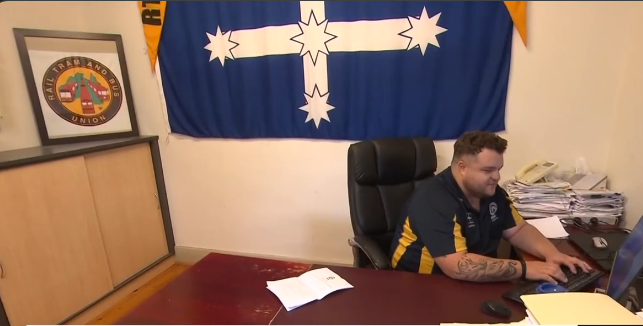
(Above: RTBU organiser Hayden Boyle)

Rail workers including suburban train drivers in Adelaide are taking strike action to win a 20% pay rise over four years. 

In their way stands multinational corporation Keolis Downer who operates the suburban train services under contract to the SA Government.

A 20% pay rise over 4 years is by no means an exorbitant wage claim when inflation rates and increases in cost-of-living increases in real terms are arguably higher than 5% per year.

Keolis Downer's current wage offer is 14.7% over 4 years.

The Rail, Tram and Buses Union (RTBU) members have taken strike action of 4 hour to 5-hour periods of time a couple of times a week over the last two weeks.  They have timed the stoppages to escalate the impact of the action which has included overtime bans.

On Friday 19 April, the RTBU members telegraphed to Keolis Downer and the SA Government that they would strike for 24 hours on Thursday 2 May if Keolis Downer did not agree to members’ claims.

Thursday 2 May is the same day that the two SA based AFL teams Adelaide Crows and Port Adelaide play their first of two annual "showdown" games. With no trains running on that day, the SA Government will have to organize extra buses to provide alternative public transport to and from the Adelaide Oval. Thousands of fans travel by train to the games and businesses will be pressuring Keolis Downer and the SA Government to "resolve the dispute" before Thursday 2 May.

Bread and Circuses

A big part of the Malinauskas Government's strategy is to keep the people happy by feeding them one "circus" after another in one form or another. The showdown football matches between Adelaide Crows and Port Adelaide are two of the annual "circuses",

The potential 24-hour strike action on 2 May will disrupt the showdown "circus " but the SA Government also knows that workers like the RTBU need more than the cost of "bread" being offered by Keolis Downer. 

Publicly the Government is saying that the dispute is an industrial matter between the employer Keolis Downer and its employees represented by the RTBU. Behind the scenes though, bet London to a brick that the Government is in earnest talks with both Downer and RTBU. An added concern for the SA Government is that the higher wages rail workers win, the more likely that other public sector workers will want to match it in their Enterprise Agreements where the SA Government is their employer and the harder it will be for private capitalist businesses to keep wages as low as possible. 

The Malinauskas Labor Government is finding out that it is no easy task to make capitalism acceptable to workers and at the same time be viewed favourably by capitalists!

Suburban trains were outsourced to Keolis Downer by the previous Liberal Government. The Malinauskas led Labor Government won the last state election in March 2022 vowing to reverse the outsourcing of train services if it won the election. 

In 2023 it announced that it would phase out Keolis Downer's contract over four years with train drivers the first to once again be directly employed by the SA Government in late 2025 and other Keolis Downer employees becoming government employees by the end of 2027.

How seriously will the SA Government be looking at introducing an automated rail transport system with no train drivers?  

They would be aware this has occurred in a limited way in NSW. 

Another aspect of the dispute is that the RTBU is a relatively small union. In the age of big unions covering many different industries, the RTBU has maintained its identity and independence and a high level of member engagement in the running of the dispute and solidarity between members.

Saturday, April 8, 2023

AUKUS, Nuclear Submarines and Public Health Crisis Dominate Malinauskas SA Government First Year

(Above: the public support for the RTBU's 2019 anti-privatisation campaign forced a commitment from the ALP, then in opposition.  Photo source: RTBU Facebook page)


 Written by: Ned K. on 8 April 2023

The SA Labor Government led by Premier Peter Malinauskas has just completed its first year of office in parliament.

Malinauskas campaigned for the March 2022 state election on 6 key policies.

1. Reverse Marshall Government's $2.1 billion contract for privatisation of trains and trams. 
2. Change planning regulations to protect the character and heritage of the city and suburbs
3. Fast track infrastructure project
4. Improve road transport construction.
5. Build a hydrogen electrolyzed facility and hydrogen storage facility near Whyalla steel works
6. Conservation planning
What progress has been made on these policy areas in the first 12 month of office? 
 
The most notable public announcement about any of the 6 key policies was made in the last month of the new government's first year. Elected in March 2022, Malinauskas announced in March 2023 that the operation of the suburban trains and trams would return to the government in 2025.  However, the customer service and security services for the trains and trams would remain with the private concern Keolis Downer until 2027. Keolis Downer would also keep maintenance services of trains until 2035.
 
The Malinauskas Government called this new arrangement with Keolis Downer an "alliance model" costing the taxpayers $30 million.
 
The positive aspect of the "alliance model" is that the workers who drive the trains and trams will again be directly employed government workers.
 
The Secretary, Darren Phillips of the drivers’ union, the RTBU said this was a good thing not only for drivers but because the money generated from public transport would no longer have a private for profit multinational "clipping the ticket on the way through."  
 
The "alliance model" is far from a complete reversal of privatisation. It shows that under capitalism privatisation reversal is often incomplete. The multinational corporations have years of experience of ensuring that under capitalist laws, it is made difficult for governments to completely reverse privatisation. In-coming governments also have to contend with the other organs of state power such a government department heads who have close relationships with the private operators who have benefitted from privatisation.
 
In other areas of the 6 key policy promises of the Malinauskas Government, there has been the usual cry from Treasury that there is not enough money in the kitty to fund the promises so they become delayed or watered down or just forgotten about until nearer the next election battle in three- or four-years' time.
 
For example, in number 3 Policy promise Fast Track Infrastructure, the new Malinauskas Government was hopeful that the federal Albanese Government would contribute to the Adelink upgrade and expansion of the Adelaide suburban tram network. This was first promised by the previous ALP state government in 2017 when Albanese as a Shadow Minister pledged support for federal money for Adelink tram upgrade.
 
Now that Albanese is Prime Minister the tram upgrade has taken a back seat, as most projects have for federal government funding in SA. The exception of course is the more than $360 billion federal government funding pledge for the nuclear submarine AUKUS project with the SA-based Osborne Naval Shipyard as its centrepiece.
 
So, Malinauskas's enthusiasm for realizing the 6 policy pledges outlined above has taken a back seat to the war preparations and profiteering of companies like BAE who benefit most from the nuclear submarine project.
 
The other headache for the Malinauskas Government at the end of his first year in office is the multi-layered crisis of the SA public health system. Ambulance ramping is still the most visible sign of a system that is not coping but there are many other problems in the health system facing the government. A new children's hospital has to be built, there are not enough nurses and doctors and those that are present are over-worked to the point of leaving the system.
 
Where will the money come from to solve all these people problems? 
 
They will not come from the federal government as funding the manufacturers of the US and UK war machine are obviously more important to this federal government.
 
So what is the Malinauskas Government doing faced with this situation?
 
So far it has tried to score points by legislating for an SA First Nations Voice, welcomed by many. 
 
The government is big on "bread and circuses" as a diversion to all the problems facing the people in their daily lives, such as job security, cost of living, high rents, high interest rates and over-crowded health system.
 
The latest "circus" is the Gather Round of AFL games in Adelaide in mid-April.
 
The government hopes this will be a boost to the hospitality industry and a slight increase in government revenue from hotel owners and food outlets through increased payroll tax.
 
Maybe an increase in tax from the Casino as well, even if it is just for a week!
 
Malinauskas is no socialist. Even if he was, it is doubtful he could find the money needed to deliver on his 6 key policies due to the nature of the capitalist system that he administers. 
 
He would have to nationalise multinationals that make millions of dollars profit from mining and energy and other industries, particularly agriculture to have any chance of having enough money to deliver on his key policies.
 

Friday, March 3, 2023

Rail disasters: profits before safety


(Above: the Tempi, Greece train wreck.  Photo source: KKE-ML website) 

Written by: Nick G. on 4 March 2023

Train wrecks do not happen very often, but when they do, the disaster is often on a grand scale.

Below we feature comments on the Ohio, USA and Tempi, Greece disasters from working class parties in those countries.

Both occurred in rail lines under private ownership. Publicly-owned rail lines are not immune to such disasters. Australians will remember the Granville disaster of 18 January 1977 which caused the loss of 83 lives. When public infrastructure is run by governments looking to cut costs, the interests of the public and of the employees are bound to suffer. The primary cause of the Granville disaster was insufficient spending on maintenance, leading to poor fastening of the track.

The February 3 train wreck in East Palestine, Ohio occurred after rail operator Norfolk Southern, along with other rail companies, had successfully lobbied for the repeal of rules requiring electronically controlled pneumatic brakes on trains carrying hazardous materials. In the aftermath of the disaster, the company was accused of prioritizing $10 billion in stock buybacks for shareholders over maintenance. 

The train that derailed in February carrying vinyl chloride, butyl acrylate, ethylhexyl acrylate and ethylene glycol monobutyl ether. Emergency crews conducted a controlled burn of the spill at the request of state officials, which released hydrogen chloride and phosgene into the air requiring the evacuation of thousands of residents.

A comment from the Freedom Road Socialist Organisation follows:

February 15, 2023

Statement by the Climate Justice Committee, Minnesota

In East Palestine, Ohio, decades of corporate and government negligence have culminated in a horrifying and entirely avoidable environmental catastrophe, the consequences of which we have only just begun to see. 

On February 3, 2023, a Norfolk Southern train hauling a massive payload of toxic chemicals derailed and exploded just outside the small town of East Palestine. For three days, the chemical-soaked wreckage burned, and then on February 6 the authorities ordered a so-called “controlled release” to avoid an even bigger explosion. As they detonated the remains, a column of noxious smoke jetted up into the sky, saturating the air and blanketing the landscape for dozens of miles in each direction with potent carcinogens and irritants. 

Two days after the “controlled release”, the official evacuation order was lifted, and residents returned home with the assurance that it was safe. Despite this assurance, we are already seeing massive die-offs of fish in the Ohio River and nearby streams, as well as of chickens, cattle, pets, and birds as far as 100 miles from the crash site. Reports of children and adults who have become suddenly ill are also widespread.

The derailment is attributed to long-outdated brakes that the rail workers union had been trying to replace, until Biden stepped and sided with railroad companies against the workers – now, Biden’s corporate collusion has resulted in an environmental disaster.

The February 28 disaster in Greece occurred on a rail network, OSE, that had been privatised. Most of the dead were young people. The Communist Party of Greece (Marxist-Leninist), in the statement that follows, calls for the overturning of the policy of privatisation. We support that call, but add that governments that own public infrastructure must be forced by public pressure to prioritise safety over budget bottom lines.

The train accident that occurred late at night on 28 February in the area of Tempi, with the fierce collision of the two trains and which led to the tragic death of dozens of passengers, most of them young children, gives rise to unspeakable sadness and anger.

The unjust loss of so many people from the unprecedented - for the railway annals - accident is not due to the "bad moment". It is the result of the policy pursued over time for more than two decades by all the governments of ND, PASOK and SYRIZA. That policy that first muddied and dispersed OSE, the public organization of the railways, presenting it as "deficient" and as a "burden" for the Greek people. And all this in order to gild the "pill", to pave the way for its sale to local and foreign interests to the famous "investors".

ND – SYRIZA and PASOK are fully responsible for the regime of degradation and abandonment of the railway network, the absence of modern traffic control systems, while a handful of private companies of Greek and Italian interests are making untold profits from the commercial exploitation of the railway networks. For more than twenty years, the governments of PASOK, ND and SYRIZA have consistently served the policy of privatization, giving impetus to the sale of OSE and so many other public bodies (PPC, OTE, etc.). It is no coincidence that both Tsipras and Androulakis, on the wreckage of the accident, rushed to meaningfully declare that "this is not the time to apportion blame", thus disguising the complicit policy of SYRIZA and PASOK that contributed to the current tragedy.

A tragic irony is both the announcements of TRAINOSE employees, who denounced the abandonment regime, referring to an "accident that is coming", as well as the European Commission itself, which just two weeks earlier (February 15th) referred the country to the European courts on charges of deficient safety measures in our country's railway network. Otherwise, Kostas Karamanlis (now former) Minister of Transport of the ND government provocatively declared on February 20 from the floor of the Parliament that "we do not play with the safety of passengers on trains".

Today the Greek people, the families of the dozens of dead and hundreds of injured are experiencing the criminal -literally- consequences of the policy of all the governments of ND – SYRIZA – PASOK over time. The crocodile tears shed in front of the television lenses by government officials and Mitsotakis, the pompous statements about "apportioning blame", the resignations of ministers, but also the orchestrated attempt to present the accident solely as a "human error" are the provocative attempt to cover up and embellish their policy.

The M-L KKE denounces the policy of privatization and selling off of OSE, which are fervently served by both the current government of ND and the previous ones of SYRIZA and PASOK. It calls on the people to turn their anger and suffering into a mass struggle to overturn the policy of privatisation.

We express our sorrow and heartfelt condolences to the families of the wronged passengers of the fatal train.

Press Office of the M-L KKE
March 1, 2023

Saturday, December 4, 2021

Hospital Workers Lead Struggle Against Privatisation


Written by: Ned K. on 5 December 2021

Hospital workers in SA have been waging a determined struggle against privatisation of services in the SA public health system.

In the last week of November about 400 support services workers from Flinders Medical Centre, Noarlunga Hospital and the Repatriation General Hospital went on a half day strike. These workers comprise one of the last groups of support services workers not yet privatised.

The workers held a rousing demonstration outside the main entrance of the hospital and received strong support from patients, members of the public and other hospital workers.

The strike is part of escalating actions by workers across the public health sector to prevent further privatisation and to preserve wage parity for workers already privatised and employed by multinational contractors.

Their struggle to defend and extend the public health system is also a part of the struggle for an independent public health system free from the clutches of multinational corporations. In SA large parts of the public health system have been privatised and handed to multinational companies Spotless (part of the Downer group) and ISS, the biggest facility services corporations in Europe and one of the largest in the world.


All the workers at the demonstration wore masks in recognition that they are also fighting an invisible enemy, Covid 19 in all its forms. The workers know that their struggle for job security and against privatisation and their struggle against Covid 19 as workers and citizens are linked.

Further privatisation means that more workers and patients will be exposed to short cuts for profits leading to greater risk of spread of the virus.

Their resilience over the last two years shows they are in it for the long haul and they will win!


Monday, October 4, 2021

Sold Down the River!


Written by: Duncan B. on 2 October 2021

Sold Down the River. How Robber Barons and Wall Street Traders Cornered Australia’s Water Market by Scott Hamilton and Stuart Kells, (Text Publishing 2021, $35), is a book that everyone interested in the sad story of the Murray-Darling Basin should read.

The authors tell how Australia’s most precious resource was handed over to speculators at the expense of farmers, the other inhabitants of irrigation areas, Indigenous people and the environment. 

From the earliest days in the late nineteenth century when irrigation schemes were established, water was publicly owned and controlled and water rights were always linked to land ownership. In the early nineteen nineties, under the influence of the Friedman economics of the “free market” which brought on a mania for “competition” and privatisation in Australia, water rights were separated from land ownership and water rights became something that could be traded or sold. 

In 2004 the “National Water Initiative” made water markets the primary tool of water management. Water became just like any other commodity. It became a financial asset. Compared to sectors of the economy such as banking and finance there was very little regulation of the players in the water market - the traders and brokers who set about making enormous profits from trading water. There was no requirement for water traders to have any connection to farming.

Farmers who often struggle with poor mobile phone and internet connections found themselves in competition for water with water traders who use supercomputers and “bots” to trade water in seconds.

Many of the traders are US based banks and hedge funds. The authors detail how these parasites manipulate the water market, benefit from periods of water shortage and create artificial shortages. They milk high profits from farmers desperate to obtain water to start or finish off their crops. 

The water traders ally themselves with the mega-farms run by organisations such as the Canadian pension funds. They ensure that there is adequate water for the huge plantations of almond, olives etc, while depriving productive farmers of much-needed water.

The authors call for a new model of governance for water where “we would decide as a society how best to allocate scarce water in a way that balanced all the imperatives such as efficient agriculture, river health, and recognising the cultural and economic rights of Indigenous people.”

Given the vested interests involved in the water market and the billions of dollars in profits they are making, the chances of this happening are remote.

Friday, September 17, 2021

Workers Struggle Against Impact of Privatisation and Outsourcing On Many Fronts


Written by: Ned K. on 18 September 2021

Government privatisation and outsourcing of services has been a feature of capitalism in Australia for many decades affecting public transport, water utilities, public health, aged care, disabilities and education and many more sectors. For example, road traffic controlling where road works are undertaken, used to be performed by workers directly employed by state or federal governments. 

In many public hospitals most of the support services have been contracted out to multinational companies like Serco, ISS, Spotless or Compass.

In public schools, maintenance and school cleaning has been contracted out for years to both large companies like Spotless as well as smaller locally based companies.

A common outcome of this outsourcing is more insecure work, higher workloads, lower wages and lower quality of service to the people who use the services.

The practice of privatisation and outsourcing over the decades has become so entrenched that governments have become almost servants of the capitalists delivering the service rather than delivering all the assurances the people were given that services would improve, and governments would ensure contractors did not put profits before workers' working conditions and service to the people.

In the last decade particularly there has been a fightback by workers to prevent further privatization and outsourcing and also campaigns to reverse privatisation and outsourcing.

Unions and their members have often supported election of a Labor Federal, State or Territory Governments with high hopes that if elected they would reverse privatisation or at least ensure that workers’ wages and conditions would be the same as if directly employed.

Workers have had some success in their struggles. For example, in the ACT several years ago, the Government agreed to take school cleaning back in house with improved wages and conditions as a consequence. In WA and Queensland, directly employed school cleaners have successfully resisted attempts by both Liberal and Labor Governments to outsource cleaning to private for-profit contractors.

In South Australia, public hospital directly employed support services workers won an Enterprise Agreement which included a clause that at change, renewal or extension of commercial contracts with companies where services had been already contracted out twenty years ago, the workers had to be paid the same wages as directly employed public sector workers.

In Victoria, workers employed by private contractors to provide support services in schools forced the state Labor Government to kick out contractors who were not even paying workers minimum award wages and conditions. This was a first step in the workers' struggle to win back direct employment as public sector workers.

Labor Governments Do Some Good Things, Some Bad Things On Privatisation Front

During the Covid-19 period, there has been even more pressure on governments to provide better services, especially to ensure a hygienic environment for people using public services. 

In Victoria for example, the Andrews Labor Government decided to increase cleaning services on public transport and areas like railway stations and tram stops. Here was a perfect opportunity to directly employ more public sector workers, ensure they were well trained and with public sector standard pay and conditions.

However, the Government fell well short of this. It gave this extra Covid-19 related cleaning work to a major contract cleaning company GJK who said thank you very much and then engaged cleaners as individual contractors on under-award pay.

In some States and Territories when under a Labor Government, through pressure from workers and their Unions, there has been a move by these Governments to disguise the continuation of the neo-liberal privatisation and outsourcing agenda by giving assurances to Unions and their members that only "responsible contractors" would be given contracts to provide public services. 

However, this has usually resulted in the Government Department bureaucrats allowing the so-called "responsible contractors" from continuing on their merry way of cutting corners, reducing worker numbers by not replacing those who leave, or replacing full time and part time workers with casuals or labor hire casuals.

At the federal level of Government, the Labor Government of Rudd and Gillard did some good things for workers such as introduce at least some regulations in relation to contracted out services such as ground maintenance and cleaning. This only came about because of workers' struggles over a number of years.

However as soon as the Abbott government came in to office, these services were again completely deregulated with severe consequences for workers.

So, while Labor Governments do some good things when pressured by the collective struggles of workers, the changes they make are often half measures at best, or temporary due to the short-term electoral cycle. 

This often demoralises workers who always vote Labor, but they also see the limitations of parliamentary system of which Labor governments and Labor out of office are a part.

Tuesday, January 26, 2021

Serco: Privatised Prisons Have A Long History


 Written by: Ned K. on 27 January 2021

Privatisation of prisons is still very much on the agenda of capitalism's governments in Australia. British based multinational Serco recently took over the Remand Centre in Adelaide to add to its private prison profit making in Australia.

This month Serco was fined $100,000 after a prisoner used a clothes rope to escape from the centre.

Soon after the escape, Public Sector Association (PSA) general secretary Nev Kitchin argued that "privately run prisons simply don't work".

"We're looking at multinational companies, we're looking at fewer staff, we're looking at inferior training, we're looking at more assaults occurring in the private prisons, we're looking at more contraband getting into the private prisons, and we're looking at overall reduced safety," he said.

Privatisation of prisons has a long history going back at least to the pre- prison reform movement in the late 1700s in England, about the same time as overflowing prisons there gave rise to transportation of prisoners to the colony of NSW.

In his extraordinarily researched book, The Fatal Shore, Robert Hughes had this to say about the prison system in England in the 1750s to 1800 period. Prisons at that time were "holes in which prisoners could be forgotten. Their purpose was not reform, but terror and sublimation". For First Nations People in Australia today, nothing much has changed.

Hughes goes on to say that,

"About half the jails of England were privately owned and run. Chesterfield jail belonged to the Duke of Portland, who sublet it to a keeper for 18 guineas a year. The Bishop of Ely owned a prison, the Bishop of Durham had the Durham County jail, and Halifax jail belonged to the Duke of Leeds. Their jailers were not state employees but small businessmen who made their profits by extorting money from prisoners. On entering the Bishop of Ely's lock-up, a prisoner was chained down to the floor with a spiked collar riveted round his neck until he disgorged a fee for "easement of irons" 

Prisoners "paid for food , for drink, for bedding, water and even air"!

Prisoners had to pay rent as well. Nowadays prisoners often work to make profit for private jail owners. 

Nothing much has changed

Sunday, October 13, 2019

Tram and Train workers lead SA anti-privatisation campaign

Ned K.                                   13 October 2019

On the morning of Sunday 13 October, over 2,000 tram and train workers and supporters from all walks of life rallied at Parliament House steps in Adelaide as part of a campaign led by the Rail, Tram and Bus Union(RTBU) to oppose the SA Marshall Liberal Government plan to sell off Adelaide's tram and train services to multinational corporations.

State Secretary of the RTBU Darren Phillips said RTBU members were determined to campaign as long as it takes to prevent the privatisation and if necessary reverse it if the Marshall Government went ahead with its plans in its first term of government which expires in March 2022.  

The large numbers of RTBU members who turned up to the rally left no doubt that they were in this campaign for the long haul. Some RTBU members at the rally had come off night shifts with just four hours sleep to be able to travel from home to get to the Sunday morning rally.

The RTBU members were given strong support from a fellow Melbourne tram and train unionist of over 30 years, Phil, who came over especially for the rally to share his experience of the disastrous privatisation of the tram and trains in Melbourne by the Kennett Government in the 1990s.

Phil said that the selloff of trams and train services to multinational corporations in Victoria had resulted in hundreds of job losses, disregard for worker and commuter safety, poor maintenance and trams and trains frequently running late. To top it off, all the profits went overseas with as much as $350 million in just one eight-year period since privatisation. Under public ownership, any surplus from the services remained in government hands for improving services instead of filling the pockets of multinational corporations.

During the rally, the RTBU members were joined by members from a wide range of other unions and members of the general public loudly chanting "No Sale".

RTBU Secretary welcomed the support of SA Labor Party leader Peter Malinauskas when he pledged in a speech at the rally to reverse any privatisation of trams and trains made by the Marshall Government if he became Premier at the next state election in 2022. He said it is easy for Labor politicians to oppose privatisations announced by a Liberal Government. He was determined to commit now, two and a half years from the next election to declare that he would reverse any privatisation of trams and trains services in SA.

His stand was applauded by the crowd and came as a welcome surprise. South Australian working people had just endured 16 years of Rann and Weatherill Labor Governments who often spoke about assets privatised by previous Liberal Governments but who never reversed any of them!

Malinauskas's commitment to reverse any privatisation of tram and train services by a Marshall Liberal Government is a sign of the growing people's movement against privatisation across Australia and indeed many other capitalist countries. It is primarily the growing people's movement led by the workers who perform the work of both government and already privatised services that will put a halt to future privatisations and reverse services already privatised.

The RTBU organised rally on Sunday 13 October was an important part of that movement.

Monday, May 27, 2019

Eyre Peninsula: Grain Transport Off the Rails

Nick G.           28 May 2019


Over a century’s worth of history will come to a close on May 31 when transportation of grain by rail ceases on Eyre Peninsula.


The move will require around 30,000 extra B-double truck movements per year along poorly maintained single lane “highways” that converge on the export silos at the deep-water harbor of Pt Lincoln.


The town of Cummins, 67km north of Pt Lincoln is where lines from Kimba (245km from Lincoln) and Wudinna (216km from Lincoln) meet.


"It's a tragedy losing our history, but all those extra trucks on the roads are going to be a nightmare," said Cummins resident Claire Holman.


Her views were echoed by Cummins farmer Michael Treloar: "The speed limit needs to reviewed — you get stuck behind a triple truck carrying 70 tonnes that can only go 100 kilometres an hour, and we technically can go 110, but you need a long stretch to pass that safely and respect the speed limit — I see serious issues there."


Multinationals out of touch with regional communities


Eyre Peninsula communities, like many regional communities across the country, have been sold down the drain by various forms of privatisation. 


In the late 1990s, the Australian Wheat Board and the Australian Barley Board were privatised becoming AWB Ltd and ABB Grain Ltd respectively. In 2009, ABB Grain was taken over by Canada’s largest grain handler Viterra which in turn was taken over in 2013 by British-Swiss multinational commodity trading and mining corporation Glencore.  Viterra still operates under its own name.


The narrow-gauge rail line to Cummins was opened in 1907.  It was once the largest employer in the region, with over 600 workers in the 1950s and 1960s. In November 1997, US rail company Genesee & Wyoming (GWA) bought the SA rail freight operations of the Government-owned Australian National and after a bit of mucking around with Wesfarmers, rebranded the operation under its own name. There are now only 35 full-time employees, all of whom will lose their jobs.


In recent years, Viterra has been the only customer/user of the GWA line.  The two could not agree on terms for an extension of their contract.  GWA cited decreased grain volumes on rail together with high maintenance costs, while Viterra cited the need to offer grain growers a more competitive supply chain.  What this simply means is that the dreaded “invisible hand of the market” is going to become highly visible as B-doubles crowd out other road users, and roadside marker pegs carrying black crosses indicate where members of the community and truck drivers have lost their lives.


Rail enthusiast Mark Carter summarised the situation in the rail magazine Catch Point: “All major stakeholders, including the state government are seemingly disinterested in the real impacts of the closure, with the final decisions made in the boardrooms of the USA and Switzerland, far removed from the Eyre Peninsula”.


Regional communities should be making regional decisions, supported by  an independent Australian government run by the real producers of wealth, the working class.