Showing posts with label Africa. Show all posts

Tuesday, March 4, 2025

ICOR strongly condemns the invasion of Congo by Rwandan troops and the blockade of the city of Goma

Written by: ICOR on 5 March 2025


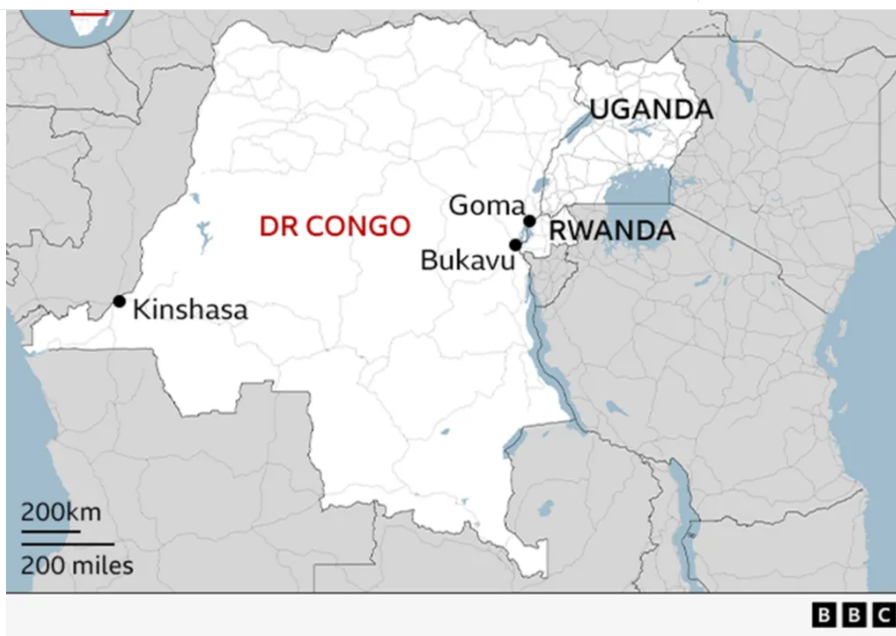
The attack of the Rwandan special forces on the city of Goma in the Democratic Republic of Congo was only possible with the support of highly developed equipment supplied by Western powers. The current situation in Eastern Congo is once again leading the region into an unprecedented cycle of violence.

The Congolese masses are caught in a vise and their situation is becoming increasingly untenable. From 25 December 2024, Goma and its population of over one million people has been added to the hundreds of thousands already wandering around in the jungles of the surrounding localities, fleeing bombings and insults from all sides. All supply routes for essential goods have been cut, including the city's water and electricity supply, which is now cut off from the outside world.
 
The destabilization of Congo, which has been going on for 65 years, is in line with the logic of imperialist exploitation and domination, with destabilization being a means to ensure the orderly plundering of Congo's natural resources. Millions of people were killed and millions more displaced. And Rwanda is playing the role once ascribed to the brokers during the slave trade, namely to serve the imperialist conquest of the Congolese mines..
 
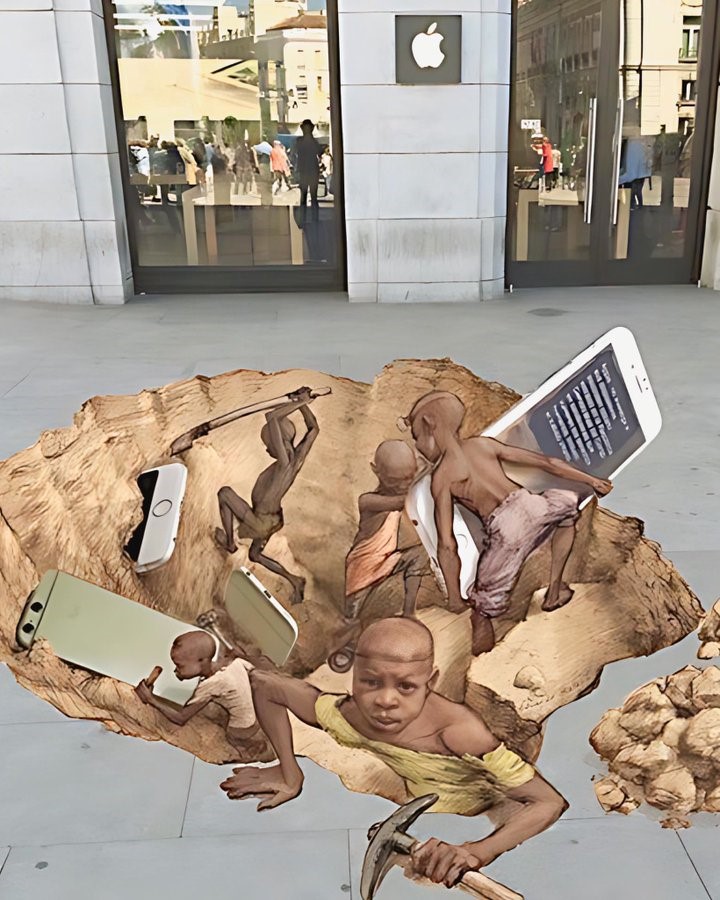
The Democratic Republic of Congo is rich in natural resources, including gold, copper, tin, uranium and minerals such as coltan, which is used in the production of tantalum for cell phones and computers. In 2016, Rwanda accounted for 50% of global tantalum production, with the majority coming from coltan mines seized in the Democratic Republic of Congo. 
(Above: street art protesting Apple'srole in exploiting African labour for coltan supplies)
 
China now owns most of the cobalt mines in the Democratic Republic of Congo, having bought out the previous owners from the US, and also controls most of the copper and uranium mines. The Congolese army has protected the Chinese assets. 
 
The ICOR demands the immediate withdrawal of the Rwandan troops from the Democratic Republic of Congo.
 
The ICOR supports the resistance of the Congolese people against imperialist domination and its Rwandan accomplice.
 
The ICOR supports the right of the people of the Democratic Republic of Congo to own and control the natural resources of their country. 
 
The ICOR calls for solidarity with the progressive organizations in the Democratic Republic of Congo in order to strengthen the resistance of the Congolese people.
 
The ICOR calls on all its members to actively oppose the import of Rwandan minerals into the European Union and demands the revocation of the Memorandum of Understanding between the EU and Rwanda from 2024 on the import of “Rwandan” minerals into the EU.
 
The ICOR demands a ban on the sale of arms to Rwanda.
 
The ICOR calls on all revolutionary organizations in the Democratic Republic of Congo to intensify their struggle against imperialism and to take a stand for socialism - the true liberation of the Congolese people! 
 
Long live proletarian internationalism in the struggle for national liberation, democracy and socialism!
 
Status of the signatories 04.03.2025. Further signing possible. Current list of signatories at www.icor.info
1. ORC   Organisation Révolutionnaire du Congo (Revolutionary Organization of Congo), Democratic Republic of the Congo
2. CPK   Communist Party of Kenya
3. CPSA (ML)   Communist Party of South Africa (Marxist-Leninist)
4. PPDS   Parti Patriotique Démocratique Socialiste (Patriotic Democratic Socialist Party), Tunisia
5. SPB   Socialist Party of Bangladesh
6. NCP (Mashal)   Nepal Communist Party (Mashal)
7. RUFN   Revolutionary United Front of Nepal
8. CPA/ML   Communist Party of Australia (Marxist-Leninist)
9. Krasnyj Klin   Аб'яднання беларускіх камуністаў «Чырвоны Клін» (Association of Belarusian Communists «Red Wedge»), Belarus
10. БКП   Българска Комунистическа Партия (Bulgarian Communist Party)
11. PR-ByH   Partija Rada - ByH (Party of Labor - Bosnia and Herzegovina)
12. MLPD   Marxistisch-Leninistische Partei Deutschlands (Marxist-Leninist Party of Germany)
13. UPML   Union Prolétarienne Marxiste-Léniniste (Marxist-Leninist Proletarian Union), France
14. BP (NK-T)   Bolşevik Parti (Kuzey Kürdistan-Türkiye) (Bolshevik Party (North Kurdistan-Turkey))
15. KOL   Kommunistische Organisation Luxemburg (Communist Organization of Luxemburg)
16. RM   Rode Morgen (Red Dawn), Netherlands
17. UMLP   União Marxista-Leninista Portuguesa (Portuguese Marxist-Leninist Union)
18. RMP   Российская маоистская партия (Rossijskaya maoistskaya partiya) (Russian Maoist Party)
19. MLGS   Marxistisch-Leninistische Gruppe Schweiz (Marxist-Leninist Group of Switzerland)
20. TKP-ML   Türkiye Komünist Partisi – Marksist-Leninist (Communist Party of Turkey – Marxist-Leninist)
21. MLKP   Marksist Leninist Komünist Parti Türkiye / Kürdistan (Marxist Leninist Communist Party Turkey / Kurdistan)
22. KSRD   Koordinazionnyj Sowjet Rabotschewo Dvizhenija (Coordination Council of the Workers Class Movement), Ukraine
23. UMU   Union of Maoists of the Urals (Union of Maoists of the Urals), Russia
24. PCP (independiente)   Partido Comunista Paraguayo (independiente) (Paraguayan  Communist Party (independent))
25. PC (ML)   Partido Comunista (Marxista Leninista) (Communist Party (Marxist-Leninist)), Dominican Republic
26. SUCI (C)   Socialist Unity Center of India (Communist)
27. Chinese Communists (MLM)   Chinese Communists (Marxist Leninist Maoist)

Tuesday, August 29, 2023

Why is such an inter-imperialist rivalry concentrated in a single country like Sudan?


Written by: Parti Communiste du Togo on 23 August 2023

(We are internationalists and want to know about and to support people's fights for liberation and socialism around the globe. Struggles in Africa have additional importance for us now that we have such a large African diaspora embedded in the ranks of AUstralian workers. This analysis from the Communist Party of Togo on the situatio in Sudan is of great assistance in helping us to understand events there - eds.)

PCTogo 15 August 2023

"If the capitalists divide the world among themselves, it is not because of their particular villainy, but because the degree of concentration already attained compels them to follow this path in order to make profits."

This quotation is the basis for the ideas developed by the Russian revolutionary LENIN in his work "Imperialism as the Highest Stage of Capitalism". In this work, LENIN explains, on the basis of precise economic facts, that the capitalism of the 19th century was characterized by the export of goods (...) and that when this capitalist system reaches its imperialist stage, the export of capital will predominate, starting from the industrialized countries, which will divide the world among themselves through colonial domination.
 
This short summary clearly shows that LENIN's ideas are still relevant and instructive to recognize and understand the predatory and economic war that is taking place before our eyes! And this fierce competition that exacerbates the centuries-old rivalries between the imperialist powers on the African continent, especially in Sudan.
 
• Sudan is the second largest country in Africa in terms of area, and its geographic location is one of the main factors behind its political instability. The country is located in a key strategic region for the various imperialist poles, which are fiercely fighting to strengthen their influence while protecting their economic interests by any means necessary. On the map of the continent, it is located between the Red Sea, the Sahel and the Horn of Africa. Sudan also borders countries such as South Sudan, Somalia and Libya.
 
• On the economic level. The agricultural question is of paramount importance in Sudan. As in most neocolonies in Africa, the land does not belong to the peasants. It is in the hands of foreign corporations and semi-feudal or capitalist landowners. In Sudan, the UNITED ARAB EMIRATES and SAUDI-ARABIA have gotten their hands on more than 500,000 hectares of agricultural land. Of this vast area, 12,000 hectares are exclusively for the cultivation of livestock feed destined for the Gulf States and the Middle East. This seizure of land by the oil monarchies is a real brake on the industrialization of the country.
 
• Also in the economic sphere: besides the exploitation of gas, oil, and gold, the bourgeois experts cite, "About 12% of world trade passes through the Suez Canal and 10% through Bab El-Mandeb. By 2050, the GDP of the Red Sea region is expected to rise to $6.1 trillion and the volume of trade to about $4.7 trillion." Another economic fact reported to us by "Ecofin Agency": Perseus Mining, an Australian group, had announced in January 2022 that it would acquire a stake in Orca Gold, the owner of Sudan's Block 14 gold project. (...) Under the agreement with the Canadian company, Perseus must pay CAD 198 million ($155 million) to acquire the 85% stake it does not already hold. Together with the 17 million Canadian dollars paid to join the company, this consideration increases the value of Orca to 215 million Canadian dollars ($168.5 million).
 
• In this relentless economic war between different capitalist groups, we also find the Moroccan group MANAGEM, which is present in nine countries in Africa. In particular, in the Democratic Republic of the Congo, Ivory Coast, Ethiopia, Mali and Burkina-Faso. The Moroccan group is developing various projects in the gold sector. In Sudan, MANAGEM has a partnership with the Chinese company WANBAO MINING. The aim of this partnership is to develop a gold project in block 15 of the Gabgaba mine. The aim is to produce almost 5 tons of gold per year in the medium term. To this end, 250 million US dollars have been invested in the modernization of the production facilities.
 
• In summary, the Sudanese economy is geared to the systematic export of raw materials and agricultural products to the world market, which means a considerable transfer of value, in plain language: an overexploitation of the country for the benefit of industrialized countries.
 
• Given all this fierce economic competition on Sudanese soil, it is understandable that U.S. imperialism grasped the ouster of autocrat Bechir early on as an opportunity to improve its relations with the coup plotters and the transitional government. HAMDOK and its government had received $700 million in emergency financial assistance from the U.S. government and substantial financial support from the World Bank and the International Monetary Fund (IMF) in particular. All of these direct or indirect financial interventions by the U.S. government served no philanthropic purpose. Rather, they served to devalue the Sudanese pound against the dollar and subsequently open the Sudanese market to U.S. companies and multinational corporations.
 
• The EU bloc and German imperialism in Sudan. The state visit of German President FRANK WALTER STEINMEIR in February 2020, when the people's struggle against the coup plotters was at its peak, was a great symbol of German imperialism trying to gain an advantage over its British and American rivals three years ago. Although Germany is among the three countries (China and Qatar) that invest the most in Sudan, its diplomacy in the Red Sea region and the Middle East remains discreet. It goes without saying that this discretion is basically just a maneuver to conceal the incessant activities of its military industry in this region of the African continent.
 
• In fact, the German government has repeatedly signed gigantic arms contracts with regional powers that intervene in Sudan. SAUDI-ARABIA, the UNITED EMIRATES and EGYPT have formed an alliance to sabotage the popular struggle by strongly supporting the coup plotters. Today, these three countries, which are customers of German arms factories, are supporting opposing camps in this reactionary civil war. Egypt is an ally of General ABDEL FATTAH AL BURHAN. The country led by the tyrant AL SISI was able to acquire in Germany various war material (surface-to-air defense guns and missiles, four U-209 submarines and four Meko corvettes) worth more than 3 billion euros. For the last eight months, OLAF SCHOLZ and the heads of the arms industry have decided to lift sanctions against SAUDI-ARABIA and the UNITED ARAB EMIRATES in connection with the import of weapons from the countries of the EU. Thus, the Kingdom of Saudi Arabia, which is intervening in Sudan, is allowed to buy spare parts and weapons for TYPHON and TOMADO fighter aircraft from the German defense industry for a total value of 36.1 billion euros. The trade press also reports the sale of six A400M tactical transport aircraft to the UNITED ARAB EMIRATES, the contract for which has not yet been confirmed. These regional powers include Qatar, which had already ordered 165 million euros worth of armaments from the German defense industry in 2019. Parallel to the intervention of its arms industry in the Horn of Africa and with the Gulf monarchies, German imperialism had mobilized its notorious "Team Europe", which includes the EU institutions and states, to provide an enormous 770 million euros in development aid.
 
• For their part, PUTIN and his oligarchs make no secret of their goals. RUSSIA has positioned itself as the main arms supplier to the Sudanese government. In 2019, Sudan became the second largest buyer of Russian arms in Africa. Sudan's rich and valuable natural resources remain a lucrative business that attracts Russian businessmen. The continent's third-largest gold producer, the nebulous paramilitary group Wagner, has continuously participated in the looting through Yevgeny Prigoshine's company M Invest and its subsidiary Meroe Gold, which set up shop in Sudan in 2017. Most of the mines are in the hands of FSR of HAMDAN DOGOLO alias HEMETTI. Meroe Gold, the so-called subsidiary openly collaborates with ASWAR, a company run by Sudanese military intelligence. Despite an alleged economic embargo against RUSSIA, the Sudanese gold industry is secretly strengthening the Russian economy during the military confrontation with the NATO bloc in UKRAINE. But this is not all! In addition to the training of officers by Russian instructors, there are also Russian experts in the Sudanese military apparatus who secure communications for the General Staff of General ABDEL FATTAH AL BURHAN and analyze emails, information websites and social networks.  In addition to these military experts, it is necessary to mention the construction of a Russian military base in Port Sudan near the Red Sea. According to some military experts, the Russian military base can house more than 300 troops and nuclear-powered warships. The main goal of this naval base is to cut off the way to the American and French fleets escorting Iranian and Syrian oil shipments.
 
• Although China and Russia have conflicting interests on the African continent, the two emerging powers in Sudan agree on one thing: unrestricted control and exploitation of the country's natural resources. Thus, in 2020, the Chinese government signed an agreement with Sudan. This economic agreement gives Chinese companies the unrestricted right to explore and mine gold, chromite, black sand, marble and cobalt in Sudan's subsoil, which is full of them. In addition to natural resources, Chinese companies are also active in agriculture, industry, construction, transportation, and energy. In the energy sector, the international press reported that ʺ China, through its national company China National Nuclear, was involved in the construction of a nuclear reactor ʺ and the Merowe Dam, located 350 km north of Khartoum. The power of the dam is 1250 kW.It is the second largest dam on the Nile. From another economic register, it is learned that the total loans granted by Sudan to the Chinese government for energy projects are estimated at more than US$5 billion. Today, Chinese investments amount to more than $20 billion.  The least that can be said is that all these investments by the Chinese capitalists confirm that Sudan has been at a standstill for several years! This is the reason why the Chinese government cynically has two irons in the fire since the beginning of this ultra-reactionary civil war, namely: as long as business is stable and positive, the better - of the two fascists - will win!
 
• Businessman Oktay Ercan, the undisputed head of Barer Holding, now stands alone in representing Turkey's political and economic ambitions in Sudan.  Barer Holding includes various business sectors such as mining, aviation, livestock, and military and ballistic textiles. In addition to the activities of his famous holding company, Oktay Ercan had established another international company called SUR (International Investisment Group), of course for the purposes of the cause in Sudan. Strangely enough, there are shareholders in the SUR company who cooperate with the Sudanese army in the production of military textiles, a large, lucrative sector. In addition, there are various investments in infrastructure on the Red Sea and, most notably, the construction of a new airport 40 km from Khartoum. Qatar, Turkey's ally in Sudan, has also invested 4 billion euros in infrastructure.
 
• In the military field, the German defense industry had supplied battle tanks "Leopard" and technical assistance in the construction of six submarines U-214 in Turkey. Since 2014, Turkey has conducted several military maneuvers in Sudan, and there are Turkish buildings in the port Sudan near the Red Sea. The Turkish press reports Erdogan's ambitions in Africa: ʺ Turkey's ambitions in East Africa are not limited to Sudan and the Red Sea. Turkey has built its largest foreign naval base in Somalia, at a cost of nearly $50 million, with the goal of training thousands of Somali and Turkish soldiers.ʺ
 
• In this political, economic and military war between predatory powers ruling Sudan, Erdogan's Turkey visibly appears as a weak link, because since the fall of autocrat Béchir, who was a strong ally of Turkey, the balance of power has changed with new actors taking over. To prepare their revenge, the former regime's henchmen fled to Turkey to unite, organize, and prepare to take back power in Sudan. This struggle for the return of Béchir's men further exacerbates the political contradictions between the army and the paramilitaries. All of this is at the heart of this reactionary civil war.

Monday, July 31, 2023

Inter-imperialist rivalry and the Niger coup


(Above: Photo by VCG)

Written by: Nick G. on 30 July 2023

The military coup in Niger is proof that without genuine anti-imperialist independence, neither bourgeois democracy nor socialism can be secured.

Four days after Niger’s democratically elected President Mohammed Bazoum was detained and removed in a coup led by members of his presidential guard, details of the rivalry for influence and control between various imperialist powers is emerging. 

Background

This relatively large and landlocked African nation has a population of 25 million, nearly all of whom are Muslims. Nearly 80% of Niger is Saharan Desert country. It was a French colony until 1960. 

Niger's armed forces have a long history of military cooperation with France and the United States. As of 2013, the capital Niamey is home to a U.S. drone base. The country has had close ties to France since independence, and relies on French and US military support against Boko Haram jihadists from neighbouring Nigeria. 

At Sochi in October 2019, Putin announced that Russia would supply Niger 12 Mi-35 attack helicopters to use against Boko Haram. 

However, Niger also decided to take on board much of the French force expelled from Mali, and this has not gone down well with everyone. In September 2022, demonstrators took to the streets of Niamey carrying Russian flags and placards attacking the French. This was very similar to the pro-Russian rallies earlier in neighbouring Burkina-Faso. 

Niger is also of interest as it is one of only a few African countries to have an arms deal with Turkey. The latter only supplies 0.5% of Africa’s weaponry, but is keen to expand its influence on the continent. In June 2022 it was reported that Turkey had delivered six Bayraktar TB2 drones to Niger. The deal includes armoured vehicles and Hurkus light attack aircraft, the first Turkish manned aircraft to be exported.

The European Union earlier this year launched a 27-million-euro ($30m) military training mission in Niger. The US has more than 1,000 service personnel in the country. France has 1,500 soldiers, which conduct joint operations with the Nigeriens. 

However, urban residents in Niger’s bigger towns, faced with continuing threats from Boko Haram, have called for intervention by Prigozhin’s Wagner mercenaries. 

In the capital, Niamey, an opposition stronghold, according to an Al Jazeera report, several hundred people on Thursday gathered to chant support for the Russian military group Wagner while waving Russian flags. Later, they burned cars and ransacked the headquarters of the president’s political party.

One of the protesters was quoted as saying, “We are tired of being targeted by the men in the bush … Down with the French people. We’re going to collaborate with Russia now.” 

This explains the demands by the US imperialists for the restoration of the Niger government, and their threats to withhold financial support for Niger.

Imperialist rivalry promotes regional instability

Niger is part of Africa’s unstable Sahel region which has seen eight coups in three years, and a growing presence of Wagner group soldiers in places like Mali, Burkina-Faso and the Central African Republic.

US Secretary of State Blinken visited Niger in March saying he wanted to promote stability in the region, imperial-speak for imposing US dictate to the exclusion of competing imperialist powers.

The Niger coup has corresponded with the opening in St Petersburg of the Second Russia-Africa Summit. Just 17 heads of African states are attending this year, less than half of the 43 heads of state that attended the 2019 conference. Russia has lost some influence across the continent in the wake of its aggression against Ukraine, a major grain supplier to African countries, and is keen to recover some of that lost influence.

The great African continent has suffered more than any other from the ravages of imperialism. 

We stand with all African peoples struggling for liberation and socialism.
……………
For further reading on Africa, see our Russia’s New African Adventure.

Sunday, October 16, 2016

Digital Age based on capitalist exploitation of workers


Ned K.

Hundreds of millions of people rely on computers and mobile phones to communicate for business and recreational purposes.

Just as the industrialization of the 1800s and 1900s in western Europe and the USA relied on extraction of coal from the ground with great exploitation of workers including premature deaths of many, so the digital age of the 21st Century relies on extraction of precious metals to manufacture mobile phones, computers and now batteries for electric cars. 

According to the Washington Post writer, Todd Frankel, the essential metal to electronic devices is cobalt. Sixty percent of the electronic communications corporations' supply of cobalt comes from the Republic of the Congo. 

Cobalt is essential in mobile phone and other electronic devices to provide sustainable performance of the devices. Multinational corporations have been trying to find alternatives to cobalt but without success. The mining of cobalt is carried out in the Congo by at least 100,000 "artisan miners" who dig out the mineral ore by hand and pick from wherever they can find it.

Frankel gives one example of miners digging shallow shafts under the dirt floors of their own homes in order to extract enough cobalt to find a buyer and enough money to buy a sack of flour to feed their families. The cobalt is then sent through a pyramid business structure until the cobalt finds its way in to a Samsung Smart Phone or now, a battery cell for an electronic car.

Frankel says that the dependence on electric car batteries on cobalt for their performance has intensified the competition between corporations for this mineral. Most of the cobalt finds its way to the electronic communications corporations through a Chinese-owned cobalt supplier, Congo DongFeng International Mining.

However it has not resulted in an increase of the incomes and standard of living of the miners in the Congo. The miners are called "diggers" because that is what they do. They dig tunnels literally by hand deep under the ground in search of the cobalt. Their income, when paid, is on average $2.65 to $6 per day. Frankel says that there is increasing evidence of health problems not only for the miners but in their communities with serious birth defects appearing in new born children in the mining communities.

The miners are in the early stages of forming a union but due to the primitive methods of production, isolation of miners from one another and the corrupt, repressive political environment in the Congo, it will take time for effective organisation of cobalt miners to develop. However as with the coal miners of the 1800s in Europe, the miners’ exploitation will be subjected to growing struggle from the miners themselves.

So next time your mobile phone does not "perform" as well as you have come to expect, spare a thought for the cobalt miners of the Congo and remember that the phone in your hand may have been made at the cost of a miner's life or a serious defect in a new born African child.

Thursday, September 27, 2012

Gina "Ironheart" blurts out the capitalist daydream

Vanguard October 2012 p. 8
Bill F.


In a fantasy world, surrounded by sycophants and consumed by greed, Gina Rinehart has suggested that the mining companies could hire African workers for ‘as little as $2 a day. No doubt she would also be looking for ‘trade-offs’.

Coming from the richest woman in the world, worth $18 billion and increasing at $600 a second, this is enough to make a decent person puke!

In spite of their obscene profits and tax-dodging schemes, she reckons the mining companies are finding Australian workers “too expensive”. For their part, the big mining companies, BHP Billiton and Rio Tinto, are silent; happy to let Gina bask in the media limelight and make the argument for slavery wages.

Australian workers, their unions and supporters have been appalled and outraged by her comments, seeing them as further cranking up the ‘guest worker’ scenario already being promoted by another loudmouth local mining boss, Clive Palmer.

Similarly, the Western Australian government proposal for ‘special economic zones’ seeks to carve out regions and enterprises that would be exempt from Australian industrial laws (weak as they are), free of trade unions, with imported workers on individual contracts, low wages and crap conditions.

Ask workers in the Philippines and what they think of ‘special economic zones’ and they will talk about company goons and spies, company police forces and military compounds – that’s where all this is heading!  

For now, this is a tactic to threaten Australian workers, weaken their unions and create divisions within the working class. As the global capitalist economic crisis of overproduction continues and the rate of profits falls, ever more vicious attacks are made on the working class, the creators of surplus value and the wealth expropriated by capital.

Insulting Australia’s history

History Professor at La Trobe University, Marilyn Lake, has pointed out that Ironheart’s comments insult and undermines the proud achievements of the Australian working class over decades of struggle.

“Australia pioneered the practice of defining wages in terms of the sum required to afford people a decent standard of living, rather than as the least amount that employers might pay. The living wage was defined in opposition to starvation wages and slave labour. Human needs were given explicit priority over the maximising of profits. We decided in the late 19th century that decent wage levels should be enforced by governments through arbitration courts and wage boards.

“Talk of introducing restrictive economic zones to enable mining companies to employ coloured labour on lesser wages in inferior conditions is contrary to all that Australians have worked for over 100 years. Once in Australia, all workers should have access to good working conditions and decent wages, sufficient to sustain them as Australian citizens.

“Gina Rinehart and her political supporters must surely be ignorant of these distinctively Australian traditions, of our achievement in fashioning a social democracy that drew the eyes of the world to Australia. These national traditions symbolised our early commitment to the ideal of equality of opportunity, the refusal of hereditary privilege and gross inequalities in wealth and position.”

Africa offended

In Uganda, where foreign owned mining companies are digging up vast fortunes and many thousands of workers subsist on as little as $1 a day, there was anger over her implication that people were content with that.

The host of Uganda’s Who Wants To Be A Millionaire Alan Kasujja, described 'Ironheart’s' comments as “extremely offensive” and pointed out that the scarcity of jobs meant many workers in Africa had little choice but to accept $2-a-day working conditions. “It is true that in my country, it is not unusual that some workers earn as little as $1 a day, but the truth of the matter is that people are looking for jobs and are willing to do the most ridiculous things to earn a living,” said Kasujja.

“She is just removed from reality and we think: there’s another person who lives thousands of miles away and doesn’t give two tosses about Africa. She is welcome to visit and see that we have dreams and ambitions - we are an aspirational country. Those people who work for $2 a day look to a future where they can earn $10 a day.”

If Gina’s wishes come true, she might just get a lot more than she wants. African workers are not docile slaves, any more than Australian workers. As strikes and protests spread across South African mining towns following the police shootings at Marikana, there has been an upsurge of militant union activity in other mining communities in Africa.

For all the vast difference between the situation of Australian and African workers, they have more in common than with the likes of Ironhearted Gina.

Tuesday, April 17, 2012

US hypocrisy in the Middle East

Vanguard October 2011 p. 7
Bill F.

The policies of US imperialism in relation to conflicts in the Middle East are riddled with hypocrisy.

Popular protest movements against dictatorial governments subservient to US interests are inevitably met with violent repression, while Obama and Clinton make their mealy-mouthed speeches urging “restraint” and “democratic reform”.

This has happened in Tunisia, Egypt and Bahrain, and is continuing in Yemen where hundreds are being slaughtered every day by the reactionary Saleh regime, another US puppet.


In Saudi Arabia, where clerical feudalism enforces its rule by trading oil for sophisticated US weaponry, any protests are quickly and violently suppressed.

Women have no democratic rights at all; not allowed to vote; not allowed to even drive a car!

The most brutal and sadistic punishments are handed out – whipping, amputations, beheading, and torture is rife in the prisons and police stations.

This all tolerated and ignored by the champions of ‘democracy’.

However, if the government is neutral or, heavens forbid, critical of US imperialism, all sorts of illegal sanctions, trade embargoes and restrictions are quickly imposed by the US and the smug gang of western countries that like to call themselves the “international community” – Britain, France, Germany, Italy, Canada, and Australia always tagging along.

Syria is one country now facing internal conflict, but not on the scale seen in Tunisia, Egypt or Yemen.


Nevertheless, the US has lobbied for sanctions and has tried to isolate and demonise the Syrian regime.

No doubt there are a clutch of servile Syrian ‘dissidents’ waiting in the United States for their chance to step in when called upon, as has happened in Libya.

Speaking of Libya, speaking of hypocrisy!!

The so-called ‘no fly zone’ that US/NATO imposed on Libya was justified in the name of “protecting civilians”. It was loudly and enthusiastically promoted by Australian Foreign Minister Kevin Rudd and endorsed by the Gillard Labor government.

To their great shame, Russia and China allowed this imperialist manoeuvre to be approved by the United Nations Security Council, thus giving it a veneer of legitimacy. When, as predicted, it turned into aggressive, offensive air support for the anti-Gaddafi rebel forces, and resulted in many civilian casualties, not a murmur was raised, not by the complicit governments, or by Russia, China or Australia.

Palestine


Hypocrisy is too gentle a word for discussing US policies in regard to a Palestinian state.

For decades the US has promoted an endless round of on-again, off-again ‘negotiations’ between the Israeli government and Palestinian representatives. Meanwhile, Israel’s ethnic cleansing of Palestinian land has been financed and even encouraged by US imperialism, which wants to maintain a foothold in the Middle East in its competition with European and Russian imperialisms.

Fearing growing pressure for unity between the Palestinian factions, the Obama government has worked hard to undermine and discredit the efforts of the Palestinian Authority to seek recognition of a Palestinian state at the United Nations. Among other threats, they have announced the intention to veto any Security Council vote or General Assembly recommendation.

Israel’s Netanyahu has celebrated his US support by announcing 1100 new settlement houses in occupied Jerusalem.

It leaves Abbas and the Palestinian Authority with nowhere to go. The Oslo Accord now lies in tatters, any prospect of a ‘two-state solution’ buried by the creeping rash of settlements in the occupied territories.

Monday, April 16, 2012

Inspiring revolt in Nth Africa and the Middle East

Vanguard March 2011 p. 1
Jim H.

As revolts against a string of governments take place, many countries in North Africa and the Middle East are in turmoil. Most of these revolts are clearly aimed against oppressive and puppet regimes, with a long history of close ties with US and European imperialism.

The region was once a set of colonies, exploited and oppressed by foreigners, often using local despots to do their dirty work. Peoples fought for liberation. Through the 1950’s and into the 1970’s, popular uprisings, combined with capable leaderships put an end to colonial status. This period saw the rise of Nasser in Egypt and of the Baath socialist movement in the Arab region. It was clearly anti-imperialist and stood for self-determination. Comparable developments occurred in North Africa. This history still reverberates through the region, affecting the developments of today.

The business of gaining independence has still not been completed. Economic and diplomatic dependence remains. Some governments continue to serve foreign masters. Others strive to gain some independence. There have been successes and failures. But it is the continuing influence and control by imperialism that is the number one obstacle to economic and social progress. Today’s revolt moves in the direction of overcoming this obstacle. Imperialism and neo-colonialism still maintain decisive influence and recruit puppets to rule on their behalf.

The effect of economic crisis
There is also the impact of the deepening economic crisis of imperialism. It has had a particularly serious impact on the region, bringing about a falling in living standards and opportunities for a better future. Peoples have found that they can no longer tolerate living in the same way.

Our monopoly media creates the impression that the political situation came almost spontaneously out of nowhere, a creation of social media. The truth is that it is the result of years of painful organising, preparing, testing and building leadership and learning through experience. Social media cannot do this alone. On this foundation, a spark was required to light the ready tinder box.

Meddling of imperialism
Imperialism also meddles in the situation, sometimes seeking to protect its existing puppets, sometimes working to replace those that have passed their use-by date. At other times, it meddles to extend its influence into new areas. Where this is the driving force for increasing instability and fomenting turmoil, it will bring no good to those affected by it, even if it carried out under the banners of democracy and human rights. When the prospect is the turning of a nation into an exploited and dependent vassal of imperialism, there will be a stop to democracy, human rights and progress.

Each situation is unique. Applying one label to all cases is wrong. An informed opinion comes out of consideration of the particular circumstances, the alignment and balance of class forces and whether the movement is objectively tied to or opposes imperialism and holds the prospect of bettering the lives of the majority.

Putting the above consideration aside, the uprisings are a fantastic development overall, not only for this part of the world, but also for other peoples, encouraged by the example to lift the level of their own resistance against injustice, against exploitation, against imperialism and for self-determination.

An example is the protest movement in Wisconsin against the arch reactionaries trying to impose a new wave of anti-people measures.

In North Africa and the Middle East, in the ferment of struggle, people work out the direction in which they have to travel, and who are their friends and who are their enemies. There is the prospect of considerable advance to a better future.

Important for Australia too
It is important for us in Australia too. We have our own battles. Anti-worker and anti-democratic laws must be ended. The damage to our economy and society being brought about through exploitation by foreign interests must also be ended once and for all. Australia must achieve its independence as a nation, working for the interests of the majority. We could borrow a slogan that has been taken up in Wisconsin – “act like an Egyptian”.