Showing posts with label Middle East. Show all posts

Wednesday, July 9, 2025

The excessive cost of the US-led policies of "constructive chaos"

 Written by: (Contributed) on July 9, 2025
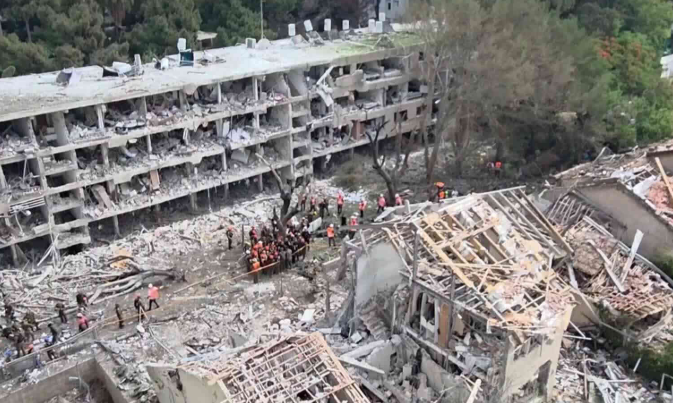
 

Above: Damage to Tel Aviv from Iranian missile strikes       Source: www.msn.com


The US peace initiative between Israel and Iran is to be welcomed although it cannot be regarded as an example of skilful diplomacy by Washington. It is more in line with an act of desperation by the Trump administration; a changing balance of forces across the Middle East has had serious implications for traditional hegemonic and diplomatic relations. The terminology used by the US has carried the hallmarks of a panic stations mentality.

Secondly, the recent problems in the Middle East, caused by Israel, have been the outcome of a failed US-led regional policy. Washington and the Pentagon, therefore, plan to move on, halting too much damage to Israel, and its regional role as their loyal 'hub' for 'US interests'.

 The hasty and problematic US peace initiative between Israel and Iran in late June has shown how serious the limited war between the two countries was for Washington and the Pentagon. Conducted in a blaze of Trump-style diplomacy following his hasty departure from the G7 summit, it was what was not openly stated that was, and remains, of vital significance and importance.

It was openly stated, for example, that Trump and his entourage left early 'because of what's going on in the Middle East'. (1) In some ways it was, but not completely due to the Israel-Iran war. Other factors were at play, raising serious considerations for the US.

A changing balance of forces has taken place across the Middle East, with far-reaching implications for US-led regional diplomacy and traditional hegemonic positions.

The rise of BRICS, and their ability to recruit further members, including Iran, has presented a serious challenge to NATO countries and their traditional allies. (2) Iran is a centre of Islam. The second-tier recruits to the BRICS international trade organisation also include Saudi Arabia, UAE, Egypt and Indonesia, together with further additional 'partner states'; about forty countries have already expressed an interest in BRICS (3) One application, Palestine, is already under consideration, with a vote due to take place in the United Nations over its existence and international status, which will enhance its BRICS application.

While the Middle Eastern additional members of BRICS will enable a challenge to US ready access to oil reserves, Iran has the second biggest natural gas reserves in the world, and Gaza has similar reserves offshore. (4)

In fact, the BRICS countries, collectively, already have 41 per cent of global GDP; the G7, by comparison, have only 29.08 per cent. (5) The growing imbalance is set to grow. In the short-to-medium term it will act as a pincer upon the US and its allies, in the long-term it will render them as being on the wrong side of history. The position of the US is increasingly untenable, as the combined weight of the G7 have difficulty getting into the first hundred league of countries and their GDP growth rates.

It has caused the Trump administration to seriously re-think its options, which were traditionally based in regional foreign policy implemented decades ago.

While Israel was always intended as a regional hub for 'US interests', part of its role was to implement a policy of 'constructive chaos' designed to weaken other countries regarded as adversaries to traditional US hegemony.

During the Bush administration twenty years ago, then Secretary of State, Condoleezza Rice, stated the US military operations in the region were designed to create the conditions for 'the birth pangs of a new Middle East'. (6) The US sought to create a new order which they could control more effectively. It emerged from the intelligence premise and assessment that 'real power cannot be exerted if one remains in the status quo, but only, quite the contrary, in the act of destroying all forms of resistance. It is only by plunging the masses into chaos, that the elites can aspire to ensure the stability of their position'. (7)

And that is what Israel has precisely done on behalf of the US across the Middle East: destabilising, bombing and illegally occupying neighbouring countries. Until, that is, a credible challenge took place from BRICS and Iran. It, therefore, sent the US into damage control, searching for further options. They continue to search.

It is no coincidence that the Trump administration has demanded NATO member countries increase their contributions to the organisation, immediately, and later, by at least five per cent of GDP by 2035. It is a way in which the US can challenge opposition. In fact, it remains the only way. The reaction of the NATO members to the demands of the Trump administration has, however, been a spectacle in itself. Most have been extremely reluctant to commit their governments to substantial increases in defence expenditure.

The fact that Iran was able to successfully bomb Israel by damaging its Iron Dome system by launching large-scale bombardments overloading the sophisticated radar has also sent the Pentagon scuttling away with their tails between their legs. (8) It was noted with alarm, for example, that, 'those new threats', had serious implications. (9) And they have, with evidence not particularly difficult to establish. The world's media are full of it.

Once able to bomb other regional countries with impunity while pursuing the constructive chaos policies, Israel is now, however, faced with its own bill for 'hundreds of buildings have been destroyed or heavily damaged, and will cost hundreds of millions of dollars to rebuild or repair'. (10) Much of Israel's economy has also been 'shut-down … as a result of the Iranian strikes'. (11)

The cost of the constructive chaos policy has also proved very expensive: it was noted from reliable sources that, 'the mounting costs add to pressure upon Israel to wrap up the war quickly'. (12) Which is what happened. The media coverage of the role of the Trump administration in the cease-fire between Israel and Iran has been couched in terminology more characteristic of an act of desperation. It was not level-headed diplomacy.

But with the scale of the problem confronting the US, it was to be expected.

The fact that the Trump administration, subsequently, had to deal with a leak of sensitive intelligence material from inside the Defence Intelligence Agency which noted the US 'strike on Iran did not destroy its nuclear program', has revealed a chaotic state of affairs at the highest levels of administration in Washington and the Pentagon. (13)

The costs, for the US, likewise, have acted as a brake upon their foreign policy: a substantial part of their US$939 billion defence budget has been allocated toward the defence and security of Israel. (14) It has not proved an investment, but to the contrary, a serious drain upon their increasingly limited resources. The so-called US Operation Midnight Hammer 'saw the deployment by the US of 125 aircraft and 75 precision-guided weapons in strikes on three Iranian nuclear facilities'. (15) It was not a peripheral costing.

Continued US diplomatic initiatives to defend Israel have also added to their increased diplomatic isolation in forums. Even Albanese has to pretend to be adopting greater “independence within the Alliance”.

In conclusion, with Indonesia, as a prominent BRICS member and the world's most populous Muslim nation, now pushing for 'international recognition of Palestine as a sovereign state', in a major diplomatic forum for Islamic Co-operation, the pincers are already closing tightly upon US involvement in the Middle East. (16)
 
Countries across the Middle East, excluding Israel, likewise, now appear to be weighing up their options and diplomatic positions, in terms of the dominant religion and future trade relations, between themselves and outside countries.


1.     Trump abruptly leaves G7, Politico, 16 June 2025.
2.     Medium – The rise of BRIC's and decline of NATO., Information Warfare Magazine, 4 February 2025.
3.     Ibid., and, 'Which new countries', The Birch Gold Group, 2 May 2025.
4.     Behind Israel's 'end games' for Gaza, The International Action Center, 14 November 2023.
5.     BRICS expands with new partner states, G.E., 25 December 2024.
6.     The Neo-Conservatives and the Policies of Constructive Chaos, Voltairenet, 28 July 2006.
7.     Ibid.
8.     How Iran broke Israeli air defences, VOX., 19 June 2025.
9.     Ibid.
10.   Golden drain: Bibi's $620m-a-day war, The Weekend Australian, 21-22 June 2025.
11.   Ibid.
12.   Ibid.
13.   'Loser': White House, The New Daily, 25 June 2025.
14.   Counting the huge cost of Trump's hammer blow, Australian, 25 June 2025.
15.   Trump's 24 hours of turmoil, Australian, 26 June 2025; and, Counting the cost, ibid., Australian, 25 June 2025, which has provided a full list of costs for Operation Midnight Hammer.
16.   Jakarta call for Islamic unity to halt conflict, Australian, 24 June 2025.

Tuesday, February 6, 2024

Iran, Iraq and the isolation of US imperialism in the Middle East


Above - Iraqis call for removal of US troops in 2020 following US assassination of Iranian military leader Qassem Soleimani 
Image: Thaier Al-Sudani/REUTERS

Written by: (Contributed) on 7 February 2024

High-level diplomatic talks between the Iraqi and US governments about a US military withdrawal from the country reveal the changing balance of forces across the region has had its effect upon the ruling presidential administration of Abdul Latif Rashid in Baghdad. US policy against the Iranian Revolution in 1979 and since has rebounded; the Middle East has responded, effectively challenging traditional hegemonic positions, and pushing Iran into a regional leadership position. Despite huge financial budgets for their military incursions into the Middle East, the US have not achieved either their initial objectives or any realistic lasting presence in the region.

When the masses in Iran rose up in 1979 and ousted the Shah and established and Islamic Government under Ayatollah Ruhollah Khomeini, the US lost one of its most loyal allies in the Middle East. The Shah was a US puppet - he 'remained the lynchpin of America's anti-Soviet efforts in the Middle East'. (1) In fact, he had been installed 'with the assistance of the CIA and Britain's SIS in 1953 in a coup organised against the left-leaning government of Dr. Mohammad Mossadeq'. (2) The motive left little to the imagination; US interests were the order of the day. It was noted that 'the catalyst for this action was Mossadeq's imminent nationalisation of western interests in Iran's oil industry … the … CIA subsequently provided organisational and training assistance for the establishment of an intelligence organisation for the Shah … and was placed … under the guidance of US and Israeli intelligence officers in 1957'. (3)

Five decades later the US has been left with the legacy of their interference in Iranian affairs; while creating a Cold War diplomatic position toward the Islamic Republic in 1979, the US has not achieved its objectives. In fact, they have proved counter-productive.  

It has given rise to three significant developments:

Firstly, a changing strategic relationship between Iran and its Arab neighbours, linked to the uncertainty about the future of the US role in the region. (4) Iran's initial relationship with its closest neighbours, for example, was strained; while the country was regarded as the centre of Islam, Iranian involvement with US interests was problematic. Slowly, however, the US Cold War position pushed Iran into a leadership role against US interests across the region.

The establishment of a Revolutionary Guard in Iran under a decree issued by Khomeini on 5 May 1979 with 'the ultimate responsibility of guarding the revolution itself', saw Iranian operatives form links with like-minded groups and organisations. (5) Its tentacles now spread across the wider region and into a multitude of armed and opposition groups.

It is, therefore, not surprising to observe Hamas in Gaza, establishing links with Iran. While differences exist between different strands of Islam, the common goal of ridding the region of US interests can be regarded as a binding force.

Secondly, Iran's growing capabilities for asymmetric warfare can be regarded as a serious challenge for US interests. (6) While maintaining a large standing army of regular forces, Iran has also forces trained in unconventional warfare: guerilla tactics, insurgency, rebellion, terrorism. Their influence has grown with the changing balance of forces following the failure of western backing of anti-Assad groups in Syria and the growing influence of Russia, Syria and Turkey, across the Middle East; US backing for anti-government forces and the so-called Arab Spring, was a serious mistake. It has rebounded upon Washington and the Pentagon; their initial intelligence assessments were clearly flawed.

Finally, Iran's success in creating more effective air-defence systems including drones, can be regarded as a serious challenge to US-led military hegemony across the wider region. (7)

The recent attack of a US military facility in Jordan and high-level diplomatic talks between Baghdad and Washington have to be assessed in that context.

The attack, by the Islamic Resistance in Iraq, on a secret US Tower 22 military facility in Jordan, close to the borders with Iraq and Syria, took the US by complete surprise. The pro-Iranian militia used a drone to attack residential quarters, killing three service personnel and injuring many others. (8) It was part of a program which has included at least 165 similar attacks on US interests across the region since last October, with serious implications. (9) A pro-Israeli intelligence source, for example, has noted that as 'the war in Gaza heads into its fifth month … it has brought … the region to the brink of full-blown conflict'. (10)  

The Iraqi Prime Minister, Mohamed Shia al-Sudani’s call for a withdrawal of US troops from the country has also led to high-level diplomatic talks; Deputy Pentagon press secretary Sabrina Singh recently issued a statement noting 'the US footprint in Iraq will certainly be part of the conversations as it goes forward, indicating that Baghdad's desire for a reduction in these forces was on the table'. (11) A statement from Baghdad, however, revealed that the Iraqi government was attempting to 'ease pressure  … from … militia groups to oust US forces'. (12) There is no wish to prolong the US presence.

The US, at present, has 2,500 military personnel in Iraq together with 900 based in Syria, and a further 900 deployed elsewhere. (13) Their longer term future is questionable. It is unlikely they will have a lasting presence, as the balance of forces continues to slowly swing away from previous US hegemonic positions. A recent statement issued by Hamas, for example, noted 'the continuation of the American-Zionist aggression on Gaza risks a regional explosion'. (14)

It should be noted, furthermore, that during the 2001 to 2019 period, the US Department of Defence has estimated regional operations had been costed at between $2,002.4 to $2,106.2 billion. (15) There has been comparatively little gained for the massive financial costs, and the position of the US, in general, would now appear precarious.


1.     US foreign policy and the Iranian Revolution, Christian Emery, (London, 2012), page 2; see also, Project Dark Gene / Project Ibex, www.spyflight.co.uk / dark gene.htm; and, Iran / RSA, Le Monde Diplomatique, December, 1976; and, Project Dark Gene and Project Ibex, Tom Cooper and Art Kremzel, www.acig.org
2.     Espionage, Spies and Secrets, Richard M. Bennett, (London, 2002), pp. 142-46.
3.     Ibid.
4.     Iran and the changing military balance in the Gulf, CSIS., 20 March 2020.
5.     Ibid.
6.     Ibid.
7.     Ibid.
8.     Three US troops killed and 34 hurt, The Sun, 28 January 2024.
9.     Drone mix-up blamed for deaths, Australian, 31 January 2024.
10.   US pushes for deal to end war, Australian, 2 February 2024.
11.   America, Iraq to hold talks on troops, The Weekend Australian, 27-28 January 2024.
12.   Militia to suspend attacks on US, Australian, 1 February 2024.
13.   Australian, op.cit., 31 January 2024.
14.   President vows revenge for dead troops, Australian, 30 January 2024.
15.   CSIS., op.cit., 20 March 2020.


Thursday, January 30, 2020

Trump’s phony Middle East peace plan and declining US power


Written by: (Contributed) on 31 January 2020 

With Israeli PM Netanyahu in Washington for meetings with President Trump to launch a US-led 'so-called' peace initiative in the Middle East, it is important to relate the diplomacy to some other developments with far-reaching implications for Israel.

A recent high-level diplomatic and intelligence assessment about the Middle East revealed deteriorating US fortunes in the region. Washington and the Pentagon are losing leverage against forces emerging from the Syria conflict: Iran, the Russian Federation and Syria.

In Lebanon, likewise, a changing balance of forces has some considerable bearing upon Tel Aviv.

Netanyahu and his political rival, opposition leader in the Knesset, Benny Gantz, travelled to Washington for Trump’s announcement. While billed as a major US-led peace initiative, the round of meetings was really an act of desperation amongst the three players. Israel, a major hub for 'US interests' in the Middle East, has entered a prolonged period of political instability. Israelis return to the polls on 2 March for their third general election in twelve months.

Behind the scenes long-time political leader Netanyahu is facing serious problems and has been formally charged with fraud, bribery and breach of trust. He has also formally dropped his request for parliamentary immunity if found guilty. President Trump, likewise, has impeachment proceedings pending, which may see him removed from presidential office by legal procedures.

The Washington meetings focus upon a fifty-page report outlining US proposals, thirty pages of which concentrate upon economic reforms which have already been rejected by the Palestinians last June. (1) The fact that no Palestinians have been included in the round of Washington talks and discussions shows quite adequately the position of the Trump administration.

The Trump peace plan offers a phony “two-state solution” which legitimises Zionist military occupation and control of the Palestinians and gifts to Israel the illegally occupied territories seized by so-called “settlers” in areas covering a third or more of the West Bank.  It does not take genuine Palestinian statehood into consideration. It is, therefore, hardly surprising that Palestinian President Mahmoud Abbas distanced himself from the peace plan, stating 'this conspiracy deal will not pass'. (2) As Palestinian protests were already taking place in opposition to the plan, President Abbas was meeting various groups and factions in Ramallah to discuss a plan of action.

Dr. Eyal Mayros of the University of Sydney says that 'Trump is the most pro-Israeli president ever … his base is made up of evangelists, the conservative wing … (of) the pro-Israeli lobby'. (3) As the Trump administration plays toward its supporters in the lead-up to presidential elections, his advisers seem to have overlooked a recent high-level diplomatic and intelligence assessment which found its way into the public domain in a rather timely manner.

In mid-January readers of the Australian newspaper had the opportunity of studying an article 140 column cms in length which included photographs and a chart listing US military capability in the Middle East, by Martin Indyk, a former US Ambassador to Israel and holder of various other titles linked to peace initiatives with Israel and the Palestinians. Entitled, Time to leave the Middle East, the article left readers in little doubt about the crisis facing the US. (4) It has also been interesting to note it has been met with diplomatic silence from the pro-Israel lobby and their Christian-Zionist supporters.

Indyk draws attention to the changing balance of forces in the Middle East, with the US having to now contend with Iran, the centre of Sh'ia for the world's Muslims. He also stated recently that 'few vital interests of the US continue to be at stake in the Middle East'. (5) He subsequently continued noting that 'there has been a structural shift in US interests in the Middle East, one that Washington is having a hard time acknowledging'. (6) Realising other forces have now managed to become players in regional diplomacy, Indyk stated the US 'should start courting European allies' for support when dealing with Iran and co-ordinating diplomatic initiatives with both the Russian Federation and China.

Interestingly, Indyk also draws upon support for a two-state solution and while acknowledging it 'is not a vital US interest', puts forward the case that 'it is a vital Israeli interest if the country wants to survive'. (7) Indyk, unlike Trump and his administration, has been able to analyse developments and forsee a logical outcome. The two-state solution which falls comfortably into United Nations diplomatic positions has also formed the basis of Palestinian positions for statehood since 1988. Successive US presidential administrations have always vetoed the position and chosen pro-Israeli positions.

Within the wider region another problem is brewing for the US.

In January, the announcement from Beirut that a new government was taking office in Lebanon led by a Hezbollah-backed candidate, Hassan Diab, has presented Israel with a direct challenge. Hezbollah, a Sh'ia political organisation backed by Iran, has amongst its strongholds the southern part of the country facing the northern part of the Israeli State. The development must have sent shock-waves into the very heartlands of the Israeli State.

Observers to the developments have already noted that 'Lebanon has become another arena in the open US-Iran showdown', which has also provided further evidence of the changing balance of forces across the region. (8)

According to reports,  Diab has appeared to have been chosen by Hezbollah as 'a relative political outsider to distance the new government from the ruling class that has governed Lebanon since the end of the civil war in 1990', which would appear to signify a radical departure from the previously existing domestic political positions of established parties. (9)

With Diab installed as prime minister within the twenty-member coalition, the US has been forced onto a back-foot position; while the Pentagon has provided aid and training for the Lebanese military, the Trump administration have already announced that they regard Hezbollah as having infiltrated the security apparatus of the country. (10) The fact Diab has appointed a female cabinet minister, Zeina Aker, with the Defence portfolio, is also a radical departure from previously existing norms.
While key Trump officials have already stated they want to cease US aid to the new coalition government, the country has, nevertheless, remained sensitive and a strategically-placed ally for containing Iranian influences. Last year, the US temporarily stopped $100 million of security-based aid. 

When dealing with the Trump peace plan and other Middle Eastern diplomatic initiatives from his administration, Indyk’s view that 'we need a sustainable Middle East strategy based on more realistic assessments of our interests' has shown how US foreign policy toward the region has become haphazard and based on out-dated diplomatic positions. (11) The fact that his article is entitled 'Time to leave the Middle East', leaves little to the fantasies and imagination of those residing in the White House who hanker for a long-lost past when US imperialism could snap its fingers and compliant governments fell into place. It exists no longer; previous positions would now appear to be rapidly falling apart.

With Australia slavishly following US-led foreign policy across the globe, which has included troop deployments into Middle East trouble-spots including Iraq, senior decision-makers in Canberra should perhaps give the Indyk article a read and ponder on the logical outcome of their sycophantic diplomatic behaviour:


                                      We need an independent foreign policy!


1.     Donald Trump's peace plan unveiled, The New Daily, 29 January 2020.

2.     Palestinian to 'resist deal in all its forms', Australian, 30 January 2020.

3.     New Daily, op.cit. 29 January 2020.

4.     Time to leave the Middle East, Australian, 20 January 2020.

5.     Ibid.

6.     Ibid.

7.     Ibid.

8.     Failure of Diab's government, Arab News, 28 January 2020.

9.     Hezbollah man to lead Lebanon, Australian, 23 January 2020.

10.   Ibid.

11.   Australian, op.cit., 20 January 2020.


Thursday, January 16, 2020

Morrison follows US into Middle East conflict

Written by: (Contributed) on 16 January 2020

(Above: Filipinos protest outside the US Embassy in Manila January 6.  Millions of Filiinos work in the Middle East)

Moves by the Morrison coalition government in Canberra to follow US-led military operations in the Middle East, have set Australia on a collision course and war-footing in the region.

While US-led Operation Manitou is primarily concerned with security around the Strait of Hormus, there are clearly wider regional considerations.

US foreign policy toward the Middle East has entered a period of crisis, the outcome of failures to act upon accurate military assessments: as the balance of forces has swung away from US imperialism, Washington and the Pentagon have become desperate to deal with Iran, which has become a dominant player, and its allies which provide Tehran with diplomatic support.

In mid-January the Australian frigate HMAS Toowoomba with a crew of 190 naval personnel joined the US-led Operation Manitou. The stated aim of the operation was couched in diplomatic jargon and stated its 'primary aim is to promote security and stability in the Strait of Hormuz – but with tensions continuing to simmer between Iran and the US – the waters of the Middle East may be more difficult to navigate than normal'. (1)
 
The military exercise has followed decisions taken in Britain to send two Royal Navy vessels to the Gulf, a destroyer HMS Defender and a frigate HMS Montrose. While the stated reason for the British involvement was to provide escort facilities for oil tankers in waters close to Iran, it has also taken the form of an escalation of diplomatic tensions with Tehran.
 
Operation Manitou clearly has wider regional implications as the US remains desperate to regain lost positions of domination and control. It is not particularly difficult to establish their predicament: US-led regional foreign policy has fallen into a number of distinct phases, each one ending in failure to achieve planned military objectives.
 
The initial invasion of Iraq, accompanied by similar moves in Afghanistan, was followed by support for the demonstrators of the so-called Arab Spring which toppled a number of governments. What tended to follow were highly unstable administrations across the Arab world, where political vacuums were quickly filled by international jihadists: US-controlled 'intelligence assets' funded through their strategic ally, Saudi Arabia.
 
It is not difficult, therefore, to observe why many of the residents of the region have little time for the US. The personal security of millions of people has been compromised, together with huge numbers of asylum-seekers fleeing for safety. Someone might like to notify the Pentagon, if you invade somewhere you are subsequently responsible for the defence and security of the land on which you stand. A sensible observer might, therefore, like to question why whole families from the region walked into Europe to settle in Germany; it is a very long way to travel, to do so on foot reveals the desperation of those fleeing.
 
The US-led Operation Manitou has followed soon after a joint naval operation with Iran, China and the Russian Federation, Operation Marine Security Belt (MSB), in the Gulf of Oman and Indian Ocean last December. The area, historically, had relied upon the US Fifth Fleet, based in Bahrain since the mid-1990s. The joint operation provided clear evidence of the changing balance of forces across the wider region.
 
An official media release from Tehran by Iranian Admiral Gholamreza Tahani about Operation MSB, for example, announced that 'the message of this exercise is peace, friendship and security … to show Iran cannot be isolated'. (2)
 
The fact Operation MSB took place near Oman while Omani leader Sultan Qaboos bin Said was on his death-bed, dying of an undisclosed illness, sent shock-waves into the heartlands of the Pentagon; Oman has long been a strategic hub for US-led regional operations. (3) The scale and military planning of Operation MSB would have been unthinkable a decade ago.
 
Following the end of war hostilities in Syria, forces grouped around Iran, which include the Russian Federation and Syria, have become a much stronger regional influence. Iran has been able to extend diplomatic links and become a major regional player, as the centre of Sh'ia for the world's Muslims. The development has enabled governments to pursue policies with a sense of self-confidence, effectively reducing US influence.
 
Far-right military hawks have, therefore, been in the ascendency during the Trump administration; the attention has remained clearly focussed upon Iran. (4) A recent media release noting that the administration had identified 52 Iranian targets with a view to a massive bombing campaign, is evidence of the extensive use of electronic warfare facilities with satellite-imaging and drone surveillance over the country. (5) The hawks, however, are also focussed upon other countries where Iran has favourable diplomatic links.
 
The Russian Federation, likewise, has become a major player in the region; strong diplomatic links with Turkey have included the Erdogan administration purchasing an S-400 missile system from Moscow, and recent threats to close two strategically-placed US bases used for Middle East operations have been met with characteristic diplomatic silence from Washington. The US imperialists are deeply concerned at developments taking place, beyond their control.
A recent announcement that Iraq was considering buying a similar missile system from the Russian Federation followed by a recent unanimous vote in the Baghdad parliament to expel the US military from the country have shown just how far forces have swung against the US. (6)  The position of the Russian Federation toward Iraq would appear also straightforward; a media release recently noted 'Iraq is a partner of Russia in the field of military-technical co-operation'. (7) The Pentagon, likewise, is well aware the missile system 'could compromise its security'. (8) The diplomatic situation in Iraq and elsewhere across the region, therefore, remains tense.
 
Recent developments in Iraq follow a disaster for US diplomacy where US Brigadier William Seeley informed his Iraqi counterpart in a personal letter that 'American troops were preparing to leave Iraq', and, 'we respect your sovereign decision to order our departure'. (9) The Pentagon, however, quickly responded with an official statement the letter 'was sent by mistake'. (10) The Morrison coalition government in Canberra appear to have slavishly followed the Pentagon position with an announcement that no decision had been taken to 'withdraw Australian troops from Iraq'. (11) Australia has 300 military and diplomatic personnel in the country. 
 
The developments were not unnoticed by Iraqi people; while the confused diplomacy was taking place, groups of pro-Iranian demonstrators stormed the US embassy compound in Baghdad. The Pentagon responded with rapid deployment of Marines to safeguard their main diplomatic premises. (12) 
 
For the record it is important to note that the US has already spent US$5 trillion in Iraq, and lost seven thousand military personnel in a failed attempt to stabilise a central country in the Middle East after initial military occupation nearly twenty years ago. (13) The US imperialists are unlikely to see any upturn in their fortunes. They are quite clearly not in control of developments taking place inside Iraq, or elsewhere in the region.
 
China, likewise, has become a major player in the Middle East, with favourable links with Teheran and the building of the One Road, One Belt logistics system using Syria as a hub on the trade route. China's involvement has further assisted in the changing balance of forces, adding weight to Russian Federation involvement. The two countries’ combined military strength has equalled that of the US.
 
Amid the general confusion with US foreign policy toward the Middle East, the Morrison coalition government in Canberra have now joined Operation Manitou. It can only send signals to countries in the region about Australian military connivance with the Pentagon. The fact that the military exercise has been accompanied by the US sending 3,000 troops to the region in an operation which has been made subject to high levels of classification has been regarded as a 'highly unusual' procedure by the White House. (14) It remains to be established just what the US are attempting to do with their regional foreign policy; something would appear to be in the offing with military planners.
 
Australia has also been placed in a situation where military exercises might escalate into real-war scenarios very quickly. The fact that an official Australian Defence Department media release about Australian involvement with Operation Manitou was given the heading 'Our troops to stay in Iraq', leaves little to the imagination for sensible people about involvement in wider regional operations and what is really going on. (15)
 
Sensible Australian people would usually stand back in such a situation and distance themselves from fighting wars far-away from our own region and where the people of the Middle East are developing new options which do not include subjugation to traditional US-led hegemonic positions. Australian involvement with Operation Manitou can only end in the fiasco of US-led foreign policy when even a recent Australian editorial noted 'the US had become an impotent observer in the Middle East'! (16)
 
We need an independent foreign policy!

1.     Cheers, tears and fears when navy duty calls, Australian, 14 January 2020.
2.     China, Russia join Iran in patrolling strategic Gulf oil routes, Australian, 30 December 2019.
3.     Steady as it goes for Oman's new ruler, Australian, 13 January 2020.
4.     'Everyone' wants revenge, Australian, 6 January 2020.
5.     Trump nominates 52 Iranian targets, Australian, 6 January 2020.
6.     Russia suggests selling S-400 missile system, Middle East Eye, 7 January 2020.
7.     Would Iraq really purchase S-400? The National Interest, 9 January 2020.
8.     Middle East Eye, op.cit., 7 January 2020.
9.     Esper shoots down letter on Iraq pullout, Australian, 8 January 2020.
10.   Crack troops rushed to Iraq, Australian, 2 January 2020.
11.   Morrison delays decision on Aussie troops in Iraq, Australian, 6 January 2020.
12.   Australian, op.cit., 6 January 2020.
13.   Australian, op.cit., 8 January 2020.
14.   Australian, op.cit., 6 January 2020.
   
15.   Our troops to stay put in Iraq, Australian, 10 January 2020.
16.   Editorial: An unholy Middle East alliance, Australian, 30 December 2019.

Sunday, January 5, 2020

Condemn US Gangster Violence in Middle East

Written by: Nick G. on 6 January 2020 

Gangsters have always been present within the US capitalist economy.  Acting illegally, they ruthlessly eliminated competitors and killed whoever was in their way.  They stood over people, intimidating them with threats and enforcing protection rackets. 

US imperialist foreign policy is a gangster policy, albeit one that tries to drape itself in the fig-leaf of domestic and international legality. Mao Zedong correctly said of imperialists that they “will never lay down their butcher knives, that they will never become Buddhas, till their doom.”

The targeted assassination of Iranian military leader Qasem Soleimani, commander of Iran's Islamic Revolution Guards Corps (IRGC) Quds Force, and Abu Mahdi al-Muhandis, deputy chief of Iraq's paramilitary Hashd Shaabi forces, in a strike near Baghdad airport on January 3, is a case in point.

Their murders were ordered by US President Trump, without recourse to the fig-leaves of Congress or the United Nations.  Trump has blamed Soleimani for the death of a US civilian contractor on December 27 near Kirkuk.  On December 29, the US bombed Iraq’s Kataeb Hezbollah bases in western Iraq and western Syria, killing 25 and injuring 51.  Hundreds of pro-Iranian Iraqis stormed the US embassy on December 31, setting fire to parts of it.

US weakening, resorts to more violence

The US imperialists are losing their grip over the Middle East.  They have been unable to overthrow Syria’s elected President Assad, and have been outmaneuvered in the Syrian conflict by imperialist Russia.  Iran, through Soleimani, has played a major supportive role for Assad and also drawn closer to Iraq.  As we reported recently, the Russians, Chinese and Iranians have just concluded naval exercises that challenge US control of the Straits of Hormuz and into the Indian Ocean.

Indeed, Soleimani was killed after having arrived in Baghdad on a diplomatic visit to Iraq’s caretaker Prime Minister Adel Abdul Mahdi. 

The Iraqi Prime Minister revealed that the purpose of Soleimani’s visit was to deliver a message from US ally Saudi Arabia that may also have had repercussions for US leadership over its stooges in the region.

"I was scheduled to meet martyr Soleimani at 08:30 in the morning," the prime minister said on Sunday.

"He was killed because he was set to deliver a response from Iranians to a Saudi message, which we delivered to the Iranians to reach an important breakthrough in the situation in Iraq and the region."

The all-round weakening of US imperialism in the region has forced it to rely increasingly on violence to assert its authority.  But it is lifting a heavy rock and has dropped it on its own feet. The mood in Iraq has hardened. The language used by the Prime Minister in denouncing the US bombing is illustrative: he strongly condemned the attack, calling the assassination of al-Muhandis "an aggression against Iraq, its state, its government and its people." And in the wake of the attack, the Iraqi Parliament has passed a resolution calling for the expulsion of US troops from the country.  The resolution also says "the Iraqi government must work to end the presence of any foreign troops on Iraqi soil and prohibit them from using its land, airspace or water for any reason", and tells the government to file a formal complaint to the UN against the US "for its serious violations and breaches of Iraqi sovereignty and security".

Iran has vowed revenge for the assassination of Soleimani, a popular symbol of anti-imperialist feeling in the region, and has announced it was removing all limits on its enrichment of uranium.

Pointless calling for “restraint”

Calls for restraint have come from members of the US imperialist bloc (Britain and the European Union).  Social-imperialist (“socialist in words, imperialist in deeds”) China has also called for restraint.  It is unlikely that they can collectively impose their will on the US imperialists or the Iranians. They certainly will have little influence on the working classes of Iraq and Iran, who have spent recent months fighting for their own rights and whose joint interests are best served by intensifying the struggle against imperialism and persevering in fighting for democratic rights.

China has “interests” that it seeks to expand in ways other than direct military conflict, at this stage, with the US. According to a report in the Chinese Global Times, “Chinese purchases of oil from the Middle East lead the world by volume, which means China is far more dependent on the region's oil than the US. China also has large investments in Iran, Iraq and many other Middle Eastern countries already linked to China's economic interests”. The article stated that “China should offer sympathy to Iran as a way of balancing the regional situation. Other countries should provide condolences to Iran instead of provoking it to fulfill its vow of revenge.”

However, Trump has already rejected calls for restraint.  He tweeted that the US has "targeted 52 Iranian sites," some "at a very high level & important to Iran & the Iranian culture, and those targets, and Iran itself, WILL BE HIT VERY FAST AND VERY HARD". 

He has also indicated that in addition to the 5000 US troops currently in Iraq, another 3000 will be sent.  And if the Iraqi government dares to implement its demand that US troops leave the country, he promises to hit them with the weapon of sanctions. Speaking to reporters on Air Force One, President Trump said the United States would put “very big sanctions on Iraq” if the country forced out U.S. troops.

“If they do ask us to leave, if we don’t do it in a very friendly basis. We will charge them sanctions like they’ve never seen before ever,” Trump said. “It’ll make Iranian sanctions look somewhat tame.”

No sanctions! No war! Imperialists out!

Australians must be under no illusions about the danger of a weakened US imperialism resorting increasingly to violence. We must demand an end to the US bullying practice of imposing sanctions left, right and centre; we must oppose imperialist war plans and ensure that Australian government grows some spine and stops following the US into its wars; and we should intensify our own fight against imperialism and for national independence and socialism.

The threat of war will exist so long as there is imperialism.  It is timely to remember Mao Zedong’s advice in the face of imperialist war preparations in the 1950s:

People all over the world are now discussing whether a third world war will break out. On this question, too, we must be mentally prepared and do some analysis. We stand firmly for peace and against war. However, if the imperialists insist on unleashing another war, we should not be afraid of it. Our attitude on this question is the same as our attitude towards any disturbance: first, we are against it; second, we are not afraid of it. The First World War was followed by the birth of the Soviet Union with a population of 200 million. The Second World War was followed by the emergence of the socialist camp with a combined population of 900 million. If the imperialists insist on launching a third world war, it is certain that several hundred million more will turn to socialism, and then there will not be much room left on earth for the imperialists; it is also likely that the whole structure of imperialism will utterly collapse.

On the Correct Handling of Contradictions Among the People (February 27, 1957), 1st pocket ed., pp. 67-68.