
Written by: (Contributed) on 21 April 2026
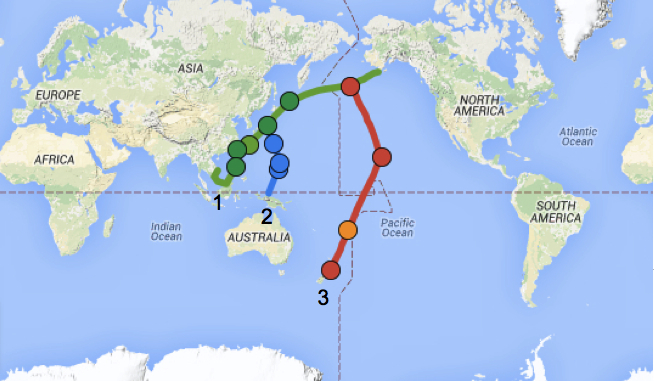
The three island chains of US military control
A Pentagon military plan to strengthen the top end of the First Island Chain has included increased reliance upon Japan. The present Takaichi government appears only too willing to oblige; couched in misleading diplomatic terminology; however, the new South-West foreign policy has a wider arc of influence than merely islands south-west of key strategic military facilities, which serve 'US interests'. The foreign policy position has, moreover, raised questions for Australia, as Japan's military partner in the Indo-Pacific region.
A major diplomatic statement from Japan, issued in early April, drew attention to it developing a South West foreign policy toward strategic islands, as it increasingly has become a front-line for the US-led Indo-Pacific Strategy (IPS) toward China. (1) In recent years the Pentagon has reverted to previous Cold War regional defence and security provision with Island Chain Theory; it has subsequently been revamped to serve 'US interests' with the onset of the present Cold War, and expanded into the Indian Ocean with fourth and fifth chains centred on Diego Garcia. (2) The Indian Ocean intelligence facility is
directly linked to similar Australian-based facilities at Pine Gap, Central Australia.
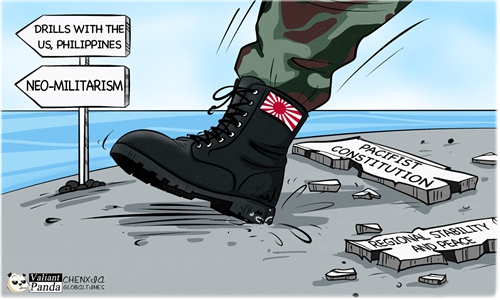
The US-Japan alliance has also been upgraded in the present Cold War to a 'global alliance'. (3) It marked the culmination of US diplomatic moves to shift Japan away from a pacifist constitution imposed immediately after the Second World War, toward a fully-fledged military power to serve 'US interests'. The moves have been accompanied by Japan's defence budget doubling during the past decade, to $77.8 billion by 2024. (4)
The position of the Takaichi government has been one of total compliance; a recent diplomatic statement issued from Tokyo announced their intentions to push for policies of 'a normal country capable of war'. (5) The issue of the 're-interpretation' of Japan's pacifist constitution, however, has proved highly contentious, amongst other countries and inside Japan itself. While the moves have been supported by other US allies, they have raised serious concerns in some Asian countries previously occupied by Imperial Japan, and also some Japanese people who fear the problems associated with militarism.
Source: Global Times
And Taiwan, and its precarious defence and security provision, has conspicuously formed part of the US-led agenda for Japan; assessments have noted that 'Taiwan is moving towards the centre of world affairs', and a regional flash-point. (6) Tokyo-Taipei diplomacy is close.
It is not difficult to calculate the extent to which the Pentagon have pushed Cold War agendas during the recent period. During the period between 1991 and 2016, Taiwan initiated about 42,000 investment projects in China; in fact, it was central to China's rise to prominence. (7) Since 2016, however, most Taiwanese businesses have relocated their China operations to other ASEAN countries, in compliance with US-led directives. (8)
The East China Sea and Miyko Strait have now also been assessed as sensitive for the wider First Island Chain, which include small islands and other outcrops which have become highly strategic. Runways are under construction on Mage Island, for example, whereas missile defence batteries and surface to air missile units have been placed elsewhere. (9)
Japan has also stationed military personnel on some islands; defence officials have verified that 'more than 10,000 Japanese military personnel are in the south-west, but several hundred each on at least four other islands'. (10) It is as if the Takaichi government has followed similar examples of policies pursued by pre-war and wartime Imperial Japan, common during the fascist period while pursuing their own far-right political agendas.
The Takaichi government has also been keen to push for the military upgrading of Japan's defence and security provision; it has followed initiatives over a decade ago for Japan to nationalise about 280 remote islands as part of military planning, despite sovereignty of some of the landmasses being contested. (11) The 'new' foreign policy has a long history.
What the recent diplomatic statement did not divulge, furthermore, was the arc from US military facilities to the islands south-west of Japan also swings northerly to the Kuril Islands and Sea of Okhotsk, which mark the beginning of the First Island Chain. (12) It has become highly sensitive in recent years with the thawing of Arctic waters, exposing sea passages north of Russia from the Chuckchi Sea and away from southerly routes. (13) The recent high-level diplomatic discourse and disagreements about Greenland are best assessed in the context. The vast landmass forms part of the access and egress into Arctic waters.
While the US has continued to fortify their First Island Chain, with military upgrading of military facilities in Japan, Taiwan and the Philippines, to restrict China's access and egress into the wider Indo-Pacific region, the northerly route, for the Pentagon, has become extremely problematic. It is largely beyond normal bounds for any direct US military involvement apart from regular spy flights from satellite systems.
These developments, with the militarisation of Japan and rapid deployment facilities, have far-reaching implications for Australia which is bound by various diplomatic agreements with Tokyo. The US-led IPS, for example, rests upon the so-called 'Quad', which has been planned to contain and encircle in China, together with other diplomatic considerations between Tokyo and Canberra. Compliance, by all concerned, remains the order of the day.
It is not idle speculation, therefore, to note that Australia could be drawn into 'real-war scenarios' by the Takaichi government eagerly following directives from the White House concerning Taiwan, or elsewhere in any one of several serious regional flashpoints:
We need an independent foreign policy!
1. Japan races to fortify island chain, Australian, 1 April 2026.
2. Websites: Island Chain Theory.
3. The reasons behind Washington's push for GSOMIA., Hankyoreh, 12 November 2019.
4. Australian, op.cit., 1 April 2026.
5. Bracing for the fallout as Japan's Iron Lady shows some mettle, Australian, 6 February 2026.
6. Australian, op.cit., 1 April 2026.
7. Ibid.
8. Ibid.
9. Ibid.
10. Ibid.
11. Japan to nationalise 280 islands, The Age, 10 January 2014; and, Japan puts disputed islands on school curriculum, The Age, 13 January 2014.
12. See: Map of the World, Peters Projection, Actual Size.
13. Ibid.


No comments:
Post a Comment