
Written by: Nick G. on 23 April 2026
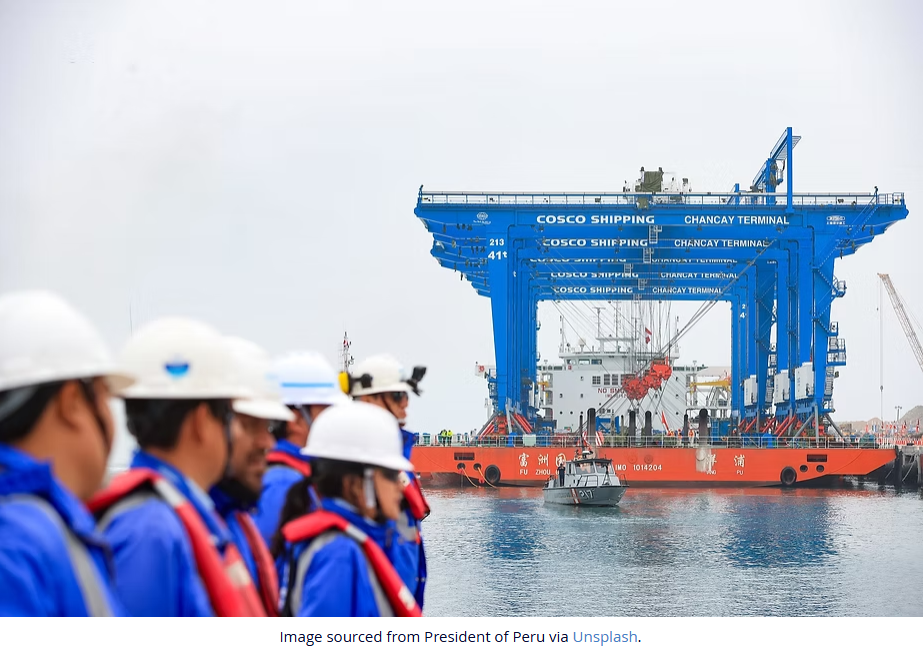
It’s a story of two imperialisms. One, trying to stave off its decline, threatens to obliterate a nation’s bridges and power plants; the other, still rising, builds ports and infrastructure.
But their aims are the same – to secure for themselves control over spheres of influence within which to extract raw materials, secure markets for their commodities, and to invest capital in the exploitation of the labour-power of the workers of other countries.
Within the broader Left, it is now quite acceptable to talk of imperialism and to label the United States as an imperialist power. It currently sits astride the globe like a colossus, demanding that all accept its hegemony, even as its feet of clay can no longer keep it standing as the king of the castle.
Chinese social-imperialism
Yet the question is not so clear in the case of the rising power, the one we label Chinese social-imperialism, because it claims to be socialist but is in reality imperialist. The term originated with Lenin during the First Great Slaughter when many European socialist parties sided with their own ruling class against the workers of other counries.
Our assessment is rejected by some who genuinely believe that China, despite the capitalist path followed since the deforms of Deng Xiaoping, remains socialist and is not imperialist. Others have their doubts about China, but argue that its rivalry with the United States has an anti-hegemonic character and is therefore welcome and to be supported.
It is obvious to all that the approaches of the two rival powers to global affairs are quite different. The US has long had economic dominance and its gun has closely followed its dollar. The other has massive amounts of capital to invest and does not yet need to blast the doors to its investments open: they are opened from the inside by local elites keen to seek alternatives to the terms sand conditions applied to economic development by the US imperialist overlords.
Starting from a much lower base than the US, the Chinese are building a formidable force of arms, outstripping the US in nuclear-armed submarine production and in the new domains of cybernetics and space.
Chinese ports, but not in China
A prime example of Chinese expansion is its acquisition of ports in foreign countries.
A list of some of the major ports includes Hambantota in Sri Lanka, Gwadar in Pakistan, Piraeus in Greece, and the Port of Djibouti in Africa. Not as large or as strategically important as these is the 99-year lease it has on the port of Darwin.
Of probably greater strategic and commercial importance is the expansion of the Peruvian port of Chancay. It has been built by China’s state-owned shipping company COSCO and the Peruvian, and now Argentinian, company Volcan.
In 2019, COSCO acquired a 60% interest in the Port of Chancay from the mining company Volcan, in which Anglo-Swiss mining giant Glencore had a stake, purchasing 23% of Volcan in 2017 for $734 million. In 2024, Glencore sold its stake in Volcan to Argentinian businessman José Luis Manzano’s private equity firm Integra Capital.
The scale of the Chancay project is enormous. It has been rebuilt as a major deep-water port with advanced technology and capable of servicing the world’s largest container vessels with an expected transfer of 6 million containers per year. It is planned to link Chancay by rail with Brazil’s Atlantic coast to facilitate export of raw materials needed by Chinese industries.
As a project financed by private capital, Chancay has aroused controversy by the Chinese partners’ insistence on Peru not having regulatory oversight of the port’s operations.
Drawing upon Article 60 of Peru’s Constitution, which safeguards freedom of private enterprise, COSCO took out an amparo, a case for constitutional protection, which was upheld by Peruvian courts in a decision on January 29 this year. The court ordered the national transport infrastructure regulator, Ositrán, to refrain from exercising its supervisory, regulatory, inspection, and sanctioning powers over the terminal’s operations.
US anxiety disorder
Not surprisingly, this has caused a certain amount of anxious pants-wetting in US circles.
Much of this has been led by R. Evan Ellis, a research professor of Latin American studies at the Strategic Studies Institute, United States Army War College.
In November 2024, he wrote: “From a military perspective, Chancay would be particularly useful as a large capacity deepwater port that could receive the largest PLA Navy warships and submarines. Its distance from the United States is sufficiently far to partially shield it from attacks by military forces coming from the Continental United States, while still allowing PLA Navy forces launched from there to influence the US West Coast.”
Following the amparo ruling, he upped the ante, writing on February 25, 2026 in The Diplomat that “in time of war, the Port of Chancay could be used to resupply Chinese People’s Liberation Army Navy (PLAN) warships operating in the Eastern Pacific, presenting a direct threat to the U.S. homeland…”
Some in the US have even speculated that Trump’s kidnapping of Venezuela’s Maduro was prompted by concerns about China’s expanding influence through Chancay, and that it was designed as a message to Latin American governments to cut ties with China, coming the day after Maduro had met with a Chinese government representative.
The imperialist and expansionist growth of China’s overseas interests are reason enough for US imperialism to plan for war with China, a war that will inflame our region and inevitably cause the US empire loyalists in the Australian government to throw in our lot with the US.
In a second article, we will review other Chinese ports mentioned earlier, as well as looking at the strange case of the port of Darwin, a Chinese-operated port adjacent an expanding US military presence in the Top End.


No comments:
Post a Comment