Showing posts with label class divisions. Show all posts

Monday, April 22, 2024

ACOSS survey and the need for a revolutionary class analysis

Written by: Alan Jackson on 23 April 2024
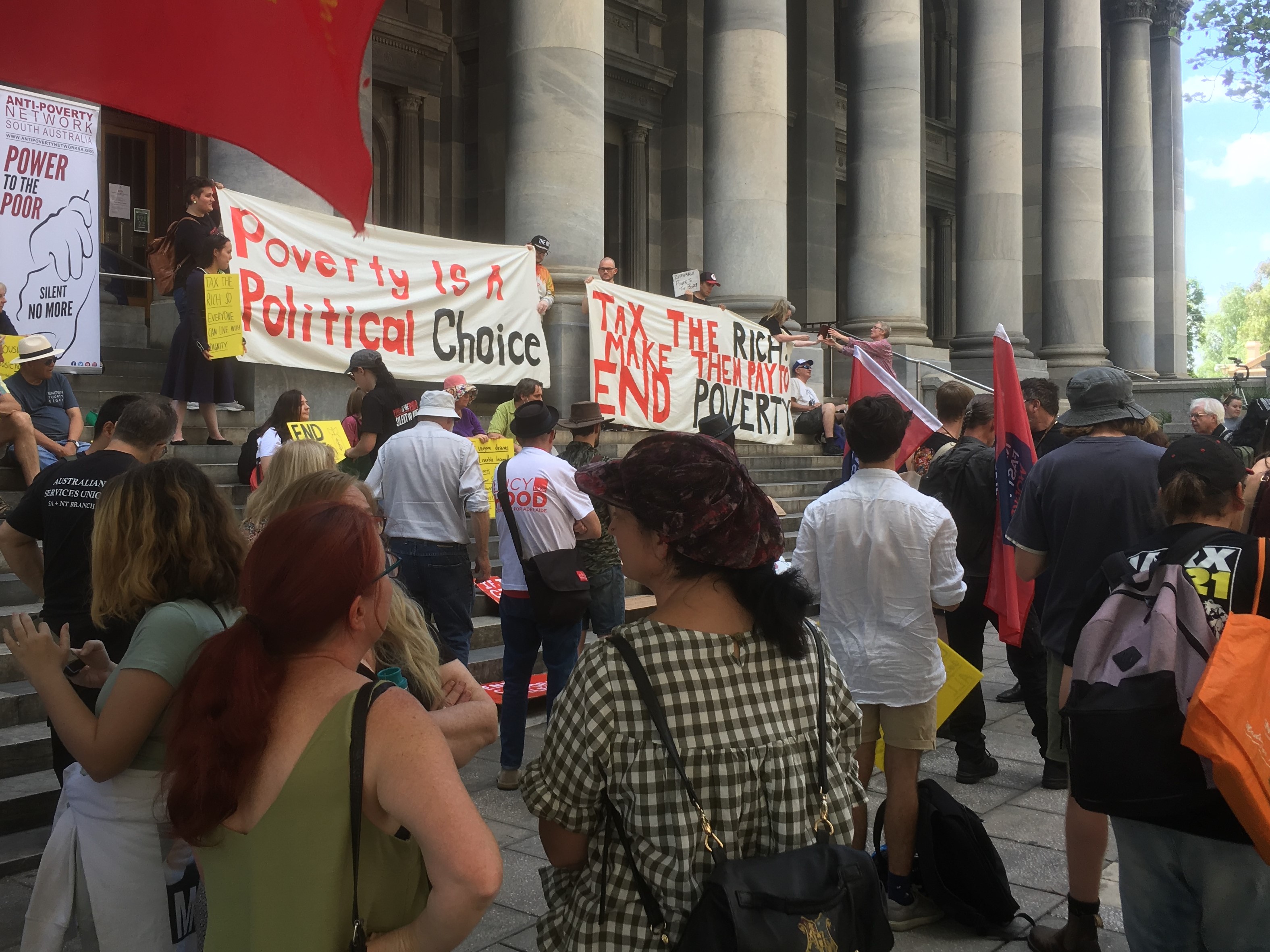
 

Above: Anti-poverty activists in 2021

Everyday life is getting harder for the average person. This is disproportionately the case for First Nations people, Immigrants, Precarious workers and Pensioners, who are being impacted the hardest in these hard times. 

History continues to show us that under capitalism the poor stay poor while the rich get richer. Time and time again history continues to show us this fact. The fundamental issue in this is Class. 

Capitalists are constantly gutting our livelihood for profit; this is inherent to Capitalism, sometimes when the economy is booming, we are able to get concessions but it is important to remember that these are simply concessions, and inevitably as the boom goes to bust, as History also shows always must bust under capitalism, our concessions are slashed and gutted and we are back to square one. 
 
Where are we now? How are these concessions? The Australian Council of Social Service (ACOSS) has released its report on poverty in Australia this year and highlights some very important insights into our situation. 
 
In the Inequality Report it states “According to the latest available data (in 2019), the highest 10% of households ranked by income had an average after-tax income of $5,200 per week, over two-and-a-half times the income of the middle 20% ($2,000) and seven times that of the lowest 20% ($800).”. (1) 
 
The gap here is extremely problematic.  While the bottom 60% of Australians are struggling the highest 10% of Australians are getting up to seven times the amount of the lower 60%. This isn’t even looking at the gap within the top 10% which starts messing with amounts of money that are conceptually hard to wrap your head around. 
 
There is clearly a very large disconnect between the highest 10% and the lower 60% which can be shown in the table below. The ACOSS also found in a previous report in 2020 that “The poverty line (based on 50% of median household after-tax income) is $489 a week for a single adult and $1,027 a week for a couple with two children, based on the latest data from the ABS.” (3.)  The table also says that the lowest 20% earns on average $794 per week. Therefore, the lowest 20% of Australians are on the poverty line. According to Centrelink’s own website you can only earn a maximum of $381 per week as a single person with no children and $408 per week with a child. With a partner the maximum you can earn is $349 per week. This puts most people on Centrelink benefits on the poverty line. (4.)

 
(2.)
The report also states that “Unequal access to employment and wages accounts for 89% of income inequality (before tax and transfers).” (5.) and that “Unequal distribution of earnings is caused by inequality of paid working hours and hourly wages.” (6.)
 
This shows that what is most important is everyone has access to constant and well-paid work. This can mean so much more than what you may think surface level. This means a home where one can sleep and survive, clothes you can wear to an interview, a phone you can use to contact potential employers, food and drink to function and so much more that is near impossible for the average person without these necessities to gain upward mobility. 
 
Not having access to transport, a home or a phone is debilitating for access to employment hurting your chances even more. These things can’t be accessed on government benefits and access is generally a matter of chance. It also reports that “Wealth inequality has escalated over the past two decades, with the highest 10% - who hold an average of $5.2m in wealth capturing almost half (45%) of the overall increase in wealth between 2003 – 2022. Of this 45%, almost half (22%) went to wealthy older households (older households in the highest 10%)” (7.)  
 
This emphatically supports the fact that the rich succeed while the poor suffer. We are in desperate need of change and the contradictions are only sharpening. This can also be shown by further statements such as “in 2019-20, the highest 10% of households ranked by income had an average $5,248 per week after tax, over two and a half times that of the middle 20% ($1,989) and six times that of the lowest 20% ($794).” (8.) 
 
They continue, saying “Wealth is divided much more unequally than income. In 2022-23 the highest 10% of households ranked by wealth (those with over $2.5 million) held 44% of all wealth, an average of $5.2 million each. This is three times the wealth of the next 30% with $1.5 million, 15 times that of the lowest 60% with $343,000 and 126 times that of the lowest 20% (with $41,000).” (9.)  and “In 2023, there were 159 billionaires in Australia with average wealth of $3.2 billion each. Their total wealth was $503 billion – so that 3.2% of all household wealth was held by 0.0007% of all adults.” (10.) 
 
Now that some of the key issues have been highlighted, what recommendations do the ACOSS make to fix these issues? In order to fix these issues, the ACOSS has suggested a few things. The policy solutions suggested by the ACOSS are: “Increase the lowest income support payments including Jobseeker Payment and Youth Allowance; Restore full employment and reform employment services for those unemployed long-term; Reduce tax concessions for investment income (such as the reduced tax rate for capital gains) that primarily benefit those with high income.” (11.) And “Reform the tax treatment of housing to discourage speculative investment that inflates home prices (such as curbing negative gearing, reducing CGT concessions and extending state land taxes to owner occupied dwellings). Remove inequities in the tax treatment of superannuation contributions; and extend the 15% tax on superannuation investment income tax to postretirement accounts, which are currently tax-free.” (12.) 
 
Whilst I would welcome these changes and, on the surface, these are quite commendable changes to the current situation, they are only short-term fixes and don’t address the root of the issue. The issue with the suggested fixes is that they are just concessions and can only be concessions. They can never become full-term solutions. The only solution is Socialism. 
 
Not only are the solutions offered only just band-aid solutions, the problem is these solutions only begin to recognise the knife that is lodged in the back of the peoples. These solutions do not remove the knife and heal the wound in our back like the late and great Malcom X once said. They simply point at the knife in our back and try to wrap a bandage over it. 
 
For immediate actions that can help take us to socialism, check out the ‘Draft Fighting Program of the Communist Party of Australia (Marxist-Leninist).’ 
 
The destruction of capitalism is the only true solution. It is only true way for the masses to heal. For a strategic approach to the destruction of capitalism, for a strategy beyond useful and necessary immediate changes, see the Party’s General Program .
 
Sources – 
1.  - Australian Council of Social Service – Inequality in Australia 2024: Who is affected and how? (Page 12)
2. – Ibid.
3. -  Australian Council of Social Service – Poverty In Australia 2022 A Snapshot (page 9)
4. - https://www.servicesaustralia.gov.au/how-much-jobseeker-payment-you-can-get?context=51411
5. - Australian Council of Social Service – Inequality in Australia 2024: Who is affected and how? (Page 12)
6. – Ibid.
7. –  Australian Council of Social Service – Inequality in Australia 2024: Who is affected and how?  (Page 13)
8. – Ibid
9. – Ibid
10. – Ibid 
11. -  Australian Council of Social Service – Inequality in Australia 2024: Who is affected and how? (Page 12)
12. - Australian Council of Social Service – Inequality in Australia 2024: Who is affected and how?  (Page 13)


Thursday, April 11, 2024

Ants and Elephants: Middle Class relations with the Imperialist Bourgeoisie and the Working class

Written by: John G. on 11 April 2024


Australia is a capitalist country. 

Big corporates rule the economy, their key owners are overseas capitalists with American moneybags top of the heap. British bosses are next in line with Japanese, German, French and other European capitalists being joined by latecomer Chinese owners.

Their involvement in the country is to make profits, either directly here or by securing resources for profit-making elsewhere, or both.  

Workers

Among Australians, the working class, the people who have to work for a living selling themselves to a boss, is the largest class. 

There’s a section who sell themselves at very generous premiums, doing very well out of looking after capitalists’ interests; managers, top bureaucrats, people doing the dirty work of policing workers in commissions like Fair Work, police and judges and the like. Many are paid handsomely to keep other workers in line and the capitalists on top. 

Still, there’s 3/4s of the population who work for a living in the grind of capitalist exploitation. 

Our interest in having comfortable lives, good education, good accessible healthcare, a good living, stand in conflict with capitalists making the best profit they can get. Working class interests are the mainstay of the opposition to capitalists plundering the country, its people, its resources and its environment. 

However, working class organisation and capacity to stand up for itself is at a low point. Unionism overall is below 10%. In the public sector, it’s higher but still under 20%. In the private sector unionism is in the lower part of single digit percentages. 

Union coverage varies hugely between industries, between industry sectors, and between sections of the workforce within an industry or industry sector. In construction, unionism is higher on major city jobs and tiny in housing construction. Among government school teachers, unionism is very high while it’s much lower in the private sector . In hospitals, unionism among nurses runs well over 70% while among hospital administrative and support staff it’s below 30%. 

Overall, there is weakness in the working class but there are some areas of strength.

 In the confrontation over capitalist profit-chasing at the cost of working-class living standards, the capitalists’ interest dominate, living standards lose out and down we go. 

Middle Classes

Classes other than the working-class superhero and the capitalist supervillain, are wedged between the two. 

Middle classes of small and medium businesses, self-employed professionals and the like, vary between those reliant for their social position on the big corporate capitalists and those screwed down by the system of finance and markets monopolised by big corporates. Sometimes they are in both situations simultaneously.

With the working class relatively quiet, the smaller classes and sections pull their heads in and try to do the best they can in circumstances dominated by big corporate monopolies led by US and British imperial capitalists. Those that get desperate, facing imminent ruin or losing out big time, pop up from time to time and squeal, but generally they hunker down. Some take advantage of workers’ support for local production and use the space that affords them to promote locally-owned businesses and locally-produced products, with the success available. 

In the building industry, there is experience of subbies and smaller builders supporting workers, some providing jobs when the big builders have blacklisted militants. At the same time they are capitalists, making profits from exploiting workers. Working with and struggling against, is just how it works sometimes.  

The main point however is that generally small businesses can’t afford to put a target on their back when the working class is weak, disorganised, lacking direction and fight for its own well-being and freedom and for the nation’s liberty from the plunder of foreign corporate giants.  

Workers' relations with Middle classes

When the working class is not able to impose its overall strength on the imperialists, our strategy has to be defensive. 

Within that defensive position, sections burst out on tactical offensives. Many public sector workers leapt into strike and protest campaigns in a few states last year. Workers’ sufferings grew as their locked down wages left them open to hardships as inflation raged. That wave of struggle gained concessions and has eased now. 

Wollongong Nurses and Midwives in struggle for ratios last year

While workers are on the defensive and under the boss’s thumb, the opportunity to call for middle classes to back the struggle against imperialist rule and get useful responses is limited. It should be carefully considered until workers are on the move. 

If the workers are weak at the moment, those middle classes are pretty hopeless. The limits on anti-imperialist struggle among them reflects the reality of class relations today. There’s a tendency to engage with limited reformism and use what influence they have to hold back the working class from confrontation with imperialism. 

The old African proverb “When elephants fight, ants get trampled” applies to middle classes keeping their distance in our current situation. 

Judgement of the relations of middle classes to the two giant class forces in Australian society and the anti-imperialist struggle won’t really be able to be made until workers are able to take the initiative in offensives against imperialism. 

Saturday, August 19, 2023

Working together "for the nation" is a class question


 Written by: Ned K. on 20 August 2023

Governments and big business often say that business, government and workers must work together for the benefit of the nation as a whole.

In the day-to-day experience of workers, it is the businesspeople and governments that get the benefits rather the workers. Who is 'the nation" is a class question that workers face every day.

There are countless examples of this on a large and small scale. Big banks often announce that they have to "let so many thousand workers go", a euphemism for throwing workers on the scrap heap. 

Many workers thrown out of work though, never have their story told in the newspapers or on the TV news. Human Resources managers, now called "People and Culture" managers have the job of disposing of unwanted workers without any disruption to the profit-making activities of the business. 

Where workers are hired by a contractor to perform work for larger host employers, it is sometimes the host employer that is the one calling the shots.

Shopping centres owned by multinationals like Westfield and commercial property developers are renowned for this type of behaviour. Shopping centers and large commercial developments such as multi-story office towers are often owned by corporations whose entire existence is based on workers’ income in the form of managed superannuation funds.

Recently a worker (Bill) employed by a medium sized contractor performing work for a large shopping center owner complained to his contractor boss about excessive workload.

His concerns fell on deaf ears. He was a conscientious worker and was worried that his contractor boss would lose the contract and he would then be out of work himself if something was not done. The quality of work required to be done at the shopping center was deteriorating as the workers hired by the contractor were not trained properly. The worker complained again about the declining standards of work but the contractor boss still did nothing.

In desperation the worker took one of his family members in to work with him after the center had closed to the public to try and catch up on unfinished work. The manager of the center’s owner saw this "unauthorised" worker on the premises and within a couple of days, the worker Bill was told not to come to work as he had breached health and safety by bringing another person in to the center to help him catch up on workload.

The contractor told Bill the shopping center owner no longer wanted him on the site.

Bill's union got in touch with the property owner and their People and Culture manager promised a full investigation. There was hope that the center owner would overturn the decision of their center manager and recognize that the real issue was workload and that Bill's action in calling in a family member to help out was with the best of intentions.

Bill's hopes were raised when it was revealed that one of the large industry superannuation funds had money in the ownership of the shopping center. After about a week of not being able to work, the property owner said that after a full investigation, Bill had to go.

Bill the worker and his union on one side, representing the viewpoint of the workers and on the other side, the contractor, property owner and property manager with the viewpoint of the capitalists. The contractor boss was not the worst boss in the world, but fearful of losing work with a major client, fell into line at the expense of the worker. All the drivel of the People and Culture manager of the property owner and the property management about people are our greatest asset came to naught. Bill was down the road, so disgusted he did not want to go for unfair dismissal but instead took up assistance from his union in helping him find alternative employment at another worksite.
 

Thursday, April 28, 2022

Book Review: Class in Australia


Written by: Duncan B. on 26 April 2022

The concept of CLASS, the existence of classes and the struggle of classes is central to Marxism-Leninism. It is essential for Marxist-Leninist parties to analyse the class structure in the society of their country. Mao Zedong carefully analysed the classes in Chinese society in his 1926 article Analysis of the Classes in Chinese Society. This is an excellent example of class analysis.

It is also necessary to review the analysis of classes as the situation changes. Mao Zedong did this in his 1940 article On Policy. Mao analysed the various classes and strata in Chinese society to determine who could be allies and who would be enemies in the war against Japan. In Australia we need to consider the effects of the large-scale de-industrialisation that has taken place in recent years, and the effects of COVID on each class. 

A new book Class in Australia (Edited by Steven Threadgold & Jessica Gerrard, Monash University Publishing, $40) contains twelve essays and two interviews on the subject of class in Australia. Class in Australia “brings together a range of new and original research for a timely examination of class relations, labour exploitation, and the changing formations of work in contemporary Australian society.”

Topics covered by the various contributors include the evolution of classes in Australia from its origins as a convict settlement, the place of workers in precarious employment and the emergence of a middle class among Indigenous Australians.

Some bourgeois ideologists and politicians have tried to deny the existence of classes in Australia. John Howard’s “battlers” and Morrison’s “quiet Australians” are examples of this. This book strongly argues against the claims that classes do not exist in Australia.

Many of the essays in Class in Australia are not written from a Marxist perspective and are couched in academic and sociological terminology, but I consider that Class in Australia is definitely worth reading by anyone interested in the question of classes in Australia.

Friday, September 24, 2021

CPA (M-L) Statement on Melbourne Rallies

 Written by: Central Committee, CPA (M-L) on 24 September 2021

When protesters including some CFMEU members smashed the John Cummins building, all trade union leaderships and their members received a wake-up call. Former Industrial Relations Minister Michaelia Cash (and the giant multinationals she represents) must have danced with joy.

The CFMEU has sustained unrelenting ruling class attack to crush any ability of workers to organise. They have continued to mobilise members to achieve big wage rises, good conditions and safety standards in a notoriously dangerous industry.  

All this in the face of millions spent on the Australian Building and Construction Commission, to threaten, charge and fine the union and its members. 

The late John Cummins was the epitome of what the ruling class feared. Not only did he and his comrades rouse workers to united militant struggle and were jailed for it, he did so as a communist, a leading member of our party. He and those around him, including a young John Setka, educated workers to exercise their strength by facing up to the ruling class of giant corporations. 

Construction workers understood who they were in this imperialist system, and who were their enemies. They knew from struggle the power of the Eureka Flag, as a symbol of unity of all peoples in Australia living under the thumb of US imperialism. 

In the face of this ruling class power, construction workers educated in class struggle joined Cummo and the CFMEU leadership in going into hell and back, knowing they would come out victorious, despite some wounds. 

The ruling class took good note of this. 

Its pervasive ideology and power, unless we constantly struggle against it, draws us all to individualism and compromise with capitalism. 

Trade union ideology seeks to win the best it can from the system. It’s a capitalist ideology of compromise. At its worst it puts our own individual interests before others. 

When people speak of keeping politics out of unions, or only allowing Labor Party politics, or refuse to fly the Eureka flag, they leave a vacuum into which the divide and conquer of capitalist ideology leaks. Capitalism brings out the worst in us. 

The people want and need more!  

Unless they are given this lead, they will take it from others. 

Most people understand that governments have lied to us again and again. 

They see the staggering profits of giant pharmaceutical companies.

They know we are not “all in this together”. 

Right now, we ask workers and their leaders to think of those who will suffer most in this pandemic, our frontline workers, First Peoples, the poor, the prisoners. 

We are your class sisters and brothers. We are nurses, and ambos, doctors and teachers. We work in supermarkets and in distribution centres. We deliver your food, working ever increasing hours.

Think of nurses working in Covid hospital wards in Sydney and Melbourne, describing the terror in Covid patients’ eyes; how they are run off their feet not able to take breaks, collapse at the end of their shifts in utter mental and physical exhaustion, the deep pain from suffocating and tightly fitting masks, of dehydration because to take a break or a drink would mean they have to remove their PPPs to drink and again later to go to toilet.  The concern and anxiety about their sick patients, about being infected themselves and infecting their own families and community, is constantly on their minds.  These nurses beg people to be vaccinated.

Governments are not the only ones lying to us. The billionaire far right – the US weapons’ corporations, the Murdoch empire and Clive Palmer – despise us as they lie about vaccines because they think they can manipulate us.  They divide us to conquer, to protect their profits from the threat our united class poses.

In both Sydney and Melbourne, police have used anti-vax rallies to practice methods of suppression that will later be used on genuine people’s protests. This includes militarised riot squads using rubber bullets. The Army keeps a lower profile but is there if and when it is needed. In Sydney police helicopters and drones have been flying over working class southwestern suburbs as part of the state’s surveillance and monitoring of people’s movements below.

A storm of Covid is rising as this continent opens up to it to “get the economy moving”. Vaccines are our best protection. They are not perfect, but without them our hospitals which are just coping now will be completely overwhelmed. 

If you are afraid of the vaccine, think what your decision not to take it will mean for others, working day after day dealing with a virus empowered by capitalist division and an unvaccinated population. 

We ask all union leaders and workers to follow the lead of those on the front lines. Stand against conspiracy and lies. Educate workers to act as one class.

United we stand. 

Central Committee
Communist Party of Australia (Marxist-Leninist)

Sunday, August 19, 2018

Regional Areas Hard Hit By Rising Utilities Prices

Ned K.


Australia has developed unevenly as a capitalist economy dominated by foreign owned corporations and finance capital.


In the 21st Century, the large eastern seaboard cities of Sydney, Melbourne and Brisbane have grown and absorbed or attracted most of the population growth of the country. This has reached the point where the urban sprawl of Sydney and Melbourne in particular is seeing the introduction of schemes which encourage new migrants to move to regional areas.


However, the regional areas are no 'land of promise" for new migrants or their longer-standing populations. Unemployment levels and underemployment levels in cities and towns west of the Blue Mountains and Great Divide Ranges are higher than the big cities on the eastern seaboard. Adelaide, although a capital city, is Included in "regional areas". It has never recovered from imperialism's de-industrialization of its northern and southern suburbs over a period from the 1980s to the recent closure of General Motors Holden. Tens of thousands of workers lost full time jobs never matched in regularity of hours and amount of income in wages if they indeed found other jobs.


There are exceptions to this gloomy picture where some "displaced" workers from manufacturing plants moved overseas, or victims of 'import replacement" found jobs in different industries in the food and beverage export-related industries like the wine industry.
However, many of these workers had to accept work further from their homes and consequently found themselves time poor and facing increased transport costs to and from work, especially if reliant on a private motor vehicle.


The killer blow though for working people in regional economies such as greater Adelaide has been the privatization of utilities and their subsequent control by multinational corporations.


In June this year an Australian Bureau of Statistics report gave caused even the small 'l' liberal journalists in the daily press to feature articles about "rising bills hit working poor" (Advertiser 26 June 2018). The report in this article revealed that in Adelaide in the last decade:


• Electricity costs increased by 136%
• Water and sewerage costs increased by 75.4%
• Gas prices increased by 89.1%


For the same period the CPI in Adelaide increased by 25.1%.


An SA Financial Counsellors Association executive officer reported an alarming increase in the number of people seeking help due to financial stress. She said working families have seen their costs of utilities and housing escalate while wages stagnated in real terms.
The situation has got so bad that now even the federal government cannot ignore the growing anger coming from their own backbenchers fearful of losing their seats at the next election as their constituents struggle to survive let alone improve their living standards.


At the center of this is a demand from broad sections of the people for control on rising cost of utilities, especially electricity. So while the reactionaries like those represented by Tony Abbott seek to use the people's demands for cheaper costs of utilities to the advantage of the fossil fuel industry, there is a deeper progressive movement developing for control and regulation of the privatised for profit utilities sector, especially electricity prices. The demand for nationalisation of utilities arises amongst sections of the people.


This situation is giving rise to demands by workers for components of Jobs You Can Count On that extend to demands for action by governments against the greed of multinational corporations who control the utilities sector. This is fertile ground for new leaders of the people's movement to emerge which in turn strengthens the resolve and resilience of those they lead
 

Sunday, March 4, 2018

The Core of The Australian Working Class

Ned K.


The decision by the multinational corporations to close down the car industry, tyre industry, whitegoods industry and others in Australia struck at the core of the working class.
 
The Australian Communist 2010 described the core of the working class (proletariat) in the following way:

 
"The Australian proletariat consists of industrial workers and rural workers who have 'nothing to sell but their labour power.' In the factories, workshops, mines, construction sites, transport systems and farms, their labour creates 'surplus value' that is expropriated by the owner(s) of each productive enterprise and the capitalist class as a whole. Profit is realised when the value-added products are sold, and pocketed by the capitalist/imperialist owner(s) individually and as a class."
 
The extent of the decline in manufacturing in the last 30 years has led some good people to think that the 'class war' is now over due to the structural changes in the economy and that there is no longer a significant industrial working class with the strength to be the leading force in the struggle against capitalism/imperialism in Australia.
 
It is true that the manufacturing workforce declined from 17% of the total Australian workforce in 1985 to 7% in 2017 according to ABS figures.
 
However an article by Bernard Salt, managing director of a company Demographics Group, in The Weekend Australian cites ABS data that show that the core of the working class (the proletariat) is still a strong force both numerically and in terms of its leading role in the class struggle in Australia. Below are some facts about the industrial workers in Australia taken from Salt's article:
 
* Australian manufacturing accounts for 877,000 jobs directly engaged in the process of production
 
* 25,000 of the 877,000 have post graduate qualifications.
 
* Manufacturing jobs in capital cities are still concentrated geographically speaking.
          17,000 in Dandenong in Melbourne
          9,000 in Campbellfield and Coolaroo in Melbourne's north
          5,000 jobs in Wetherill Park in Sydney
          5,000 jobs in the north west suburbs of Adelaide in the Port area
          5,000 jobs in Rocklea , Brisbane
          3,000 jobs in Malaga near Mirrabooka in Perth
 
* Manufacturing jobs in regional areas are the main employers in key country towns
           7,000 jobs in Barossa Valley towns of Nuriootpa and Angaston: Berri, Renmark in the Riverland:        Clare in the mid north of SA, Coonawarra in the south east of SA
            20% of the workforce in Griffith, 19% of the workforce in Colac, 17% in Portland NSW and 16% in Whyalla
 
These regional towns process and add value to rice, timber, wine, steel, alumina.
 
* Bread manufacturing (factory based) employs 24,000
*Meat processing employs 29,000
*Poultry processing employs 13,500
* Other manufacturing industries where production line jobs have increased between 2011 and 2016 are breweries, log saw milling, and spirit manufacturing.
 
These workers are in the front line of the struggle for an independent and socialist Australia as the factories they work in are owned by multinational corporations. As Bernard Salt says, “Many of our manufacturing skills and markets are being disrupted by powerful new global forces. A strong manufacturing industry is essential if we want to project to the next generation bold ideas such as the preservation of our independence and the cultivation of a culture of technical ingenuity. Making Australia make things is good for all Australians, now and in the future".
 
Bernard Salt can even see the importance of "independence" from "powerful new global forces". He emphasises "preservation" with respect to independence. Preservation yes, but more importantly winning real independence from the "powerful new global forces". The core manufacturing working class is the force can than lead this struggle and as Bernard Salt's article reveals, it is still a powerful force

Sunday, September 17, 2017

Book Review: Class in Contemporary China

Ned K.
 
In 1957, Chairman Mao stated, "Class struggle is by no means over...The proletariat seeks to transform the world according to its own world outlook, and so does the bourgeoisie. In this respect, the question of which class will win out, socialism or capitalism, is not really settled."
 
60 years later in 2017, Mao's statement holds true for China with many concluding that capitalism has won out. University of Sydney academic David Goodman's book Class In Contemporary China definitely supports the view that there is a ruling bureaucrat capitalist class in China. However he provides enough evidence in his book to suggest that he calls "the subordinate classes" are so many in numbers and so exploited that "the question of which class will win out" as Mao put it, is by no means over, done and dusted.

Goodman's book is full of useful information about the changing class composition and resultant class struggle in China today.
 
Using both external and Chinese government sources he provides a breakdown of the changes in occupation in China between 1988 and 2006. Some of the changes are significant changes in class composition during this period of expanding so-called "market socialism".
Individual business owners increased from 3.1% of the workforce to 9.5%. Office workers from 1.7% to 7%. Industrial workers declined from 22.4% to 14.7% and agricultural labourers from 55.8% to 40.3%. Commercial services workers and professional and technical workers increased in the same period from 11.2 % of the workforce to 16.4%.
 
Where do all these people actually work?
 
By 2013 there were still 110,000 State Owned Enterprises (SOEs) in various stages of being corporatised or sold off to private business. The exception has been the 117 most strategically important to the government being owned by the Assets Supervision and Administration Commission.
 
10.59 million large and medium sized enterprises and 39.85 million small scale businesses providing 60% of China's GDP existed.
However, Goodman argues that this break down between SOEs and the private capitalist entities is blurred as 25% of private enterprises are part owned or fully owned by SOEs.
 
In 2013 within these enterprises there were 212 billionaires in US$ terms and 1.2 million millionaires, 20 % of whom were professional investors and 15% real estate investors. In 2006, the Organisation Department of the Communist Party reported that 90% of millionaires in 2006 were children of high ranking officials.
 
Within the ownership and management of these enterprises there has been increasing links both direct and indirect with the ruling Party cadres at both local and central level. Their influence on the direction of the Party is reflected in the resolution of the 17th Congress of the Chinese Communist Party in 2007 which saw private business change from an  "important component" of the national economy to one which the Party pledged to "unswervingly encourage, support and guide the development of the 'non-public sector'”.
 
How have these changes manifested themselves within the industrial working class, and agricultural labourers?
 
According to Goodman, in 2011, 60% of urban and 80% of rural industrial and agricultural labourers were in the "informal economy".
 
What does "informal economy" mean for these workers?
 
No protection of state labour laws, no job security, lower pay, casualisation, no retirement benefits, no workers compensation. In fact worse off than labour hire workers in Australia.
 
In 2011 these rural workers represented 53% (405.6 million) of the total working population, while in the urban areas these informal economy workers (218.2 million) represented 28.6% of the working population of China.
 
Some of these workers are migrant workers from rural areas looking for work in the cities, both in the private sector and even within what is still nominally an SOE.
 
The minority of the working class in China now is what Goodman calls 'regular workers" with secure jobs and reasonably regulated pay and conditions. These regular workers during the period 1988 and the present day are a declining proportion of the working class due to privatising of SOEs.
 
Finger In The Dyke
 
The ruling Communist Party is aware according to Goodman that the increasing number of strikes, peasant association revivals and community protests is the price it is paying for allowing the country to become increasingly out of control due to capitalist sector strength in the economy. One of the few things holding back a torrent of unrest and perhaps revolution is that the millions of peasants who alternate between work on the land and seeking work in the cities still have land use right in their villages to fall back on. However even this is increasingly threatened by developers and corrupt officials who redefine land use to suit their capital needs.
 
The Communist Party leader Xi Jinping has been forced to do something against corruption to quell the rising tide of unrest from the informal economy sector of workers and peasants.
 
Abandonment of the peasants' land right use would give them nothing to fall back on and risk a rebellion on a large scale. So the leaders have to live with relatively low productivity rates in agriculture and hold off the calls of the wealthy capitalist interests to "open up" large scale agriculture to huge agriculture conglomerates that we are familiar with here.
 
So while Chinese leaders have a big say on the world stage now, they need to take heed of Mao's 1957 assessment of the on-going presence of class struggle and which class rules. For in China classes and class struggle are very much alive for the majority of the working population.
 
As Yan Hairong (quoted by Goodman) said in 2008,  "Class as a spectre exists between absence and presence".