Showing posts with label Solomon Islands. Show all posts

Sunday, June 16, 2024

Chinese presence remans in Solomon Islands despite Marles’ visit

Written by: (Contributed) on 17 June 2024


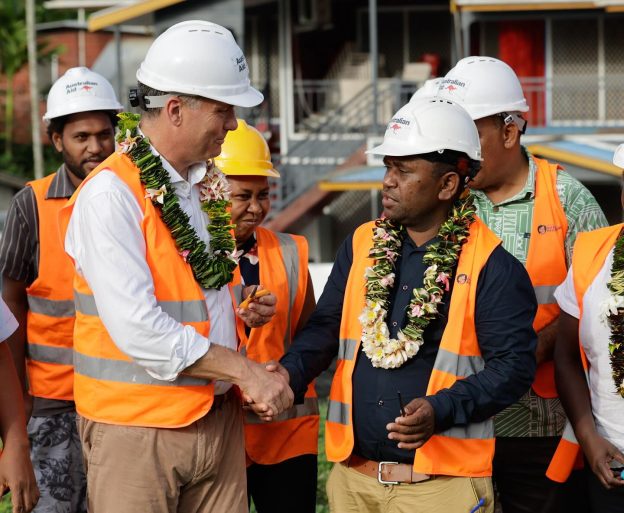
(Above; Marles in Honiara at Australian ad project.  Photo: Richard Marles MP Facebook)

Diplomatic statements invariably reveal far more than they contain; the recent high-level visit by Deputy Prime Minister Richard Marles to Honiara proved no exception to the general rule. Timed to coincide with the establishment of a new Solomon Island's government, the diplomacy highlighted the strategic significance of the small South Pacific country for Australia's specific Cold War military and security considerations and general 'US interests'. 

Another important factor, however, was not an open agenda item, although it can be regarded as a serious consideration for Australian diplomacy following a recent US global directive to allies when dealing with relations with China.

In late May, Australian deputy-prime minister Richard Marles made a high-level diplomatic visit to the Solomon Islands to meet the incoming prime minister in Honiara, Jeremiah Manele. It was explained in an official media release as 'Australia seizes the opportunity for a relationship reset with the South Pacific's most pro-China nation'. (1) Diplomatic relations between the two countries have proven problematic following a decision by then Solomons' prime minister Manasseh Sogavare to switch from diplomatic recognition of Taiwan to China in 2019.

Subsequent high-level diplomacy between Honiara and Beijing included fears being raised in Canberra of China being able to move at random in the South Pacific country, which has long been used by Australian military planners as a base for projecting influence in the region. Traditional Australia-Solomon Islands diplomacy has been conducted along neo-colonial lines. The challenge presented by China has, therefore, been assessed as a serious problem for Canberra.

A diplomatic statement issued by Canberra noted 'it is a new government that has been formed there. We want to be there very much at the start to talk about how we can take our bilateral relationship to the next step'. (2)

While Canberra openly greeted the demise of the Sogavare administration, little, however, has changed, or will do so. The new Manele government is unlikely to change political course; Sogavare is also the new Finance Minister. A prompt media release from Honiara accompanying the high-level Australian diplomacy noted 'Australia and China as equally important partners for Solomon Islands … its security agreement with Beijing will remain'. (3)  

Elsewhere, however, another statement issued earlier noted the new government and 'its Look North policy, embraced by Manele, says the Solomon Islands' economic future depends upon China, rather than its traditional partners like Australia'. (4) It followed recognition that 'Manele is committed to maintaining his country's China-friendly policies … China is already deeply enmeshed in the country's political fabric'. (5)

The Solomon Islands is a desperately poor country; its 800,000 population live on six major islands, with over nine hundred smaller landmasses. Since achieving independence from the Australian colonial administration in 1976, little meaningful economic development has taken place since that time. Per capita GDP remains at about $600 pa, with more than 75 per cent of the population employed in subsistence agriculture.

The Solomon Islands is dependent upon foreign aid which, invariably, arrives with strings. Some of this is not considered particularly problematic by the Solomon Islands.

Serious studies have concluded 'the neo-liberal framework within which Australia has engaged with the region has not delivered optimal social outcomes. Why would it, given its track records? … Chinese aid is attractive to the Solomon Islands because it largely stays in the Solomon Islands; Australian aid does not … it … is a form of boomerang aid that simply returns to Australia … Australia was the largest direct recipient of its own aid funding'. (6)
   
Australia, therefore, has difficult diplomatic relations with the Solomon Islands. In fact, it has been noted that 'Australia is at the cross-hairs of this big shift. It is frozen out by Beijing which is also making a power play in the Pacific islands … that's why the Solomon Islands matters … China has surpassed Australia in terms of two-way trade with Pacific islands nations'. (7)

Accompanying the recent high-level diplomatic visit from Canberra to Honiara, a brief media release was issued from Washington, about US foreign policy initiatives to deal with China. It contained information about the Biden administration raising tariffs on Chinese exports and a request that allies should do likewise to ensure the success of the US-led trade war diplomatic position. (8) Washington has embarked upon classic Cold War diplomatic initiatives 'as a critical way to isolate Beijing on the global stage'. (9)

Due to Australia's close diplomatic links with Washington, it would be almost unthinkable that Canberra would not also follow suit. It is obliged to do so with usual diplomatic protocol. 

The US agenda item did not, however, form part of the stated reason why Australia's diplomatic relations with the Solomon Islands were seemingly being re-booted afresh, although would appear the main factor explaining why such a senior government figure travelled to Honiara: Marles, is also Minister for Defence, diplomacy is usually conducted through Foreign Affairs;

                                         We need an independent foreign policy!

1.     Marles' diplomatic dash to Solomons, Australian, 21 May 2024.
2.     Ibid.
3.     Ibid.
4.     PM hails new Solomon Islands leader, Australian, 3 May 2024.
5.     Ibid.
6.     Sub-Imperial Power – Australia in the International Arena, Clinton Fernandes, (Victoria, 2022), pp. 94-97.
7.     As the Solomon Islands heats up, SBS News, 28 November 2021.
8.     US seeks EU support in trade war, Australian, 23 May 2024.
9.     Ibid.

Monday, February 19, 2024

The Solomon Islands and the 'Look North' policy.

 Written by: (Contributed) on 20 February 2024

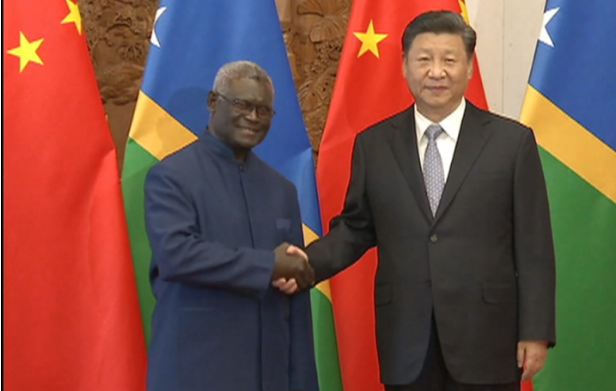
Above - Sogavare and Xi Jinping establishing a comprehensive strategic partnership July 10, 2023.  Photo China Daily

The Solomon Islands goes to the polls on 16 April with the present government of Prime Minister Manasseh Sogavare expected to retain power. The ruling Sogavare administration remains popular with Solomon Islanders although it has been demonised in recent years by right-wing defence and security hawks in Canberra, backed by the US. An assessment from the right-wing Lowy Institute, influential in the corridors of power in Canberra, therefore, has provided an interesting insight into the nature of Australia-Solomons Islands diplomacy.

With electioneering taking place in the Solomon Islands, the present government of Prime Minister Sogavare has announced its five key policy priorities if returned to office; the priorities are all linked to China and its active diplomatic involvement since the Solomon Islands switched to Beijing from Taipei in 2019. They include a national broadband project by Huawei, closer involvement with the Belt and Road Initiative, Chinese police training their Solomons' counterparts, with closer security co-operation with China together with strengthening existing relations with China. (1)

The new Look North policy of the government has also been strengthened with the formation of a ruling political organisation, the Ownership, Unity and Responsibility (OUR) Party.

Politics in the Solomon Islands, like much of the vast Pacific region, has traditionally been based on strongly localised leaders representing a multitude of different ethnic groups. The new OUR Party, however, is based at the national level and has over-ridden many of the ethnic problems which have plagued the Solomon Islands for decades, hindering economic development of one of the poorest countries in the region.

The problem was also exacerbated by diplomatic links between the Solomon Islands and Taiwan; Taiwanese aid programs were channelled through provincial government administrations, the outcome favouring some ethnic groups over others. The decision by the Sogavare government in 2019, to switch diplomatic links to China was regarded by many Solomon Islanders as a good move, although those ethnic groups which lost their aid provision on Malaita Island subsequently marched on the capital Honiara and attacked businesses regarded as owned or controlled by China. Direct involvement from Canberra for law enforcement was necessary to restore political stability.

The Solomon Islands, as part of the South Pacific sub-region, has always been regarded as an important addition to Australia's defence and security in conjunction with neighbouring Papua New Guinea and Vanuatu. It is, therefore, in keeping with the relationship for the arc from Australian military signals intelligence facilities in Queensland to swing through the capital cities of all three Melanesian countries. (2)

While the three countries have their own defence and security provision, established when they achieved independence, they have historically been over-ridden by Australia as the former colonial power. Australia retained the status of the Mother Country afte independence. The defence and security facilities, however, are also further over-ridden by the US, with its global intelligence system at Pine Gap, Central Australia. The US, nevertheless, has usually relied upon Australia for localised operations in line with Five Eyes provision; the 'alliance' always has been the dominant force in US-Australian diplomacy as part of the elite Five Eyes intelligence facilities.

From the early 1970s the US National Security Agency (NSA) together with the British GCHQ starting sharing intelligence work with other members of the Five Eyes. (3) It has now evolved into a highly sophisticated defence and security-based relationship. The origins, however, were not coincidental. In 1973 the US opened sensitive intelligence facilities on Diego Garcia in the Indian ocean which operated in conjunction with Pine Gap.

The opening of the US intelligence facilities included counterparts at Silvermine, near Cape Town, in South Africa, likewise, became operational at the same time. The stated range of the South African intelligence facilities reached from Argentina to Bangladesh, and from north Africa to the South Pole, providing defence and security provision for the South Atlantic and Indian Ocean regions. (4) The South African facilities maintained direct contact with both the US and UK, as dominant within the Five Eyes. (5)   

As the present Cold War position taken by the US toward China has escalated, regional defence and security provision has become increasingly important for the Pentagon and its military planners. A quick study of the US regional military involvement has revealed endless obsession and preoccupation with the maintenance of traditional hegemonic positions in the face of increasing competition from China.

The US-led Indo-Pacific Strategy (IPS), for example, has included Japan being elevated into a global alliance with the US for regional operations, resting on the so-called 'quad' designed to hem in China on all sides. (6) The 'quad' is linked to lower-level partners. (7)

Elsewhere, the Pentagon has re-opened a multitude of military facilities across the vast Indo-Pacific region. (8) The US-led regional foreign policy has included re-using Island Chain Theory (ICT), largely discredited during the previous Cold War, and using it to host numerous missile networks. (9) The ICT is, at present, being upgraded to include the Indian Ocean. (10)

It is, therefore, hardly surprising to find the Sogavare administration has been increasingly demonised by right-wing defence and security hawks in Canberra eagerly pursing the US line; it cannot be trusted to follow their diplomatic positions. A recent assessment from the Lowy Institute, for example, included reference to 'the wide array of China-backed policies that will continue to cause Canberra unease if Mr Sogavare is returned after the April election, as is expected by many analysts … he fully intends to pursue closer ties with China'. (11) No recognition was provided in the assessment for Melanesian traditional diplomacy conducted along lines of the peoples of the sub-region being 'friends to all and enemies to none'. (12)

In conclusion, the diplomatic position of Canberra toward the Solomon Islands remains one based in neo-colonial attitudes based on wanton speculation. 

At this stage, Australian and US fears that China plans to establish a military base in the Solomons appear unfounded, but China is pursuing its own imperialism – with Chinese characteristics – and must be watched if countries are to maintain their independence.

                                         Every country needs an independent foreign policy!


1.     Solomons PM vows: 'I'll look to China', Australian, 14 February 2024.
2.     See: Peters Projection, World Map, Actual Size.
3.     Spyworld, Mike Frost, (Canada, 1995), page 40.
4.     'Maritime Operational Communications HQ', The Star (South Africa), 10 March 1973; and, Security in the Mountain, The Star (South Africa), 17 March 1973.
5.     Ibid.
6.     The reasons behind Washington's push for GSOMIA., Hankyoreh, 12 November 2019.
7.     Ibid.
8.     US eyes return to south-east Asian bases, The Guardian Weekly (U.K.), 29 June 2012; and, The Guardian Weekly, (U.K.), 2 May 2014.
9.     US to build anti-China missile network along first island chain, Nikkei Asia, 5 March 2021.
10.   Wikipedia: Island Chain Theory.
11.   Australian, op.cit., 14 February 2024.
12.   Ibid.

Friday, December 31, 2021

Solomon Islands 2021: Crisis of Neo-Colonialism


 Written by: (Contributed) on 31 December 2021

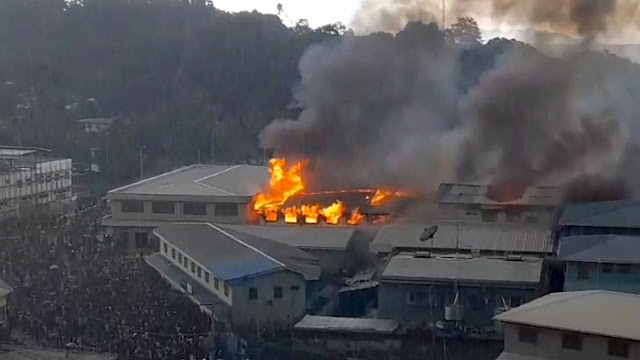
In late November, Honiara, the capital of the Solomon Islands experienced three days of extensive rioting targeted upon strategic areas including the official residence of the Prime Minister, a Police Station and Chinatown.

The country's small defence and security provision with their police were clearly outnumbered: the response from Australia was also immediate, followed by other countries. While Honiara has returned to relative stability, the situation remains tense with serious underlying problems: the Solomon Islands has a relatively small and weak economy, heavily dependent upon foreign aid and assistance, marked by neo-colonial diplomatic and economic relations.

On 24 November groups of Malaitians marched on Honiara, following a number of grievances which included the country switching diplomatic allegiance from Taiwan to China in September, 2019, and a declining economy causing greater hardship. The political situation had also been inflamed with separatist calls for independence of Malaita from the rest of the country.

The Solomon Islands is composed of six major islands and a further nine hundred smaller landmasses with a population of about 652,858. The country is also faced with a rising population together with relative economic decline. The population totals in 2010, at 555,453, are set to rise to 746,412 by 2025. (1) Economically, the country is faced with serious problems which include a decline in annual GDP growth rates from around six per cent in the period before independence in the 1960s to about minus four per cent last year. (2) While year by year totals show many erratic peaks and troughs, the general trend is decidedly downward; there has been little, if any, sustainable economic development for decades. A sudden peak of about 12.5 per cent GDP growth in the early 1990s, for example, fell away as quickly as it had arisen. (3)  

Internationally, the Solomon Islands economy is, therefore, minute: its total GDP in 2020 was $1.55 billion, amounting to less than 0.01 per cent of the global economy; three-quarters of the population live by subsistence agriculture and fishing with a per capita GDP income of about $600 per annum, which amounts to about $11-12 per person per week. (4) The rapidly rising population is living in a smaller and smaller economy; financial hardship is a common problem. Economic problems have been played-out in the political forums at provincial and national levels.

While the population are overwhelmingly Melanesian, they are sub-divided into many ethnic minorities. The two main ethnic groups, Malaitains and Guadacanalese, have long-standing rivalries. While the Malaitians are the biggest ethnic group with 168,000 population, for example, the capital Honiara is on the island of Guadacanal. (5) Hostilities between the two ethnic groups about twenty years ago resulted in a long-term western intervention to stabilise the country. The most recent disturbances, however, appear to date specifically from September, 2019, when the government of Prime Minister Manasseh Sogavare switched their diplomatic allegiance from Taiwan to China, following 36 years of strong links with Taipei. At an official level it was diplomatically noted that in 36 years, the Solomon Islands 'has received considerable financial support from Taiwan'. (6)

Both China and Taiwan are major diplomatic players in the Pacific region; they use different styles of aid provision. Chinese diplomacy, for example, is invariably conducted through official government channels. Taiwan's, however, is usually conducted through dominant local figures and strongly localised patronage systems. A recent official statement from Malaitian Premier Daniel Suidani would appear to have clarified a great deal about the present situation when he stressed while Taiwan had been generous with diplomatic aid, 'some major developments in the country', did not take place due to problems with previous political leaders. (7) No reference was made to corruption although it was implicit that aid money had not been used in the usual manner for economic development programs.

Following the diplomatic switch to China the situation on Malaita would appear to have become tense; it is not particularly difficult to establish outside forces manipulating problems. In 2020, Taiwan and the US sent $25 million to Malaita which was accompanied with political demands for independence of the island from the Solomon Islands. (8) In September, 2020, Malaitian Premier Daniel Suidana, issued the demand for independence, outlining four criteria to support the move: the island had a defined territory, a permanent population, a government and a capacity for diplomacy with restoration of links with Taiwan. (9) It was accompanied with references to a Malaitian leaders' summit where 'delegates adopted a resolution calling for the province to break away from the Solomon Islands'. (10)

The present situation in Malaita would appear increasingly divided: while Suidana is pushing for the provincial government to conduct a survey 'regarding Malaita self-autonomy status', his deputy-premier, Manasseh Maelanga, has stated 'independence is not my agenda'. (11) The results of the survey are expected early 2022 and are likely to be highly divisive, not only in Malaita but across the whole country and possibly, the wider region.

The arrival of groups of Malaitains into Honiara last November was taken to influence political decision-makers in the federal parliament about long-standing and more recent grievances. The rioting that followed was met with a quick response from Australia which provided 73 Federal Police and 43 military personnel the following day. They were soon accompanied by similar support from New Zealand, PNG and Fiji. As dominant regional players, they feared political disorder spilling over into neighbouring areas of the Solomon Islands and elsewhere across the South Pacific. It was not coincidental that PNG military personnel were used to stabilise the situation: a recent poll on Bougainville saw the vast majority of those on the island vote for autonomy or independence from PNG. The matter is scheduled to be officially dealt with in their national parliament in 2022. The political decision is likely to have far-reaching implications, whatever the outcome.

The sins of the father continue to linger, with lasting implications: Australian colonial administrations, in the lead-up to independence for a number of Pacific countries, grouped smaller islands and land-masses into larger countries due to political expedience. The people of Bougainville, for example, regard themselves as ethnic Solomon Islanders not Papua New Guineans. The colonial administrations, furthermore, foisted spurious economic models and development programs upon countries to serve external, corporate interests.

Across the Pacific, islanders have seen their countries, islands and smaller land-masses literally handed over to mining companies, many of which remain registered in Australia. Despite huge levels of mineral extraction, most islanders have seen little, if any, benefit, for themselves, their families and communities. Huge dividends, however, continue to be paid to shareholders who have no interest in sustainable economic development.
 
It is important to note relative stability was soon achieved across Honiara and Sogavara easily survived a no-confidence vote in the national parliament in early December. He used the occasion to make an official statement accusing 'agents of Taiwan' for an attempted destabilisation of his government. (12) The curfew across Honiara, Legal Notice 359, was subsequently repealed by the Governor-General on 9 December. (13)   

The matter, however, is far from resolved; in fact, it is likely to remain so for the foreseeable future with serious implications for Australia. It is, therefore, not difficult to establish the position of the present Australian government and their adherence to US-led Cold War regional foreign policy and 'US interests'; they continue to carry all the hallmarks of neo-colonial relations which they want to preserve, in particular for Australian-based corporate business organisations. A recent highly critical statement from Canberra, for example, concluded with the lines: 'Sogavara will continue to lead his country to the brink of disaster by building ties with Beijing … Australia will have no intention of allowing a Chinese proxy to emerge in the Coral Sea'. (13)

It is important to note while the Solomon Islands have their own defence and security provision they generally rely upon Australian-based intelligence facilities which are then over-ridden by larger capacity US facilities also based in Australia. Two final factors arose which throw considerable light upon the manner in which decision makers in Canberra have monitored recent developments in the Solomon Islands: the timing of the march by Malaitians on Honiara and the rioting that took place together with the rapid response from Australia, followed by it being recorded that about forty per cent of all foreign arrivals in the country were Chinese and the later condemnation following China's offer to train local police with six liaison officers and their supplying of 'riot equipment'. (14) 

Those who continue to complain about China's diplomatic initiatives in the South Pacific, including politicians from both the Coalition and Labor, and many in the media, generally do so from a position of subservience and loyalty to US imperialism. 

Every country, big or small, has the right to independence from all foreign interference and control. might like to consider the fact the Solomon Islands are a sovereign country as ratified by the United Nations; decision-makers in Canberra should take note!

 We need an independent foreign policy, in our own right, and as a guarantee that Australia will not engage in foreign interference on behalf of US imperialism!


1.     Projected Population, Solomon Islands Statistics Office.
2.     GDP  Growth – Annual % - World Bank; and, Trading Economics, GDP Growth, Solomon Islands.
3.     Ibid.
4.     Ibid., and, Wikipedia: The Solomon Islands.
5.     Call for independence, PAC News / Solomon Times, 11 December 2021.
6.     China extends influence in the Pacific, The Guardian (U.K.), 16 September 2019.  
7.     Suidana says MARA stand for Malaita issues not Taiwan, The Solomon Star, 9 December 2021.
8.     Wikipedia: Rioting – The Solomon Islands.
9.     'Malaita has it all' / Why Suidana is pushing for independence vote, IslandSun (On-line), 8 September 2020.
10.   Ibid.
11.   Maelanga speaks, The Solomon Star, 10 December 2021; and, Call for independence dividing Malaita province of Solomon Islands, One PNG., 11 December 2021.
12.   Solomon Islands Prime Minister survives no confidence vote, The Guardian (U.K.), 6 December 2021.           
13.   Curfew lifted, The Solomon Star, 10 December 2021.
13.   A new year, and fresh turmoil in world order, Australian, 30 December 2021.
14.   Solomon Islands National Statistics Office: Press Release, International Arrivals, 26 October 2021; and, Solomon Islands accepts Chinese offer for riot police help, ABC News, 24 December 2021.   

Monday, November 29, 2021

US behind Australian military expedition into Solomons


Written by: John G. on 30 November 2021

 Instability in the Solomons arises from capitalism operating within the country. Problems arising from development conflict with traditional customary land ownership as more people are dragged into capitalist relations of production and exchange. There is a deep background to the current conflict in the Solomons and the Australian-led imposition of armed forces in the streets of the capital. 

For starters the national government has been fraught with financial troubles. A goldmine operation, representing nearly a third of Solomons exports, closed in 2014. 75% of its main export, tuna, is processed overseas leaving local plants selling internally and to a handful of island nations. The price of canned tuna, the main product, has been in decline for decades. The problems in the export sector and high transport costs limit the imposts the government can place on exports, a key element of government finances. The nation faces big financial hurdles when considering development projects and providing basic services to people. 

People face problems with jobs, housing in urban centres, prices of necessities, education, healthcare and basic services; power, water, sewage and waste.

They intensify divisions existing with multiple languages, clan loyalties and rivalries. 

Development centred in Honiara

75% of the labour force is involved in subsistence agriculture and fishing at any one time. Virtually every family has members who engage permanently, occasionally or for a limited time in the cash economy (capitalist relations of production and exchange) to provide funds for purchases of trade goods, clothing, building products, homewares, etc. The portion engaged in the cash/capitalist economy is steadily growing. 

Capitalist development in the Solomon Islands has centred on Guadacanal, traditional lands of what are locally called Guale people, since American forces focused their headquarters and extensive bases at Honiara in WW2. Government offices, international trade, international tourism, port and other transport development have centred on Guadacanal. The island now has one third of the nation’s population including large numbers of migrants from other islands and overseas, while development on other islands with two thirds of the population has languished. The most populated of the nation’s island, Malaita, remains relatively undeveloped.

At Independence in 1978, all alienated customary land was returned to its traditional communal custodianship and is legally absolutely inalienable. 

85% of the Solomon Islands lands are managed under ‘customary’ tenure in which control lies with local clans and clan groups, in which the people belong to the land. In the capitalist economy, this provides for clans and clan groups to rent land. There is a tendency for Honiara’s customary landholders to become landlord capitalists renting out land to work-seekers from other islands and overseas, thereby exploiting a portion of migrant income. 

Housing prices are off the charts in Honiara in the last few years. Prices for basic necessities in the Solomon Islands are generally very high relative to incomes. 

International & Internal Migrants compete for Guadacanal homes

Foreign migrant communities largely of Australians, NZers and Chinese along with government workers and institutions as well as traditional customary owners have dominated land use in the centres of capitalist development, particularly around the capital Honiara on Guadacanal. The growth in overseas immigration since the Australian led intervention of 2003 to 2017 has intensified pressures on land use in and around Honiara.

Intra-Solomons migrants from less developed islands are drawn to Honiara for work, education, healthcare, and to engage in trade. They find themselves economically exploited with very high rents and house prices. The poorly-paid are forced out to unserviced informal shanty-town settlements on the outskirts of Honiara, with poor if any water, power, sewage or waste services, as well as workers forced into separation from their families due to poor conditions. 

While customary tenure is the constitutional framework, under capitalist development that is being compromised as village norms are being swept aside as urban capitalist life overtakes the Pacific idyll. Urges towards commercial and other developments weigh heavily on Pacific governments and local communities. 

The need for housing for inter-island and intra-island migrants moving in or around Honiara for work, education, marriage, health services etc. is growing. By 2017 NZ researchers estimated 40% of Honiara’s population was living in informal settlements with patchy jerry-rigged water and power supply, limited if any sanitation and toilet facilities. They reflect the squeeze on housing and the difficulties of the migrant population. Formal urban housing is beyond the reach of the Solomon Islands villager going urban seeking employment, education, healthcare, etc.  These tendencies run counter to traditional authority, custom and culture. 

Growing urbanism and integration into capitalist relations of production and exchange, confront the land impasse aligning traditional customary land control with landlord capitalist tendencies.          

Urban land and landlord capitalism 

The landlord-tenant relationship between Guadacanal customary land owners and Malaitans, involves landlords taking a significant portion of surplus values Malaitan production workers create, taking a slice of tenant traders’ profits, and part of wages other commercial, government and other non-production workers earn. It is an exploitative relationship involving accumulation of capital within the control of people of Guadacanal, their building developers and financiers. Add the monopoly element of rents in developed areas and it’s also quite oppressive. It is right to rebel against such exploitation and oppression.

This broke out into open rebellion in 1998 with riots followed by repression by government police and armed forces. Malaitan migrants on Guadacanal turned to armed insurrection led by the Malaitan Eagle Force.

Australian armed forces and police were sent in in 2003, and led forces from NZ, Fiji and PNG, which decisively turned events in defence of Guadacanal customary landowners suppressing Malaitan migrants on Guadacanal and the wider Malaitan rebellion.  It took 14 years before conflict settled enough and Solomon Islands state forces were trusted to maintain order sufficiently for the RAMSI forces to be withdrawn. It has taken just 4 years for the internal contradictions to reassert themselves, in a pressure cooker of conflict heated by big power rivalry and meddling.       

Big Power Meddling, US-China rivalry

The imposition of unsustainable outcomes on the Solomon Islands by suppression of working people in favour of landlord capital has broken down. Key to that breakdown has been meddling by superpower rivals. 

The Sogovare government had been in negotiations for some time in 2020 over establishing diplomatic relations with China, and was committed to ending the Solomon Islands recognition of Taiwan. 

Not long prior to the Sogovare government’s announcement of establishing diplomatic relations with China, the US government sent a high-powered delegation in August 2020 including members from the Department of State, Department of Defense, Department of Trade, as well as embassy and aid personnel to meet with Malaitan Premier Daniel Suidani. There was no press statement, photograph, or social media post issued about the meeting and no announcement of what had been on the agenda and nor of any agreement. 

But Suidani began crowing about American support and his intention to invite the US and Australian governments to assist with “Malaitan security.” The hand of US imperialism was clearly at the back of the Maliatan Premier.

With some form of assurance of American support, Suidani set out on instigating a pogrom. In addition to denouncing Chinese aid projects he announced Chinese nationals would not be allowed to visit. A pro-independence outfit “Malaita 4 Democracy,” demanded all ethnic Chinese businesspeople leave Malaita within 24 hours on 1 September. Many shops in the Malaita provincial centre of Auki were boarded up on September 2, before police intervened to prevent attacks.

In mid-September, Malaitan Premier Suidani announced he was planning an Independence referendum, touting it could be held in a few weeks. 

On 17th September Suidani sponsored pro-Taiwan demonstrations on the island, whipping up anti-Chinese sentiment through anti-communist and evangelical Christian, anti-atheist rhetoric. The Malaitan provincial administration has been coordinating aid and economic assistance from Taipei, in defiance of Solomons national sovereignty. Suidani announced no Chinese aid projects or economic investment would be permitted on Malaita, and no Chinese nationals would be allowed to visit. 

On the 25th of September 2020 the Solomon Islands switched diplomatic relations from Taiwan to China. The US was furious. Vice President Mike Pence cancelled a meeting with Sogovare at the UN. Republican Senators threatened sanctions and called for aid to be stopped. 

On 30 October 2019, the National government entered into agreements with the Chinese government, just 35 days after diplomatic relations were switched from Taiwan to China, for an $825 million development of a port, railway and hydro power station at Honiara and to reopen a nearby goldmine.  

On 21 November 2019, the Malaitan Provincial government announced an agreement with the US to build a new fisheries and tourist harbour project on Malaita, the Bina Harbour and cannery project. The project had been bubbling away for ages without any firm undertakings. Australia quickly announced grants to support the American move. That development has been added to a major road project for 230kms of main roads and a new hospital build on Malaita funded by the World Bank.

US and Australia skirting sovereign national government

The US and Australian governments have been negotiating with the Malaitan provincial government directly skirting the National government and diplomatic norms, and meddling in the internal affairs of the sovereign Solomon Islands nation. 

Despite the meddling, the National government has supported the Bina Harbour project, but has been locked in a familiar national leaders/ provincial leaders brawl. 

In October, figures in the PM’s party pushed for a no-confidence motion in Premier Suidani to be pushed through the Malaita provincial legislature. It was withdrawn when thousands protested in the Malaitan capital Auki and women occupied the steps in front of parliament. Tensions between Malaitans and the national government leaders were high and being intensified. 

In mid November, Malaitans held a solemn traditional ceremony, attended by cultural, ethnic, religious, and political leaders, bringing Malaitan communities together in an act of reconciliation after generations of enmity between clans. 

The enmity went back to a 1927 killing of a colonial district officer and Malaitan members of his protection force in resistance to imposition of a colonial head tax. An extensive reprisal massacre was carried out by colonial administrators and foreign plantation owners leading relatives of the Malaitan dead. The reconciliation buried the hatchet on more than 90 years of Malaitan trauma and division. They also unveiled a plaque in honour of the leaders of the Solomon Islands independence movement, an implied slight to PM Sogovare. Not one of the PM’s party MPs attended. 

A week later the national parliament resumed with a very large protest against “corrupt foreign influence” in the streets of Honiara. Malaitans were in the lead but not the sole participants. Police tried to drive the protesters away using tear gas. Rioting followed with burning and looting targeting Chinese merchants and homes of Chinese migrants, but not excluding other premises. Damage ran into many millions. The pogrom element was certainly prominent. 

Days of rioting saw the national government call for foreign forces to enter and decisively suppress unrest. It represented a victory for foreign interference by the US using its sycophants in the Australian and NZ Governments. The Sogovare government was reminded that its hold on office was dependent on the ‘grace and favour’ of the US and its local agents the Australian and NZ governments.

Internal contradictions magnified by big power meddling 

The Malaitan Premier’s reactionary agitation is built on the back of provincial rivalries and capitalist oppression. It serves US interests. 

The disputes, with their countervailing elements threaten to tie the Solomons in a number of long-term internal wrangles. Contradictions between traditional customary land title and exploited renters in developed areas exacerbate historic inter-island and inter-clan rivalries, underpinned by opportunist political rivals, all stoked by superpower rivalry, bullying and bribery.   The financial troubles of the National government hamstring its capacity to ease the internal conflicts.  

No good will come of US-instigated unrest and imposing decisive foreign forces on the people. 

The Solomons need an end to US-China meddling. The people need assistance with basic urban living conditions, decentralised development and finances for compensating customary landholders but not at the expense of internal migrants. The country needs aid to facilitate that. 

The sooner foreign forces are out the better. 

It is for the people of the Solomons to resolve their problems with aid, but without the conditions superpower rivalry imposes.   

Sunday, May 17, 2020

The case of the Coral Sea Cable, or….

Written by: (Contributed) on 17 May 2020

How US-led military planners misused $136m of Australian tax-payers money and PNG and Solomon Islands government revenue.

In 2018, the then Turnbull coalition government in Canberra provided a telephone cable linking Sydney with Papua New Guinea and the Solomon Islands for internet provision.

Other, more important factors, were hidden amongst the wording of the plan which reveal the dual-agenda of US-led regional military planning operating through Australia.

To date, furthermore, the cable had not met expectations or promises from Canberra to the countries and peoples it was expected to serve.

One of the many US-led military plans for the South Pacific in recent years has included the laying of the 4,700 kms Coral Sea Cable system to provide PNG and the Solomon Islands with internet provision linked to Australia. The project was hastily planned to prevent the Chinese Huawei telephone company from undertaking the work, in a small region where major US-led Cold War diplomatic positions have been played out. The required $136 million for the project was taken largely from Australia's overseas aid budget, controlled by the Department of Foreign Affairs and Trade (DFAT) together with contributions from PNG and the Solomon Islands. All the governments in Port Moresby and Honiara wanted was cheap, affordable internet connections for their own people.

The Coral Sea Cable project, however, took place against a rising tide of US-led diplomatic tensions and hostilities directed toward China. The three Melanesian countries of the South Pacific, PNG, the Solomon Islands and Vanuatu have been regarded as buffer-states and the first line to repel possible threats to Australian sovereignty from northern approaches. The project formed part of standard dual-agenda type aid provision where 'assistance programs in the South Pacific, designed to build capacity and strengthen resilience … (were also intended) … to keep Beijing out of security activities in the region'. (1)

The 2018 annual Australia-US Ministerial Consultations were dominated with an agenda which included intelligence assessments of the South Pacific and diplomatic statements about China establishing greater influence within the 'small but strategically important South Pacific'. (2) Using the pretext that China was considering establishing a military base in Vanuatu, US-led military planning to upgrade the Lombrum base on Manus Island together with the neighbouring Momete airfield, 'as a forward operating base', noted for being situated in a 'strategically vital position overlooking key trade routes', took place. (3)

There was little ambiguity who was pulling the strings with the planned upgrading of military facilities. It was announced Australian vessels would be 'based permanently at Lombrum under the deal', and that 'the US would also join the project'. (4)
The developments followed a common pattern of US-led diplomacy toward the South Pacific, invariably marked by an 'attitude of benign neglect' and neo-colonial relations. (5) The countries have, for example, produced enormous wealth in dividends for shareholders of mining companies elsewhere, while the mass of South Pacific Islanders live subsistence life-styles in poverty.

The hurried laying of the Coral Sea Cable was a further example of the type of diplomacy countries in the South Pacific are expected to accept, and took place primarily to serve US military considerations; military planners have become obsessed with 'real-time' telecommunications systems in recent times. The obsession is evidence of the linkage of intelligence facilities in the Indo-Pacific region to the Pentagon, for both regional surveillance and military planning. Satellite telecommunications facilities have the problem of 'milli-second delays in data transmission', creating problems for military use. (6)

While the US military planning for the Coral Sea Cable clearly served US interests, other problems have arisen with far-reaching implications.

The cable has been noted for operating well under capacity and has failed to provide lower internet prices for the South Pacific. In fact, it has continued to provide rates of $350 a month for users while other facilities using satellites costs $250 for similar packages. (7) And, as if to add insult to the injury, Digicel, one of the main providers of mobile telephone services for the wider region which have specialised in using satellites, has recently announced a $10.3 billion debt following financial problems elsewhere. (8) Fears have, therefore, arisen that Digicel will be eventually sold to China Mobile, which has been considering making a bid for the debt-ridden telephone company, effectively throwing US military and security considerations into disarray. (9) To date, those responsible for the Coral Sea Cable have remained tight-lipped, hiding behind a wall of diplomatic silence.

The present Morrison coalition government in Canberra, together with others are, however, formulating an estimated $3.3 billion bail-out for PNG in the name of foreign policy. They will, inevitably, seek to extend their influence still further into a country which nominally won its independence from the Australian colonial administration in 1975.

Australia has tarnished its reputation by being so closely allied to US regional military planning.  We need an independent foreign policy!


1.     Top threat now lies in South Pacific, The Weekend Australian, 22-23 September 2018.
2.     US to lift its Pacific clout to counter China, Australian, 26 July 2018.
3.     Benefits for all in Manus being a base for US and Australian forces, Australian, 29 August 2018; and, Cold War in the Pacific, The New Daily, 17 November 2018.
4.     US to partner with Australia, PNG on Manus Island naval base, ABC News, 17 November 2018.
5.     US strategic objectives in the South Pacific challenged by Sino-American competition, Strategic Analysis Paper, Future Directions International, 10 October 2019.
6.     Taxpayers' PNG cable to dear to use, Australian, 15 May 2020.
7.     Ibid.
8.     Fears over a Chinese digital footprint on our doorstep, Australian Financial Review, 14 May 2020.
9.     Australian, op.cit., 15 May 2018.