Showing posts with label Papua New Guinea. Show all posts

Saturday, October 18, 2025

The Pukpuk Australia-PNG mutual defence treaty and the wider US-led Indo-Pacific strategy

 Written by: (Contributed) on 14 October2025
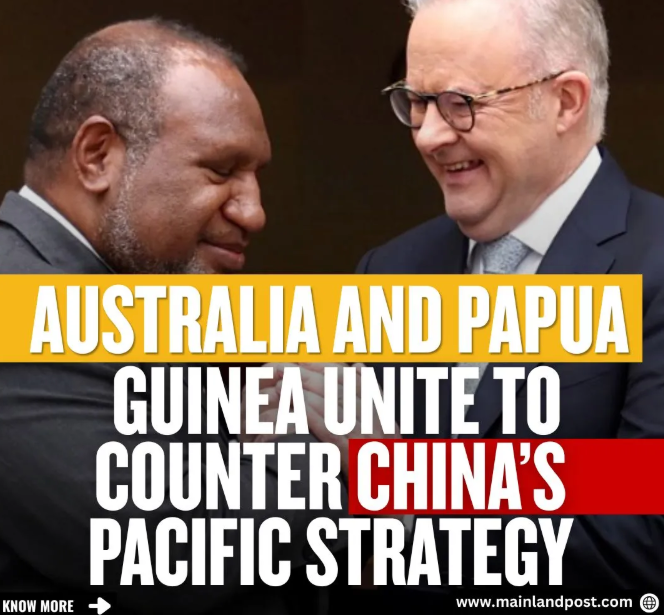
 

Above: Credit Mainland Post

The recent Australia-Papua New Guinea Pukpuk mutual defence treaty (named after the PNG Pidgin word for “crocodile”) forms a small, but highly significant, component part of the wider US-led Indo-Pacific Strategy (IPS), which is responsible for the waves of Cold War militarism sweeping the vast region.

The small print contained in the treaty is likely to eventually cause problems for both countries. The changing regional balance of forces has already created problems for traditional US hegemonic positions. The declaration by Bougainville, likewise, to move toward full independence in the next few years is also an important consideration.

The Pukpuk mutual defence treaty was greeted by Canberra as a significant step toward defence and security provision in the South Pacific. The big print of the treaty contained reference to both countries having an obligation to 'act to meet the common danger if either comes under attack'. (1) Other similar references included 'Australia's plans form a hub and spoke security network with our closest neighbours'. (2)

Media coverage of the treaty tended to play down the fact that PNG's South Pacific neighbours, the Solomon Islands and Vanuatu, wanted nothing to do with the treaty or similar provision. The Solomon Islands already have a security pact with China, signed in 2022; Vanuatu, likewise, has China-led police and security training programs. (3)

Opposition to the Pukpuk treaty inside PNG also raised serious concerns that it would 'threaten PNG's independent foreign policy and could draw the country into a future war with China'. (4)

It remains highly significant to note that the Pukpuk treaty contained reference to PNG being elevated with defence and security provision 'to the same status as its alliance ties with the US and New Zealand', carrying hallmarks of the US-led IPS remaining an important consideration behind the scenes. (5)

The revamped IPS has a framework where the US, Japan, India and Australia, have established a 'quad' containing and encircling China on all sides; other regional countries have then been linked through one or more of the 'quad' as lower-level partners. (6) The IPS, furthermore, also has the main US-Japan alliance upgraded to that of a global alliance, and the recent Pukpuk treaty closely followed other high-level diplomatic initiatives between Australia and Japan.

As the balance of forces swings against traditional US-led regional hegemonic positions, moves pushed by the Pentagon have become ever more desperate to block China's diplomatic initiatives in the vast Indo-Pacific region.

It is not particularly difficult to establish the small print of the Pukpuk treaty, despite it not being well publicised.

Six years ago, more than 97 per cent of the people of Bougainville, an island part of PNG, voted for the autonomous region to seek full independence. The final decision is still in the hands of the PNG government, and part of a longer agenda stretching back to before PNG was granted independence in 1975.

The people of Bougainville were included into the sovereignty of PNG by the Australian colonial administration, despite declaring their independence; the demands of the Bougainvillians were never accepted by either Canberra or Port Moresby. (7)

Geographically, nevertheless, Bougainville is the largest island in the Western Pacific's Solomon Islands Chain, and five hundred miles from PNG. (8) The subsequent independence war fought between 1988 and 1998, led by the Bougainville Revolutionary Army (BRA) against PNG, resulted in widespread human right abuses.

To date, the whole matter has simmered on longer and not straightforward neo-colonial agendas. The fact that Bougainville hosted the enormous Panguna mine, which was closed by the BRA, has recently been assessed as still containing 5.3 million tonnes of copper and 547 tonnes of gold, remains a major consideration. (9) The deposits have been estimated to be valued at about $60-100 billion. (10)

As an act of defiance, Bougainville has recently set 2027 as the date from which they will establish full independence. The move has been strengthened by the recent re-election of the President Ishmael Toroama, a former BRA leader and leading political figure in Bougainville.

It remains unclear whether PNG will even agree to the creation of a new country in the South Pacific; they have not accepted the proposed 2027 deadline. (11) An official statement from Port Moresby, for example, noted the whole matter was regarded as 'still subject to the parliamentary process'. (12) Political leaders in PNG have long feared ethnic considerations potentially resulting in other independence struggles, including the Western Province bordering on West Papua and controlled by Indonesia.
PNG, therefore, has a constitution which enables conscientious objection as a right for all military personnel; due to extensive ethnic groupings and rivalries it was created to prevent separatist threats to the sovereignty of PNG itself. The Pukpuk treaty, however, would appear a way around constitutional problems, by placing Australia as potentially the main policing power in the region, if, and when, required, under IPS supervision.

Part of the treaty, for example, has provision for 10,000 PNG citizens to serve in the Australian Defence Forces. (13) The move was, however, supported by an official media release acknowledging that 'Bougainville is a no-military zone for the PNG Defence Force
.. . this would ensure there would be no stepping into Bougainville by PNG's military or police'. (14)

Canberra and Port Moresby, have, therefore, used the Pulpuk treaty to circumvent problems arising with interpretations of PNG's constitution. It has been noted, for example, that while the PNG Defence Force report to their Commander, including Papua New Guineans in the ADF, those accepting Australian citizenship report to their respective Commander in Canberra. (15) The PNG constitution does not allow joint citizenship. The status of former PNG Defence Force personnel attached to the ADF and serving at the Lombrum base on Manus Island, which has been recently upgraded by Australia for rapid deployment into the wider region, therefore, has yet to be officially clarified.     

Reading the small print of the Pukpuk treaty would tend to indicate, however, that Australian defence and security provision has been extended into PNG to safeguard long-time neo-colonial and economically dependent interests, particularly with Bougainville. References, elsewhere, to Australia viewing Bougainville as a 'strategically important inner security arc', have shown just how close class and state power considerations and assessments remain to Canberra's diplomatic thinking in regard to the South Pacific.

The fact that Bougainville rests on an arc from sensitive military facilities in Queensland and the Northern Territories, swinging across the whole of the South Pacific, including counterparts in Port Moresby and Lae in PNG, leaves little to the imagination. (16) There remains a fine line between genuine defence and security considerations and general interference inside other political systems. The localised Australian facilities, for example, enable the constant monitoring and surveillance of all movements and developments taking place in their designated area of interest. They are, subsequently, also over-ridden by US facilities based at Pine Gap, with a global range for monitoring and surveillance, specifically for counter-insurgency and counter-intelligence provision. (17)

The Pukpuk treatyis a component part of the US-led IPS:

                                         We need an independent foreign policy!


1.     PNG set to approve Pukpuk defence treaty, The Weekend Australian, 4/5 October 2025.
2.     The pain of Pacific's twice-jilted bride, Australian, 18 September 2025.
3.     China's influence mission in the Pacific,  The Weekend Australian, 13-14 September 2025.
4.     Retired PNG general seeking legal advice on Pukpuk treaty, Australian, 23 September 2025.
5.     Weekend Australian, op.cit., 4/5 October 2025.
6.     See: The reasons behind Washington's push for GSOMIA., Hankyoreh, 12 November 2019.
7.     See: How China is paving the way for Bougainville independence, The Asia Times, 12 June 2025.
8.     Bougainville's long goodbye to colonialism, Who, What, Why, 24 July 2025.
9.     Asia Times, op.cit., 12 June 2025.
10.  Who, What, Why, op.cit., 24 July 2025.
11.   PNG's Bougainville leader see independence by 2027, Islands Business, 12 December 2024.
12.   Ibid.
13.   PNG pact could put PNG troops into Bougainville, Australian, 7 October 2025. 
14.   Ibid.
15.   See: Military treaty to boost PNG force, Australian, 3 October 2025.
16.   See: Peters Projection, World Map, Actual Size.
17.   See: Pine Gap is a place for counter-insurgency, IPAN., (South Australia), 24 July 2025.

Sunday, June 9, 2024

PNG: Wealth for Foreign Exploiters – Sweet FA and Destruction for the People

Written by: J. Clarke on 9 Jue 2024


Above: Opposition to sea bed mining in PNG. Photo Civicus.org

While the eyes of the world are focussed on the devastating tragedy of the Enga Province landslide in Papua New Guinea (PNG), it is timely to reflect on the environmental and development issues that foreign investment has brought to the country.

PNG is a country abundantly rich in natural resources. The Indigenous people have utilised these resources for their essential needs sustainably since their arrival in ancient times (estimated to be some 50,000 years ago and agricultural practices commencing around 7000BC).

On the other hand, with the arrival of Europeans and the accompanying colonisation, the exploitation of resources for profit rather than needs intensified with little regard to sustainability. In modern times, exploitation has intensified even more dramatically, resulting in severe damage to the environment.

What caused the devastating Enga landslide in which so many lives were lost? There are multiple reasons. Firstly, PNG is located on an earthquake zone, which creates the conditions prerequisite for landslides. In a nutshell the ground is loosened and water penetrates, creating something akin to a massive sponge. A deluge of rain can make the “sponge” release its contents, with devastating consequences for those living nearby.

The other reasons are man-made. You guessed it! - Deforestation by foreign companies acting to extract as much timber as possible in the shortest time for maximal profits, with little or no subsequent remediation work. There is no substantial vegetation remaining to hold the soil in place, so when a landslide occurs, its damaging effects are amplified.

Add to this, the effects of climate change – more storms, more intense rainfall, therefore more frequent and severe landslides.

Not much can be done about the natural causes (earthquakes) however the last two causes are preventable if a sustainable approach is taken. This will never happen under capitalism, but the people of PNG are valiantly opposing the activities of the foreign plunderers.

The volume of logging has consistently exceeded the target limits. The government appears to be doing very little to curb this. The people, with the assistance of NGOs, are putting pressure on the government to act. In response, logging companies threaten activists with litigation. This is despite the activists exposing not only the over-logging, but money laundering practises by the industry as well1.

An appallingly unscrupulous practice used by foreign companies to obtain access to land for logging is to illegally con traditional holders of customary land into handing the land over to them. As a result, a significant percentage of customary land has become permanently inaccessible to the traditional landholders. This land-grabbing is facilitated by corrupt government officials and others in PNG for selfish gains. (Corruption is rife in PNG, and it is estimated that up to 50% of the government annual budget goes missing as a result. Consequently it is a walk in the park for foreign companies to get what they want.) Such lands are then rubber-stamped as “Special Agriculture and Business Leases” under the Land Act. The categorisation as “agriculture and business” is a con in itself. Essentially it means all out logging.

The government copped a lot of flak from traditional landholders about this illegal land-grabbing practice and in 2014 the government promised to return the lands stolen in this way to their original owners. However, there has been limited progress in this direction. Further, compensation to traditional landholders for being deprived of the use of their land and the destruction of forests on these lands is yet to be agreed to.

Here’s another example of ruthless business practices which are enabled by corrupt government officials. A Malaysian company (actually a logging company) applied to set up the “Wasu Cattle Farm Project” and got the nod. Local people report that they have not sighted any cattle but that there is an awful lot of logging going on!

It is not only the forests that are being intensely exploited by foreign companies. PNG is rich in mineral resources and oil and gas – both on land and sea.

A case in point is the proposed Frieda mine project for the extraction of gold and copper. If it goes ahead, it will be the largest mining project in the history of PNG. The project will operate along the mighty Sepik River. The river traverses some 1100km and is one of the few remaining untouched large rivers on the planet. It provides sustenance, both spiritual and material, to the tens of thousands of people who live in traditional communities along its length.

The mine threatens all this and the people know that it will end their traditional way of life. They have seen it in other communities in PNG. Promises of benefits are made (schools, hospitals etc) but they end up losing everything, including their independence, spiritual life, links to their ancestors and sense of belonging.

The people of the Sepik want to avoid another Bougainville, but the communities are not taking this lying down and are currently organising to oppose the mine. Death threats have been received but people have stated that this river is so important to them that they will die for it.

The foreign corporations are not limiting themselves to mining the land, but also have in mind to mine the sea bed for minerals such as gold, copper, nickel, cobalt and manganese. Sea bed mining has not taken place anywhere in the world yet, due to insufficient knowledge of the environmental, social and economic consequences and the lack of laws to govern its practice.

The PNG government has placed a moratorium on sea bed mining until 2029. However, coastal people living in the vicinity of the proposed sea bed mining area have grave concerns that the government will not live up to its promise. The PNG government has its own vested interests in the project proceeding. The people living here practice their traditional way of life and rely on the sea as their main food source. They are already organising against this project2.

The people of PNG face the same enemy as other Indigenous populations the world over, threatening their traditional existence and the destruction of the lands which they have nurtured over the eons.

Whether it is in PNG, West Papua, Palestine or the First Nations people of Australia there is common ground for the struggle against imperialism and colonialism.

Oppressed people of the world unite!

The CPA (ML) supports the struggle of the people of PNG for justice.
The CPA (ML) supports the struggle of the people of West Papua for independence.


Monday, December 18, 2023

Australia’s sub-imperial relations with PNG


(Above: US agent of influence Albanese with PNG Prime Minister James Marape on December 7.  Photo: Nick Haggarty, ABC News)


Written by: (Contributed) on 19 December 2023

The signing of a new security treaty between Canberra and Port Moresby on December 7 has carried all the hallmarks of Australia being a sub-imperial power for 'US interests' in the wider Indo-Pacific region.

The security treaty, aimed at side-lining China as an emerging regional power, has followed the US treating China as a competitor and thereby, threat to their traditional diplomatic and hegemonic position.

The security treaty, however, is especially fraught with controversy as PNG remains faced with a constitutional crisis over its strained relationship with Bougainville.

Australia's diplomatic relations with neighbouring PNG have been topical for over fifty years, since independence of the country during the mid-1970s. PNG, as part of the Melanesian South Pacific, has also included the Solomon Islands and Vanuatu, as strategically-placed countries for the pro-imperialist exercise of Australian sovereignty. Diplomacy between Australia and the three countries has been historically based in neo-colonial type relations: the former has exploited the latter for cheap minerals and resources.

The present potential $80 billion merger between Australian-based Santos and Woodside, for example, is primarily focussed upon greater access to PNG's vast oil and gas reserves. (1) Similar moves are common across the South Pacific, as vast wealth has been systematically siphoned off and paid in massive dividends to shareholders in western countries. Ordinary residents and citizens of the South Pacific, rarely, if ever, see any benefit from the neo-colonial relations.

Australia, officially, has 41 billionaires, a number of whom own and control large-scale mining companies. (2) What proportion of their vast wealth was linked to the extraction of South Pacific minerals and resources has not been disclosed in documentation in the public domain. It is likely to be considerable, if not huge.

The three South Pacific countries, however, tend to be politically unstable and have a multitude of internal problems: effective and transparent governance, basic security considerations, ethnic and inter-ethnic rivalries and separatist movements. They have far-reaching implications: the PNG constitution and military regulations, for example, contain the right to conscientious objection when dealing with ethnic problems as a safeguard for preventing the escalation of ethnic tensions.

The fact that China has also courted the three countries in recent decades has, therefore, raised serious diplomatic considerations in Canberra and the US, as the dominant regional players. Large-scale Chinese investment has taken place in recent years, based, primarily, in economic programs and infra-structure projects, which have effectively been designed to open the countries for later development.

Regional diplomatic rivalry between the US and China has, therefore, been increasingly played out in the small South Pacific arena. The US fear competition: their regional development programs have historically, however, been barely effective; the mass of the population of the South Pacific continue to live in poverty with subsistence life-styles.

The diplomatic rivalry has also had to take into account that Melanesian culture and sovereignty is based upon the notion of a 'friends to all, enemy to none' standpoint: domestic and foreign policy diplomatic positions tend to remain relatively independent and non-aligned. (3) A recent defence agreement with the US, for example, raised concerns in Port Moresby that 'it could compromise PNG's sovereignty'. (4)

The US, for example, recently re-opened an embassy in the Solomon Islands after decades of ignoring the small country and its significant strategic importance. Elsewhere, across the small region the US has now increased its presence. Australia, nevertheless, has remained the dominant player for 'US interests'; with all which that position entails.

China, diplomatically, remains quite popular in the South Pacific: local people rely upon cheap manufactured produce from China in their everyday lives.

Studies of the Solomon Islands, furthermore, have revealed China's aid 'is attractive to the Solomon Islands because it largely stays in Solomon Islands; Australian aid does not … this is a form of boomerang aid that simply returns to Australia … Australia was the largest recipient of its own aid funding '. (5) The studies concluded with Australia being assessed as a sub-imperial power.

Defined along the lines that 'Australia has a capable, technologically advanced military and a number of intelligence agencies that operate in the region and far afield to uphold the US-led order. Australia's trade and investment agreements are organised with a similar goal in mind', sub-imperialism is conducted by Australia remaining subservient to 'US interests'. (6)

Bougainville and PNG

The new security treaty between Australia and PNG, therefore, has to be evaluated and assessed in that light. The smaller print of the treaty is particularly revealing. A total of $200 million has been included for a new PNG police infra-structure and a new $110 million 'police investigations training centre in Port Moresby'. (7) While law and order is an important consideration for stability in PNG, the concern has to be seen in light of moves by the peoples of Bougainville for full independence from PNG.

The issue of Bougainville has been contentious for decades.

The former Australian colonial administration placed the island in PNG in the lead-up to independence in the mid-1970s. It was an uncomfortable fit. The inhabitants of Bougainville
had a strong independence movement and regarded themselves as ethnic Solomon Islanders.
During the late 1980s an insurgency led by the Bougainville Revolutionary Army (BRA) began, which resulted in the largest open-cast mine in the world being closed due to hostilities. All attempts by the mine-owners and mercenaries to re-open it, failed.

The armed conflict saw human rights abuses on a wide scale: controversy over the use of Australian-issued helicopters for PNG Defence Force personnel to throw BRA personnel into the sea, some being still alive, remains a strong allegation from the Autonomous Bougainville Government (ABG). (8)

While a lasting peace agreement was eventually established after a decade of hostilities, a referendum in 2019 saw 97.7 per cent of the population of Bougainville vote for full independence, as opposed to the present autonomous status.

The whole matter of the referendum still remains a matter for the PNG government to resolve. They have, to date, proved apprehensive to deal with issue on account of other
parts of PNG feared to follow suit leading to the fragmentation of the large country into smaller 'countries'. The issue, nevertheless, will continue to simmer as separatist groups continue to agitate for a more localised sovereignty.

Behind the scenes, however, the US fears China will establish stronger diplomatic relations with Bougainville, given the opportunity. It has already been noted that 'China looks to make inroads in Bougainville, with promises to fund major infra-structure upgrades in the autonomous region'. (9)

A statement issued by the ABG Attorney-General, Ezekiel Massat, about the new security agreement was unequivocal: it was noted, 'Australia was deliberately avoiding its obligations to hold PNG accountable, amid delays by the Marape government in tabling the referendum result in the nation's parliament … Australia is supposedly the Big Brother in the Pacific, but it is a coward when it comes to the Bougainville independence issue'. (10)

As a sub-imperialist power Australia has moved into a very murky diplomatic area by signing the new security treaty with PNG. It is also highly significant to note that the agreement document itself, has constitutional considerations with the small print possibly having serious implications at a later date: it is considered legally binding, not merely a military-based treaty. (11)

                                         We need an independent foreign policy!     
 

1.     See: PNG key in Santos-Woodside merger, Australian, 12 December 2023.
2.     See: Aussie rich-listers' wealth up as inheritances pay off, Australian, 1 December 2023.
3.     PM stokes Bougainville tension, Australian, 8 December 2023.
4.     Ibid.
5.     Sub-Imperial Power – Australia in the International Arena, Clinton Fernandez, (Melbourne, 2022), pp. 94-97.
6.     Ibid., page 3.
7.     Australian, op.cit., 12 December 2023.
8.     Australian, op.cit., 8 December 2023.
9.     Australian, op.cit., 12 December 2023.
10.   Ibid.
11.   Australian, op.cit., 8 December 2023.

Wednesday, July 19, 2023

Papua New Guinea and the US Indo-Pacific Strategy


(Above: Signing the US-PNG Defence agreement     Photo source: ABC)

Written by: (Contributed) on 19 July 2023

A major diplomatic statement from a well-placed source in Canberra about planned sensitive military facilities in PNG has shown how the South Pacific has become a front-line for Australian military and security with the wider region. Reference to the US and their Indo-Pacific Strategy (IPS) partners was also contained in the statement showing how it has become the core of US regional foreign policy.

In early July, the Strategic Analysis Australia in conjunction with the National Security College, issued a major statement about US regional foreign policy in general, with specific reference to PNG. (1) In recent times, due to the changing balance of forces with the rise of China, countries such as PNG have become more sensitive to military planners in Canberra and the Pentagon.

The timing of the statement coincided with similar moves made between Canberra and Indonesia with a high-level contact established with President Joko Widodo visiting Australia in early July. It was noted, 'in the diplomatic sphere, direct engagement is an opportunity to build on a key strategic partnership as the Indo-Pacific becomes increasingly fraught'. (2)

Reference in the PNG report, likewise, was made to the Milne Bay area being assessed for military facilities; the sheltered deep-water harbour surrounded by heavily wooded terrain has made the area ideal for covert US-led regional operations. Previous attention given to the Lombrum facilities on Manus Island have proved highly controversial with complaints from local land-owners. Milne Bay also faces Fiji, another Pacific country with a strategically-placed deep-water harbour, used by submarines for regional operations.

There is also another important reason why Milne Bay has been chosen over Manus Island for the defence and security of 'US interests'. Milne Bay faces a multitude of small island chains, including the Calvados Chain reaching to Rossel and Adele Islands. They are situated on a straight line from the Kuril Islands in the northern hemisphere through Australian military bases in Queensland, at 153 degrees east and face the western Pacific between 10 and 30 degrees south and the Solomon and Coral Seas. (3)

The Kuril Islands mark the beginning of Pentagon regional military planning with Island Chain Theory, a re-used relic of the previous Cold War now upgraded for containing and encircling perceived Chinese interests. Island chains are used for regional demarcation to restrict easy access and egress into the wider Oceania.

Of the nine military bases in Queensland, Lavarack in Townsville remains the most important, hosting the Third Brigade of the Combat Signals Regiment. It is also not surprising to find the arc from Lavarack to Milne Bay also swings through Darwin, used by the US for troop rotations into the wider Indo-Pacific. (4)

References in the diplomatic statement to the 'US agreeing to share satellite data with PNG', is also evidence of the strategic significance of Milne Bay. (5) While the US is able to spy on the entire world with their surveillance and monitoring systems, they require local knowledge to identify areas of interest from agents and 'ground human'. Local people in the Milne Bay area, for example, would have experience of islands and population movements between the small land-masses which have become more sensitive in recent times.

It is also significant to note references in the diplomatic statement to other US allies included in their Indo-Pacific Strategy (IPS), as lower-level partners: Taiwan, South Korea, India, and others. (6) The Japan-South Korea General Security of Military Information Agreement (GSOMIA) is regarded by the US as 'essential as a military intelligence sharing framework for trilateral missile defence as a key axis in the IPS targeting China', and has four key points: the US, Australia, India and Japan, with the enclosed area including strategic assets for 'US interests', particularly in Asia. (7)

Recent regional assessments have revealed how the US has been pressurising Australia to upgrade its influences in South-east Asia to counter China's large regional aid program. (8) A total of $55.7 million was allocated in the recent federal budget to 'deepen ties with South-east Asia'. (9) At present Australia's two-way trade with the area of the Indo-Pacific only amounts to fourteen per cent of its total trade. (10) China, by contrast, has increased its regional diplomacy during the last decade by using programs based on mutual benefits with a $38 billion program launched in 2015 and completed in 2021. (11) 

When PNG signed a Defence Co-operation Agreement with the US in May, to enable the Pentagon to deploy assets to selected PNG bases, it was noted that 'PNG will become a key location to build some real influence in Melanesia', and that they were placing themselves in the front-line of US-led regional hostilities. (12)

Australia should really consider an independent foreign policy before it is too late to prevent the drift into real-war scenarios, most likely through rapid escalation of hostilities elsewhere in the region.

It is not idle speculation: a recent study conducted by the University of Technology, Sydney, and their Australia-China Relations Institute, for example, found most Australians thought military conflict with China a distinct possibility within the next three years, and fewer than half thought the AUKUS military agreement will make Australia a safer place. (13)


1.     America walks the walk in battle for Pacific minds, Australian, 10 July 2023.    
2.     Canberra-Jakarta union to bolster growth, security, Australian, 3 July 2023.
3.     See: Peters Projection, Map of the World, Actual Size.
4.     Ibid.
5.     Australian, op.cit., 10 July 2023.
6.     The reasons behind Washington's push for GSOMIA., Hankyoreh, 12 November 2019.
7.     Ibid.
8.     China holds regional sway with $38 bn aid, Australian, 5 June 2023.
9.     Risks and rewards in Asia, Australian, 6 July 2023.
10.   Ibid.
11.   Australian, op.cit., 5 June 2023.
12.   Australian, op.cit., 10 July 2023.
13.   War with China on the cards, says poll, Australian, 11 July 2023.

Sunday, June 18, 2023

Australia-PNG Defence and Security Agreement


(Above: joint planning Australian and PNG militaries   Photo: PNG Embassy, Australia)

Written by: (Contributed) on 18 June 2023

A defence and security agreement between Australia and Papua New Guinea has to be viewed in the wider context of increased US-led militarisation of the Indo-Pacific region.

The agreement, nevertheless, forms an important component part of traditional Australian military and security concerns following intelligence assessments about the vulnerability of sensitive northern approaches.

In early June, with the bare minimum of publicity, an announcement from Canberra stated Australia and PNG were close to reaching agreement on a defence and security agreement scheduled for completion by the end of the month. (1) PNG, historically, together with the similar South Pacific countries, the Solomon Islands and Vanuatu, have had strategic significance as buffers, protecting sensitive northern approaches to Australia. In recent years, a constant stream of well-publicised intelligence assessments has warned about the increased presence and threat from China, in the South Pacific and wider Indo-Pacific region.

It is, therefore, hardly surprising to find both the Solomon Islands and Vanuatu are also being considered for similar defence and security agreements with Australia.

Within the corridors of power in Canberra, however, there remains widespread US influence: the so-called 'alliance' has bound Australia ever closer to Pentagon regional military planning. The sovereignty of Australia accounts for little in the eyes of the Pentagon. The recent Defence Strategic Review, for example, contained numerous references to the perceived vulnerability of northern approaches to Australia and the role of the US in large-scale military upgrades to secure 'US interests' elsewhere in the region.

Reference in the review to a 'network of bases stretching from the Cocos Islands in the Indian Ocean across northern Australia to Townsville, must allow the ADF the capacity to deny an adversary's attempt to project power against Australia through our northern approaches', clearly shows the strategic importance of the South Pacific countries and elsewhere. (2)

It is, therefore, not coincidental the US have also recently signed their own defence agreement with PNG. (3)

The arc, from the Cocos Islands to Townsville, also swings through sensitive areas of Micronesia, where a number of the countries remain under US political and diplomatic control and form strategic parts of Island Chain Theory, designed to restrict access and egress to the wider region. (4) As members of regional trade and other bodies, the US uses its protectorates as pawns with diplomatic manoeuvres which include Taiwan.

The list of Australian bases in the network include: an upgrade to the airfield on the Cocos Islands for the specific purpose of intelligence and surveillance assets; major works at Tindal in the Northern Territory in conjunction with the US; Darwin, to cater for rotational deployments; Townsville, Learmouth and Curtin in north-west Australia; Scherger on the Cape York peninsula; and elsewhere. (5) The review also stated that, 'the RAAF's northern bases will be hardened, and developed as regional logistic hubs'. (6)

Planned upgrades at Townsville have, furthermore, already been designated as an ADF 'jumping off point for operations in the north as well as the Pacific together with those on Cocos Island as 'vital for offence as well as defence and, as such, are front-line installations'. (7)

It is not difficult to establish the role of the US and Pentagon in these military plans.

In fact, the review has included a statement that 'intense China-US competition is the defining feature of our region and our time'. (8) Australia remains little other than an appendage.

An official statement from the US Department of Defence has noted the strengthening of US regional force posture, by, 'launching a series of new force postures with Australia … including increased rotations of US bombers and fighters at Australian bases, alongside expanded maritime and ground forces co-operation'. (9)

The same factsheet also lists five forthcoming US-led regional military exercises, which increasingly resemble a preamble for 'real war scenarios'. (10)

These developments place Australia as a client state of the US, not as a regional ally:

                                          We need an independent foreign policy!


1.     PNG security pact nears completion, Australian, 2 June 2023.
2.     Comprehensive upgrade works to northern bases 'imperative', Defence Report, Australian, 25 May 2023.
3.     Factsheet: Secretary Austin's 7th trip to the Indo-Pacific region, United States Department of Defence, May 2023.
4.     See: Peters Projection, Map of the World, Actual Size.
5.     Comprehensive upgrade, Defence Report, op.cit., 25 May 2023.
6.     DSR calls to strengthen northern bases, Defence Report, Australian, 25 May 2023.
7.     Mission critical, money neutral, Australian, 25 May 2023.
8.     Ibid.
9.     Factsheet, op.cit., United States Department of Defence, May 2023.
10.   Ibid.


Sunday, December 18, 2022

PNG wants to assert greater independence

(Above: PNG Prime Minister James Marape    Photo from Flickr)

 Written by: (Contributed) on 19 December 2022

High-level diplomatic talks in December between Australia and Papua New Guinea have revealed the transient nature of the important relationship. PNG has moved from being a 'client-state' of Canberra in recent decades to having a more assertive role when governing its own affairs.

PNG is still, nevertheless, a strategic component part of Australia's military and security presence in the South Pacific although the neo-colonial relationship of yesteryear is now being successfully challenged by a rising generation of younger politicians and decision-makers. PNG-Australia diplomacy is no longer clear-cut, with the latter informing the former of their wishes: the relationship is now based more in shades of grey, where present-day PNG decision-makers are more astute than their fore-fathers and less inclined to follow the dictat of US-led initiatives channelled through compliant governments in Canberra.    

In early December PNG prime minister James Marape travelled to Australia with what was referred to as a 'heavyweight delegation of ministers' to finance a number of major development projects aimed at 'economic independence' for PNG. (1) The country won its independence from the Australian colonial administration during the mid-1970s, although political independence was accompanied by neo-colonial relations largely through Canberra
in the name of 'US interests'. The Marape administration is now challenging the status quo.

During the one-to-one talks with business leaders Marape drew attention to the problem of Bougainville, which he attributed to the failings of Australian-based business interests which did not assist local people. (2) Disputes, between local landowners, mining companies and the people of Bougainville erupted into a full-scale war in the late 1980s and resulted in the largest open cut-mine in the world being closed; the hostilities have recently been played-out with the people of Bougainville voting for independence from Port Moresby in a referendum. The matter has yet to be finally resolved.

During the early years of independence political leaders in Parliament House, Port Moresby, were keen to attract foreign expertise and investment to exploit the country's vast natural resources. The development plan was to use the returns from the joint ventures to finance the state and co-operative sectors for the benefit of local people. It never happened. To the contrary, Australian-based mining companies merely siphoned off huge returns which were paid to shareholders elsewhere.

Round after round of economic rationalism imposed on the country by international financial institutions largely controlled by the US were, furthermore, subsequently responsible for reducing PNG to a poverty-stricken country dependent upon foreign aid. Since 2019, for example, Australia has provided PNG with $1.2 billion in support.

Recent developments have also been accompanied by revelations that the population of PNG is larger than officially estimated. While official government statistics put the population at about 9.4 million, a UN study, using satellite modelling, housing data and household surveys, has found it might be as high as seventeen million. (3) The findings therefore reduce PNG's per capita income from $3230 per year, to about $1770 a year, which has been noted as 'putting Australia's closest neighbour on par with African states such as Sudan and Senegal'. (4) If the UN estimates are proved correct, PNG will be entitled to concessional loans from international financial institutions.

The effect of the economic crisis in PNG, in human terms, is not difficult to establish.

Despite PNG continuing to accommodate western mining interests, classroom sizes of 120 students in education and one medical doctor to about 10,000 people with one nurse or mid-wife for every 2,000 people, show basic services do not exist for many local people. (5) The failure to accurately calculate population totals has also created difficulties for any realistic economic modelling and forward planning.

PNG's Institute of National Affairs, furthermore, has acknowledged 'the UN population estimate reflects the situation on the ground in PNG, where unemployment and a weak state were feeding community unrest. Vast areas of the country were effectively ungoverned'. (6)
The problem is exacerbated by the country's population being divided into five main ethnic groups, which are then sub-divided into about eight hundred localised groupings. Inter-ethnic problems and violence remain commonplace. Effective governance is difficult.

The present political leaders and decision-makers in PNG have, nevertheless, used previous experiences, when dealing with Australia, as an autodidactic experience.

The Marape administration in Port Moresby used their diplomatic visit to Australia, for example, to table an ambitious economic development plan for PNG: they are seeking to replace 2.2 billion kina worth of imported foodstuffs with locally grown produce, grown in tax-free havens and 'new special economic zones' to encourage as wide a participation as possible. And if Canberra is not willing to co-operate the administration has already stated it will approach Beijing for assistance. (7)

While the US continues to focus its attention on the wider Pacific region with Partners in the Blue Pacific initiatives in June and the US-Pacific Island National Summit in September,
aimed primarily at countering China's role in the region, countries like PNG have had favourable relations with Beijing since the earliest days. PNG-China diplomacy has remained particularly strong for decades. The present Chinese ambassador in Port Moresby, sworn in last year, is the fifteenth since official diplomatic relations began in 1976!
Australia, however, has tended to use the South Pacific countries, including PNG, as buffer-type zones to protect northern approaches and so-called threats to Australia's sovereignty; the defence and security relationship is regarded as particularly sensitive for Canberra with a continuous stream of intelligence assessments about perceived threats. As the US continues to escalate diplomatic tensions with China, countries such as PNG have become more strategic for Australia's military planners, drawing both countries ever closer to real-war scenarios: it has resulted in dramas being acted out against a backcloth of shades of grey.

An announcement that PM Anthony Albanese will visit PNG in mid-January and will use it to visit Wewak 'to pay his respects at the grave of PNG's first PM Michael Somare', is a useful indication, however, of renewed favourable diplomacy; a lot of water has already passed under the bridge, nevertheless, since the time of Somare's leadership, which was marked by open optimism and a belief in Australia as the 'Mother Country'. Somare, as the Father of the PNG Nation, has remained a revered figure of a country ruthlessly exploited by the forces of international finance capital.

An official announcement from Canberra noted the high-level diplomatic meeting early next year would be to specifically 'discuss increased security co-operation'. (8)

Elsewhere, coverage of the diplomatic initiatives noted that while PNG regarded Australia as its main provider of 'security support', the country is now 'the beneficiary of significant Chinese investment for new roads and infrastructure in recent years', which are aimed, primarily, at longer-term economic development. (9)

Those long-serving Australian diplomatic officials responsible for the economic crisis now facing PNG might like to take the opportunity to ponder on some of their past initiatives and assess how they failed, and the outcome: the balance of forces, for example, is now turning. And they may also ponder on how they might rectify the chaos, some of which is of their own making from neo-colonial political expedience.

A major provincial newspaper in Australia has already reluctantly acknowledged these developments and the accompanying silent diplomacy and stated 'Australia's unchallenged  dominance in the Indo-Pacific is over forever, and Labor knows it – even if it won't say it aloud'. (10) It follows a US congressional commission's findings in 2018/19 where similar assessments found the US were no longer the dominant power in the Pacific and 'the implications for American interests and American security are severe'. (11)
 
These are important developments for the people of PNG, as they challenge traditional US-led hegemonic positions foisted on their country through Australia with independence and the accompanying neo-colonial diplomatic relations!


1.     PM's Pacific 'weak spot' warning, Australian, 5 December 2022.
2.     Ibid.
3.     Population shock puts PNG in peril, Australian, 5 December 2022; and, Editorial, PNG must put is house in order, Australian, 7 December 2022.
4.     Australian, ibid., 5 December 2022.
5.     Ibid.
6.     Australian, ibid., 7 December 2022.
7.     PNG hunts for funds from wherever it can, Australian, 6 December 2022.
8.     Albo's on a mission, The Advertiser (Adelaide), 12 December 2022.
9.     PM's PNG visit another step in our Pacific journey, The Advertiser (Adelaide), 12 December 2022.
10.   Ibid.
11.   Study: US no longer dominant power in the Pacific, Paul D. Shinkman, Information Clearing House, 22 August 2019.


Thursday, May 20, 2021

Australian-based Chinese company encounters opposition in PNG


 Written by: Nick G. on 21 May 2021

More than 40 clans along the Sepik River in Papua New Guinea have joined forces to oppose an Australian-based company and its plans to open one of the world’s largest copper, silver and gold mines.

It is the latest development in an on-going dispute which has been raging for over a decade.

The company, headquartered in Brisbane, is PanAust.  In addition to its interests in PNG, it owns a 90 per cent interest in the Lao-registered company, Phu Bia Mining Limited (Phu Bia Mining, PBM). The Government of Laos owns the remaining 10 per cent.

It also owns a 90 per cent interest in Myanmar’s Wuntho Resources Company Limited (WRCL) and has established a joint venture with Myanmar Energy Resources Group International Company Limited, a Myanmar-based company which holds the remaining 10 per cent of WRCL.

In South America, it holds a 66 per cent interest in the Inca de Oro Copper-Gold Project through a Chilean incorporated joint venture, Inca de Oro S.A. (with Codelco). The Company also as a 100 per cent interest in the nearby Carmen copper-gold deposit.

Not bad, perhaps for a small Australian-based company. But who owns it, and what is it up to in PNG? 

Aussie-based, Chinese-owned

PanAust began its life as a small Australian-owned mining company.  It was listed on the Australian Stock Exchange (ASX) and its largest shareholders were originally nominee companies of some of the world’s largest banks. They included JP Morgan, HSBC, National and Citicorp. 

But then the Chinese started buying in. In 2011, the Guangdong Rising H.K. (Holding) Limited, a wholly-owned subsidiary of Guangdong Rising Asset Management (GRAM) had 23.38% of the shares, becoming the largest shareholder. 

In 2015, GRAM offered $1.1 billion to buy out the remaining shareholders.  The Directors opposed the sale, but agreed when the Chinese raised stakes to $1.2 billion. Having become a wholly-owned private Chinese company, it was delisted from the ASX and there were no further trades in its shares.

Chinese-owned, Chinese-run

With its takeover completed, the new Chinese owners sacked the old Board of Directors and six of the seven are now Chinese. The two most influential are Dr Yang Qun, Executive Chairperson, and Mr Zheng Daling, Director and Chief Financial Officer. 

Since 2011, Dr Yang Qun has held the roles of Deputy General Manager and General Manager with Shenzhen Lingnan Nonfemet Company Limited (Nonfemet) overseeing corporate culture and human resources for the Company and its subsidiaries (including overseas entities). He has been active in dismantling socialist ownership, having been involved in mergers and acquisition processes for state-owned enterprises and state-owned listed companies in China.

Dr Yang is also a Non-Executive Director of Perilya Ltd, another Australian-based and formerly Australian-owned mining company. Perilya Limited is a foreign-owned public unlisted company, deriving revenue from the mining and exploration of base and precious metals. The company operates in Australia, Malaysia, Americas, Ireland, South Africa and Mauritius, and is administered from its head office in Perth. The company is a wholly owned subsidiary of Dr Yang’s Shenzhen Zhongjin Lingnan Nonfemet Co Ltd.

Prior to joining PanAust, Mr Zheng Daling worked at Dr Yang’s Zhongjin Lingnan Nonfemet Co Ltd where he was involved in mergers, acquisitions, and the asset management of international mines. He also worked at the China Ping An Group where he was responsible for the acquisition of global-listed companies and commercial banks, and has also been responsible for corporate banking at the China Minsheng Bank.

Does a socialist society produce such avaricious finance capitalists? No, but then China is no longer socialist.

What is the story in PNG?

The scale of the proposed mine is enormous. If approved and built, it would be the largest in PNG’s history, and one of the largest in the world, covering 16,000 hectares. It is situated on the Frieda river, a tributary of the Sepik in the north of PNG, and is forecast to yield gold, silver and copper worth an estimated US$1.5bn a year for more than 30 years.

However, clans downstream of the Frieda, and particularly along the Sepik are concerned by forecasts of environmental damage and health risks, particularly given the propensity of tailings dams to leak with disastrous consequences. And the location of the proposed dam is a seismically active area, adding to fears about the dam being damaged by earthquake.

Determined to try and win a “social license” (community approval) for the mine’s go-ahead, PanAust has engaged in consultation with some local communities and has show-cased a so-called Frieda River Project Accord with leaders from seven nearby villages. However, this was compromised by reports of official (mainly police) intimidation of anti-mine activists, and by reports that some human rights defenders in the region had received death threats and been shot at by “unidentified individuals”.

Then there was a conflict with employees over unresolved pay disputes that led to a work stoppage or ‘sit down’. According to the company, “a small group of employees acted outside of the agreed Company grievance protocols and demanded PanAust address their concerns. The actions of these employees endangered other site colleagues, placed the Company’s property at risk, and forced the evacuation of the Project site. These interruptions also forced the suspension of all site activities, including community programs.”

Australians should be concerned that a company based in Australia, but owned by China, is out to exploit PNG’s resources.

We will soon publish a report on a similar pattern involving Australian and Australian-based mining companies operating in Africa.