Showing posts with label Health. Show all posts

Thursday, June 26, 2025

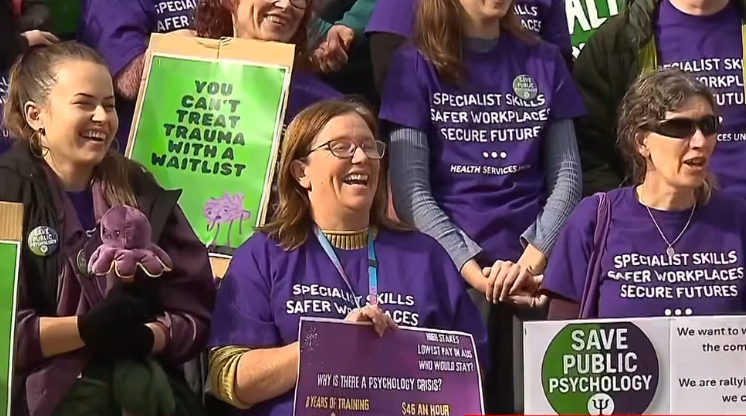
Public sector workers take on SA government

 Written by: Ned K. on 26 June 2025


Public sector workers in South Australia are refusing to accept the SA Government's attempt to peg wage increases in new Enterprise Agreements at 3% per year.  Unions representing a broad range of occupations from hospital cleaners to salaried medical officers employed in public hospitals have been negotiating for new Agreements since mid-2024.

The medical officers and their union, SASMOA, have been the punching bag for the Government and Premier Malinauskas in particular.

The medical officers wage claim is for 10% increase each year for three years. Malinauskas, ably supported by the Murdoch Press with a headline "Mali slams belligerent union claims", (Adelaide Advertiser page 1, 26 June 2025) claims that such wage increases will put the State of SA Government budget "back into deficit" and that such wage increases will impede the Government's ability "to invest in infrastructure".

Workers across the public sector are not copping this argument. They know that some of the public sector jobs in SA are 20% lower pay than the same jobs in the eastern States. This includes medical officers' jobs in critical areas of patient care.

Hospital cleaners, disability workers, food services workers and nurses have all seen the above Award margin in their Enterprise Agreements shrink over the last decade as governments took advantage of the job losses in manufacturing in SA with the closure of the car industry to depress public sector wages and increase workloads.

Workers can see that the current "Mr Popularity" Premier Malinauskas has no problem in finding undisclosed money amounts for car races, Liv Golf and AFL Gather Rounds, plus corporate welfare to big business in various forms, but when it comes to frontline workers providing public services, there's a hue and cry about "greedy" unions!

The attempt to clamp down on public sector workers' incomes comes at a time when NATO countries agree to the USA's demand to increase defence spending to 5% of GDP and pressure from the USA for Australia to follow. 

In SA, the SA Government sold off land to expand the proposed nuclear submarine ship building base at Osborne in Adelaide's northwestern suburbs. More SA Government money has gone towards supporting the submarine base but the exact amounts are rarely published.

Malinauskas is committed to the submarine base as the saviour of SA's future. 

The higher the public sector wages paid, the less money to throw towards SA as "the Defence State".

There is also the reality that under capitalism, workers in the private sector know that historically public sector wages have been higher than in the private sector and have set the benchmark for many workers in the private sector to struggle towards.

So, the lower the public sector wages are puts downward pressure on wages across the board and hence increases profitability in the private sector as a whole.

Malinauskas comes from the line of politicians dating back to the days of the Groupers and the DLP. Dedicated supporters of the "freedom and democracy" of capitalism.

Keeping the working people at bay through a "bread and circuses" approach is the game the ruling class and its Premier play.

The determination in struggle of public sector workers shows that this strategy is wearing thin. 


Print Version - new window Email article

Monday, June 2, 2025

Residential aged care - for people's needs or private profit?

Written by: Ned K. on 2 June, 2025


(United Workers Union aged care worker members rallying in adelaide in 2022 - X UWU)

The residential aged care sector is increasingly owned and operated on a profits first basis.

Under the current system, aged care providers (both for-profit and supposed not-for-profit) from 1 January this year can charge a new resident an upfront bond payment of up to $750,000. This is an increase from the previous maximum amount of $550,000.

The $750,000 maximum will be indexed each year from now on, according to the Aged Care Task Force (The Saturday Paper, May 17-23,2025). For the small minority who constitute the ruling class in Australia, this amount is water off a duck's back. They pay up to the maximum bond up front and even more to ensure they get the highest possible residential care. In every capital city, you can see that the residential aged care homes in the leafy, quiet suburbs of the very wealthy offer far better facilities and care than aged care homes in the outer working class suburbs of all major cities.

In the article in The Saturday Paper, the sector accountant firm Stewart Brown found that the average bond of $500,000 for a residential aged care place to live works out to be a daily accommodation payment of $109.59. This does not include the cost to the provider of wages for nurses and carers, as their wages come from federal government funding.

This average bond figure includes bonds paid by aged care residents from the wealthiest to any resident who has any assets (including their modest family home).

The increasing number of aging people who need residential care but who have no assets to speak of is growing.

The maximum accommodation supplement paid by the federal government to the aged care provider for those people "lacking financial means" is $69.79 per day.

As higher accommodation prices continue, the gap between the quality of care and facilities for those "lacking financial means" and the wealthy in aged care homes will only increase.

The incentive for the aged care providers is to "admit" elderly Australians who have enough assets to afford at least the average accommodation bond of $500,000 and rising each year.

There are some not-for-profits who will accept those "lacking financial means" even if it means their bean counter accountants assess the place is running at a loss. Given that the providers are allowed to keep the interest they make on the bonds paid by residents, the claims of some providers that they are running at a loss are questionable when you see the directors and CEOs drive to and from work in their BMWs or Mercedes Benz!

Working people pay taxes all their lives yet they cannot be guaranteed even basic quality aged care if needed without paying a huge bond. If they are "lacking financial means" then not even basic care is assured.

Under capitalism in Australia, governments have no problem in spending $360 billion or more on nuclear submarines for use in a USA war against China. But they are quite ok with an aged care system fundamentally run for private profit of operators and a system with levels of care based on class lines. 

The immediate demand should be for the federal government to eliminate private-for-profit operators and turn them in to public ownership, with the not-for-profit sector supplementing a public sector aged care system.

The long-term solution for quality aged care is an independent socialist Australia.


Thursday, October 3, 2024

SA Ambo’s election shows workers want their unions to fight regardless of who holds office

Written by: Nick G. on 4 October 2024


The election of a new leader for the Ambulance Employees Association in South Australian reflects the desire of union members for their union to pursue their objectives free of any alignment with the Labor Party.

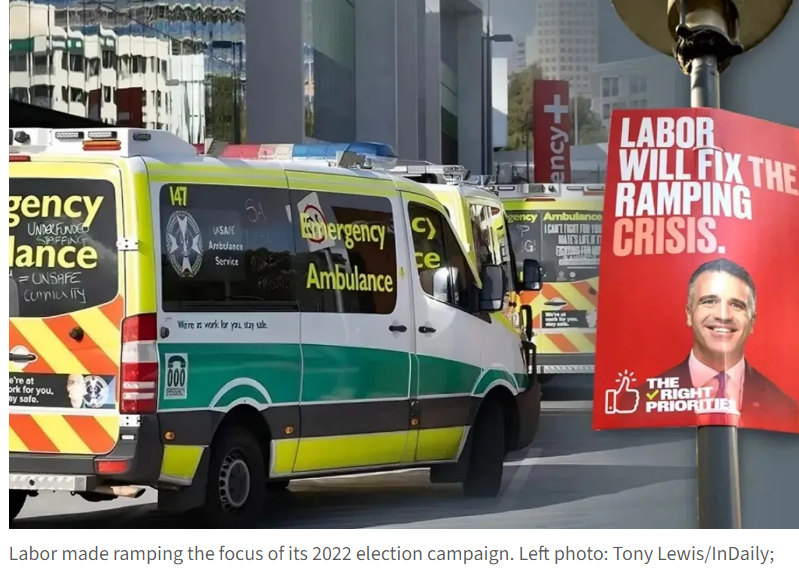
Like ambulance services around the country, SA ambos and the community are angry at continuing problems with ramping where unwell or injured persons are delivered to hospitals but are unable to be admitted, so are kept for hours in ambulances parked at the doors of the hospitals.

The problems in SA became so acute a couple of years ago under a State Liberal government that Labor ran a single issue campaign, promising to fix ramping and was duly elected.

Despite opening a half a dozen new 24/7 ambulance stations across the metropolitan area and in several country locations, and despite an extra 27 ambulances added to the fleet over last two years and extra beds created for hospitals, ramping not only remains a problem, but has worsened.

In the lead-up to the last election, the ambulance union ran a highly visible campaign. Ambulances carried chalked messages damning the Liberals and calling for public support, and stories of critical incidents, including of people dying while being ramped, filled the media.

But after the election, the heat was lifted from the incoming Labor government, the AEA disappeared from the media, and ambulances went unchalked.

But the crisis kept on delivering bad news. Last December, a 54-year-old man died after waiting more than 10 hours for an ambulance. In July, an 83-year-old woman spent 12 hours waiting to be admitted to the Royal Adelaide Hospital overnight. The same month saw the worst ramping on record, with more than 5500 hours of ramping for the month - equivalent to 15 ambulance crews ramped, unavailable for the community, every single day.

The crisis continued into August when at one point up to 54 ambulances were ramped across Adelaide Hospitals, 17 of which were ramped at Flinders Medical Centre alone, some for up to 7 hours.

Meanwhile 23 emergency cases remained uncovered in the community. 

Paramedic Paul Ekkelboom contested the AEA election for the General Secretary position on a campaign headlined by the promise of re-establishing the AEA’s political independence, and including promises to empower AEA representatives, have a stronger stance and advocacy on ramping, and a preparedness to take legal and industrial action. He won the election with 801 to 342 votes.

The election result clearly shows that workers want their union to have the capacity to fight for their interests regardless of which party holds office. 

We say “holds office” rather than “gets into power” because real power resides in the boardrooms of the giant local and overseas monopolies that control the economy, and hence the political and legal structures that sustain their rule.

The demand that unions adhere to an independent working class agenda, not “go soft” on Labor when it holds office, and even disaffiliate from it to secure their independence, is bound to grow.


Monday, May 6, 2024

How the Australian state machine breeds terrorism

Written by: Louisa L. on 6 May 2024


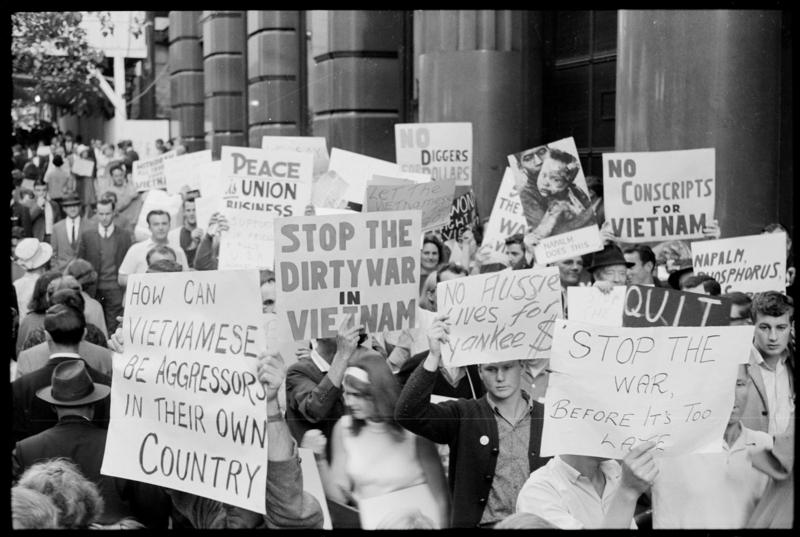
Anti-Vietnam War demonstration outside Phillip Street Court, Sydney. Wiki Commons Image courtesy of the SEARCH Foundation, from the collections of the State Library of New South Wales

In 2003, when Australia joined the US invasion of Iraq, Coalition politicians were obsessed with terrorist threats. 

They ignored the fact that imperialist war is terrorism at its worst. They ignored that Sadam Hussein was an enemy of Al Qaeda. They knew Iraq would become another wartime training ground for terrorists to overflow from the US war on Afghanistan declared just two years earlier, after 9/11.

Yet for years there was only one terrorist attack here, at Sydney’s Lindt CafĂ©. The perpetrator was on bail for 43 sexual assaults, and organising his wife’s murder. Not terrorism?

But what has shifted in 20 years since then, for seven teens, at least one with mental illness and disability, to be charged with terrorism? With their right to silence and independent lawyers denied, much reduced levels of evidence needed, and presumption of innocence reversed, not guilty verdicts are unlikely. 
But surely, even with churchgoers quickly defending their priest, a trained terrorist had time to inflict a fatal blow.

US imperialism and traitors like John Howard

People capitalism calls terrorist usually take individual action because they feel powerless against injustice. They don’t understand real change comes from mass action. 

In 2003, at one southwestern Sydney school with a high Muslim enrolment, every staff member, from teachers to cleaners, wore purple ribbons against the war. When students walked out statewide, the school was almost empty of older students of all backgrounds. At a peace assembly, the principal told the whole school, “We should not go to war with Iraq. If we don’t stop the war, at least we will have tried.”

He knew 94 percent of Australians supported his stand. The Muslim community knew their enemies were US imperialism and traitors like John Howard, not our peoples.

And now? At the same school, students have been suspended for refusing to remove the keffiyeh. They’ve been hauled to the principal and berated for drawing Palestine flags on their hands, or wearing Palestine bracelets. 

Teachers at some schools refused orders by principals to remove keffiyehs. Those principals mostly backed down, knowing they risked community backlash.

Staff and students have been told not to discuss Palestine at all. Repeat that at schools across the region. It’s statewide department policy, backed by the government. To their credit, some principals refuse to cave in to this abusive, US imperialist-driven policy.

So, troubled young people without guidance went underground to seek answers.

Funding cuts bite

The NSW Teachers Federation took a good stand on Palestine, much to the fury of Zionists. It has supported staff. But it’s nowhere near as strong as it once was. Funding cuts have savaged the state system. 

State schools enrol the vast majority of students with disabilities, especially the most complex and serious ones. In April, the Australian Education Union revealed, each state school student eligible for Commonwealth disability payments, on average, receive $2,941 while private school students get $10,000. 
The parents of the teenager charged over the stabbing said their son had severe behaviour issues at home and at school. Did that teenager get the help he needed?

Did the school he attended have teachers to staff each class? For two decades, the union repeatedly warned governments of predicted teacher shortages. Ignored! Last year shortages hit with a vengeance. Especially in poorer areas, students frequently had no teachers. Parents who could, turned to private schools. State school enrolments plummeted.

 Instead of tackling the problem, the government squeezed teachers. It demanded deputies and assistant principals head back to classrooms. It didn’t know that in primary schools they’d never left!

For years, elitist private schools with higher wages, better conditions and fewer discipline problems (because any student with problematic behaviours would never be enrolled) lured teachers into their system. 

Collective antidote

Meanwhile, an epidemic of teacher-sackings plagues the state system. It takes just three months to sack a teacher. 

There are still many strong principals who support staff. But authoritarian behaviour and culture is rewarded with promotion. Secretive “Teacher Improvement Programs”, TIPs, are largely a tick-box affair for supervisors. Now union reps are being sacked, or pressured to resign beforehand.

All unions have been systematically disempowered by repressive industrial policies of successive Labor and Coalition governments since the mid-1980s. There’s an old union saying, ‘An injury to one is an injury to all’. Even unions that lead successful wages’ strikes can’t survive if they can’t protect their members. 

In 1970, unionists round the country were strong enough ‘to stop work to stop the Vietnam War’. Despite being bigger than the three 1970s anti-war protests, in 2003 the working class didn’t go on strike against Australian war against Iraq. Unions were no longer strong enough.  

Both war and terrorism arise naturally from capitalism. Collectivism, embodied in the working class, is its antidote. It’s time to do much more, learn much more, build organisation and strength. Capitalism is the problem. It has to go!

Wednesday, April 24, 2024

Before Sydney stabbings, capitalism’s cupboard was bare for mental health

Written by: Louisa L. on 24 April 2024


The tattered remnants of public mental health care in NSW are held together by family members and volunteers. 

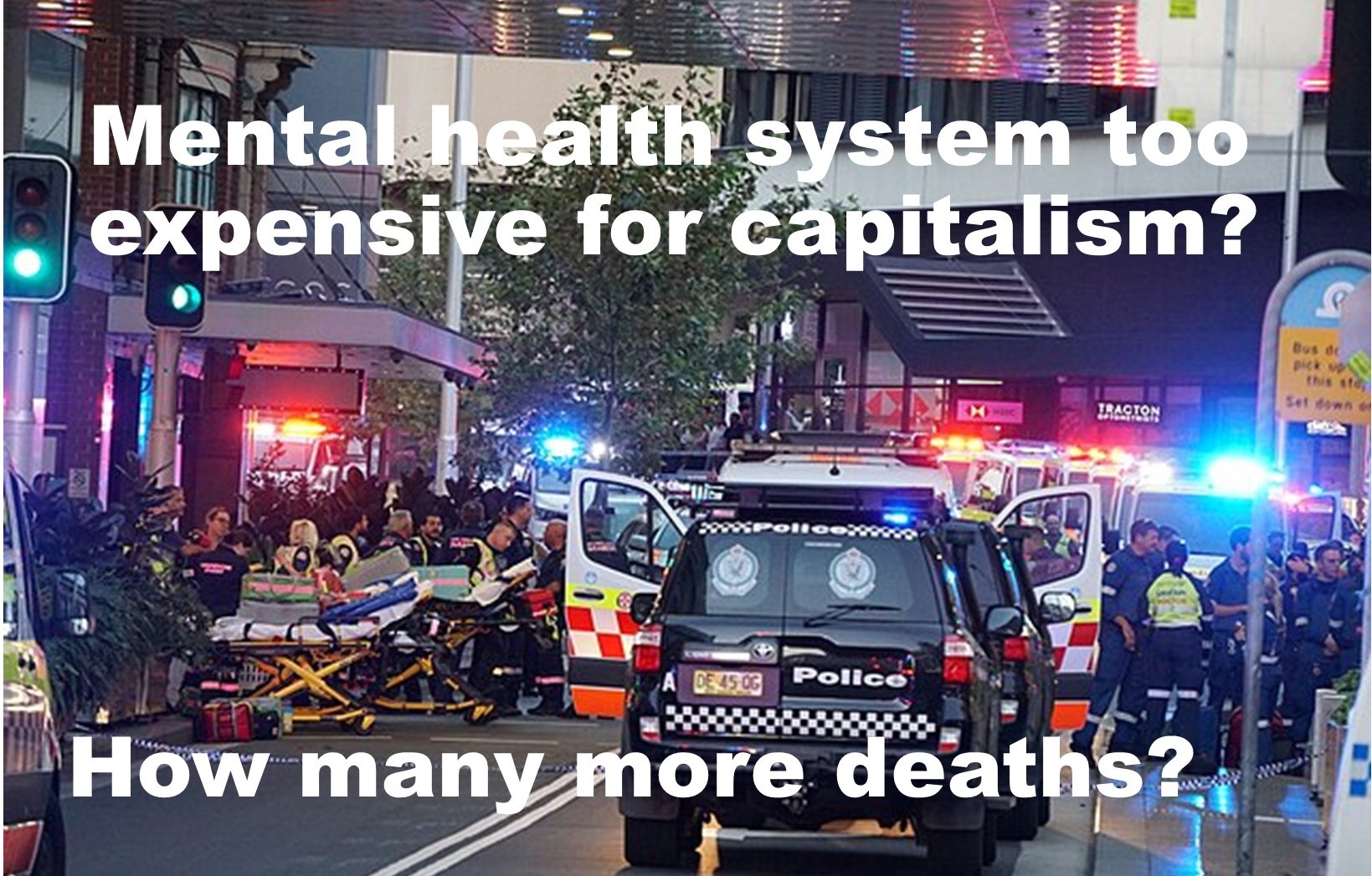
The week before six people were fatally stabbed in Bondi, and a mentally ill 16-year-old stabbed a priest, two Uniting Church psychiatric hospitals were closed in Sydney, because they were losing money.

When six strangers in a crowded public place are killed, grief and shock is inevitable. The media fans it to fever pitch. But people are frequently “murdered” by family members suffering psychotic episodes. And police too often shoot mentally ill people who ought to have been in hospital or long-term residential rehabilitation. 

Instead of suggesting triple zero and an ambulance, when “you or someone you know” is mentally ill, the media choruses Lifeline and Beyond Blue. A young friend frequently uses Lifeline’s skilled volunteer services.  Being alone and suicidal is not enough to be admitted to hospital – unless she’s taken an overdose.

On a pension she pays private health cover, so she can have occasional and much needed treatment in an expensive private hospital.

After the ambulance left 

The mental health system is designed to stop people being hospitalised, unless they have money to pay, and they are well enough to understand they need help. 

Last winter, under a suburban Sydney neighbourhood centre awning in pouring rain, a close friend, a mother and two adult daughters, waited for police and an ambulance.

It had taken hard arguing to convince my friend that police be called after her 16-year-old son threatened them, so he could be admitted to a psychiatric hospital. A centre worker did unpaid overtime while they talked. 

What happened? The son, who had previously assaulted his mother, sister and brother, assured the ambulance officers and police he wouldn’t harm himself or anyone else. Imagine the family’s vulnerability when the police and ambulance officers left. Instead of a dangerously ill young person receiving necessary treatment, the three women each found separate accommodation. An uncle and a youth worker checked on my friend’s son the next day, but he lived alone for over two weeks until his still fearful mother returned.

Desolation and grief

But his family’s grief is nothing compared to the desolation of the Bondi attacker’s parents whose son endured a living nightmare, denied desperately-needed health care, his life ended in such terrible circumstances. Nor does my friend’s ongoing worry compare to the grief of the families of those killed in that suburban shopping centre, or the family of the 16-year old on terrorism charges.

The media babbles about “people falling through the cracks in the mental health system”. What system? It’s not cracked. It’s been dismantled brick by brick because the mentally ill and their families are weak and unable to defend themselves. They are the bottom of capitalism’s heap. Their treatment is expensive, not privately profitable. They are disposable.

Mentally ill people are disproportionately part of the homelessness epidemic. Alongside First Peoples, alongside the poor and illiterate, mentally ill people fill our jails. Because under capitalism there’s always money for jails to mop up its normal functioning.

NSW Premier Minns announced an $18 million inquiry into what went wrong in the lead-up to the Bondi stabbings. Unless it’s accompanied by struggle to reinstate public mental health care at all levels, it will be just another whitewash. We know the state government funding cupboard is bare, after decades of corporate plunder and privatisations. 

For mental health, it’s been empty for decades. More deaths, more suffering – that’s capitalism’s promise to profoundly ill people and their families. Seven more dead and a 16-year-old charged with terrorism? Collateral damage. Nothing $18 million, plus media evasions and a lot of sorry talk, can’t sweep from sight. 

We need a new system. We need a revolution.


Friday, April 7, 2023

“I don’t go to the doctor. I don’t want to know the answer.”


Written by: Louisa L. on 7 April 2023

Spirits were high on Wednesday 5 April when thousands of workers around Australia walked out over deadly silica dust. In Sydney, the CFMEU, ETU, Plumbers, MUA and AMWU members gathering were full laughter and energy, seeing old mates. 

But one group was quieter. Concreters still chatted and smiled, but they weren’t celebrating. Along with workers making and cutting engineered stone, they know they are on the front line for deadly silica dust diseases.

“I don’t go to the doctor. I don’t want to know the answer,” a long-time concreter told me. 

Governments won’t act unless people do first

Workers don’t need to be told things they already know. At the strike rally they said they knew ‘all about dust’, while generously taking leaflets with “Dust kills” screaming in giant font. One spoke of the microscopic hooks on silica, that make it so devastating.

The Spirit of Eureka leaflet asked, “Companies and governments have known dust kills for over 100 years.  So why do you have to strike because workers are dying from silicosis again?”

Its brief answer was true, but a bit too blunt, “Profit rules. It’s capitalism’s driving force. It’s private profit from your collective work. Anything that gets in its way, like health, is sidelined unless workers unite and act.”   

Like silica, companies had known the danger of asbestos since 1929 and done nothing. Forty years after this corporate mass murder was finally exposed, with not a single person charged, what’s changed? It still takes strikes and protests to get something done. 

If we live in such a great democracy, how come the corporate bastards with their billions can still rob young and old of health and even life? It’s clear governments won’t act unless people do first.

A striker revealed he still checks the lists showing which Chinese companies export asbestos products, that it was difficult finding the name the killer asbestos company James Hardie now uses. 

A sparky said all construction workers are affected by silica dust. The day after, a labourer friend told how, four years ago, he’d swept piles of Ceasarstone dust, wearing just a basic mask.

Another at the rally said the hairspray his hairdresser wife uses every day is full of silica. Like asbestos, silica spreads its gifts. Is it why my middle-aged hairdresser is often in hospital with lung problems?

Our “great democracy”

In our “great democracy”, unions and workers that consistently stand up and fight have their reputations trashed and face special laws and giant “commissions” attacking them.

A Spirit of Eureka leaflet handed out at Wednesday’s Sydney joint unions rally stated, “Your unions continue struggles of others like the Builders Labourers Federation, that surrounded corporate headquarters over asbestos and insurance companies refusing to pay” sick and injured workers. 

For crimes like these, for demanding better wages, conditions, safety and basic human dignity, the Hawke Labor government deregistered the BLF.

The Builders Labourers Federation fought till they could no longer do so as the BLF. It took two deregistrations, trumped up royal commissions, jailing of leaders and hundreds of arrests of organisers just for doing their jobs. 

The CFMEU took up the struggle where the BLF left off.  

The union and its members have withstood threats of jail over nearly twenty years of ABCC attacks on their basic rights to organise.  Members refused to front the Commission, risking jail.

As the leaflet said, “Albo has shut down the ABCC as promised, and dumped the shitty 2016 code of conduct.” 

But he’s shifted the ABCC bosses to the UnFair Work Ombudsman. There, those ex-ABCC bosses are refusing organisers’ rights of entry. They target rank and file leaders too, saying they’re “bringing ABCC methods” with them. 

Spirit of Eureka’s leaflet declared, “Let them try! Your unions are united. Today you show your strength.” 

Breaking ABCC power right now is essential, because Australia’s longest construction boom ever is winding down. 

Ongoing resistance to deadly dust has the potential to win wide community support for big compensation, for bans on silica products and against the ABCC new style persecution. 

On Wednesday striking workers took another battle to the streets and to NSW Parliament House, a reminder to both state and federal governments that workers and trade unions made sure they were elected, that they expect promises to be kept in deeds not just words. 

But there’s three more questions needing answers. Why are we fighting the same battles won decades ago? Isn’t the system we all live under the problem? Isn’t it time for fundamental change?


Friday, February 24, 2023

Book Review: Scattered Minds: The Origins and Healing of Attention Deficit Disorder.


Written by: Peter Curtis on 19 February 2023

Scattered Minds: The Origins and Healing of Attention Deficit Disorder. 

Gabor MatĂ©. Vermillion, 2019. ISBN 9781785042218. 

Gabor MatĂ© is a medical practitioner and therapist whose book Scattered Minds: The Origins and Healing of Attention Deficit Disorder is a refreshing and revelatory read about understanding the challenges of what is commonly labeled as a ‘disorder’. Every teacher should read it. We would agree that ‘managing behaviours’ which disrupt and threaten the purpose of teaching and learning because of a student’s inability to self-regulate and exercise control are among our foremost challenges. ‘Behaviours’ is a polite way to say what many outside our profession would call appalling. 

An enlightened view understands that any behaviour, be it conscious or involuntary, is a form of communication, expressive of a desire or need. However, we are encouraged to believe that perplexing, and disruptive, troubling habits, like so much else, can be managed with a pill. The challenges for those suffering, and for their carers  and teachers, can be overpowering. No surprise therefore, that AD(H)D, oppositional defiance disorder, and other associated behaviours, or comorbidities, receive the most attention in school settings. 

Born a Jew in NAZI-occupied Hungary, Gabor MatĂ©, as an adult, discovers that he too has ADD which, he explains, helped him a great deal in understanding his own triggers and patterns of behaviour and the impact that they have on those around him. His three offspring also have ADD. Proof of a genetic inheritance? He does not deny that there is a biological propensity or predisposition which heightens our sensitivity to the environmental factors that impact on us and which subsequently trigger our physiological and psychological reactions. An analogy is some people’s sensitivity to plants and foods resulting in allergies, whereas AD(H)D is a somatic and psychological reaction to external stimuli which results in sensory overload which then creates the neurological and chemical changes that occur in our nervous system. 

The neurobiological and psycho-medical terms used to define AD(H)D as a disease rather than an impairment are impugned by Maté. Explanations crafted for popularisation so often explain away the mostly undesirable human traits as our genetic inheritance. The misunderstandings and suffering that are thereby produced turns us all into the victims of a pathology over which we have no control. Mass myopia affecting children in parts of Asia, for example, has nothing to do with genes but everything to do with very little outdoor play. Perhaps too, genetic explanations are clung to because parents who are already stressed-out and time-poor, can reduce their feelings of guilt.

MatĂ© insists rightly that we must turn our attention to the environmental conditions in which we are immersed rather than look for the answers in our genes alone. The medicalised view is a narrow one, he argues, and it is this “genetic fundamentalism” that dominates our outlook and explanations for such ‘disorders.’ Our lives are a tangle of demands from family, at work or school. Under these pressures, we make myriad adaptations so to better meet the daily expectations made of us to consume, to conform and to contribute our labour. 

There is dis-order, that is, an absence of order, which can be detrimental to daily living and to personal and professional relationships. Intentionally or otherwise, genetic determinism discourages us from giving full attention to the socio-economic forces that destabilise us. Big pharma is a maleficent contributor, actively researching and marketing individualised pill-popping solutions for everything. Shoving these solutions down our throats discourages us from appreciating more exactly how our lives are socially produced and conditioned. 

Absence of a grounded critical view will mean that we fail to face-up to our challenges and responsibilities as adults and carers. It is easier to dismiss nuanced questions and to seek solutions to complex social and family dynamics if troubling behaviour is a consequence of each individual’s biological make-up. While the ‘c’ word, ‘capitalism’, is never stated, MatĂ© condemns the culture it produces as a causal factor mostly because of the deleterious effect it has on our familial relationships, but also, on all our lives. He is right to do so. He describes the social roots of AD(H)D as one consequence of “this most frenetic of cultures.” 

AD(H)D as a phenomenon needs qualification: the label does not describe what is actually happening; why is there is an inability to give attention to something? The ‘deficit’ is in the label because it mistakes the outward sign for the symptom. Safety and security are paramount for anyone to thrive, but for children particularly. From a child’s point of view, the deprivation of an emotionally secure environment provides a causal connection to reactive behaviours. MatĂ© believes a more accurate description would be an “attunement deficit,” which is “the quintessential component” of the attachment process between children and those who are in the parenting role. 

Self-regulation and control are not endowed, or magically bestowed upon us. Like speech, they are developmental processes which occur not only within our immediate family but from anti-social media. While such an observation may seem obvious, we need to inoculate ourselves by repeating it to absorb its truth. MatĂ© makes the point that if we neglect to understand and articulate how our social relationships contribute to the AD(H)D origins then we will fail when exploring the possibilities for healing. Our struggles for social justice must engage too with these insights with all the urgency that mental health and social wellbeing demand. 

The cultural revolution being materialised by digital technology depletes focused attention in us all while depriving us of the mental space to daydream. Immersed as we are in a bath of online hyper-activity, we are creating a culture of distraction and information overload. Just how digital technology and virtual worlds are changing our brains and personal relationships is complex. However, sufficient evidence has been accrued to sound the alarm on the deleterious effects of dopamine-producing hyper-stimulation on executive function. 

The harm is especially evident when screentime dominates over human interactions and physical play in the early years of life. Maryanne Wolf, a neuroscientist and reading development expert, and author of Reader, come home: The reading brain in a digital world, calls this destructive cycle of treating the problem with the cause, the “dopamine lollipop.” Linda Stone, a high-tech consultant and past executive with Apple and Microsoft, coined the term continuous partial attention. This is a permanent state of crisis, compromising our ability to reflect, make decisions, and to think while being sold on ‘multi-tasking.’ We need to be alert to what digital technologies are disrupting or diminishing. As teachers, we witness daily the incapacity for the kind of sustained focus required for reading, studying a painting, or metacognitive thinking, be it for pleasure or otherwise.

Behaviour is a reaction to some provocation, although it can become habituated, but it does not occur outside of inter-personal or social relationships: “The situationality of AD(H)D reflects the input of the emotions, which play a powerful role in attention”. An underlying anxiety is common to these clusters of so-named disorders, with autism, AD(H)D, oppositional defiance and obsessive compulsion the common examples. When regarding childhood and adolescent behaviour, we must investigate what is occurring relationally and to their families. While such difficult and destructive behaviours are emotionally demanding, and time consuming, there is hope for healing.   

Adult attunement, an essential aspect of parental/carer attachment, is critical to reducing anxiety and the behaviours that are consequently produced. The deficit is not only the inability to give sustained attention to something, a sign, but equally the absence of positive attention given to the sufferer. Their emotional needs are not being met sufficiently for them to feel safe and secure in their relationships. For instance, a baby’s healthy development is inordinately dependent upon regular eye contact with their attentive adult. If a carer’s attention is regularly consumed by their own screentime, we must expect a consequential deficit in the infant.

What is being asked of us who have the power and responsibility to change the terms of these relationships, and then, how do we engage? We must examine our own behaviours to gain insights into what we are doing that is a catalyst for undesirable reactions. Those with these disorders are likely to have a diet of negative emotional reactions to their behaviours from their parents and carers. Negative reactions are expressions of our frustration, exasperation, and anger, which are delivered as commands and punishments. 

It is a repetitive and counter-productive cycle. There has to be a circuit breaker. Over half of Mate’s book is dedicated to discussing what can be done to meet these emotional and psychological demands. His reflections contribute to our understanding of what should to be done to assist young people and adults when they are learning how to improve their self-regulation and control. Our hope-filled purpose is to mitigate what indeed are anti-social behaviours, not only in their effects but also in their causes.

Peter Curtis is an educator in the ACT public school system. He has worked in early childhood and primary school settings for more than twenty years. He is currently working in a high school.  

Monday, March 21, 2022

Big Pharma Makes a Killing - Literally


Written by: John S on 22 March 2022

 Another reason capitalism cannot and will never protect the people.

Moderna made a massive profit in 2021 - US$13 billion i.e. US$36 million a day.

Moderna’s COVID vaccine can be produced for as little as $2.85 per dose, but averages $19 -24 on the market, up to $37 in some countries  i.e. up to 13 times the estimated cost price.

The People’s Vaccine Alliance calculated that COVID-19 vaccines had  created nine new billionaires. Moderna CEO, Stephane Bancel, is worth $5 billion!

Some other facts about sheer perversity:

In September, 2021, Moderna had delivered 85% of its supply to the richest countries (home to some 12% of the world population), and almost no doses to low-income countries.

Big pharma justifies its profits and patents with claims about the huge expense of research.

In truth, vast amounts of public money have been given to Moderna, for one, to support or enable the research. 

Nearly $1 billion of US taxpayer money was poured into Moderna, and the US government provided another $1.5 billion as an advance purchase agreement.

Despite this, Moderna refuses to share its recipe, patents or know-how. South Africa is hosting an mRMA research effort for the purpose of  developing the technology to share freely with the world. Moderna has refused to collaborate. Indeed, Moderna has even applied for patents in South Africa to maintain control and ownership of the know-how it developed with public money.

Moderna is currently in legal patent disputes with rivals and the US government. It would rather spend millions on litigation than help the world's population.

All this is regular big pharma behaviour. Milk the public purse, then profits before people.

Only a socialist system will nationalise pharmaceutical research and provision, targeting  people’s real needs, and providing medicines for free.


Thursday, January 27, 2022

Big Business Backed "Let It Rip" Covid-19 Policy A Disaster For Working People


Written by: Ned K. on 27 January 2022

In November 2021 big business cranked up its demands on federal and state governments to "open up" interstate and international borders and to lift so-called "restrictions" such as social distancing, mask wearing, limits on number of people at indoor events and hospitality venues.

The federal government and state governments obliged to varying degrees with the NSW Government the most subservient to big business demands. The only government to hold the line was the WA Labor Government due to pressure from the people and the fragility of its hospital system.

The Morrison Government line was that people wanted government "out of their lives" so they could enjoy Christmas and New Year period and that people just had to "get used to Covid 19" which Morrison said was pretty well done and dusted as a serious health threat.

From late November the "let it rip" policy was in full swing. Within a week though public health authorities in one State after the other warned that the new Covid Omicron strain was spreading very quickly, despite being less severe than the previously dominant Delta strain.

Every night on the TV News, the number of cases of people with Covid 19 and the number of hospitalisations and deaths from Covid-19 escalated.

The impact on workers was severe. Christmas and New Year turned in to the opposite of what Morrison and his corporate bosses had promised. Families remained apart due to positive cases and others being close contacts of positive cases of Covid-19. Capitalism's supply chains started to fall apart as workers had to isolate due to the impact of the virus. Some small and medium sized businesses closed down altogether due to the spread of the virus. The get-used-to-living-with-Covid-19 line of big business and governments in order to increase profits was turning in to its opposite for small businesses in particular.

A good example of this occurring hit the daily media cycle in South Australia. Both the city and regional media reported that social events at a seaside hotel and restaurant at historic Robe in the South East of the State on New Year's Eve and the following weekend had become super spreader Covid-19 events. The number of cases jumped from a handful in early December to over 200 in a town whose population swelled from 2,000 to 15,000 in the holiday season. Most small businesses in the town either closed or were on restricted hours due to lack of available workers,

The largest hospitality venue that caused the outbreak in the first place was reported to have made $150,000 profit on the two nights when all the Covid-19 safety protections such as mask wearing and social distancing were ignored as the hotel owner was counting dollars coming in, not the number of potential Covid cases. The daily media reported that the impact of the spread of the virus due to the irresponsibility of the hotel owner so upset local people that the SA Health authorities were forced to step in and provide a Covid testing station and fined the hotel owner $5,000. Locals said that the owner shrugged off the $5,000 fine as chicken feed compared with the $150,000 profit from the two nights.

This small incident in a small seaside town in the small state of SA was a microcosm of the impact of the "let it rip" policies that impacted adversely people in all States, including to a lesser extent in WA. What happened in SA showed the class nature of the impact of Covid-19 and government policies with workers and small businesses, the elderly and people with disabilities being worst affected.

It was later reported that in SA, the Liberal Government Premier and the Police Commissioner (who some say ran the State, not the Premier and his government) disregarded the health advice of the Chief Medical Officer Nicola Spurrier. She wanted the SA Government to close the interstate again in November until the medical people knew more about the Omicron strain. However, in the name of profits over Christmas first for business, her advice was ignored. This is a commonly known fact now. It may well come back to bite the Marshall and Morrison Governments when they face election day in March and May respectively.

People seem to have no illusions that Labor Governments will be much better, but people still delight in kicking out governments that clearly serve the interests of the rich few.


Wednesday, January 5, 2022

Young People's Action On Climate Change Is A Key To Fight Against Pandemics


Written by: Ned K. on 3 January 2022

In the last few years, young people across the globe have led the people's struggle for decisive action by governments and big business on climate change. 

Media outlets owned by the likes of the Murdoch empire have ridiculed these young people, as have reactionary political leaders like Prime Minister Morrison. 

The lockdowns due to Covid-19 decreased the number of mass demonstrations temporarily. However growing evidence from naturalists and ecologists is that there is a definite between climate change and pandemics such as the current Covid-19.

During the Covid-19 outbreak over the last couple of years, well known naturalists, ecologists and other critics of capitalism such as Chomsky have spoken out about the link between climate change and Covid-19 in support of young people. Their proposed solutions are not always the same but all say the current growth for growth's sake imperative is the root cause of the problem.

Attenborough in his book Life On Our Planet says that in 1937 when he was 11 years old, remaining wilderness made up 66% of the world's land area. In 2020, remaining wilderness made up just 35% of the total land area. Carbon in the atmosphere during this period of his life had risen from 280 parts per million in the atmosphere to 415 parts per million in 2020.

Chomsky adds to Attenborough's observations in saying that during this same period of environmental destruction, there has also been a concerted effort by global capitalism to wipe out mass working class organization, the very force capable of forcing major changes on governments. Chomsky stops short of calling for complete change from capitalism to socialism and settles for what he considers the more immediate task of a "Green New Deal".

He is not alone in promoting a Green New Deal, as some capitalists think this is their only hope of maintaining ruling class power in the face of the climate change crisis.

What have these ideas got to do with Covid-19?

An ecologist from the Scandinavian countries, Andreas Malm, says that the deforestation rate has led to a spill-over of viruses from animals to humans such as the pangolins sold in Wuhan markets. He also points out that dependence of mega cities and advanced capitalist countries in Europe on food from other regions of the world will further accelerate deforestation. Germany, for example, imports 80% of its land based food resources. Malm also points out that coupled with deforestation in regions where cash crops to feed the West are grown, is increasing extremes of climate including severe drought.

The dependence on transportation of food resources across the globe has added to another major cause of carbon pollution of the atmosphere and also transmission of viruses like Covid-19. 

The polluters he refers to are transportation by air and sea. Aeroplane travel by the rich business class in particular are the worst offenders.

He doubts whether pandemics will disappear as long as the system of capitalism continues on its destructive way. He sees the solution as a form of ecological “war communism”.

He is sympathetic to the hope of capitalist social democracy advocates such as Jeremy Corbyn and Bernie Sanders, but says the problems cannot be solved by mere reform of capitalism due to the latter's inbuilt destruction of nature in search of growth.

The important point about the ideas expressed so widely by people like Attenborough, Chomsky and Malm (who also writes for Jacobin magazine), is that young people read them and that the likes of the Murdoch press do not have the monopoly of ideas when it comes to how young people in particular think and act.
Mao said “Once the correct ideas characteristic of the advanced class are grasped by the masses, these ideas turn into a material force which changes society and changes the world.”

The ideas about climate change and pandemics have moved past describing their impact  and on to people discussing solutions and organising action. 

Young people taking to the streets in their hundreds of millions across the globe over climate change contain the working class leaders of today and tomorrow. That is what scares the likes of Murdoch the most.