Showing posts with label France. Show all posts

Tuesday, June 11, 2024

European elections and dissolution: the fire of crisis consumes French bourgeois democracy

Written by: La Cause Du Peuple on 12 June 2024
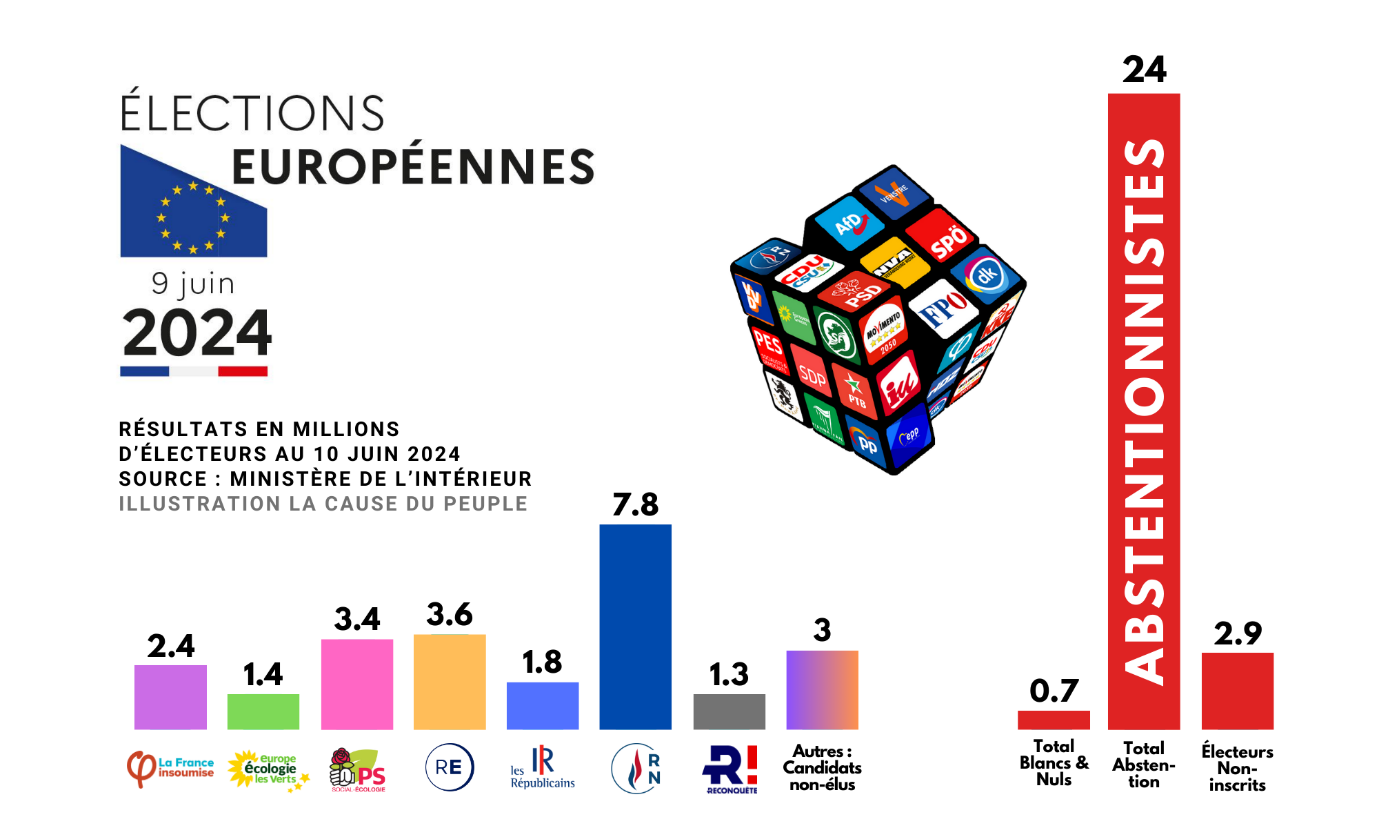
 

Much has been made in the Australian capitalist media of the “swing to the right” in the French elections to the European Parliament.  They concentrate on the votes won by RN, the right wing National Rally, but not on the staggering rejection of the parliamentary charade as witnessed by the number of abstentions from voting. We reprint this translation from the website of La Cause Du Peuple in the interest of a better understanding of French and European sentiment -eds.

European elections and dissolution: the fire of crisis consumes French bourgeois democracy
June 10

The ‘European elections’ circus has played out its final act in France. The results are clear: like all the elections since Macron took over the presidency, the rejection of the electoral system (abstention, blank votes, invalid votes) is the big winner with 25 million votes. This is the historical tendency of the broadest and deepest masses in France: to reject the bourgeois state, its government, its system. That is the main lesson.

Bourgeois commentators dwell on the ‘historic turnout over the last 30 years’. They consciously forget that the European elections in France in 2019, 2014 and the 2000s had a ‘European’ character, i.e. the bourgeoisie incited the masses to go and vote in relation to the ‘European parliament’, this powerless instrument where 705 actors (MEPs) play tasteless parts for the benefit of the struggle and collusion between the imperialist powers of Europe and all the monopolies and their lobbies.

2024 was different: after the election of 2022 and the great year of revolt of 2023, in a situation of economic, social and political crisis, the European elections were used by the bourgeois parties, led by the RN and the presidential party, as a rehearsal for the confrontations to come at national level. That's why Prime Minister Attal debated with the RN. That's why Jordan Bardella, who received 7.7 million votes (15% of the electorate), i.e. 1 million less than Le Pen in 2022, immediately called for the dissolution of the National Assembly.

The results speak for themselves: the RN's victory means that its electoral base voted. It's not a meteoric rise. Bardella's popularity is only high because all the parties around him have collapsed. Macron's party has lost 1.5 million voters compared to 2019.

In 2017, Macron opened a period of political crisis in the French bourgeoisie by consolidating a new bourgeois party on the smoking ruins of the PS (Socialist Party - eds.). In his first five years, through his prime minister Édouard Philippe, he managed to bring LR (Les Republicaines-eds) to its knees. He took the king's share of the spoils and became the ideal standard-bearer for the French imperialist bourgeoisie. In 2022, alone against Le Pen, he was re-elected. Today, he is declaring the dissolution of the National Assembly.

The bourgeoisie as a class fights in parliamentary fractions: the interests of French imperialism are defended in common by the presidential party and the RN. These are two parties of the bourgeoisie. There isn't a fireman on one side and an arsonist on the other: they are both arsonists in the service of a reactionary state.

The bourgeois media and politicians are hungover today: how could Macron dissolve the government? What for? According to them, there is nothing logical about it. For the most Machiavellian, it would be a ‘political stunt’, a ‘risky gamble’. For the naive, Macron has simply ‘put the ball back in the people's court’ after the ‘shock’ of the European elections... which shocked nobody because the polls had said it all before the ballot box!

They ignore the reality of the class struggle in France and the process of reactionarisation of the bourgeois state. The bourgeoisie wants to stave off the crisis at all costs, and is prepared to accept any recomposition, any party in power, any regime, in order to maintain itself as the dominant class in the face of its inevitable decline and overthrow by the proletariat.

So to claim that Macron dissolved the National Assembly, one of the exceptional powers of the French president, ‘lightly’, is an outright lie. The only people who sincerely believe it are the outgoing MPs, from both left and right, who are slapping their legs and blinded by the loss of their privileges.

Le Monde revealed on 10 June that a cell had been working at the Élysée for several months on the dissolution. So it was a prepared plan. In France, the President, even with a minority in the Assembly, retains immense power. That's what the French bourgeoisie decided when it chose De Gaulle in the last century. Macron has thrown out the projects of the end of the five years (such as the thawing of the electorate in Kanaky (New Caledonia), which led to the great revolt of recent weeks, but also the end of life or the plans to reform unemployment) to get to the bottom of the crisis.

The early parliamentary elections he has called are not a campaign: with 20 days to prepare them, he is taking everyone by surprise, even the RN, which was calling for them in its speeches. It's a real electoral farce, pure and simple. After 2 years of circus in the Assembly, where the masses were able to understand what ‘parliamentary cretinism’ actually meant, dissolving it is no loss for Macron. If he wins the election with a coalition, he closes a period of recomposition and opposition and can prepare for 2027, which is the real next deadline. If he loses and the RN gets into government, it will move forward with the same reactionary plans, only more assertive, and it too will fail to avert the crisis: just as Meloni is failing at the moment in Italy. Reactionarisation will progress and the French imperialist bourgeoisie will contemplate, as it already does, its possibilities of stripping bourgeois democracy of its trappings during a crisis of regime.

As for the trumpets and bugles of the Left, they are miserable. They think that an opportunistic, unprincipled electoral alliance will bring the broad masses, the 25 million who have turned their backs on the bourgeois chambers and the polling booths, to vote for them. They want to make these ‘disappointed’ and ‘disinterested’ people feel guilty en masse. It's all a waste. In the decomposition of imperialism in which we live, the proletariat has only one policy: boycott the elections, prepare seriously for revolution.


Saturday, December 5, 2020

S.W. Pacific – the French Connection


Written by: (Contributed) on 6 December 2020 

Serious studies of the sensitive Pacific part of the wider Indo-Pacific region focus upon the rising US-led diplomatic hostilities toward China.

They tend, however, to overlook other, smaller regional players, which also have influence.

Such is the case with France, which has three colonies in the Pacific together with other important interests across the wider region.

France would also appear to be intent on using the three colonies as strategically-placed assets in conjunction with US-led diplomatic positions, with far-reaching implications for Australia as the southern regional hub for 'US interests'.

France is a major diplomatic player in the Pacific: its three colonies, New Caledonia, French Polynesia and Wallis and Fortuna, provide France with direct access into regional organisations including the Pacific Islands Forum.

French colonialism in the Pacific, despite emphasis on military and security considerations, is, however, primarily based upon economic factors.

New Caledonia, for example, has about ten per cent of the world's nickel reserves which are dominated by private French-based companies. France also has direct control of a vast seven million square kilometres exclusive economic zone (EEZ) in the Pacific, providing crucial access to sensitive shipping-lanes and oil and gas reserves.

France has developed neighbourly relations with Australia as a dominant southern regional hub for 'US interests'. While France has continually pushed 'Francophone cultural influence wherever that is possible', the balance of power in the Pacific remains based on strong Australian-French diplomacy. (1)

Military agreements

In 2016 Australia and France signed a defence agreement, which was subsequently updated in 2018 in conjunction with support from the Trump administration. It included intelligence co-operation in what had become a potential theatre of war for US-led military planning against China. French overseas intelligence, the notorious SDECE/DGSE, has a long history of regional operations. Military exercises now take place with Australian and French personnel in a variety of official capacities on the regular basis.

The defence agreements, however, rested upon earlier military co-operation with the 2012 Defence Co-operation Agreement and later involvement, by France, with the Quadrilateral Defence Co-ordination Group which evolved into the so-called 'Quad'.

French military presence, in the Pacific, has the following provision:

                                 New Caledonia         1,400 troops
                                 French Polynesia       900 troops
                                 Wallis and Fortuna    defence responsibility of France.

French military presence in its three colonies is supported by a civilian, settler population: in the Kanaky area of New Caledonia, 27 per cent of the population are French residents. These French public servants, often with strong links to the official military apparatus and tentacles of their vast, sprawling intelligence services, are paid high wages. They contribute toward an economic and social imbalance in the country: an estimated ten per cent of the capital city, Noumea, for example, live in shanty-towns; they form part of an under-class of nationals for French interests to exploit.

The timing of the military agreements between Australia and France also coincided with moves by the Pentagon to revamp Island Chain Theory (ICT), a relic of the previous Cold War. Present-day US-led military planning has continually pushed ICT agendas. They include the significance of Taiwan and the third and final part three of Oceania, where France has a significant stake with its three colonies. (see diagram)

The French regional military position has, therefore, tended to fit comfortably into the bigger US-led defence and security provision, resting on a vast network of facilities hosted by various governments across the wider region. (2)

We remember….

French regional foreign policy, also has a murky side.

In the mid-1980s, France was developing a nuclear capacity which they tested in the Pacific; their intelligence services were noted as possessing the Cold War mind-set that 'France's nuclear independence … was … under threat from a co-ordinated and implausibly diverse conspiracy of jealous Anglo-Saxons, long-haired environmentalists, island nationalist groups financed by communists, and the Soviets, whose submarines lurked in the azure waters off the atoll' and therefore sought to deal with those concerned in a covert operation, which began with agents infiltrating Greenpeace in Auckland, New Zealand. (3)   

The subsequent attempt by the SDECE/DGSE to destroy the Rainbow Warrior monitoring ship owned by Greenpeace, however, was as fundamentally flawed as the disposition of the conspirators, and botched; while continuing to reside behind plausible denial, it was noted 'the agents might as well have left a beret, a baguette and a bottle of Beaujolais at the scene of the crime', which included two bombs and a Greenpeace photographer dead. (4)

Australia has, nevertheless, continued to rely upon France and their gung-ho intelligence services for regional military and security provision.

Australian foreign policy, for example, with its emphasis upon the South Pacific as a buffer for military incursions from the north, has had to include New Caledonia as part of the same defence and security provision.

Independence?

Recent moves in New Caledonia to push an independence referendum have, therefore, had serious implications for Australian defence and security provision. While the recent vote was lost to French loyalists, a third and final referendum will take place in 2022. Australia, as a matter of course, has opposed the independence movement, although played-down its specific role in strengthening French colonialism for obvious reasons. Any publicity about Australian connivance inside the murky world of French foreign policy and the Pacific has serious implications; the position Australia has entered into with its support for French colonialism runs counter to its position held in the United Nations and other regional representative bodies which support independence movements.

As the stakes become ever higher for US-led regional military and security provision, Australia, however, is likely to be drawn toward the position of openly defending French colonialism in the Pacific, as a matter of course; the three French colonies will be increasingly regarded as vital strategic assets for the Pentagon. Their military facilities, likewise, will have increased significance for regional deployments of troops.

Moves to establish a third Australian space-port at Bowen in Queensland, similarly, may have some considerable bearing upon Australian-French regional diplomacy and military co-operation. Bowen is geographically close to New Caledonia. It has been noted that 'the Bowen space-port … is … a key location to support Defence's space requirements in coming years', which will, 'launch rockets across the Coral Sea', in conjunction with satellite systems. (5)

With these developments taking place: We need an independent foreign policy!


1.     Australia and France in the Pacific Ocean, New Eastern Outlook, 24 November 2020.
2.     See: US signs defence deal in Asia, The Guardian Weekly (U.K.), 2 May 2014; and,
        US eyes return to south-east Asian bases, The Guardian Weekly (U.K.), 29 June 2012.
3.     The French Secret Services, Douglas Porch, (London, 1996), page 456, page 460.
4.     Ibid., page 460.
5.     Blast off from Bowen, Queensland Defence, Australian, 25 September 2020.