
Written by: (Contributed) on 2 June 2026
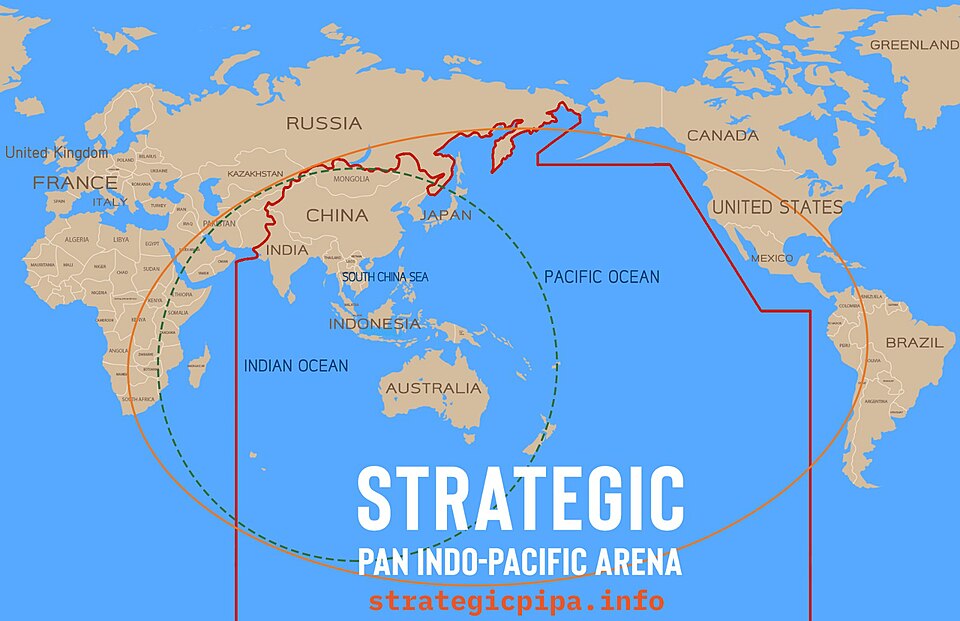
(Source: Creative Commons Attribution-Share Alike 4.0)
Official announcements from the Pentagon that the Indo-Pacific Strategy (IPS) is being upgraded into a “new defense architecture taking shape across the Indo-Pacific” have revealed far more about the changing balance of forces taking place across the wider region than the US is usually prepared to divulge. A down-scaling of the importance of Guam for hosting sensitive defence and security facilities has taken place due to China's increased capacity to hit the Micronesian islands with missiles; they have been assessed by the Pentagon as vulnerable.
Alternative sitings for the Guam facilities have, therefore, been identified; other geo-strategic military facilities, including those in Australia, have also been subject to quick relocation procedures. The moves carry all the hallmarks of serious preparations by the US for 'real-war scenarios' in the Indo-Pacific region.
The Pentagon has acknowledged a changing balance of forces is taking place across the vast Indo-Pacific region; China has moved from being a competitor to traditional US hegemonic positions toward establishing primacy in some areas.
Regional US defence and security provision has, historically, included the role of sensitive intelligence facilities based at Pine Gap in Central Australia, being linked to a hub on Diego Garcia in the Indian Ocean, and their counterpart based on Guam in Micronesia. The two hubs swing on an arc from Pine Gap and have been upgraded for military operations, linked to Darwin Harbour as a support centre for deployments.
Revelations, therefore, that Guam has been assessed by the Pentagon as well within the range of later designed Chinese missiles, has caused the US military to re-organise part of their regional defence and security provision; Guam, itself, is regarded as a target. (1) Recognition of the problem, by the Pentagon, also acknowledges China's range and sophistication of military satellites for intelligence-gathering and planning of operations.
The fact that Guam rests upon the Second Island Chain, used by the US to block China's access and egress into Oceania and Australia's geo-strategic regional area, has caused a serious setback to traditional US hegemonic positions.
War Secretary Hegseth, for example, recently addressed a regional defence and security summit with the announcement that 'stronger alliances, greater burden-sharing and a shift away from dependence on the US', were to become the order of the day. (2) The US, however, continue to take the line that peace is established through military strength. (3)
The moves follow already established acknowledgement that the US is no longer the dominant power in the Pacific. In fact, a US Congressional committee revealed those findings nearly a decade ago; it also included reference to the Pentagon making greater use of both Australia and Japan as regional hubs for 'US interests'. (4)
It should, therefore, come as no great surprise to find moves by the Pentagon to draw Australia into the position of a 'central node' alongside the US; it marks a shift away from the traditional 'hubs and spokes' type defence and security provision toward a 'multi-node web' with the US in position at the centre. (5)
And recent high-level diplomatic meetings between Australia and Japan appear to follow the new US regional upgrades to existing defence and security provision. A diplomatic statement issued by the Japanese Ambassador to Canberra, Kazuhiro Suzuki, noted that the recent visit to Australia by PM Sanae Takaichi, aimed to 'forge an unprecedented level of solidarity and strategic co-operation'. (6)
Indonesia and Australia involved
Indonesia also has an upgraded role, alongside Australia and the US. A report in Breaking Denece (see note 1) talks of “the emerging amphibious partnership among the US, Australia, and Indonesia”.
“The Australia-Indonesia Defence Cooperation Agreement and the expansion of Exercise Keris Woomera are formally a bilateral story. But that framing leaves out the unspoken third leg of the triangle.
“The United States Marine Corps is woven through nearly every aspect of what Australia brings to the littoral. Marine Rotational Force–Darwin has made northern Australia a sustained laboratory for US and Australian experimentation in Expeditionary Advanced Base Operations, stand-in forces, land-based anti-ship fires, and the logistics of dispersing small lethal units across austere island locations. The November 2024 amphibious landing at Banongan Beach in East Java, the largest and most complex joint drill Australia and Indonesia had ever conducted, carried that intellectual and operational DNA directly into a bilateral framework where no American flag appeared on the beach.”
Camel train
As an example of the projected dispersal of forces, Breaking Defense cites the Australian “camel train project” which uses drones to carry out supply chain tasks in northern Australia.
“The problem is operationally straightforward: Australia has only a handful of permanently manned air bases, all of which would be priority targets in a high-intensity conflict. Camel Train addresses this by turning general aviation itself into a defense asset,”
No doubt influenced by the successful use of drones in the war to resist Russia’s invasion of Ukraine, the article says that “Australia has approximately 30,000 licensed drone operators certified under CASA standards; in a mobilization phase, this represents a potential operational reserve that has never existed before in this form.”
New role for “lower-level partners”
Announcements about wider scale military inter-operability and the significance of the AUKUS agreements have to be viewed in that light. The US will maintain its control of existing military agreements although it will increasingly rely upon US allies to take front-line diplomatic and military positions, as directed by the Pentagon.
What the Pentagon appears to have also begun is a systematic upgrade to their IPS, by using former lower-level partners as hubs for future regional deployments and the siting of military facilities at short notice. While the main IPS, for example, uses the 'Quad' to contain and encircle China, lower-level partners, including the ROK, Taiwan, Singapore, Vietnam and others in the South Pacific, are now regarded as strategic attachments to the main military body. (7) They are now set for enhanced use, and operations, by the Pentagon.
A recent statement from Canberra about the defence and security of Australian military bases also contained fears that China may have the potential to use their advanced satellite imaging to threaten military facilities in the Northern Territories 'with a long-range strike'. (8) A recent military operation, for example, relocated important facilities 'to safer locations … it was … taken to rehearse counter-strike operations had this occurred due to conflict'. (9) It was noted in military communiques that 'within 24 hours we'd flushed the base, repositioned the assets', and then conducted a lengthy air-born operation involving flights of 2,400 nautical miles in a 'maritime strike mission'. (10) South China Seas?
In conclusion, the moves can only endanger individual countries across the Indo-Pacific region by drawing them closer to likely military hostilities between the US and China:
We need an independent foreign policy!
1. The new Indo-Pacific security architecture, Breaking Defence, 18 May 2026.
2. Pentagon chief Hegseth, Gulf News, 30 May 2026; and, 'US not retreating, its remaking world, Australian, 1 June 2026.
3. Ibid.
4. Study: US no longer the dominant power in the Pacific, Information Clearing House, 22 August 2019.
5. Breaking Defence, op.cit., 18 May 2026.
6. See: Takaichi's visit strategic more than ceremonial, Australian, 15 May 2026.
7. See: The reasons behind Washington's push for GSOMIA., Hankyoreh, 12 November 2019.
8. Making our bases harder nuts to crack, Indian Ocean Defence and Security Supplement, Australian, 26 May 2026.
9. Ibid.
10. Ibid.


No comments:
Post a Comment