Showing posts with label Eureka Rebellion. Show all posts

Tuesday, November 30, 2021

Celebrate Eureka Anniversary

 Written by: Nick G. on 1 December 2021


(Above - invitation from Ballarat organising Committee for the 167th anniversary celebrations)

December 3, 2021 will mark the 167th anniversary of the Eureka Stockade rebellion.

We have long promoted the Eureka Stockade as a potent symbol of the Australian people’s struggle for democratic rights and for national independence from colonialist oppression and imperialist control.

Together with the socialist red star, it is part of our Party’s logo.

The Eureka flag belongs to the working class. From the Great Strikes of the 1890s to workers’ struggles of the present day, the Eureka flag has demonstrated workers’ resolve to dare to struggle and dare to win.

For nearly 50 years some neo-fascist groups have deliberately tried to steal the flag’s true legacy, with the intention – stated in the mid-1970s – to stop “Maoists” from using it. They call everyone Maoist (a label we proudly wear) who simply raises the flag to unite the people. They try to promote it as a symbol of white nationalism and as a banner of racial pride.  Their followers are ignorant of its origin as a unifying factor on the multiculturally diverse Victorian goldfields where miners were called upon by Rafaello Carboni “irrespective of nationality, religion or colour, to salute the Southern Cross as a refuge of all the oppressed from all countries on Earth”.

The Ballarat goldfields were located on the lands of the Wadawurrung peoples. The miners unsettled the stable communities of the Wadawarrung, staying on their lands without observing the necessary reciprocities. There were some positive relationships built. Carboni learned language from the Wadawarrung and wrote a musical, Gilburnia, in which he highlighted injustices done by the unsettlers. Had they built better ties with the Wadawarrung, the miners could have used their knowledge of Country to ambush the approaching troopers well before they reached the Stockade.

In the context of the current Covid-19 pandemic, the Eureka flag has been taken to anti-vaxxer rallies to protest the coercive powers of state governments applying lockdowns and mandating vaccinations for some categories of workers. We disagree with this use of the flag which essentially places the "right to bodily autonomy of the individual in refusing the vaccine" against the collective need for community control over the spread of the virus. This is just an extreme manifestation of petty-bourgeois individualism. It is, however, different from the use of the flag by racists.  We place the latter in the category of contradictions between ourselves and the enemy, and the former in the category of contradictions among the people.

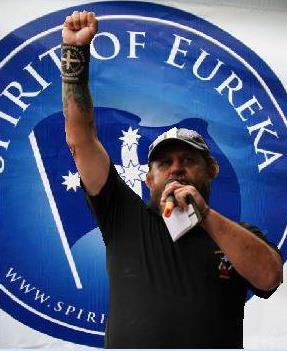
On the home page of the Spirit of Eureka  is the text of a presentation give to SA Unions by a delegate in 2015 and subsequently endorsed by SA Unions executive. It addresses the question of “to whom does the Eureka flag belong?” It looks at the use of the flag by the workers’ movement from 1854 to the present day, and concludes with these words:

Clearly, the Eureka flag belongs to the unions, republicans, anti-racists and refugee advocates.

The best argument against its misuse by racists is a widespread public embrace of the flag as the first expression in Australia of a multicultural aspiration for democracy, freedom and Australian independence from imperialism.

No union should be ashamed to claim the flag as part of this inheritance.  It is part of our history, of the history of our class and our people.  It can only be a divisive symbol so long as Nazis and racists are allowed to carry it unchallenged as to its symbolism and its multicultural origins.

Unions, more than any other organisations, should protect and defend the Eureka flag from misuse by those who would divide the unity of the working class.

The organising committee for the Ballarat celebrations of the 167th anniversary of the Eureka rebellion calls on supporters to “Reclaim the Radical Spirit of the Eureka Rebellion”.

We certainly agree!

Sunday, June 10, 2018

Eureka is a weapon for the people

Louisa L


When the Australian Building and Construction Commission banned the Eureka flag on building sites it launched a pallet of bricks onto its own feet.


Instead of repressing the flag, it had the opposite reaction. Suddenly the Eureka flag was flying on cranes across the country.


The ABCC realised they’d underestimated the power of the workers. Its inspectors would march onto sites to throw their weight around, and there it was, a silent ‘Up yours!’ to all their threats. 

They pretended the flags weren’t there. 


ABCC squeezes employers
The CFMEU refused to deal with them, so since its rebirth, the ABCC has put the squeeze on employers. 


Some corporations have a lot to lose. The biggest, like Business Council of Australia member Frasers, have few worries. Frasers is a developer that contracts out its construction work to companies including Probuild. Frasers’ watertight contracts ensure any delays by industrial action mean compensation from the construction company.


This is why Probuild copped abuse from ex-Industrial Relations Minister Michaelia Cash, for daring to tell her it didn’t want to pick a fight with its workers over the new construction Code.


Meriton, however, was barely affected by the ban because it doesn’t need government contracts. It almost exclusively develops and constructs houses and apartments, overwhelmingly for rental, and owns staggeringly large swathes of cities like Sydney. 


Targeting individual workers
The ban only applies to companies reliant on government contracts. Mid-level Watpac is one of these. A Eureka flag flying on any of Watpac’s sites, whether it was a government job or not, meant they were in breach, and risked losing contracts. So said the ABCC.
Previously Watpac could hardly keep up with demand, but construction of apartments is slowing.  The company is increasingly reliant on those government contracts. 


Watpac managers had maintained good relations with their workers. In a massive building boom, this is important. Stoppages and delays are poor advertisements for future contracts. On time means bigger profits. Besides, screwing workers is easier during busts when work is scarce.


The ABCC was targeting a Watpac worker, Denis McNamara, who was on the CFMEU’s NSW Committee of Management, so inspectors put pressure on Watpac management. Soon management told eight workers including Denis McNamara to take down Eureka flags. Every one refused. They knew they had the backing of their workmates right round the country.


Watpac lodged a dispute in Unfair Work Australia naming individual workers, rather than the CFMEU. The workers didn’t attend the hearings but worked as normal. It was lawyers at 30 paces. 


Targeting the imperialist ruling class
The Eureka flag is a dangerous weapon in the hands of the people. It embodies 160 years of struggle. It targets the imperialist ruling class. It has the potential to unify and clarify a multitude of smaller battles under one banner, Australian independence. 


As the struggle developed more and more people were learning this. Eureka flags, hard hats and t-shirts multiplied on building sites. The Queensland branch of the Australian Education Union issued Eureka stickers to its members and refused orders from the government to withdraw them. 

In mid May 120,000 workers on Melbourne streets put the nail in the dispute’s coffin. They had many grievances, including the flag ban. 
The ruling class wanted Eureka’s message taken out of this fiery mix.


Uniting the vast majority
In early June, Fair Work found in favour of the workers. The legal arguments summed up in the mainstream media are secondary to  the united refusal of workers to back down. The construction boom, although slowing, strengthened their hand. 


This doesn’t mean moves to crush unions will end. The state apparatus of police, courts, gaols and even the army have long been used against the people, when struggle gets too hot. 


On May Day in Sydney, CFMMEU delegate Luke Allen reflected this, “We’ve been fined millions and millions of dollars, even threatened with deregistration, and some of our leaders locked up, arrested, charged, facing gaol time just for doing their jobs.


“Branches have had their offices raided, staff terrorised, cars and home phones bugged, all in attempt to bring down the CFMMEU.”
He made it clear the fight would continue. 


A working class looking beyond its day to day skirmishes with the boss, to the multinational corporations that the state apparatus and parliaments serve, is a class that understands its true enemy. 


A working class that also arms the Australian people with Eureka’s message of anti-imperialist independence can unite the vast majority behind its lead. 


That’s the task.

Monday, May 7, 2018

Eureka flag – more than just a union symbol

Danny O.

In response to an outright attack on their democratic rights, workers are showing they are willing to fight to protect that most treasured symbol of Australian working class struggle.

After the Turnbull government’s building industry attack dog, the Australian Building and Construction Commission (ABCC), issued a directive explicitly banning the Eureka flag from construction sites in February this year, unions and workers have rallied together in defence of their democratic rights and are taking up the Eureka flag with enthusiasm not seen for years. 


Construction workers are displaying the flag on job sites across the country in active defiance of the ABCC directive. It is now not unusual to see it flying high from the many tower cranes that litter the skylines of our major cities even where it had been absent before.


The construction division of the CFMEU has been leading the way with its call to ‘Break the Ban’, and solidarity has been strong from across the union movement. The Queensland Teachers Union notably came out in support saying that they would “make sure there are Eureka Stockade flags in every school in Queensland”. 


All of this is a very welcome development and should be encouraged. It is an opportunity for workers to rediscover the importance of the Eureka rebellion and its flag to the countless struggles of ordinary Australians. However, it’s also important to realise that the Eureka flag is attacked not just because it is a symbol used by the CFMEU, nor because it’s just a union symbol, but because it stands for so much more.


At the time of its creation, the Eureka flag represented the struggle against the oppressive British colonial authority and growing calls by the Eureka rebels for an independent Australia.


Today it has become a powerful symbol of ordinary people’s determination to stand up for justice, democratic rights, and liberties. It is a flag of resistance and defiance that continues to inspire unity, solidarity, and courage in the collective struggles of Australia’s working people against injustice and exploitation. What it represents scared the ruling class when it was first raised in 1854, and it still scares them today.


The flag of an independent Australia 

Dave Noonan, the national secretary of the CFMEU’s construction division, recently described the Eureka flag as “an Australian flag which represents the struggle for democracy and national independence.” He’s quite right.


In 1854, the British Governor of Victoria, Charles Hotham called it “the flag of Australian independence” that “threatened British rule.” The local newspapers echoed his words. 


For generations, activists, workers and ordinary Australians have rallied under the Eureka flag fighting for workers’ and democratic rights, and calling for national independence. 


Despite having achieved a certain level of formal independence, Australia has never been truly independent and since WW2 has been a client state of US imperialism. 


We see some examples of this in the giant US monopolies that dominate our economy and pillage our resources without paying tax like ExxonMobil and Chevron.


We see it politically when parliamentarians of both major parties fall over themselves to prove their loyalty the US.


Militarily we see it with ever further integration of the Australian armed forces into the US war machine and an unswerving loyalty to the ‘US-Australia Alliance’ and a commitment to fight in its perpetual imperialist wars. 


Our Party logo and the strategy of a two-stage Australia revolution 

The logo of our Party is the Eureka flag flying in front of the red star of socialism. This is a symbolic representation of our strategy of a two-stage continuous revolution in Australia.


In analysing the concrete conditions of society in this country, the CPA (M-L) puts forward the position that the current stage of Australia’s revolutionary struggle for socialism is the struggle against the imperialist interests that dominate this country economically, politically and militarily and for a truly independent Australia under the leadership of the working class. This struggle will continue to flow into the second stage of socialist development.


We unashamedly raise the Eureka flag as a powerful symbol in this revolutionary struggle for real independence and encourage the people of Australia to understand its significance and fight for everything it represents.

Saturday, April 16, 2016

Building and Construction Workers Stay Strong Despite On-Going Attacks from Big Business


Ned K.

Nearly 30 years to the day (Wednesday 13 April) of the de-registration of the BLF, construction workers at a Lend Lease construction site in Brisbane went on strike when Lend Lease removed the workers' Eureka flag (symbol of their union CFMEU) from the site.

More than 90 workers took the strike action despite it being "unprotected action" under the ruling class's Fair Work Act.

The Australian Financial Review reported on Friday 15 April that the company ran to the Fair Work Commission to get the predictable Order for the workers to end the strike. However the workers had made their point and while they lost wages Lend Lease lost whatever small amount of credibility it may have had for showing such a lack of respect for workers. 

Perhaps Lend Lease provoked this strike action on purpose a week out from Turnbull trying to pass the ABCC laws in federal parliament. Or perhaps it was an act of disrespect towards builders’ labourers.

The deregistration of the BLF 30 years ago was supposed to restore 'law and order' to construction sites and the employers and government hoped to turn the CFMEU in to a tame cat union by having labourers’ influence curbed by a labour aristocracy from the trades groups within the union. The opposite has occurred over the 30 years with all building and construction workers irrespective of their job, trades or non-trades, uniting to defend their rights and working conditions.

No more clearly was this shown than in the extraordinary level of support for Ark Tribe (above) who was facing gaol as a result of the ABCC.  

Mao used to say that the imperialists make trouble, fail, make trouble and fail again.

The same can be said for the imperialist controlled building and construction industry employers and their lackeys in parliament.

Friday, November 21, 2014

“So we must fly a rebel flag…”

Vanguard December 2014 p. 1

by Alice M.


The 3rd December marks the 160th anniversary of the Eureka Stockade Rebellion that holds great significance for Australia’s working people, in particular the organised working class.

The 1854 armed uprising was more than a rebellion. For that time it was a revolution for freedom from oppression and exploitation, a call for genuine democracy for the people, and national independence from the domination of the British colonial ruling class.

The rebels’ demands carried the seeds for far-reaching fundamental change in Australia and the necessity for the working class to eventually become the masters of an independent Australia. This was the beginning of social and political movements in Australia for a thorough-going change in class relations.  It continues today.

The issues and demands around which the Eureka rebels united are still with us in a fundamental way. Those early strivings for justice, a genuine democracy for ordinary people and independence for Australia have yet to be achieved. The many struggles and mass movements of the people today, flow towards the realisation of these demands.

Colonial oppression

The British colonial ruling class forcefully dispossessed Australia’s Aboriginal people in 1788, and violently suppressed the indigenous resistance to the occupation of their lands. Aboriginal land was brutally stolen by the British colonial state and given away to the wealthy squatters from the British aristocracy and later to the newly arising ruling class of wealthy merchant bankers and industrial capitalists. A heavy mining tax was imposed on the impoverished gold diggers whilst the wealthy squatters paid no taxes on the stolen land, from which they made their fortunes growing wheat, sheep and cattle.

By November 1854, the oppressed, and mainly poor gold diggers, most of whom flocked from many corners of the world to Ballarat searching for gold to make a living, banded together, taking  up arms to resist the harsh and unjust treatment by the colonial ruling class. 

The Eureka rebellion was the first organised political class struggle and mass uprising in Australia by a newly emerging working class. They demanded the abolition of mining licences and the right to vote for parliamentary representation through which they hoped the will of the people would prevail. 

They called for Australia to become a republic, independent of Britain.

The Eureka rebellion laid the foundations for many future progressive political movements and workers’ struggles, and produced the militant trade union tradition of working class solidarity.  It gave birth to Australia’s working class fighting spirit against injustice, and the power of the collective and united action by the people. 

This was the first sign of class struggle between the young, organised working class and British colonial capitalism, the ruling class in Australia at that time.

Eureka flag

For 160 years the Eureka flag has appeared above many battles uniting and giving hope and courage to working people.

The flag of blue and white appeared in 1856 battles for the 8 hour day, in the formation of unions in late 1880s, the 1891 shearers strike in Barcaldine, Qld, and many countless struggles of working people. To this day the Eureka flag is raised in many workplace, community and environmental struggles; in the struggles for democratic rights.  

The passionate hopes and yearnings of Eureka rebels and their supporters, that the visionary demands they had fought for would bring real equality, fairness and a genuine democracy for the people, have yet to be realised in a thorough-going way.

For independence and socialism

The ruling class of British colonialists and wealthy capitalists running Australia in the 19th Century have today been replaced by the local and foreign monopoly corporations and banks.

The Business Council of Australia, the mouthpiece of 100 biggest foreign and local corporations dictates the neo-liberal economic policies and agenda to whichever parliamentary party is in power, Liberal or Labor.

The mining corporations, multinational monopolies and banks pay little tax, if any, whilst more of ordinary people’s taxes are being syphoned off from public health, education, welfare, to subsidise big business profits.

The ISDS in the TPP and other Free Trade Agreements will further erode what’s left of Australia’s sovereignty and independence, destroy jobs, workplace rights, our public health, education and the environment.

US imperialism and its multinational corporations have replaced the British colonial ruling class as the dominant class of monopoly capitalism in Australia.

Parliamentary democracy and the right to vote that Eureka rebels had fought for is being exposed as a farce where the real power still lies in the board rooms of big corporations.

The democratic and civil rights to protest, to fight for workers’ and union rights, are whittled away as more legal power and force is used by the bourgeois state. 

The organised working class will fulfil the revolutionary aspirations of Eureka in 1854, and continue to struggle to resist capital’s onslaught, and finally take charge of the country and rule for the interests of working people.

The vision of the Eureka rebels will be achieved in an independent and socialist Australia.

Monday, October 28, 2013

Face the future with boldness and daring

Vanguard November 2013 p. 3


The end of this month and the first few days of December see the 159th anniversary of the Eureka Rebellion.

The Rebellion preceded the emergence of the Communist movement in Australia but it has become inexorably linked with the modern Australian workers’ anti-capitalist and anti-imperialist movements.

Echoing contemporary newspaper reports from Australia, the leader of the international working class, Karl Marx, noted that the gold diggers had “raised the banner of independence”. 


Marx went on to note similarities between the issues that drove the revolutionary movement in Victoria and those which led to the Declaration of Independence of the United States, namely, the gold licence fee as a tax on direct labour, and agitation for the direct representation in the legislature of those who were subject to the tax.

However, there was a difference as well, and that was “that in Australia the opposition arises from the workers, against the monopolists tied up with the colonial bureaucracy.”

That defining characteristic of the Eureka rebellion forms a thread through which the struggles of the working class are linked across each of these 159 years.
 
Into that thread are knotted critical moments in those struggles: the armed shearers’ camp at Barcaldine in 1891, the WWI anti-conscription movement,  the 1938 Pt Kembla wharfies’ struggle against shipping pig-iron to militarist Japan, the organisation of youth aligned to the Communist Party into the Eureka Youth League, the defeat of the anti-Communist referendum in 1951, and the re-emergence of the flag as a symbol of working class struggle and anti-imperialist struggle for independence and socialism in the 1970s.


In each critical moment of the working class history of Australia, the capitalist state has been revealed as the instrument through which force and violence or the threat of force and violence are visited upon workers by the ruling class.

The spirit of Eureka is the spirit of daring to defy the force and violence of the capitalist state, it is the spirit of declaring that it is right to rebel against reactionaries, that defiance of injustice is a good thing.


It is for this reason that we celebrate each year the anniversary of the armed clash that took place at the Ballarat gold fields in 1854.

Commemorating that momentous event helps steel our resolve to stand up to whatever the ruling class can throw against us.

It helps us to face the future with boldness and daring.