Showing posts with label Antarctica. Show all posts

Monday, April 8, 2024

“Grey-Zone” intelligence assessments and real-war scenarios

Written by: (Contributed) on 8 April 2024


The US diplomatic response to credible competition from China in the Western Pacific and wider Indo-Pacific region has taken the form of an intensification of Cold War hostilities using grey zone-type intelligence assessments. They rest upon their desperate attempt to reassert traditional hegemonic positions, although remain fraught with dangers of real war scenarios for the US and their allies upon which they are increasingly dependent.

The recent high-level diplomatic visit of US Secretary of State Antony Blinken to the Philippines was accompanied with a brief media release high-lighting the perceived threat of China's 'grey-zone strategy' which had been assessed as a threat to 'US interests'; it included reference to 'a constant ratcheting up' of China's diplomatic brinkmanship. (1)

Grey-zone conflict in military jargon has been usually associated with subversion and has included: destablisation, weakening or undermining traditional structures, in order to systematically weaken an adversary. It has become the face of the new Cold War which exists in the murky area in-between 'between peace and conflict'. (2)

It is, however, accompanied by grey-zone conflict in political circles which has far-reaching implications for civil society and contemporary Australia. It has taken Australian society into the darkest depths of Cold War positions whereby anything linked to China is regarded as suspicious in classic 'reds under the beds' scenarios. (3)

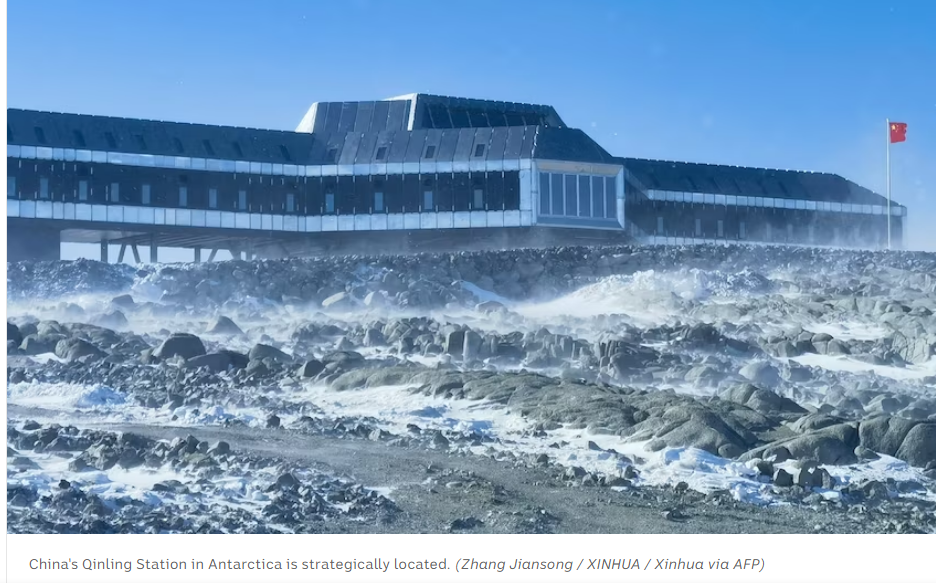
A typical example of the crude conspiracy theories entering into mainstream Australia has been the claim by the so-called US Centre for Strategic and International Studies that China's Qinling base on Antarctica 'was perfectly located … to spy on Australia and New Zealand particularly the satellite launch location in the Northern Territory'. (4) More sensible commentary, however, has noted 'many South-east Asian and Pacific countries are closer, and some would be more hospitable hosts. The growing number of Chinese satellites going over Australia could also do the job'. (5)

It is important to note the US Centre for Strategic and International Studies is a Washington-based 'think tank' with tentacles reaching deeply into Australian academia through seemingly harmless associates; to the contrary, it is an arm of the massive military-industrial complex designed specifically to serve 'US interests'. War, and preparation for war, is big business.

The US-led diplomatic position and controversy about the Qinling base has rested on  two significant points: the decision by the Pentagon to transform their Defence Intelligence Agency (DIA) early in the last decade to provide as many as 1,600 newly recruited intelligence-gathers 'into a spy service focused on emerging threats'; a highly controversial study conducted in Washington which found 'the US is no longer the dominant power in the Western Pacific and would struggle to win a conflict against China'. (6)

The former has included extensive use of open-source intelligence (OSINT) with intelligence assessments based on information already in the public domain, raising problems that anything even remotely linked to China or Chinese endeavour can be spied upon and subject to surveillance as being regarded as suspicious. Intelligence-gatherers now also lurk on-line or in university libraries accessing post-graduate research documents while Defence publications openly flout links between universities as centres of learning with military-based programs. The position actively promotes the worst aspects of the previous Cold War now being played-out in the present one; publications from the past have revealed the extent of contemporary class, state paranoia and hysterical mind-sets. (7)  

Within those hysterical circles of Cold War fanatics, those who pay the piper, invariably call the tune; the Pentagon remains closely linked with the US military-industrial complex which thrives on increased defence budgets and arms sales. The US defence budget for the last year amounted to $816.7 billion. (8) Vast amounts of US defence spending support the corporate sector and research and development programs, often directly linked into universities which have become dependent upon the hand which feeds them. China, by contrast, had defence spending at only $224.79 billion. (9)

The US imperialists, nevertheless, are relentless and seek to increase their defence budgets on the annual basis in order to reassert traditional hegemonic positions. They fear any competition from China, whether it originates from economic considerations and trade, or defence and security concerns.
 
The increased US defence budgets, however, have not made the world a safer place. In fact, to the contrary, we live in a world of seemingly endless US-led sabre-rattling and escalating diplomatic tensions. Australia is clearly drifting toward a US-led confrontation with China, and successive governments in Canberra have done little to stand-up for national interests; Australia, furthermore, is increasingly out-of-step with regional neighbours.

The recent ASEAN Special Summit in Melbourne in early March, for example, saw Australia assume the role of the sub-imperial power, although it failed to achieve the Cold War US-led consensus it sought. It took place at a pivotal time. The ASEAN countries have a total population of about 600 million and have become China's largest export market with $790 billion in trade, pushing the US into second place. ASEAN member countries, furthermore, see little benefit in choosing sides between the US and China; they have little to gain from side-lining China.

Some ASEAN political leaders were also forthright in their chosen diplomatic position: Malaysian Prime Minister Anwar Ibrahim, for example, used his visit to Australia to push for countries in the region to remain neutral and non-aligned, with foreign policies decided upon by their sovereign governments, not foisted upon them by Washington and the Pentagon.

In conclusion, the US-led 'grey-zone' assessments of China have taken the region into a dangerous diplomatic position whereby even Washington has acknowledged the strategy is 'on track to create a serious regional crisis and probably armed conflict'. (10)

                                         We need an independent foreign policy!


1.     Grey-zone response a way to call China's brinkmanship bluff, Australian, 22 March 2024.
2.     Today's wars are fought in the 'grey zone', Atlantic Council, 23 February 2023.
3.     See: Labor's national security kowtow a win for the CCP., Australian, 26 March 2024.
4.     China's Antarctica moves should be a cause for concern, Australian, 4 April 2024.
5.     Ibid.
6.     Pentagon plays the spy game, The Guardian Weekly (U.K.), 7 December 2012; and,
        Study: US no longer dominant power in the Pacific, Information Clearing House, 22 August 2019.
7.     See: None dare call it treason, John A. Stormer, (Missouri, 1964), which was distributed across Australia by the far-right Australian League of Rights. The book was first published in 1964 and was subsequently re-printed twenty times in-between February and October of that year.
8.     Website: US Department of Defence, Biden Signs, 23 December 2022.
9.     See: China to increase defence spending, CNN., 7 March 2023; and, China's 2023 defence spending, Jamestown Foundation, 14 April 2023.
10.   Australian, op.cit., 22 March 2024.


Thursday, April 29, 2021

Bringing Antarctica into the new Cold War


 Written by: (Contributed) on 30 April 2021

A report tabled by the Australian Strategic Policy Institute (ASPI) at the highest levels in Canberra in April will have far-reaching implications if implemented by the Australian government next year.

The report, part of a US-led Cold War military and security package, is aimed at transforming logistics with Antarctica for rapid access and egress with a continent of vital strategic significance and rich in minerals.

There are two important considerations:
 
the moves will introduce a wave of militarisation into a continent which is supposedly neutral;
 
the potential environmental damage including rare plant, wild and animal-life.
 
Neither consideration has been addressed in the report, which has followed a line typical of US-led regional Cold War military planning.
 
In late April the ASPI forwarded its report to Canberra. It was primarily concerned with Australia's hegemonic presence across the vast frozen continent and the plan to construct a 2.7 kms paved concrete runway for international flights near the Vestfold Hills area adjacent to the Australian Davis Station. (1)
 
The Davis Station was established during the previous Cold War in 1957. It now looks set to become a vital strategic asset with the present Cold War; the ASPI report stated fears existed that China might also lodge territorial claims and establish its own landing strips. (2) No evidence was provided about any serious plans by China to develop interests on Antarctica. The ASPI, likewise, are no strangers to the Cold War political muck-raking against supposed Chinese influences in Australia; previous examples have included targeting people of Chinese ancestry with highly questionable motives and levels of accuracy about the subject matter. (3)
 
At present there are seven countries with territorial claims which include: Argentina, Australia, Chile, France, New Zealand, Norway and the UK. A number of other countries also have stations on Antarctica although they work through one or more of the main seven countries. The US, for example, makes extensive use of Australia as the conduit through which they conduct their interests on Antarctica.
 
There are already at least 55 different landing strips on the continent to serve various
interests; most, however, are only operational for part of the year and covered with gravel and not capable of being used with 'heavy airliners'. (4)
 
Historically, Antarctica has had numerous research and weather stations, although few serious territorial claims. Most of the continent is hardly inhabitable for lengthy periods of time; there are no Indigenous peoples.
 
Plans, however, for increased Australian development of Antarctica now appear under-way.
 
It is interesting to note, therefore, that the ASPI report stated the Davis Station 'requires long-term funding and political commitment' based upon Australian 'influence on Antarctica'. (5) The report, furthermore, also noted 'the proposed Davis aerodrome will increase Australia's strategic weight in Antarctica, where we claim 42 per cent of the continent'. (6)  
 
It is also interesting to note the proposed aerodrome is planned for all year operations with heavy airliners in a small area of the continent which is usually ice-free. Due to the area being about twenty kms from the continental ice-field, it is rich in marine and bird-life. The proposed major aerodrome will obviously have a serious effect upon environmental issues; it has been noted 'pollution, dust, noise and carbon emissions are further problems'. (7)   


The Australian Antarctic Program also rests upon strong strategic links with Hobart. The airport in Tasmania is regarded as 'a leading gateway to Antarctica', by Australian military officials. (8) Plans, therefore, for a major $100 million upgrade of Hobart Airport for international flights, to double capacity reveal longer-term planning with Antarctica in mind. (9)
 
Elsewhere in the coverage of the proposed aerodrome a brief reference is made in passing to possible competition for Antarctica's resources and possible potential military uses. (10) The  
Australian Casey Research Station already has a program to study bedrock geology and marine biology although official websites reveal little information about any of their findings.
 
A study of the 77 Australian registered mining companies, likewise, has revealed nothing of their interests or plans on Antarctica.
 
It would appear, nevertheless, the Casey Station is important as a satellite tracking facility and was upgraded in 2016. It also has its own Wilkins aerodrome about seventy kms south-east of the station.
 
Many of the projects hosted by various foreign governments based on Antarctica have had other more clandestine operations. During the Apartheid period in South Africa, for example, publicity about Pretoria's Silvermine Maritime Operational and Communications Headquarters had a stated range from Argentina to Bangladesh and North Africa to the South Pole.  Its establishment, in 1973, was regarded by Pretoria as part of a 'current global struggle for power'. (11) Following the demise of the Apartheid regime, South African projects on Antarctica were quietly shelved.
 
The proposed aerodrome project in Antarctica is, furthermore, part of a much bigger package aimed at re-asserting traditional US-led regional hegemonic positions: it has not been particularly difficult to establish the US quietly pulling the strings of their puppets in Canberra; in recent months the coalition government has implemented the 'foreign arrangements scheme' which has enabled Foreign Minister Marise Payne to review more than a thousand agreements between foreign national governments and their federal and state Australian counterparts together with universities. (12)
 
An official media release from the Australian Defence Department recently acknowledged there were literally thousands more cases also planned for future investigations. (13)
 
With the present coalition government in Canberra expected to make a decision over the next year about the proposed aerodrome on the basis that it would provide 'a distributing hub for personnel and equipment', Australians might well ask the question in whose interests will it serve?
 
It has already been noted the cost outlay for the proposed aerodrome will be likely to be 'substantial' and involve a massive fifteen-year building program. It is said that 'investing in Antarctica logistics is the most effective way to advance our long-term Antarctic interests' which carries little sensible weight when other areas of government expenditure have been subject to cuts and failures to provide adequate coverage and support  for ordinary Australian people.
 
All the proposed aerodrome will achieve is a further wave of US-led militarism sweeping the Indo-Pacific region and contravening the neutrality of Antarctica.
                                       
We need an independent foreign policy!
 
 
1.     Game-changer, ASPI., 21 April 2021; and, Antarctica runway 'a good strategic move', Australian, 21 April 2021.
2.     Ibid.
3.     Water licence given to group with China ties, Australian, 27 April 2021.
4.     Australian, op.cit., 21 April 2021.     
5.     Game-changer, ibid., 21 April 2021.
6.     Ibid.
7.     'A real bad precedent', The Guardian (U.K.), 31 December 2020.
8.     Antarctic flights 'a huge success', Contact: Defence Rates, 20 February 2016.
9.     Hobart Airport, ABC News, 9 April 2019.
10.   Australian, op.cit., 21 April 2021.
11.   Maritime Operational and Communications Headquarters, The Star (South Africa), front page, 10 March 1973; and, Security in the mountain, The Star (South Africa), 17 March 1973.
12.   Push to cut more Chinese accords, The Weekend Australian, 24-25 April 2021.
13.   'We must get real on a possible China war', Australian, 26 April 2021.


Friday, September 14, 2018

US imperialism and violations of Antarctic neutralilty

(Contributed)

As United States defence and security planning increasingly concentrates upon the threat posed by China to its traditional hegemonic position, previous decisions taken by the Pentagon during the  Cold War about Antarctica have now become problematic.


The problem remains particularly sensitive by being linked to the US space program.


As the military drama unfolds, the US is likely to be exposed for flouting international treaties while expecting other countries to operate within a 'rules-based' environment.
 
Antarctica has had a unique eco-system from the beginning of time, supposed to have been protected from damage and destruction by whatever country planned exploration of its landmass or scientific discovery of its long history. The US, however, was never one to play by established rules.
 
Antarctica, for the US, has long been recognised as important for forming the lower border of the southern oceans, used by the maritime and naval fleets of numerous countries. There are three strategic sections of the Southern Ocean, which include: South Africa and the Cape of Good Hope, Chile and Cape Horn, Australia and the South East Cape with Tasmania. All three have remained vitally important for US-led military and security planning and its associated involvement in their political systems.
 
An international agreement signed by twelve countries about Antarctica in 1959 was supposed to provide guidelines to prohibit 'military activity'. (1) In fact, the treaty opened with the statement that Antarctica: "shall continue forever to be used exclusively for peaceful purposes and shall not become the scene or object of international discord." (2)
 
Further sections of the treaty also include reference to 'the promotion of 'international cooperation', and Antarctica shall 'be used for peaceful purposes only', with specific reference to the prevention of use of military equipment. (3) Despite the stated intentions of the 1959 treaty, Antarctica, for the US, formed 'the southern-most reach of the US Pacific Command'. (4) The treaty itself was arranged to restrict the former Soviet Union from having ready access to the sensitive southern oceans during the previous Cold War. 
 
During the period of the so-called New World Order, following the demise of the former Soviet Union, however, Antarctica became even more strategically important for the US. Technological advancements required further ground stations and the US imperialists were desperate to maintain their traditional hegemonic position within the increasingly globalised world. 
 
The US placed sensitive Global Positioning Systems (GPS) on Antarctica in 1995. It has been noted in official media releases as a critical enabler 'for the military operations of the US and its strategic partners for two decades'. (5) The system grew out the US space program and the race for technological supremacy in the 1960s. Initially launched in 1973, the original system was composed of 24 satellites 'for use by the US military'. (6)
 
The original US GPS system rested heavily upon defence and security considerations with the southern oceans. It relied upon support from South Africa and the Silvermine Maritime Operational and Communications Headquarters near Cape Town which opened in March, 1973, the military facilities having a range from Argentina to Bangladesh, North Africa to Antarctica. (7) Despite official sanctions against South Africa because of its apartheid policies, Pretoria maintained direct contact with the US through Puerto Rica, and Whitehall in London through Mauritius. (8) The system was also linked to similar US military facilities based on Diego Garcia in the Indian Ocean, linked directly to Pine Gap, Central Australia.  
 
With the renewed US space-race, the US is racing to 'modernise GPS' by 2020. (9) A recent Pentagon report stated an official US Space Command would be established toward the end of the year. (10) The role of the command was defined as being 'responsible for a range of crucial space-based US military capabilities, which include everything from satellites enabling the global positioning system to sensors that can track missile launches'. (11)
 
With Australia following suit and establishing an Australian Space Agency (ASA) this year, it has been interesting to note developments. The official ASA website noted their priorities include communication technologies, 'ground stations' and 'remote asset management', which leave little to the imagination. It is, therefore, interesting to note the official Australian position about Antarctica.
 
A recent official Canberra media release noted the 1959 Antarctic Treaty 'continues to serve Australia's interests and that countries needed satellite communications devices to continue scientific research'. (12) The statement also included references to 'technologies that can be dual-use such as satellite communication, geo-spatial devices and remotely-sensed data'. (13)

The deliberate flouting of the 1959 Antarctica Treaty by US-led military forces should never have been allowed to take place. The fact those concerned are now attempting to promote and enforce a “rules-based” global environment in their own favour is ridiculous. We should be on our guard against such duplicity.
 
The further fact that all the information for this article was openly accessed from readily available source material has revealed two important factors: US-led defence and security planning has taken place within a culture of impunity of their own making; it has operated
on the basis of imperialist arrogance.
 
We urgently need an independent foreign policy before the US-led military planning for real-war scenarios become reality.

 
1.     Antarctic Treaty, 1959,
2.     Ibid.
3.     Ibid., Article 1, Part 2.
4.     Cold War's Polar Rivals, Australian, 6 September 2018.
5.     Ibid.
6.     GPS – Wikipedia.
7.     Maritime Operational and Communications Headquarters, The Star, South Africa, 10 March 1973; and, Security in the Mountain, The Star, South Africa, 17 March 1973.
8.     Star, ibid., 17 March 1973.
9.     Australian, op.cit., 6 September 2018.
10.   Trump wants American space force by 2020, The Weekend Australian, 11-12 September 2018.
11.   Ibid.
12.   Warning Antarctica is the new frontier for China's military, Australian, 6 September 2018.
13.   Ibid.