Showing posts with label ASEAN. Show all posts

Monday, April 8, 2024

“Grey-Zone” intelligence assessments and real-war scenarios

Written by: (Contributed) on 8 April 2024


The US diplomatic response to credible competition from China in the Western Pacific and wider Indo-Pacific region has taken the form of an intensification of Cold War hostilities using grey zone-type intelligence assessments. They rest upon their desperate attempt to reassert traditional hegemonic positions, although remain fraught with dangers of real war scenarios for the US and their allies upon which they are increasingly dependent.

The recent high-level diplomatic visit of US Secretary of State Antony Blinken to the Philippines was accompanied with a brief media release high-lighting the perceived threat of China's 'grey-zone strategy' which had been assessed as a threat to 'US interests'; it included reference to 'a constant ratcheting up' of China's diplomatic brinkmanship. (1)

Grey-zone conflict in military jargon has been usually associated with subversion and has included: destablisation, weakening or undermining traditional structures, in order to systematically weaken an adversary. It has become the face of the new Cold War which exists in the murky area in-between 'between peace and conflict'. (2)

It is, however, accompanied by grey-zone conflict in political circles which has far-reaching implications for civil society and contemporary Australia. It has taken Australian society into the darkest depths of Cold War positions whereby anything linked to China is regarded as suspicious in classic 'reds under the beds' scenarios. (3)

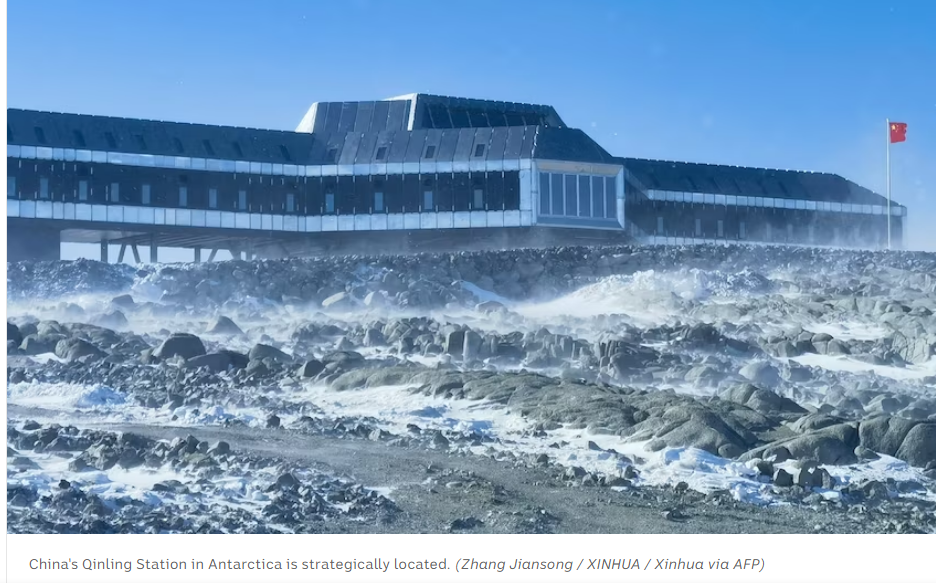
A typical example of the crude conspiracy theories entering into mainstream Australia has been the claim by the so-called US Centre for Strategic and International Studies that China's Qinling base on Antarctica 'was perfectly located … to spy on Australia and New Zealand particularly the satellite launch location in the Northern Territory'. (4) More sensible commentary, however, has noted 'many South-east Asian and Pacific countries are closer, and some would be more hospitable hosts. The growing number of Chinese satellites going over Australia could also do the job'. (5)

It is important to note the US Centre for Strategic and International Studies is a Washington-based 'think tank' with tentacles reaching deeply into Australian academia through seemingly harmless associates; to the contrary, it is an arm of the massive military-industrial complex designed specifically to serve 'US interests'. War, and preparation for war, is big business.

The US-led diplomatic position and controversy about the Qinling base has rested on  two significant points: the decision by the Pentagon to transform their Defence Intelligence Agency (DIA) early in the last decade to provide as many as 1,600 newly recruited intelligence-gathers 'into a spy service focused on emerging threats'; a highly controversial study conducted in Washington which found 'the US is no longer the dominant power in the Western Pacific and would struggle to win a conflict against China'. (6)

The former has included extensive use of open-source intelligence (OSINT) with intelligence assessments based on information already in the public domain, raising problems that anything even remotely linked to China or Chinese endeavour can be spied upon and subject to surveillance as being regarded as suspicious. Intelligence-gatherers now also lurk on-line or in university libraries accessing post-graduate research documents while Defence publications openly flout links between universities as centres of learning with military-based programs. The position actively promotes the worst aspects of the previous Cold War now being played-out in the present one; publications from the past have revealed the extent of contemporary class, state paranoia and hysterical mind-sets. (7)  

Within those hysterical circles of Cold War fanatics, those who pay the piper, invariably call the tune; the Pentagon remains closely linked with the US military-industrial complex which thrives on increased defence budgets and arms sales. The US defence budget for the last year amounted to $816.7 billion. (8) Vast amounts of US defence spending support the corporate sector and research and development programs, often directly linked into universities which have become dependent upon the hand which feeds them. China, by contrast, had defence spending at only $224.79 billion. (9)

The US imperialists, nevertheless, are relentless and seek to increase their defence budgets on the annual basis in order to reassert traditional hegemonic positions. They fear any competition from China, whether it originates from economic considerations and trade, or defence and security concerns.
 
The increased US defence budgets, however, have not made the world a safer place. In fact, to the contrary, we live in a world of seemingly endless US-led sabre-rattling and escalating diplomatic tensions. Australia is clearly drifting toward a US-led confrontation with China, and successive governments in Canberra have done little to stand-up for national interests; Australia, furthermore, is increasingly out-of-step with regional neighbours.

The recent ASEAN Special Summit in Melbourne in early March, for example, saw Australia assume the role of the sub-imperial power, although it failed to achieve the Cold War US-led consensus it sought. It took place at a pivotal time. The ASEAN countries have a total population of about 600 million and have become China's largest export market with $790 billion in trade, pushing the US into second place. ASEAN member countries, furthermore, see little benefit in choosing sides between the US and China; they have little to gain from side-lining China.

Some ASEAN political leaders were also forthright in their chosen diplomatic position: Malaysian Prime Minister Anwar Ibrahim, for example, used his visit to Australia to push for countries in the region to remain neutral and non-aligned, with foreign policies decided upon by their sovereign governments, not foisted upon them by Washington and the Pentagon.

In conclusion, the US-led 'grey-zone' assessments of China have taken the region into a dangerous diplomatic position whereby even Washington has acknowledged the strategy is 'on track to create a serious regional crisis and probably armed conflict'. (10)

                                         We need an independent foreign policy!


1.     Grey-zone response a way to call China's brinkmanship bluff, Australian, 22 March 2024.
2.     Today's wars are fought in the 'grey zone', Atlantic Council, 23 February 2023.
3.     See: Labor's national security kowtow a win for the CCP., Australian, 26 March 2024.
4.     China's Antarctica moves should be a cause for concern, Australian, 4 April 2024.
5.     Ibid.
6.     Pentagon plays the spy game, The Guardian Weekly (U.K.), 7 December 2012; and,
        Study: US no longer dominant power in the Pacific, Information Clearing House, 22 August 2019.
7.     See: None dare call it treason, John A. Stormer, (Missouri, 1964), which was distributed across Australia by the far-right Australian League of Rights. The book was first published in 1964 and was subsequently re-printed twenty times in-between February and October of that year.
8.     Website: US Department of Defence, Biden Signs, 23 December 2022.
9.     See: China to increase defence spending, CNN., 7 March 2023; and, China's 2023 defence spending, Jamestown Foundation, 14 April 2023.
10.   Australian, op.cit., 22 March 2024.


Saturday, September 30, 2023

ASEAN Solidarity Exercise keeps US and China at a distance


(Source: Ministry of Defence, Singapore)

Written by: (Contributed) on 1 Octobe(r 2023

The ASEAN Solidarity Exercise, a joint military drill, has provided further evidence of a growing reluctance by South-east Asian nations to get drawn into escalating US-China diplomatic hostilities. 

There was, for example, no official US or China involvement.

While it will take time to assess the significance of the exercise, it is important to note the response as indicative of deeper problems and issues. It is highly relevant that the exercise took place with widespread publicity across the region. In Australia, the main hub for 'US interests' in the southern part of the region, however, there was near silence; a brief official media release from Canberra was terse in style and did not follow the stated ASEAN line but merely reiterated the standard US diplomatic position.

On 19 September ASEAN member countries began a five-day joint military exercise, ASEAN Solidarity Exercise, near Batan Island, adjacent to Singapore on the eastern approach to the Straits of Malacca, a sensitive maritime area with congested shipping-lanes. (1) The host country, Indonesia, chose the area for the drills due to it not being contested by China and its claim to sovereignty of the South China Seas. The exercise was initially planned for the southern edge of the South China Seas although it was relocated to not provoke a confrontation with China. (2)

Singapore is regarded by the US as highly strategic: it is placed on a straight line from US intelligence facilities of Diego Garcia in the Indian Ocean, and Guam: the facilities have undergone extensive upgrading in recent years as part of US regional military and security provision, and rest upon an arc from base facilities at Pine Gap in Central Australia. Singapore is also situated approximately half way between Diego Garcia and Guam. (3)

Military personnel and their civilian counterparts working for US signals intelligence (Sigint) were, no doubt, working overtime throughout the ASEAN Solidarity Exercise, sitting silently focused on computer screens in numerous regional facilities.

While officially planned in June, there was very little publicity in western media outlets although widespread coverage across South-east Asian countries, highlighting a welcoming stance after years of escalating US-led diplomatic hostilities toward China as a serious competitor and rival to their traditional hegemonic positions. Stand-offs in the contested South China Seas have become common, as the US moves toward real-war scenarios.

Official ASEAN diplomatic positions were pragmatically stated along the lines that 'by uniting together, we can maintain stability in the region for the favour of the people … and the drills were … about ASEAN centrality'. (4) The softer style diplomacy has highlighted ASEAN's attempt to accommodate China as a major trading partner with trade agreements.

The response from Canberra, however, was both direct, but extremely limited; a 32-column centimetre news item explained the ASEAN Solidarity Exercise was, 'largely aimed at countering Beijing's muscular defence of its claims to the disputed water-way', with reference to the South China Seas. (5) Scant on details, the official Australian diplomatic position slavishly followed the recently implemented US-led Indo-Pacific Strategy. (6)

A recurring problem is that the US bases its foreign policy upon geo-strategic goals for control with neo-colonial designs and finance capital, whereas China's foreign policy is more trade-based and subtle. Played-out in the ASEAN example, the sub-region forms a significant part of the US first island chain running from the Kuril Islands in the north to Borneo in the south; during the past and present Cold War the island chains are regarded as a first line of defence, with reference for the defence and security of Taiwan. (see diagram)

China, by contrast, has regarded Borneo as an important centre for its part-financing of a huge $132 billion trade zone and manufacturing hub; China has provided a hydro-plant for electrification. (7) The US has responded to the whole matter with icy diplomatic silence.

China's financing of overseas facilities also tends to be extensive, with outlays for longer-term planning. Flows into Indonesia, for example, doubled to $3.2 billion in the 2021-22 period. (8) Behind a great deal of economic development planning across South-east Asia, however, there is concern that the rapid growth could unleash new social and political forces. The nature of the independence struggles of yesteryear waged against unwanted outside interference in their own and neighbouring countries, continues to shape a great deal of political thinking of later generations of leaders across the sub-region; they fear politicisation of the working class and small farmers due to exploitation by the corporate sector and big land-owners who wield enormous power and extensive influence.

It is interesting to note, therefore, that while the ASEAN drills were officially billed as non-combat exercises, some coverage revealed a photograph of a counter-insurgency operation exercise in jungle terrain with Indonesian soldiers from the 112th Infantry Battalion (9) Indonesia has a long history of highly repressive military operations designed to stifle any political opposition, including in Indonesian Papua and East Timor, which is now part of ASEAN.

A number of the ASEAN countries have opposition political groups which has led to involvement with US-led military personnel and their allies for training local military forces in counter-insurgency and counter-intelligence operations. Those countries associated with ASEAN through various regional forums and observer status, likewise, include some with highly questionable political, economic and social stability: Ski Lanka, Bangladesh, DPRK.

Inside ASEAN, the Philippines, for example, has had a long-time insurgency led by the Communist Party New People's Army. As the US remain highly unpopular in the country, Australian Special Forces have been used, in their place, for training Philippine counterparts in recent years.

Thailand, furthermore, witnessed serious political upheaval following economic planning for agricultural areas by the World Bank over twenty years ago. It unleashed new popularist social and political forces which shook the foundations of Thailand's electoral system and saw the military step into civil society. Controversy surrounding recent elections was merely a continuation of the massive political discord sweeping Thailand.

Elsewhere, Malaysian politics has remained bogged down by massive corruption scandals and political intrigue; the problem could easily spillover and destabilise one of the dominant diplomatic players in ASEAN, particularly amongst rival ethnic groupings.

In conclusion, the ASEAN Solidarity Exercise can best be viewed initially as a highly localised attempt to deflect unwanted US-China diplomatic rivalry, regarded as an obstacle to further and higher levels of economic development amongst member countries and their associates. 


1.     See: ASEAN holds war games amid regional tensions, Australian, 20 September 2023.
2.     Ibid.
3.     See: Peters Projection, World Map, Actual Size.
4.     First ever ASEAN drills held,  21 September 202; and, ASEAN kicks off joint military exercise near Batan Island, The Diplomat, 19 September 2023; and, ASEAN kicks off, REUTERS, 19 September 2023.
5.     Australian, op.cit., 20 September 2023.
6.     See: The reasons behind Washington's push for GSOMIA., Hankyoreh, 12 November 2019, which has provided a fully detailed account of the US Indo-Pacific Strategy.
7.     China doubles investment, Benar News, 24 October 2022.
8.     Ibid.
9.     Star, op.cit., 21 September 2023.