Monday, June 16, 2025

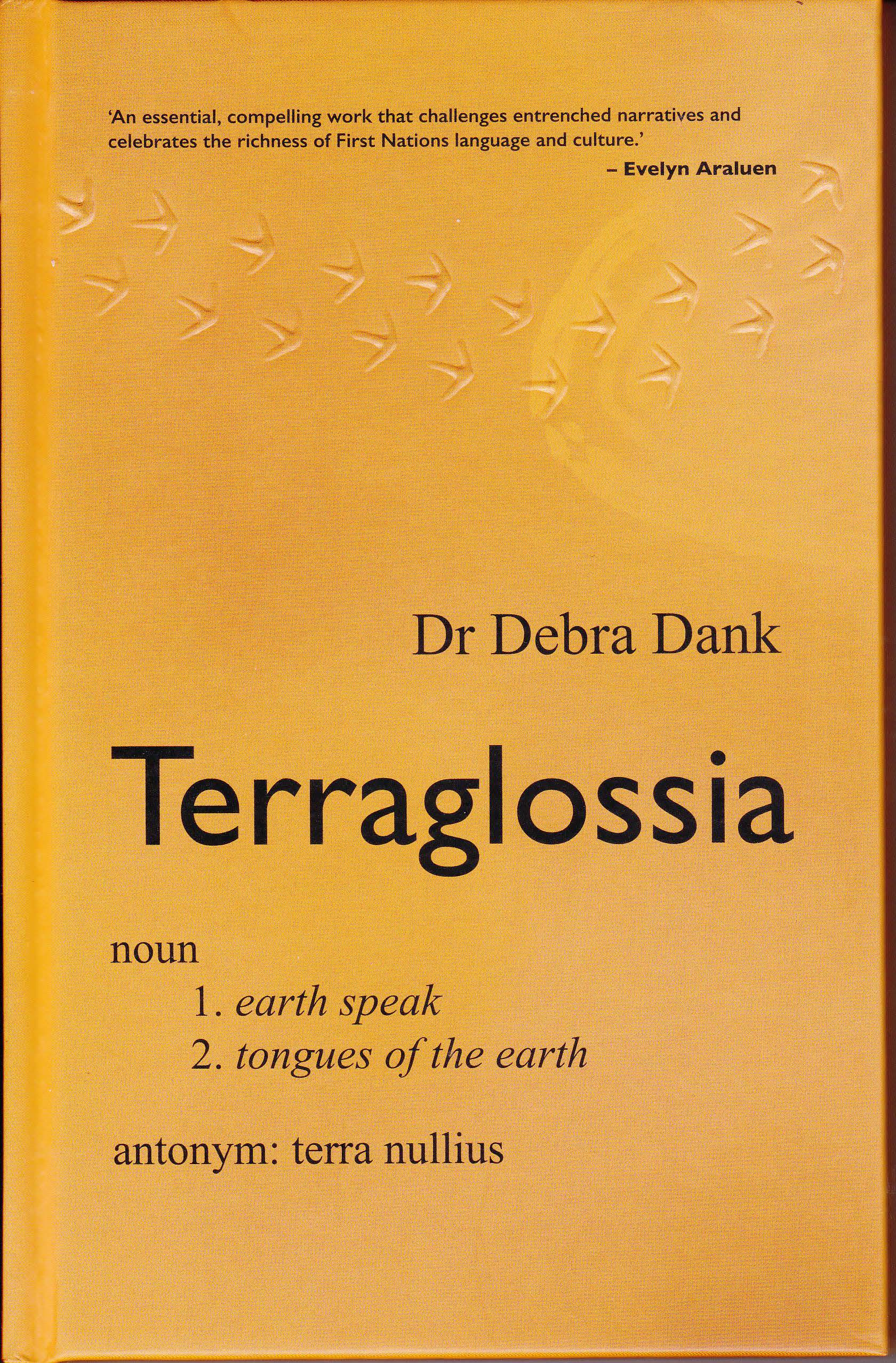
Book Review: Terraglossia

 Written by: Duncan B. on 16 June 2025


Last year Vanguard reviewed the book Bina-First Nations Languages Old and New, which told of the destruction of Indigenous languages in Australia following the colonisation of Australia. A new book Terraglossia, also discusses the damage caused to Indigenous civilisation by the English language.

The author, Dr Debra Dank is a Gudanji/Wakaja and Kalkadoon woman from the Barkly Tablelands in the Northern Territory. She has worked for 40 years in primary, secondary and tertiary education roles in various parts of Australia.

Terraglossia is a word that means earth speak or tongues of the earth. It is the opposite of terra nullius, the concept which was used to justify the dispossession of the Indigenous peoples from their lands. It is a word Dr Dank coined herself to allow us to identify “the words that illustrate or define Aboriginal and Islander ways of thinking, knowing, being, doing and seeing as defined by us through our concepts, and not merely non-Aboriginal concepts massaged into something that is close enough.”

Dr Dank points out how the English language is unsuitable to describe and define Indigenous culture. She writes, “Since Cook, Aboriginal Australian lives and ways of living have been defined through the vocabularies, the concepts and the perceptions of people and languages that are not our own.”

She uses as an example of this the English word nomadic. She writes, “This word, which means ‘migratory’ or ‘moving from place to place’, does not recognise the systematic and structured ways of travelling across a defined landscape. It does not represent the thinking, knowledge and disciplined decision-making that means people can relocate to another environment, one that has had time to regenerate since its last occupation.”

Languages are critical to the continuity of cultures, but Colonisation made English the dominant language in Australia with the destruction of many Indigenous languages along with their speakers. The survivors were often forbidden to use their own languages when they were herded into missions and reservations. 

The English language, along with guns, disease and religion were the weapons that the colonial invaders used to almost wipe out Australia’s Indigenous people and their centuries-old culture. Terraglossia helps us to understand the role the English language played in this destruction.


Friday, June 13, 2025

AUKUS reviews expose Australia’s secondary status

 Written by: Nick G. on 13 June 2025


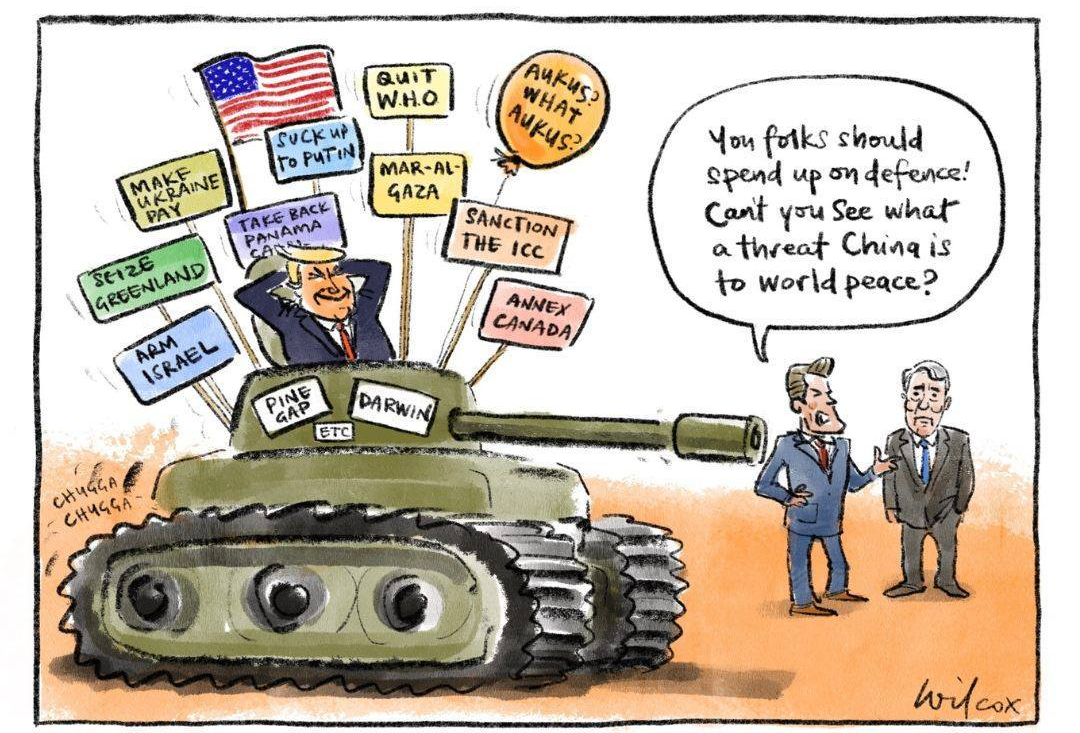
The Trump Administration has just announced a 30-day review of the AUKUS arrangements to make sure that they comply with Trump’s “America First” policy.

The announcement comes just days after Albanese publicly differed with US Defense Secretary Hegseth’s demand that we increase “defence” expenditure.

It is a signal to Albanese of US displeasure with Australia having the gall to think, even in a very hesitant and half-hearted way, that it should have the right to decide things for itself.

It really does expose how Australia, which is not a Third World country, but an advanced capitalist country, is quite secondary in importance and influence to the major powers.

The US joins the UK in conducting a review into AUKUS. Australia timidly refuses to conduct a review, believing that whatever happens, “she’ll be right”. So, the two beneficiaries of the arrangements are enquiring into AUKUS, but the country that has to pay for it – at an average of $30 million a day for the next 30 years – is not prepared to conduct its own enquiry.

The British House of Commons announced on April 2, 2025 a two-month public enquiry into AUKUS. The first submissions were published in early June.

In the meantime, the UK announced on June 2, 2025 its Strategic Defence Review. Among its 62 recommendations – all since adopted by PM Sir Keir Starmer – was that the UK would build for itself up to 12 SSN-AUKUS class submarines, with additional funding to production sites to produce one SSN-AUKUS submarine every 18 months.

This sounds very ambitious given a spate of reports suggesting that UK submarine production always runs behind schedule and is beset with workforce shortages.

The US enquiry, announced days ago, will be led by Undersecretary of Defense Policy Elbridge Colby. He said on March 6 that the US commitment to the AUKUS arrangements was “conditional on U.S. industry building enough attack boats to meet domestic needs first”.

Both the US and UK have “opt-out” clauses in the AUKUS arrangements and are not required to refund any of the billions (nearly $5 billion each) that Australia has committed to giving them in order to pump-prime their industries. These amounts are just gift donations - we are not buying anything with them.

It should be no surprise that Australia is at the beck and call of the imperialists controlling AUKUS.

Scott Morrison’s original AUKUS arrangement was for the sharing of technology that would enable Australia to build its own nuclear-powered submarines. It was not taken to parliament for debate.

After sleeping on the matter overnight, and not consulting his Cabinet colleagues, new Labor PM Anthony Albanese was persuaded to incorporate into the AUKUS agreement a plan to purchase three and possibly five US Virginia-class submarines. Parliament  - supposedly representing the voice of the people in a bourgeois democracy – had no say.

This stupid arrangement, however, was conditional on the US President of the day certifying that the sale of these submarines, which would be half-way through their operational life, would not compromise US submarine strength.

And that is where we are today, with Donald Trump about to say whether AUKUS goes ahead.

Maybe it will, and more’s the pity if it does.

Will Trump demand further non-refundable pump-priming of US industry for it to go ahead?

Will he demand Australia agree to follow the US into more of its unjust and unwinnable wars for it to go ahead? We currently say we will not join them over Taiwan so we can expect pressure from Trump to pull us into line there for it to go ahead.

Will Trump say the US is so far behind in Virginia-class production that it cannot afford to sell even second-hand clunkers to Australia, and that we must further expand facilities here for the basing and maintenance of US subs?

Whatever the outcome, there will continue to be complete Australian subservience to the US demands, with the Australian government claiming that duckshit has been tuned into ice-cream, jobs have been saved, and the great Alliance remains as strong as ever.

This moment presents a really clear example of our sub-imperial power status, of our Second World status, that while the government might try and exercise some sort of imperial authority in our neighbourhood (and behave ruthlessly to Indigenous people within our own country), at the moment where Australian and US policies diverge, we'll be quickly put back in our place.

Stop AUKUS now!

For an anti-imperialist independent, peaceful and socialist Australia.

Monday, June 9, 2025

US to rely on military means of countering Chinese Pacific presence

 Written by: (Contributed) on 10 June 2025
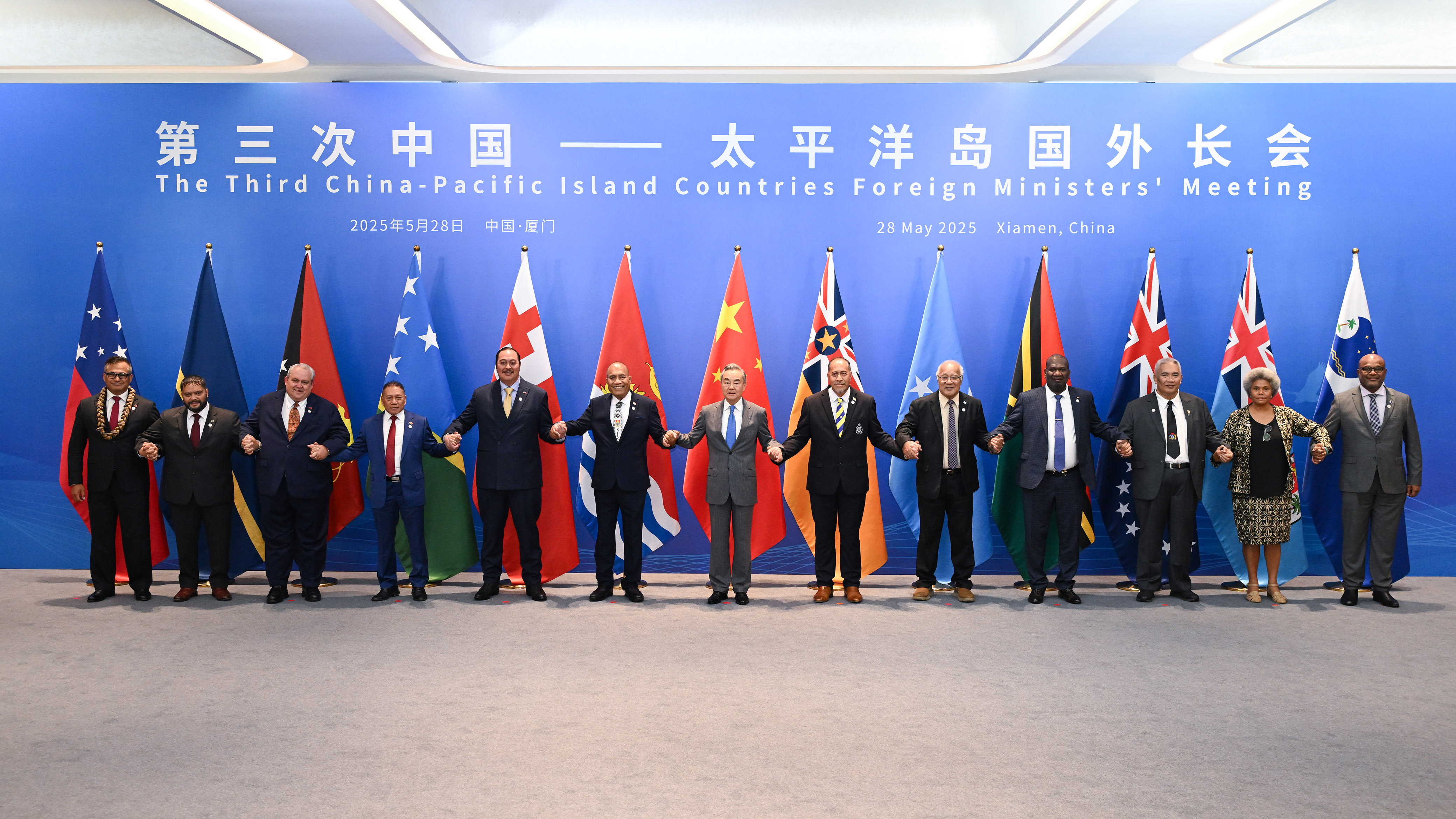
 

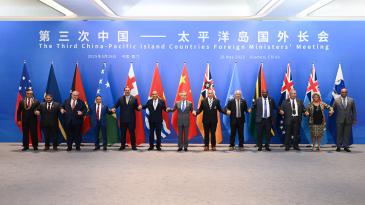
(Above: from China News Service)

Tensions and hostilities between the US and China are set to escalate following the announcement that Beijing hosted some high-level diplomatic meetings in late May. They included meetings with the Pacific Islands, ASEAN and the Gulf Co-operation Council.

The US response included movement of troop elsewhere in the region and claims by the US that China was preparing to invade Taiwan, assessed by the US as a threat to the whole Indo-Pacific region; information emerging from reliable sources has revealed Washington is reassessing various options to deal with the rising power of China.

The options have implications for US regional allies, especially Australia.

In late May the leaders of eleven Pacific Islands had high-level diplomatic talks hosted by Beijing in the eastern city of Xiamen. (1) China announced the regional summit was aimed at fostering closer ties with the Pacific; agenda items included discussions on 'comprehensive exchanges and co-operation … as well as international regional issues of common concern'. (2) China's foreign policy has remained based in mutually beneficial matters which has won increased support from diplomatic partners, with an emphasis upon 'jointly building a closer China-Pacific Island community with a shared future'. (3)

Examples of China's soft-style diplomacy has included a 'suite of new building's' as part of Vanuatu's presidential palace. (4) There are numerous other examples of similar standing:
China's diplomacy has won the country increased support across the Indo-Pacific region, presenting a credible challenge to traditional US hegemonic positions.

One noticeable addition to China's diplomatic moves has been the shift across the region of countries previously recognising Taiwan to China. In recent years Kiribati, the Solomon Islands and Nauru have switched diplomatic allegiance, thereby strengthening China's position at the United Nations. With Taiwan now being officially diplomatically recognised by only a handful of countries it has become increasingly vulnerable and, therefore, a major preoccupation with US regional diplomacy. The official US position is that China has already established plans to invade Taiwan by 2027. There is, however, little credible evidence available in the public domain. A far more likely assessment and scenario is that the US is using it as a pretext for a massive regional military expansion to appease Wall Street and the military-industrial complex.

It is not difficult to establish the hidden hands wringing their greasy mitts in glee behind the US defence department: Pentagon contractors were paid US$108 billion for services they provided in Afghanistan. (5)
  
Taiwan, furthermore, also marks the centre-point of sensitive island chains used by the US to restrict access and egress across the region, at present being enlarged into fourth and fifth chains across the Indian Ocean.

The Pacific Islands diplomatic meetings were quickly followed by a further round of similar meetings with the ten ASEAN countries which also included the Gulf Co-operation Council, composed of Bahrain, Kuwait, Oman, Qatar, Saudi Arabia and the United Arab Emirates.(6) An official diplomatic statement about the meeting noted 'these engagements reflect how ASEAN, the GCC and China can come together to advance their shared economic interests'. (7) It was also noted that ASEAN and the GCC 'were emerging economies in Asia, important members of the global south, and important partners in the Belt and Road co-operation'. (8) China's diplomatic influence can be seen to have moved into countries historically associated with US diplomatic hegemony, with relative ease.

Recent ASEAN diplomatic initiatives have also included moves toward incorporating both East Timor and PNG as full members; both countries have, historically, been closely associated with Australia as a regional hub for 'US interests'. (9)

The China-led diplomatic initiatives have shown their skilful nature toward dealing with the US, which has been increasingly forced out of similar initiatives. In fact, at a time when countries across the global south have proved both resilient and robust in the face of US-led challenges with the threat of tariffs, Washington has become increasingly isolationist while pushing its America First agenda. China has filled the vacuum.

The US response to these recent developments was two-fold: an announcement they were considering moving 4,500 troops from South Korea (ROK) to elsewhere in the Indo-Pacific and calling upon Australia to increase its defence budget while drawing attention to the vulnerability of Taiwan.

Both announcements are best viewed in the context of preparations for a US-led regional war.

The US has, historically, maintained troop numbers in the ROK at about 28,500. Many of the military personnel remain in the country for lengthy periods, indicating specialist positions in various capacities, including signals intelligence (SIGINT). Based in the interception and analysis of telecommunications, SIGINT has a long and secret history of espionage; shadowy spooky figures operating on the margins, monitoring the centres of societies. (10) Detailed studies of SIGINT operational inside the elite Five Eyes intelligence-sharing network, for example, reveal civil liberties for ordinary people have already largely disappeared with the introduction of hi-tech equipment by governments. (11)

It is not particularly difficult to establish where the US are considering placing their SIGINT specialists. Earlier in the decade the Pentagon established a Pacific Deterrence Initiative based on a 'network of precision-strike missiles along the so-called first island chain'. (12) The initiative is now well under-way, with additional 'integrated air missile defence on the second island chain'. (13)

The proposals, which have yet to be ratified by the White House, have included official statements from the Trump administration about their intention of 'bolstering the second island chain'. (14)

Secondly, US Defence Secretary Pete Hegseth, has called upon Canberra to drastically increase defence spending from the present 2.02 per cent of GDP to 3.5 per cent. No reason was forthcoming from the Pentagon about the magic number of 3.5 per cent of GDP, or how the extra funding should be allocated. It has, however, tended to follow a trend of frequent outbursts of speculative and erratic behaviour by the entire Trump administration, reflecting diplomatic behaviour falling well short of being regarded as professional and competent.

The US Defence Department, with a budget of nearly US$ 1 trillion, with 1.3 million active duty personnel and a further one million civilians, for example, has been described by informed and reliable observers as being both chaotic and dysfunctional. (15) It is not difficult to establish why the Pentagon is experiencing such problems; Hegseth is well known as an alcoholic. (16)

Australia, in fact, when compared to its four other partners inside the Five Eyes, already has an average defence budget:

                                               Defence Spending as % of GDP

                                                              US  -  3.4
                                                              UK  -  2.3
                                                     Australia  -  2.02
                                              New Zealand  -  1.31
                                                       Canada  -  1.3
                                                           Total  =  10.33
                           
                                          10.33 divided by 5 = 2.066  (17)

In conclusion, there is no need for Australia to increase its defence budget:

                                          We need an independent foreign policy!

*****
                                                                                           
1.     China to host Pacific leaders summit, Australian, 22 May 2025; and, China to host Pacific Islands leaders, seeking closer ties, AFP., 21 May 2025.
2.     Australian, ibid., 22 May 2025.
3.     Ibid.
4.     See: China builds a new presidential palace in Pacific's Vanuatu, AFP., 2 July 2024.
5.     Pentagon contractors in Afghanistan pocketed $108 billion over 20 years, change.org., 23 August 2022.
6.     Jakarta calls on ASEAN to make PNG a member, Australian, 28 May 2025; and, South-east Asian leaders meet to talk tariffs, truce and East Timor, Australian, 27 May 2025.
7.     Australian, ibid., 27 May 2025.
8.     Ibid.
9.     Australian, ibid., 27 May 2025; and, Australian, op.cit., 28 May 2025.
10.   Espionage, Spies and Secrets, Richard M. Bennett, (London, 2003), SIGINT, pp. 283-84.  
11.   See: Spyworld, How the C.S.E. spies on Canadians and the world, Mike Frost, as told to Michel Gratton, (Toronto, 1995).
12.   US to build anti-China missile network along first island chain, Nikkei/Asia, 5 March 2021.
13.   US Indo-Pacific Command proposes new missile capabilities to deter China, RFA., 5 March 2021.
14.   US bolsters 'second island chain', Nikkei/Asia, 1 April 2025.
15.   'Chaos' and 'dysfunctional' reign inside Pete Hegseth's Pentagon, ABC News, 22 April 2025.
16.   Pete Hegseth's Secret History, The New Yorker, 26 January 2025.
17.   Defence Spending as % of GDP., Stockholm International Peace Research Institute, 2024.


Thursday, June 5, 2025

Reject US military interference in Australia

Written by: Nick G. on 5 June 2025


(Above: Marles and Hegseth.  Original image https://www.skynews.com.au)
 

The US imperialists are brazenly demanding an increased level at which Australia commits to “defence” spending.

Coming from any other country, these demands would be rejected as interference in Australian sovereign decision-making, but neither Marles nor Albanese have adopted such a principled stance.

Despite some minor differences in approach by Marles and Albanese, it really comes down to when, and by how much, the Australian “defence” budget will be altered to accommodate the demands of our US rulers.

The current level is 2.02 per cent of GDP with a projected increase to 2.33 per cent of GDP by 2034.

But Trump is demanding that it be raised to at least 3 per cent. 

Peter Hegseth, US Secretary of “Defense” told the annual Shangri-La Dialogue security summit in Singapore on May 31 that countries in our region should be looking to 5 per cent.

“It is hard to believe I can say this, but Asian allies and partners should look to countries in Europe as a newfound example. NATO members are pledging to spend 5 percent of their GDP on defense, even Germany,” Hegseth said.

In our region, this is for US preparations for war against its main imperialist rival, China.

The US wants to use our continent as a base for threatening China. The Force Posture Agreement between Australia and the US guarantees the US imperialists access to whatever areas in Australia that it wants, and for whatever purposes it wants, and for Australia to cover the cost.

According to the US website Breaking Defense, “One of the ways Washington hopes to deter Beijing is by first by improving forward force posture of US forces in the region, citing the example of the deployment of more advanced US military capabilities to the Philippines and the planned live-firing of the Typhon Strategic Mid-range Fires System in Australia later this year.

“The event will take place in July during the Talisman Sabre exercise, marking the first firing of the weapon outside of the US….”

Typhon is a United States Army transporter launcher for Standard SM-6 and Tomahawk missiles.

In April 2024, the Army operationally deployed Typhon batteries to the northern Luzon in the Philippines, making its first deployment overseas. According to US Army officials, from that position in Luzon, Typhon's missiles could cover not only the entire Luzon Strait but also reach the Chinese coast and various People's Liberation Army bases in the South China Sea. According to Philippines “defence” officials, the system was not used in live-fire exercises, but Philippine troops were trained on how to handle and maintain the missile system.

Now, without any consultation with the Australian people, and with the complicity of Marles and Albanese, a live-firing of one of the two Raytheon missiles used by Typhon, namely the RIM-174 Standard Extended Range Active Missile (ERAM) or the Tomahawk, will be fired in the direction of the South China Sea, setting Australia on a war course with China directed by the US.

In March 2023, the US sold more than 200 Tomahawks to the Australia Navy worth an estimated US$895 million, with a further sale of support equipment worth US$250 million in 2024.

In December 2024, Marles said the RAN had successfully fired its first ever Tomahawk missile. The missile was fired from a Hobart-class air warfare destroyer, making Australia the third nation, after the United States and UK, to acquire and fire the weapon.

Australia has not yet won genuine independence from imperialism. 

First the British, and now the US, dominate and control the Australian state and its most important institution, the armed forces.

US control of Australia and its increasing military interference here must be rejected.

This can only be done by the organised revolutionary working class with the support of the progressive anti-imperialist allies in other sections of Australian society.

More of those allies are emerging and the movement is growing stronger.


Trump's "Make America Great Again" tariffs a case of "be careful what you wish for"

Written by: Ned K. on 5 June 2025


(Above: sourced from https://www.cnn.com )

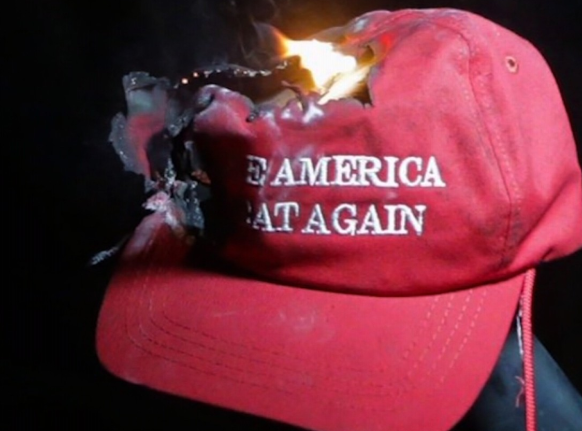
President Trump's tariffs imposed on its main enemy, China, are turning into their opposite. The tariffs imposed were supposed to revive the manufacturing sector in the USA to fulfil Trump's election slogan " Make America Great Again".

However, the Wall Street Journal reports that US-based major car manufacturers and car component companies are seriously considering relocating key car component manufacturing from the USA to China. 

The car component manufacturing most likely to be relocated to China is manufacture of electric motors to gain access to regular supply of the rare earth magnets which are essential components of the electric motors for cars. 

When the USA imposed the tariffs on Chinese made products, China responded by restricting the export of rare earth magnets to car manufacturers based in the USA. Despite the supposed 90-day freeze on imposition of the tariffs agreed between the USA and China, the supply of the crucial rare earth magnets from China has been slow, with US car manufacturers warning that they will have to close down plants.

China produces 90% of the world's rare earth elements essential for the magnets in electric motors and for other goods such as mobile phones. 

The US car manufacturing barons say they have no choice other than moving at least the electric motor manufacturing to China where there will be no restriction on the supply of the rare earth magnets installed in the complete electric motors. The export restriction imposed by the Chinese Government is on the magnets, not on the export of an electric motor manufactured in China.

The US car manufacturers see this as being better than the alternative of shutting down whole production lines in their USA-based plants.

The Wall Street Journal sees the irony in this situation between the competing big powers when it says, "If carmakers end up shifting some production to China, it would amount to a remarkable outcome from a trade war initiated by President Donald Trump with the intention of bringing manufacturing back to the US".

USA After Australia's Rare Earth Minerals

The USA is desperate to find alternative supplies of the essential rare earth minerals. Trump is trying to coerce the Australian Government to guarantee supply of rare earth minerals from the north of Western Australia, and also wants then from Ukraine, to decrease almost total reliance on China's rare earth minerals. In exchange Trump may decide to reduce the tariff on imports of products such a steel and beef from Australia.

Workers Lose Out Whether Free Trade Or Tariffs

The way capitalism in its imperialist stage arranges production and trade, it is workers who lose out. It is workers who lose jobs not only when one imperialist power imposes tariffs, but also when there are no tariffs and "free trade" wins out. Australian workers lost jobs in their thousands when "free trade" enabled manufacturers here to move plants to China and other developing cheaper labour countries in the 1980s through to the closure of the car industry here a decade ago.

Under capitalism, when workers lose jobs due to the anarchy of capitalist production on a global scale, they have to struggle for redundancy payments and have no guarantee of adequate income when redundancy pay runs out (usually capped at 12 or 16 weeks under the Fair Work Act in this country).  For workers who lose their jobs in many other countries, the situation is even worse with no redundancy payments at all.

Trade between countries will continue to occur. Under socialism, trade will still be required but the Australian economy will be based on people's needs first, not profits for a small minority. The surplus produced overall in the country will enable all workers to receive adequate income if there are any periods of unemployment due to changes internally in the economy or due to break down of trade with an external country that is still under capitalism.

Wednesday, June 4, 2025

Hegseth beats the drums of war

 Written by: Bill F. on 3 June 2025


At the recent Shangri-la Dialogue in Singapore, US Defence Secretary Pete Hegseth beat the drums of war against China, proclaiming America’s right to dominate the Pacific Ocean and pledging to militarily combat any move by China to regain its Taiwan territory. (formal name Republic of China)

Hegseth proclaimed that such a move by the Chinese was “imminent” and that countries in the region must increase their military defence spending to meet the targets set by President Trump – 3-5% of Gross Domestic Product.

Never mind that most of the countries present have peaceful trade relations with China. Never mind that they have copped Trump’s disruptive and oppressive tariffs. Hegseth demanded they ramp up their military capabilities to augment US imperialism as it competes with Chinese imperialism a long way from the US mainland.

Australia didn’t miss out either. Hegseth got stuck into Deputy Prime Minister Richard Marles complaining Australia wasn’t spending enough on weapons acquisition and demanding that Australia commits up to $40 billion rather than the current $2 billion, raising defence spending to $3.5 billion in budget estimates. This would be on top of Australia handing over to the US control and access to ports and airfields and locking the country in as a launching pad for the US war machine. Oh! And let’s not forget the $800 million already coughed up and with no guarantee of delivery or reimbursement for (unlikely) nuclear submarines in the distant future, as long as the US gets its own first!

Where would all this money go? US arms manufacturers, the military industrial complex most likely, and certainly in Australia’s case, being locked into “interoperability “with US forces and equipment. As a decaying imperialism under pressure, the US must rely more and more on overt threats and force.
Marles, the seasoned collaborator of US imperialism, grovelled and grinned, nodding in agreement with Hegseth. No doubt it was all recorded by the snoops at Pine Gap.

Prime Minister Albanese, on the other hand, publicly seemed less enthusiastic. Already a bit cranky over Trump’s tariff hike on steel and aluminium, he was well aware that large sections of the Australian people are repelled by Trump and wary or outright opposed to the AUKUS deal and war with China. He wasn’t going to openly grovel like Marles, even though he would never oppose or reject the influence and control of US imperialism.

Before US imperialism manoeuvres the country into another US war that makes Australia a nuclear target, a powerful mass people’s movement or united front must be built to unite and organise, and eventually challenge the hold of imperialism. To win, the working class needs to push up front and seize the running.

Monday, June 2, 2025

Residential aged care - for people's needs or private profit?

Written by: Ned K. on 2 June, 2025


(United Workers Union aged care worker members rallying in adelaide in 2022 - X UWU)

The residential aged care sector is increasingly owned and operated on a profits first basis.

Under the current system, aged care providers (both for-profit and supposed not-for-profit) from 1 January this year can charge a new resident an upfront bond payment of up to $750,000. This is an increase from the previous maximum amount of $550,000.

The $750,000 maximum will be indexed each year from now on, according to the Aged Care Task Force (The Saturday Paper, May 17-23,2025). For the small minority who constitute the ruling class in Australia, this amount is water off a duck's back. They pay up to the maximum bond up front and even more to ensure they get the highest possible residential care. In every capital city, you can see that the residential aged care homes in the leafy, quiet suburbs of the very wealthy offer far better facilities and care than aged care homes in the outer working class suburbs of all major cities.

In the article in The Saturday Paper, the sector accountant firm Stewart Brown found that the average bond of $500,000 for a residential aged care place to live works out to be a daily accommodation payment of $109.59. This does not include the cost to the provider of wages for nurses and carers, as their wages come from federal government funding.

This average bond figure includes bonds paid by aged care residents from the wealthiest to any resident who has any assets (including their modest family home).

The increasing number of aging people who need residential care but who have no assets to speak of is growing.

The maximum accommodation supplement paid by the federal government to the aged care provider for those people "lacking financial means" is $69.79 per day.

As higher accommodation prices continue, the gap between the quality of care and facilities for those "lacking financial means" and the wealthy in aged care homes will only increase.

The incentive for the aged care providers is to "admit" elderly Australians who have enough assets to afford at least the average accommodation bond of $500,000 and rising each year.

There are some not-for-profits who will accept those "lacking financial means" even if it means their bean counter accountants assess the place is running at a loss. Given that the providers are allowed to keep the interest they make on the bonds paid by residents, the claims of some providers that they are running at a loss are questionable when you see the directors and CEOs drive to and from work in their BMWs or Mercedes Benz!

Working people pay taxes all their lives yet they cannot be guaranteed even basic quality aged care if needed without paying a huge bond. If they are "lacking financial means" then not even basic care is assured.

Under capitalism in Australia, governments have no problem in spending $360 billion or more on nuclear submarines for use in a USA war against China. But they are quite ok with an aged care system fundamentally run for private profit of operators and a system with levels of care based on class lines. 

The immediate demand should be for the federal government to eliminate private-for-profit operators and turn them in to public ownership, with the not-for-profit sector supplementing a public sector aged care system.

The long-term solution for quality aged care is an independent socialist Australia.