Tuesday, March 19, 2024

Poverty in Australia: more entrenched than ever

 Written by: (Contributed) on 19 March 2024
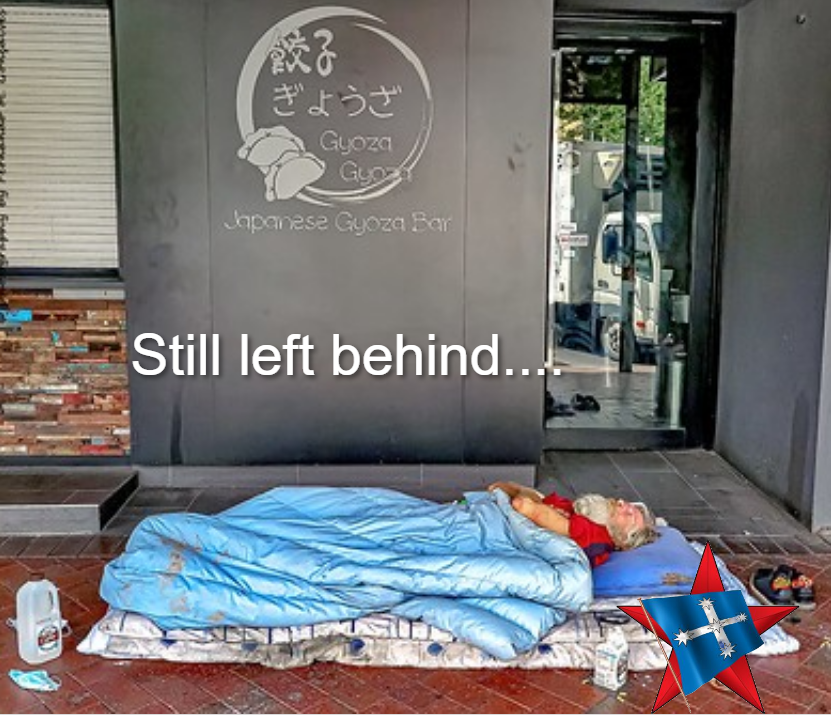
 

Original photo by Fernando Goncalves

Some recent studies have revealed just how much the Australian working-class have lost in the past few years with rampant inflation which has undermined living standards. Lower socio-economic groups have been particularly hard-hit. While economists continue to discuss the likely causes of the problem, the seriously dysfunctional nature of the Australian capitalist economy would appear the likely outcome of being part of the imperialist globalised economy.


A recent study conducted by the Australian Bureau of Statistics (ABS) has found 970,000 Australian workers were employed in multiple jobs, up by 13,600 compared to the previous quarter ending last December. (1) Many Australian workers find it difficult, if not impossible, to retain their living standards with one job. Australia, in recent years, has been hard-hit with soaring price/profit inflation levels which have reduced spending power by as much as 20 per cent to 25 per cent.

Australian workers have experienced a drastic wage-cut.

While Australia has a total workforce of 14,201,300, the participation rate has remained relatively constant at 66.8 per cent. In reality, therefore, the workforce is only 9,486,468. (2)
Using the official government statistics as the benchmark, therefore, a total of 10.23 per cent of the Australian working class cannot financially survive with only one job.

The what extent the second jobs remain outside the usual structured and policed economy with recorded wages and entitlements together with income tax and super being paid and non-official work with payment in the form of cash-in-hand is difficult to accurately establish. The latter, nevertheless, is a factor which has to be taken into account together with the problem of wage-theft.

A further problem workers experience when employed in more than one job is that entitlements for injuries are affected; income protection insurance for main employment, for example, does not apply usually apply if a worker is injured in a second job. If the second job is in the informal economic system, serious legal and liability issues automatically arise during the subsequent investigation.

The official statistics are all the more appalling when taking other criteria into account.

Those employed on the casual basis or precarious levels of employment, while sometimes earning high wages, usually lack credit ratings to raise a mortgage to buy their own homes. They are, subsequently, frequently found in rental accommodation. A recent study conducted by PropTrack has established rental affordability is now at the worse levels since records began. (3) While the average national median household income has increased 19 per cent during the 2019-24 period, rents have increased by 38 per cent during the same period. (4) Last year an ABS study found city rents across Australia increased by an average of 7.3 per cent. (5)

Soaring interest rates have also exacerbated the problem, with the age of cheap credit well past. Many Australians with credit card debts now experience serious financial difficulties.

While economists continue to argue about the causes of the price/profit inflation, a common theory is that it has been the natural outcome of a financial stimulus by the then Trump administration in Washington, designed to ease the problems caused by the COVID pandemic. It was noted 'every year from 2017 when Trump took over from Obama, his administration increased the federal deficit significantly, ultimately adding more to US debt than all former US presidents combined'. (6)

Due to the globalised economy, the problem quickly spread through financial and banking systems to those countries such as Australia which remain strongly linked to the US.  

At the top-end-of-town, however, unequal distribution of wealth has continued to be a serious problem. The rich and wealthy continue to expand their portfolios well above levels of inflation while giving their workers wage increases below half that of existing inflation rates! (7) There is no sign the problem of price/profit inflation will end in the near future.


1.     Multi-job record a sign of bad times, The Weekend Australian, 9-10 March 2024.
2.     ABS: Australian Workforce, January 2024.
3.     Rental crisis worst on record, The Weekend Australian, 9-10 March 2024.
4.     Ibid.
5.     Quoted: Prefabricated and build-to-rent houses, The Conversation, 12 March 2024.
6.     Trump or Biden? It won't matter to the US economy, Australian, 14 March 2024.
7.     Website: Forbes List, where the rich openly flout their wealth and gloat over their ill-gotten gains; information about what they pay their workforces can be accessed through the ABS and trade-unions.

Friday, March 15, 2024

The return of the Philippines puppet Mark 2

Written by: (Contributed) on 16 March 2024


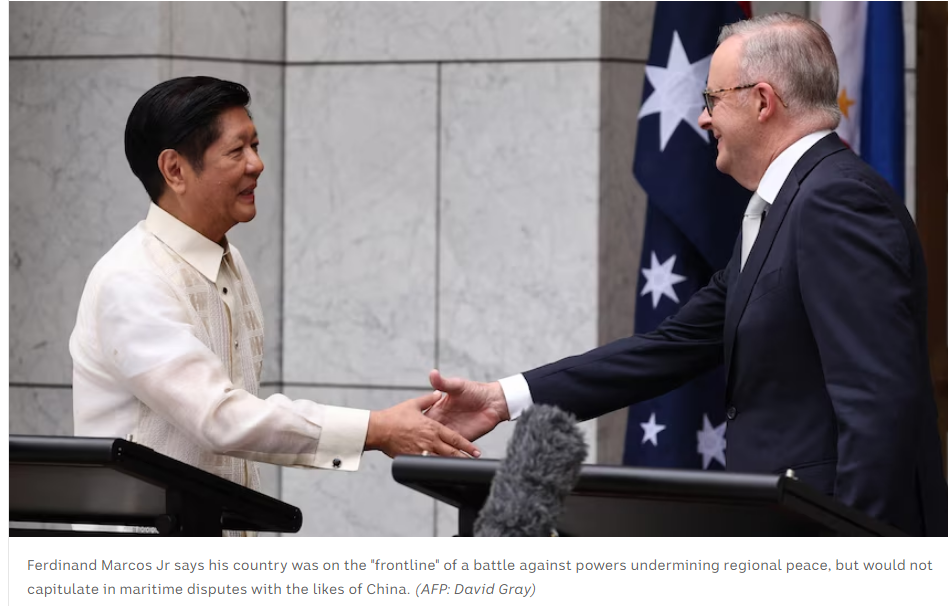
The recent visit of Philippine President Ferdinand Marcos Jnr. to Australia for high-level diplomatic talks marks a return to the days of the previous Cold War now being played-out with the present one against China.

Taking place on the eve of the ASEAN Summit in Melbourne, the Marcos address to parliamentarians in Canberra was designed to act as a rallying-cry for a further escalation of diplomatic hostilities between US-led positions and China inside the regional trade body.

The Philippines has had a long history of political leaders who acted as puppets for US-led regional diplomacy; the present President Ferdinand Marcos Jnr. is no exception to the general rule. Historically, US military strategists have used the Philippines as the centre of an arc which swings to the more economically developed countries of northern Asia and the under-developed yet resource rich countries of South-east Asia. (1) Operations have followed the regional planning.

An arc from sensitive US intelligence facilities based at Pine Gap, Central Australia, likewise, swings to counterparts on Diego Garcia in the Indian Ocean and Guam in the Pacific which have been upgraded as hubs for regional operations. (2) The arc also cuts across the Philippines where the US now has access to nine military bases in strategic areas of the country based on the defence and security of 'US interests' in Taiwan and sensitive island chains used to restrict access and egress across the region. (3)

While great play was made of the Philippines closing some of the huge US military bases in the 1990s with the end of the previous Cold War, the Pentagon soon returned by stealth; emphasis was placed upon re-opening former military facilities then hosted by the Philippine government, partnered to enable US troop rotations with 'permission to operate from the old installations as guests, mostly on the temporary basis'. (4) The moves in the Philippines were also accompanied by similar diplomacy across the region; high-level diplomacy conducted by then President Obama toward traditional allies included numerous agreements about increasing the US military presence without too much publicity about longer-term implications. (5)

The relationship between US-led regional foreign policy and the Philippines, nevertheless, soured considerably with the election of President Rodrigo Duterte whose administration pursued a popularist and pragmatic line; Duterte, politically, came from outside the traditional ruling oligarchies imposed on the Philippines by the Spanish colonial administrations. Instead of, therefore, pursuing the US-led policies of confrontation with China, the Duterte administration stated that it 'will not take sides with any parties contesting China's move to set up a missile base on some of the islands in the South China Seas … this is to avoid the Philippines being dragged into a conflict between superpowers'. (6) The political and diplomatic position was quite clear. It included reference to 'it is not in our national interest … to … be involved in any armed confrontation between China and the US … an independent foreign policy is the best position to take … everything will be resolved in peaceful and diplomatic means'. (7)

The position of the Duterte administration also included their questioning and possible termination of a 1998 agreement with joint US-Philippine military exercises, which set alarm bells ringing frantically in the Pentagon. (8) It effectively threatened to push the US into a front-line position as opposed to lurking behind regional partners and allies. When then President Obama addressed a graduation of US military cadets at West Point, New York, in 2014, for example, he stated 'it was possible for the US to lead through example and by creating international alliances … and … the promise of a less aggressive American foreign policy', was subsequently used for the later Indo-Pacific Strategy. (9)

With the demise of the Duterte administration and election of Marcos Jnr. the US gave a sign of relief; the oligarchies were back in control, with the Marcos oligarchy holding presidential power. Washington and the Pentagon were subsequently able to return to the traditional hegemonic and diplomatic positions of the previous Cold War, now played-out in the present one against China.

It was, therefore, no surprise to observe President Marcos Jnr. being given a big welcome in Canberra; Australia is a regional hub for 'US interests', with defence and security considerations resting partly on the Philippines. In fact, the US regard the Philippines as the front-line with its diplomatic hostilities toward China, with 'Australia the main rear for US military forces'. (10) The diplomatic positions include preparations for 'real-war scenarios'. In recent times, for example, Australian military facilities have been upgraded specifically for this purpose, coinciding with the formal Visiting Forces Agreements between the Philippines, Australia and the US leaving little to the imagination about longer-term implications.

Marcos, furthermore, used his visit to Canberra and address in Parliament House, on the eve of the ASEAN Summit in Melbourne, to state the Philippines 'is prepared to choose a side', namely the US against China. (11) Most ASEAN member countries, however, prefer to not take sides between the US or China; they benefit from diplomacy with both sides. (12)

No doubt the US is, therefore, pleased with their Marcos Mark 2 puppet in Manila, who is serving 'US interests' well, as his father did before him, together with the sowing of seeds of doubt and division inside ASEAN, the premier Asian trade bloc:

                                      We also need an independent foreign policy!

  
1.     The objectives of the US, The Guardian, 6 August 2003.
2.     See: Peters Projection, World Map, Actual Size.
3.     US plans to expand its military presence in the Philippines to counter threats against Taiwan, USA Today, 2 February 2023.
4.     US eyes return to south-east Asian bases, The Guardian, 29 June 2012.
5.     US signs defence deal in Asia, The Guardian, 2 May 2014.
6.     Duterte won't antagonise China over missile system, The Philippine Star, 9 May 2018.
7.     Ibid.
8.     Philippines rethinks defence deal with the US, Australian, 4 June 2020.
9.     US signals foreign policy shift away from military might, The Guardian, 6 June 2014, and; The reasons behind Washington's push for GSOMIA., Hankyoreh, 12 November 2019.
10.   Guardian, op.cit., 6 August 2003.
11.   Bongbong knows he needs friends, Australian, 1 March 2024.
12.   See: Tapping in to ASEAN needs, Australian, 7 March 2024, with reference to the 'China plus one' strategy of ASEAN member countries.


Aged Care Workers Win Higher Wages and Some Respect

 Written by: Ned K. on 15 March 2024


Source: United Workers Union, X

On Friday 15 March 2024 the Fair Work Commission handed down its second Decision on wage increases for aged care workers. In 2022 the Commission handed down a Decision increasing nurses and personal care workers and chefs in aged care facilities a 15% wage increase.

The principal unions with membership in the aged care sector (Nurses Union, Health Services Union and United Workers Union) initial case was for a 25% wage increase for all occupations in the aged care sector. 

The second Decision of the Commission handed down on Friday 15 March 2024 increased the wage increase (inclusive of the 15%) to up to 28.5% for nurses and personal care workers and a 6.8% wage increase to support service aged care workers such as cleaners, laundry workers and food preparation workers assisting the chefs.

Although aged care workers did not take industrial action to win increases in pay, they raised their voices in unity exposing to Royal Commissions, politicians and the media the impact that low pay had not just on their own personal lives but on the quality of care of elderly people dependent on aged care. It has been their stories that demanded the Fair Work Commission and the federal government ensure that aged care workers be paid wages that reflect the skill and complexity of the work they perform.

Aged care workers’ wages are paid from money allocated to the aged care employers who own and dominate the aged care sector, both residential and home care.

Many aged care sector employers, even the so-called not for profit operators, have a history of mis-allocating federal government money provided to pay workers.

Sometimes this has been done by outright underpayment (wage theft) of workers and sometimes by "creative rostering" and not replacing staff absent from work. 

With the increase in wages to aged care workers, the temptation to continue bad practices will no doubt continue. 

However, through the workers’ campaign for higher wages and respect for the work they do, they have become more united and organized with thousands joining their appropriate union for the first time. Many are migrant workers who are standing up for their rights and the rights of residents like never before.

The next big battle for the aged care workers and indeed communities is to tackle the question of ownership and control of the sector.

Is it in the interests of aged care residents, workers and communities as a whole that aged care is dominated by private for-profit operators, many of them large overseas owned conglomerates?
 

Party Anniversary and Congress

Written by: Central Committee, CPA (M-L) on 15 March 2024


Today, March 15, 2024 marks the 60th anniversary of our Party’s founding.

To mark the occasion, we are announcing today that we will be holding our 16th Congress this year.

Congress is taking place at a time of intensifying inter-imperialist rivalries and continuing crisis of global monopoly capital.  Although US imperialism is still strong, especially militarily, it is more widely exposed and isolated. The gulf between the ruling classes of monopoly capital and the masses is widening globally.  Conditions for expanding anti-US imperialist forces are strengthening, not least in Australia. Economic and living conditions of the people are worsening.  Climate crisis is rallying the people against monopoly capitalism.  Nevertheless, we need to take account of uneven conditions and developments. 

The heroic Palestinian resistance is isolating reactionary and imperialist forces, inspiring and mobilising the oppressed and progressive forces. The overwhelming international solidarity for Palestinians is an antidote to the ruling class’s push towards fascism.   

The inter-imperialist rivalries between the US bloc and China/Russia bloc are intensifying, threatening imperialist war, giving rise to anti-war and independence movements.   

Congress consultations offer excellent opportunities to examine Australia’s and international conditions, class struggle, the people’s and revolutionary movements, enabling the party to set the direction for our work and study in the next 4-5 years.

Central Committee

CPA (M-L)  

Tuesday, March 12, 2024

Australia surrenders sovereignty again: integrates with US-UK military exports and RnD

 Written by: Nick G. on 13 March 2024


A new set of policies on Australian exports introduced last November has been designed to make local research and development interoperable with that of our AUKUS “partners”, the US and UK imperialists.

Hugh Jeffrey, Australia’s Deputy Secretary of Strategy, Policy, and Industry made the announcement during a Canberra speech sponsored by the Centre for Strategic and International Studies, a Washington-based think tank.

Hugh Jeffrey has had 4 overseas postings, including as Minister Counsellor at the Embassy of Australia in Washington DC and to NATO in Afghanistan, where he was Senior Adviser to the International Security Assistance Force Commander and the NATO Ambassador.

Jeffrey said that the changes will mean “a net decrease in regulatory compliance costs, and actually expand the amount of research that can occur internationally without a permit”.

“…with the national exemption for export permits from the US and UK, (the changes will) remove regulation from $5 billion of almost $9 billion in annual Australian defence exports.”

That will please not just the American and British, but also our good friends in the Zionist genocidal army to which we are exporting arms and technology.

But local researchers outside the US loyalists in the Australian military, public service and government, are worried about the implications. 

The president of the Australian Academy of Sciences, Chennupati Jagadish, was concerned about the prospect of a brain drain towards the military. “My ability to attract the best and brightest in the world, wherever they are, will diminish,” he said. “It’s timely to ask what Australia is really seeking to secure if we are restricting the development of technologies that are critical for the future of our country?” 

Even people in the US close to their military are surprised at the gullibility of their Australian servants.

Bill Greenwalt, who as a staffer on the Senate Armed Services Committee wrote many of the US export control rules, said he thought “Australia just gave up its sovereignty and got nothing for it.” 

Greenwalt, also a former US deputy undersecretary of Defense for industrial policy, warned that incorporating many of the principles of the International Trafficking in Arms Exports (ITAR) regulations to gain access to US nuclear submarine technology would set Australia back 50 years. 

The changes are designed to more closely bind Australia to the United States and Britain in return for access to the technology and intellectual property that comes with the primary goal of the AUKUS agreement — buying and building nuclear-powered attack submarines.

The gullibility extends to a promised gift to the US of A$4.7 million to pump prime their submarine production at a time when there is no guarantee of that happening. A matching contribution of US$3 billion has yet to pass Congress, held up by the same Republicans who are hoping for a Trump return to the Presidency.

Editor of the online Australia Pacific Defence Reporter, Kym Bergmann, commented yesterday: “In the US the return of Donald Trump to the Presidency is suddenly looking more likely – and if he scraps AUKUS it might do us all a favour by bowing to the inevitable.”

Commenting on US-Australia relations, former Senator and submariner Rex Patrick wrote yesterday that “There are no guarantee the US will actually deliver. US national interests will always take precedence.”

Former Prime Minister Malcolm Turnbull also said yesterday that under AUKUS, Australia has ‘lost all sovereignty, all agency’.

Australia will never have the capacity for independent decision-making in matters of foreign policy so long as our economy is dominated by the US, and our ruling circles are blindly loyal to US imperialism.


Friday, March 8, 2024

WOMAD: Marley to perform, Palestinian musicians banned

 Written by: Nick G. on 9 March 2024


Photo: Asbjorn Kanck

Yesterday, members and supporters of the Australia Friends of Palestine Association picketed the entrance to the popular WOMAD music festival calling on audiences to boycott the performance by Ziggy Marley, son of the famous Rastafarian Bob Marley.

Their very vocal calls of "cease fire NOW" and "stop the genocide" rang out during the one and a half hour-long rally. Drivers of passing cars honked their horns in support. 

The AFOPA bookshop in Adelaide said that many with tickets to WOMAD had called at their shop to purchase pro-Palestinian t-shirts to wear to WOMAD.
Calls on WOMAD organisers to drop Marley from the program owing to his support for Israel and its armed forces, calls rejected by the organisers, had fuel added to the fire when the same organisers, at the last moment, withdrew their invitation for Jordanian-based Palestinian group 47SOUL.

Marley’s wife Orly Agai, is an Israeli of Iranian-Jewish descent. In Israel in 2011 for two concerts, Marley told the Zionist Israeli news agency Ynet: "The history of our connection to the roots of Israel, to David, Solomon, goes way before I met my wife. My father, my Rastafari culture, has a tight link to the Jewish culture. We have a strong connection from when I was a young boy and read the Bible, the Old Testament.” He told the agency that he “felt very close to Israel”.

In November 2018, Marley displayed that closeness when he joined US rapper Pharrel Williams on stage at the annual Friends of the Israel Defence Forces gala which raised US$60 million for the genocidal army.

Their audience included Israeli soldiers in uniform.

Although he claims his music sends a “message of justice, love, and peace for all people,” on October 20, 2023 Marley posted a picture of a raised hand, along with the words, “You know wha! There must be a better way. Free Gaza from Hamas.”

He also signed an open letter affirming his support of Israel amid the war with Hamas. 

The letter instructs Hollywood “to speak out forcefully against Hamas, to support Israel, to refrain from sharing misinformation about the war, and do whatever is in their power to urge the terrorist organisation to return the innocent hostages to their families”.

WOMAD director Ian Scobie tried to defend his decision to allow Marley to perform, saying that it was a lie that he had performed for the IDF and only promoted harmony in his songs. 

47SOUL, which had twice before performed at WOMAD, were to be banned, he said, because of the way feelings were running in the community at the moment, and his inability under those circumstances to be able to guarantee their safety. He added that they could perform in 2025 if they wanted to. This was a bullshit excuse, because anyone can see how feelings are running in the community at the moment.

47SOUL issued a statement on the withdrawal of their invitation to play:

"Having initially accepted the invitation, we were later informed that WOMADelaide took the decision to rescind 47SOUL's invite, citing doubts at being unable to present a 'suitably safe environment' for the artists and audiences at the festival due to community protests taking place in Australia," it said.

"We find this line of reasoning deeply problematic and disheartening as it feeds into the narrative of Palestinians being an inherent source of danger to others.

"At this critical time, the message of multiculturalism that WOMAD seeks to espouse, and its specific relevance to the events we are witnessing, could not be of greater importance."

British-Lebanese multi-genre music producer and DJ Saliah withdrew from WOMAD in protest, saying “I am of British-Lebanese heritage. Members of my family are currently suffering daily bombardment by the IOF (Israeli Occupation Force)  in Lebanon….WOMADelaide…refuses to provide a ‘safe’ platform for Palestinian artists and their allies at a time when amplifying our voicescould not be more critical.”

Australian singer-songwriter Jen Cloher, who is part of Sunday’s WOMADelaide program and has vowed to donate any profits from that performance to 47SOUL and the Palestinian cause, lashed out at organisers’ claims the decision was based on safety.

Tunisian performer, Emel Mathlouthi performed last night, waving a Palestinian flag for a supportive audience.

In contrast to the deplorable decisions that have mired WOMAD in controversy, peaceful audiences of many hundreds of people listened with great interest to speakers on Palestinian and Israeli issues at the previous week’s Adelaide Writers Festival.

Avi Shlaim, whose Arab-Jewish family fled their Iraqi homeland after the First Arab-Israel War in 1948, described the discrimination his family faced from the   Ashkenazi Jews who had come to Israel from Europe. He had researched the circumstances of the large-scale migration of Jews from Iraq to Israel at that time, and had discovered “incontrovertible proof” that three of the five terrorist bombs directed at Iraq’s Jewish community had been planted by the Israelis themselves to induce a state of panic, forcing Iraq’s Jews to seek refuge in Israel. He explained why he rejected the “two-state solution” and now sought a singular secular and democratic state of Palestine. His book is Three Worlds: Memoirs of an  Arab-Jew.

Tareq Baconi serves as the president of the board of Al-Shabaka, the Palestinian Policy Network. He was listened to without interruption by more than 2,000 people at 8am as he outlined the origins of Hamas, its political ambitions and the reasons why it has the support of the people of Gaza. His book is Hamas Contained. 

Several hours later, another huge audience heard Israeli-born Ilan Pappé address the question of Israel and Palestine more broadly. The author of several books on the topic, he is best-known for his detailed study of the Zionist crime of ethnic cleansing that both pre-dated and continued through the Naqba. It was “a crime that needs to be confronted politically as well as morally”, he wrote in The Ethnic Cleansing of Palestine. 

As a tale of two decisions, Adelaide Writers Week and WOMAD could not be further apart.

Further protests are planned at the latter.


Rising Tide Lifts All Boats

 Written by: Ned K. on 8 March 2024


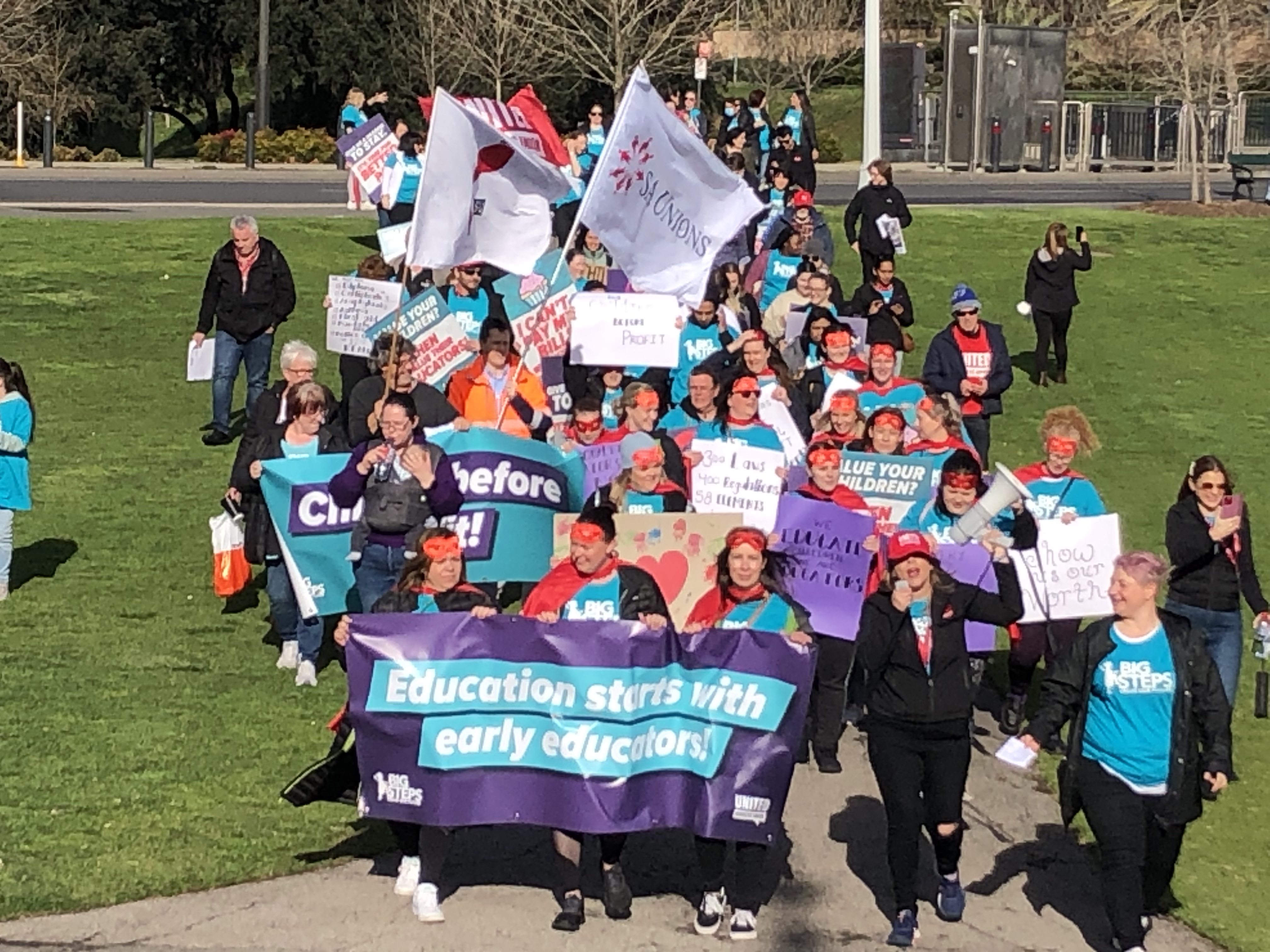
Above: Early Childhood Workers at a rally in 2022.

The dust has settled on the federal government's changes in the Fair Work Act in relation to enterprise bargaining. Workers and their Unions are looking to see where the changes can be used to advantage workers and what are the traps to look for.

The employers said the sky would fall in if the federal parliament approved widening the opportunities for multi-employer bargaining. So far that has not proven to be the case. One of the few sectors where the new multi-employer laws have been applied is the Early Childhood Education sector. The sector is now dominated by private equity companies and other private for profit operators while the wages paid to workers are highly dependent on federal government funding.

The Early Childhood Education workers (predominantly women) and their Union, United Workers Union, initiated multi-employer bargaining and utilised the new provision in the Fair Work Act regarding relevant funding third parties being involved . The third party involved was the federal government as it funded the wages in the sector. While the federal government said it as sympathetic towards the low pay and poor conditions of workers in the sector it dragged its heels on committing to fund wage increases. 

Consequently the sector owners stalled the bargaining process.

The workers and their Union responded in February this year by giving notice of a strike on Internatinal Women's Day, 8 March.

About a week before the intended sector wide strike, the federal government announced it would fund a substantial increase in wages. Union members' Delegates agreed in consultation with members to postpone the strike action and possibly withdraw it altogether once they knew the exact amount that the federal government was going to agree to fund in the form of wage increases and over what time frame.

Delegates thought it best to keep the powder dry as they realised that their members may only get one clean shot of strike action as under the new laws the employers and fderal government had plenty of legal options to try and block on-going industrial action.

The threat of industrial action definitely moved the federal government's position on funding wage increases in the sector.

From the workers' perspective, their Union had utilized changes in the new laws to apply the "rising tide (of struggle) to lift all boats(multiple private for-profit Early Childhood Education Centre owners)".

On International Women's Day, thousands of women workers in the sector will be keeping a close eye on developments and waiting to see the dollar signs from the federal government.

In a completely different sector of the economy, the stevedoring and maritime sector, there is a history of protracted enterprise bargaining disputes between the Maritime Union members and a single employer. The new laws in relation to enterprise bargaining have strengthened the powers of the Fair Work Commission to arbitrate when an employer or group of employers argues that workers and their Union are being "unreasonable" if they have not accepted an employer offer after 9 months of bargaining. The new provisions come under an Intractable Bargaining section of the Act. 

This new provision of the Act went through without headlines in the daily press and for good reason. The big corporations and no doubt both Labor and Liberal governments want to limit the power of the workers in key areas of the international economy such as shipping trade and turn around time of containers on and off ships.

So whatever the laws of capitalism regarding the class struggle within workplaces, workers and their Unions learn how to both use the laws to their advantage and how to avoid the worst aspect of the laws to further the interests of the working class as a whole to maximize the opportunity of a rising tide lifting many, if not all boats!