Showing posts with label state elections. Show all posts

Monday, March 31, 2025

Elections in WA

Written by: Allan M. on 1 April 2025
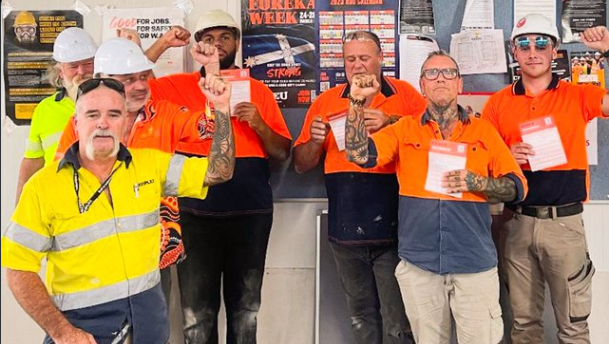
 

(Above: CFMEU members in WA  - Paid Up And Proud!)

2025 is a year of elections in WA, with Western Australians being asked to head to the polls to decide their State and Federal representatives. The State election here has just occurred, and WA Labor has had a decisive victory for a third term. Opposed by a Liberal/National Coalition (whose shambolic campaign, candidates, and policies are not worth further thought) the WA Labor Party entered their election campaign promising ‘a steady hand’ for WA. When looking back at their previous terms, we can see that this steady hand was used to quietly rob Western Australians of their future while enriching mining magnates and their political cronies.

The WA Labor Party experienced a record win in 2021, securing a 4-year term with no effective opposition in either house of Parliament. With this significant majority, WA Labor has had the opportunity the address major issues in our State. But in 2025, we face a huge housing crisis, with more and more families having to choose between rent payments and food, continued attacks on our natural environment, and attacks on worker power. 

With a record majority in Parliament, WA Labor promised to address the State’s seriously outdated rental laws. Soon after making this promise to the people of WA, the Labor government was falling over themselves to placate the landlords and property developer lobby, giving assurance after assurance that their proposed new law would not impact their ability to gouge tenants. What WA renters got from this law was a requirement that landlords are limited to a once-yearly rent increase, compared to the previous twice-yearly limit. What a comfort! To the landlord class, WA Labor delivered a massive green-light to continue their daylight robbery. With the retention of no-grounds evictions and the ability to increase rent to whatever they like on a yearly basis, landlords are still able to scare renters into shutting up and paying up for the privilege of living in low-quality housing. 

Now WA, like the rest of Australia, is in the midst of a massive housing crisis. In late 2024, Perth became the least affordable capital city to rent in, while 0% vacancy rates in many of our regional centres have led to rapidly increasing homelessness. Working families are in precarious conditions, having to find ways to keep up with extortionate rent increases or risk eviction. Many have been unable to keep up, shown by the growing number of families living out of cars. 

This is what the Labor party achieves when it faces no opposition.

With a record majority in Parliament, WA Labor promised to protect the State’s natural environment and heritage, while promoting sustainable economic growth. In the wake of the tragic destruction of Juukan Gorge in 2020, that vast majority of Western Australians were eager to see the arrogance of mining companies reined in. After introducing a new law to modernise the protection of Aboriginal heritage in WA, the WA government came under increasing pressure from pastoralists and smaller mining companies to water it down. Scared of a fight with industry, the WA Labor government revoked the law overnight and reverted our Aboriginal heritage protections to rely on a law from 1972. 

This disgraceful weakness of our ‘elected representatives’ and their deference to big industry continued throughout their term. Under pressure from mining and property developer lobbyists, the WA government introduced changes to our environmental protection laws with zero mandate or public consultation. These changes limited rights of appeal for the community, and changed the composition of the Environmental Protection Authority to enable greater representation of industry interests. The egregious lack of transparency in this process caused uproar for many Western Australians, but the WA Labor government was able to use their Parliamentary majority to push through the changes unopposed in late 2024. Shortly after, it was revealed that the WA Labor government also gave special privileges to Alcoa, allowing the mining giant to continue expanding its bauxite mine outside of Perth while an environmental assessment on that expansion was ongoing. It was further revealed that public servants advising the government told them that this could poison a significant portion of Perth’s water supply. Despite this, the WA Labor government allowed Alcoa to continue mining effectively without any constraints. 

This is how the Labor party uses it’s Parliamentary majority, not for the benefit of the workers, but to bow down to business interests.

With a record majority in Parliament, WA workers might have thought that the Labor government would enact policies from their allegedly ‘pro-worker’ platform. Instead, the WA Labor government used their majority to continue an attack on workers across the state. In 2022, WA nurses went on strike as part of their campaign for a pay-rise after years of being over-worked, understaffed, and protecting our community from Covid-19. Instead of supporting the workers, the WA Labor government attacked them through the Industrial Relations Commission. After continued pressure from the government, the nurses union were forced to call off their campaign and pay a $350,000 fine. 

In the Pilbara, where most of the State’s mining occurs, unions are looking to build up their membership and support mine workers who are experiencing worsening pay and conditions. Instead of supporting the unions, WA Labor has sided with their friends in the Chamber of Minerals and Energy, with the Deputy Premier stating that workers in WA ‘thrive without unions’. It should also come as no surprise that as the union presence in the Pilbara is growing, the WA Labor government joined in the attack on the CFMEU and introduced an arbitrary ‘fit and proper person’ test for any union representative seeking to enter a worksite. 

This is how the Labor party treats the workers when they fight for fair conditions.

The WA government has had a once-in-a-century opportunity to improve the lives of the WA community. With no effective opposition in Parliament and large public support, the government could have embarked on a series of reforms to ensure we have good housing, strong protections for our heritage sites and our natural environment, and good conditions for our workers. Western Australians can now see how the WA Labor government used their majority to cosy up to big business, for individuals to secure Board positions at Rio Tinto, BHP, or  FMG, and to attack the working class. The best thing to come out of this term of government has been that WA Labor has exposed to all Western Australians just how hostile they are to the working class. This is driving us to continue building the worker solidarity, to reject the bourgeois Parliamentary system, and to fight for a system that represents the working class and our interests.

Sunday, November 27, 2022

Victorian Election Result No Surprise - Labor Re-elected As Workers' Struggle Rises


(Photo: Dan Andrews Facebook page)

Written by: Ned K. on 27 November 2022

During the evening of the Victorian State Election on Saturday 26 November, I watched the results of the count on ABC TV. By 10.30pm it was pretty clear that the Andrews Labor Government would prevail for another term. 

For someone like myself living outside Victoria, this came as no surprise. In the lead up to the election, the big business media tried its best to get people to vote the Andrews Government out due to the long lockdowns of the Covid-19 pandemic period. Big business was hoping that its preferred parliamentary Party, the Liberal Party would then become the new Victorian State Government.

From the ABC coverage of the election vote counting, it looked like Labor first preference votes declined but not in the right seats to throw them out of office, while the Liberal Party embarrassed their big business backers by making no parliamentary gains at all.

The reduced first preference votes for Labor in traditionally strong Labor voting areas in working class suburbs highlights the limitations of Labor in office and limitations of parliament as an institution of capitalism in solving the problems of the working people.

On the eve of the election, the Andrews Government was aware of the unrest among its traditional voter base. It announced that it would fund the establishment of up to 50 new Early Childhood Learning Centres and conduct a review into public school cleaning standards. It also reminded voters of some of its other initiatives on issues such as wage theft.

All these frantic measures by the Andrews Government took place against a background of an increasing emphasis by progressive elements of the union movement in organising workers "on the ground" outside parliament, building working class power in workplaces and the communities. 

The Andrews Government in its third term of office will be put to the test by the further development of this growing and powerful grass roots movement of organized workers.

More experience of a Labor Government in office will be a good thing from two perspectives. Firstly, it will show more workers that parliament, even with a left leaning ALP in government is not the answer to their problems. Secondly, it will force the Andrews Government to make more concessions to workers' demands. Any concessions made will be the result of the increased level of struggle by workers outside parliament.


Sunday, May 10, 2015

Andrews’ government’s budget cake


Bill F.

The Victorian Treasurer Tim Pallas has carved up the first budget cake of Labor Premier Dan Andrews’ government. It serves some tasty chunks for big business and then serves smaller portions to the working people.

The budget allocations are a typical social democrat exercise – keeping capitalist profit-making ticking over efficiently while keeping the working class and small farmers and communities disappointed, but not furiously rebellious.

With a rapidly growing population, Victoria has serious problems with run-down and overcrowded schools and inadequate funding for public hospitals. In this capitalist system these things are always issues of blame and point-scoring between the state and federal levels of government. Widespread opposition to the austerity cut-backs in the last federal budget flowed into a strong union mobilisation during the election campaign and swept Labor into office, with the expectation that education and healthcare funding would get a significant boost.

Labor’s response was to shell out for badly needed hospital beds and a new Women’s and Children’s Hospital. More than 60 schools will be renovated and 10 new schools built, but the promised new technical schools will be delayed for two years, and the final two years of the ‘Gonski’ education agreement have not been funded.

Traffic congestion is a huge problem in Melbourne due to the inadequate privatised public transport and short-term planning based around freeways and toll-roads. Labor came to office last year on the back of a popular campaign to scrap the disastrous East-West Link project. Labor belatedly took up the popular demand and campaigned in favour of building a new underground Melbourne Metro line with 5 new stations linking the east and west sides with the centre of the city (below, red line). Work would start on removing some 50 level crossings and improving travel times with extra trains, improved signalling and a trial of all-night public transport on Fridays and Saturdays.


These plans were well received, but the East-West Consortium contracted by the previous Coalition government just weeks before the election had to be ‘compensated’ at the cost of $399 million, plus an extra $600,000 in legal fees. There is still uncertainty about the ongoing funding for Melbourne Metro as the Abbott federal government was ready to throw billions of dollars at the East-West (road) Link, but is opposed to funding suburban rail public transport.

Labor’s solution to its immediate funding problems is to privatise the Port of Melbourne, the largest in the country, even though it is highly profitable and expected to handle double the tonnage over the next ten years. As part of “fattening up for sale” the Andrews government is planning to improve road transport access to the Port area and the under-utilised Webb Dock. This will most likely be done in conjunction with a proposal from the Transurban tollwaymonopoly to build a new Western Distributor Tollway linking West Gate Freeway to CityLink via a 2 km tunnel and a new crossing over the Maribrynong River with an elevated roadway along Footscray Road. Even though the tollway may charge trucks $13 a journey, these costs will inevitably be passed onto the people in the form of higher prices. Cars will be looking at a $3 toll if they want to avoid the bottlenecks on West Gate Bridge.

While these were the big ticket items, much smaller amounts of cash have been set aside for many worthy projects, such as regional programs, asbestos removal, supporting disadvantaged schools, more child protection workers and a clean-up of rivers and parklands. Labor was unwilling to fully fund many projects and had committed to keeping the budget in surplus. However, more public service jobs will be created to manage the changes and cater for the growing population.

So, a ‘bread and butter’ budget for the masses? Well, not quite. The people were demanding action on healthcare and education which had suffered from previous austerity budgets, federal and state. Some concessions had to be made.

With the demise of the manufacturing industry thanks to imperialist ‘globalisation’, in particular the immanent closure of Ford, Toyota and General Motors Holden, there is an obvious need for re-training workers and improving educational standards in schools. While Andrews and Co. shovelled out $3.9 billion in this budget, almost 25% goes to private schools under a new state government funding formula that undercuts the agreed ‘Gonski’ model.

While the spend on public transport gets the headlines and certainly benefits the people of Melbourne, it also benefits big business by overcoming the congestion that effects work hours, delays deliveries and dents profits. Money will also go into widening the Tullamarine Freeway (instead of the long-postponed rail connection to the airport) and the Western Ring Road, while the Western Distributor will funnel road transport directly to and from the soon-to-be-privatised port.

It all creates a few jobs in a listless economy, at a time when the heroes of capitalism are nervous about investment. This is the role of governments under capitalism; to prop it up and spread the burden onto the people when times are tough, and step back and let the pigs get at the trough when things pick up. It’s called ‘socialise the losses, privatise the profits’.

With all the commentary about funding disputes between the state and federal governments, there is little connection made between the tight budget constraints and the enormous tax evasion and avoidance carried on every day of the week by multinational corporations and the big local monopolies.

When Nicholas Moore, the chief executive of Macquarie Group, can rake in nearly $8000 an hour, there is no shortage of wealth in society; it’s just in the wrong pockets. Socialism would spread the wealth created by the working people and use it in a planned way to provide meaningful jobs in sustainable industries, with decent housing, education and healthcare for all the people, and at minimal or no cost. The alternative is not Liberal or Labor; the alternative is socialism.

Monday, March 30, 2015

Cynicism undermines action


By Louisa L


Unless it is linked with an understanding that the subservience of Australia to its imperialist masters can be broken, disillusionment with politics and politicians can be profoundly disempowering.  

This was capitalised on in last weekend’s NSW election by No Land Tax (NLT), whose bewildered pamphleteers were paid $30 an hour to hand out leaflets attacking 'Labor crooks'  and 'Liberal crooks', and suggesting “Teach them both a lesson” by not distributing any preferences. The ALP was the real target. 

Apparently the head of the group, Peter Jones, had been rebuffed by the Liberals in a preference deal, and had a verbal brawl with shock jock Ray Hadley. As not too much mud had stuck to Teflon Mike Baird compared to the decade of deep and personal corruption of NSW Labor under Joe Tripodi and Eddie Obeid, the Labor vote was diminished.  

While the vote was small, for a group that had materialised just weeks before the election, in at least one seat, East Hills, the NLT vote of 2.15 per cent may have changed the result. 

More important was the role played by the Christian Democratic Party (CDP). Their preferences went straight to the Coalition, while their bright orange placards “No Sharia Law” and “Stronger Bail Laws” muddied the waters. Nowhere in Australia is sharia law being considered, and bail laws are now more punishing than for decades. Our gaols are bursting with people on remand, many of whom will be found not guilty.


In the marginal seat of East Hills where the CDP garnered its largest vote, the ALP candidate, Cameron Murphy - former head of the Council for Civil Liberties who only needed a 0.2 per cent swing to take the seat - was a particular target. 

Democracy?

But it didn't stop there. 

According to the Sydney Morning Herald, unknown people plastered Murphy's corflutes “with stickers maliciously alleging he is a 'paedophile lover'”.

Mr Murphy was awarded the Order of Australia in 2014 for his contribution to human rights, and is the son of former Labor federal attorney general and former High Court judge Lionel Murphy.
"It is very disappointing when people engage in gutter politics," Mr Murphy told the Herald. "There have been leaflets and stickers claiming I am a paedophile, a serial rapist, and in favour of a mosque in every street.”


It all had an effect and Murphy may not gain the seat. Labor sources told the Herald, “voters were walking into pre-poll booths this week, and booths on Saturday, saying they wouldn't vote for a paedophile.”


And this is our grand democracy. No wonder people are disillusioned. 


Turning that to deep knowledge and action is important post-election.