Showing posts with label energy issues. Show all posts

Sunday, November 17, 2024

Nullarbor Plain Environment Threatened By Proposed "Green" Hydrogen Energy Hub

Written by: Ned K. on 18 November2024
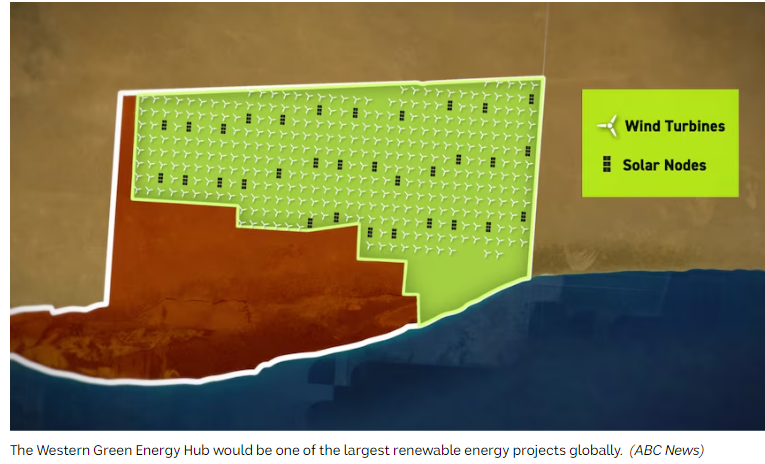
 

"Developers" Intercontinental Energy and CWP Global are planning one of the largest "green" hydrogen energy production hubs on the Nullarbor Plain north of Eucla. The project involves building a desalination plant, use of ground water in the Basin below the Nullarbor, 3,000 wind turbines and 60 million solar panels. The multinational corporations involved claim it will produce 3.5 million tonnes of "green" hydrogen a year for the Australian and international market.

According to The Weekend Australian of 16-17 November, the corporations involved in this proposal formed a "partnership" with Korea Electric Power Corporation, the largest South Korean electricity provider. 

Venture capitalists Paris-headquartered Hy24, and Government of Singapore Investment Corporation GIC have together sunk equity investment totalling $US115 million ($180 million) into the project.

The project will involve hydrogen electrolysers, water and hydrogen pipelines, a new port and the clearing of over 27,000 hectares of Nullarbor Plain land.

The corporations involved claim 10% of the venture will be owned by the First Nations Mirning people who have native title rights to the area. InterContinental (46 per cent), CWP Global (44 per cent) account for the remaining 90% ownership.

Intercontinental Energy and CWP Global had previously begun a similar-sized green hydrogen project in the Pilbara, the Asian Renewable Energy Hub (AREH). In 2022, British multinational BP bought into the project and took over its operations, renaming it the Australian Renewable Energy Hub.

Scientists say that the project will be a disaster for the Nullabor Plain environment which includes extensive underground caves and unique fauna.

The corporations and WA Government of course say that "avoidance of impact" on environment and marine life is their highest priority!

The scientists say "The caves have preserved ancient underground landscapes, environmental histories and fauna that have remained frozen in time for hundreds of thousands and even millions of years".

The network of the cave system and groundwater system is so interconnected that scientists say that the project cannot avoid or mitigate harm to this environmentally fragile area. 

In 1994 the area in question in a report to the UN found that the Nullarbor karsts met World Heritage criteria.

The message from the scientists is "go build your ‘green’ hydrogen hub somewhere else"!

In the hands of multinational corporations and their governments at state and federal level, "development" for profits come first, especially when they throw in the argument that projects like this one are renewable energy projects and not fossil fuel projects.

This puts traditional owners, the Mirning, in a difficult conflict-of-interest situation.

The Mirning are the traditional owners of the Nullarbor, and Mirning Green Energy, whch holds 10% equity in the project, is the commercial arm of the Mirning Traditional Lands Aboriginal Corporation (MTLAC).

In 2017 the Mirning People were granted native title over the land on which the developers now want to build, which means before any development can go ahead, an Indigenous Land Use Agreement must be negotiated.

"Our cave systems are our storylines," MTLAC chair Shilloh Peel said.

"Each family is connected to each cave, as well as the rock holes that provide water to the caves.

"We need to bring our people along with us … and we would have to make sure that all our cultural sites, heritage sites are protected."

However renewable energy projects are not much use to the struggle against capitalism's global warming crisis if the projects destroy the environment, including the cultural heritage of First Nations peoples.

What's the answer then?

As an interim demand, all renewable energy projects should be nationalised rather than in the hands of "developers" and only proceed by agreement with First Nations peoples.

Only an independent socialist Australia will maximize Australia's contribution to saving the planet.

Saturday, May 19, 2018

“Hands across the sands” rallies target multinationals

Nick G.

Thousands of Australians from seventeen coastal communities have joined hands across the sands to protest offshore drilling and offshore seismic testing for oil and gas.

The annual “hands across the sands” movement began eight years ago in the USA following BP’s Deepwater Horizon oil spill in the Gulf of Mexico.

The Australian focus is on the Great Australian Bight where first BP (in association with Nowegian state-owned Statoil) and then US Chevron sought exploration licences.  An alliance of Indigenous Australians, conservationists, tourism operators and commercial fishers campaigned strongly and forced BP and Chevron to abandon their plans.  However, Statoil purchased the abandoned licences and is the new target of the movement.

What is wrong with deepwater drilling and seismic testing?

Deepwater drilling is a potentially dangerous process and oil spills have a devastating effect on marine and coastal environments. But it is the seismic testing that explores for oil and gas deposits below the seabed that really concerns environmentalists.

Seismic airguns are towed behind ships and shoot loud blasts of compressed air through the water and miles into the seabed, which reflect back information about buried oil and gas deposits. These blasts are repeated every ten seconds, 24 hours a day, for days and weeks at a time. Airguns are so loud that they disturb, injure or kill marine life. Impacts include temporary and permanent hearing loss, abandonment of habitat, disruption of mating and feeding, and even beach strandings and death.

A broad alliance

When a Liberal State Minister for Resources opposes seismic testing, you know there is broad opposition to the practice.  Earlier this year, NSW Minister Don Harwin explicitly voiced his opposition to seismic drilling off Newcastle, arguing the federal guidelines that governed its approval were more lenient than state laws. The exploration licences were held by Asset Energy, a wholly-owned subsidiary of Perth-based Advent Energy whose board of directors has ties to a number of multinational energy corporations.

When a rural Mayor opposes seismic testing, you know there is broad opposition to the practice.  Kangaroo Island Mayor Peter Clements (above) campaigned against BP and Chevron, and travelled to Norway last week to attend the Statoil AGM and address shareholders on the dangers posed by their company to the Great Australian Bight. He had with him a letter from Bight Indigenous leader Sue Coleman-Haseldine, who visited Norway late last year as part of the group that won the Nobel Peace Prize, the International Campaign to Abolish Nuclear Weapons (ICAN).

“We write on behalf of people around the world that are fighting to protect their Country, livelihoods, and water from dangerous oil drilling and climate change,” Ms Coleman-Haseldine writes in the letter signed by locals from the Bight area.

“Consent to drill the Bight has been neither sought, nor given. Together, we ask that Statoil abandon their plans to pursue risky deepwater oil drilling in the Great Australian Bight, and around the globe.

“We call on Statoil to instead invest in our country in clean and renewable energy. Statoil must respect the Indigenous custodians of the land and sea from who you wish to extract oil and gas.”

When Indigenous leaders, leaders of local government, fishing and tourism industry leaders and surfies stand shoulder-to-shoulder outside the annual conference the Australian Petroleum Production and Exploration Association (APPEA), you know you have a broad alliance in defence of the environment.  Ms Coleman-Haseldine, a proud Kokatha-Mula elder from Ceduna, joined the protest outside the APPEA conference in Adelaide on Tuesday of last week, as did Keith Parkes, the mayor of Alexandrina Council encompassing the Southern Fleurieu Peninsula and Murray Mouth.  His Council has passed a motion opposing oil drilling in the Bight. “We are concerned about the risks posed by drilling for oil in the Great Australian Bight and the impact on our community should the worst happen and a spill occurs,” he said.

Semaphore sends a signal
Semaphore is an iconic Adelaide beach-side suburb, host to the equally iconic Semaphore Workers Club. On May 19, some 3-400 people gathered for the “join hands across the sands” event.  Indigenous elder of the West Coast Mirning People (the Whale People) Uncle Bunna Lawrie sang us into the event with a bracket of numbers that included “Jeedara”, his song about the White Whale. It begins with his eerily beautiful mimicry of whale calls which he said he hoped his brothers in the sea could hear. (See this Youtube clip for an earlier version of the song: https://www.youtube.com/watch?v=DYg7OwNtWME ).
Greens Senator Sarah Hanson-Young recalled her meeting earlier in the week with Statoil reps at the APPEA conference.  She said they were clearly unsettled by and fearful of their loss of a “social license” (public approval) for exploration and drilling in the Bight. 

Wilderness Society South Australia director Peter Owen said that Statoil was so concerned about its image that it had rebadged itself as Equinor, removing the ugly “oil” word from its name. The name change had taken place at last week’s AGM. Statoil held its name for 46 years during which time it emerged as the largest operator in Norway, where it is 67% owned by the Norwegian Government. The move also indicates a company shift away from fossil fuels  and towards a renewable energy future.

“A name with ‘oil’ as a component would increasingly be a disadvantage,” said Eldar Saetre, Statoil’s chief executive. “None of our competitors has that. It served us really well for 50 years, I don’t think it will be the best name for the next 50 years.”

Stand up, Bight back!

“Stand up, bight back!”, a placard carried at the APPEA Conference, expresses both the determination of the alliance against seismic testing and the influence of the methods of the organised working class.  Regrettably, only one union had a visible presence at Semaphore: an Australian Education Union’s Environment Action Group banner carried by SA Branch vice-President Dash Taylor Johnson and his son.

The chief causes of the global environmental catastrophe are to be found in the capitalist system of profits-before-people.  Working people everywhere bear the brunt of its consequences. Militantly, purposefully, locally and globally they must confront the power of imperialist capital and destroy that power so as to save the world and create a real unity of humanity and nature.

Wednesday, August 16, 2017

Solar-Thermal Power Plant Win

John C.
 
On the 14th August 2017, the South Australian premier, Jay Wetherill announced that the construction of a concentrated solar-thermal power plant has been given the go ahead. This is a monumental step forward in the transition to 100% renewable energy.
 
The notion of establishing a viable solar-thermal power plant in Australia was raised by the renewable energy think tank Beyond Zero Emissions (BZE) as far back as 2010 . In 2012 plans for such a power plant were firmed up by BZE and the Repower Port Augusta campaign came into existence .
 
During the intervening 5 years between then and now, a peoples’ movement in collaboration with scientists, engineers and local government lobbied the South Australian government relentlessly with powerful, logical and well backed up arguments for constructing a concentrated solar-thermal power plant in Port Augusta to replace the existing system of coal-fired power plants which was coming to the end of its life. The idea was widely supported throughout South Australia, but it was the people of Port Augusta who played a pivotal part in the campaign. In the process, the people developed and honed their skills and strategies in united front work. There was involvement of ordinary citizens of Port Augusta, workers from the power plant, local government, local businesses and city people (Adelaide). Pt Augusta residents took action online, crowdfunded TV ads and billboards, doorknocked and had thousands of conversations. They rallied in the streets, and 100 of them even walked from Port Augusta to Adelaide to make their voices heard.
 
The success of the campaign was never a given, especially considering that those behind the push for more traditional and environmentally unacceptable methods of electricity generation have loud political and financial voices. This makes the victory all the more significant and demonstrates what can be achieved by the people when they unflinchingly stand united.
 
The basic principal of operation of a concentrated solar-thermal power station is as follows. A large array of mirrors tracks the transit of the sun across the sky during the day. The reflected radiation is focused on to a tower, the top part of which is filled with sodium chloride – the common salt that we eat with our food and that exists in sea water. The focused radiation is sufficiently intense that the salt becomes molten. The molten salt contains large amounts of stored energy (look mum, no batteries!) which can be called upon as required to generate electricity in the same way that the last stage of conventional electricity generation does. Namely, the energy is used to heat water to produce steam which drives turbines which in turn generate the electricity.
 
This type of solar-thermal power generation is proven technology with such plants having been in use for example in Spain since 2011 and in Nevada in the USA.
 
One argument that was posed by those against the case for a concentrated solar-thermal power plant for Port Augusta when the idea was first put forward, was that it would not be able to cater for periods of peak electricity demand. This is no longer an issue in the latest designs. The proposed plant is capable of generating 150MWatts and the maximum load requirement set by the government is 125MWatts. The excess capacity during daylight hours can be fed back into the grid. The heat that is stored in the molten salt can generate electricity for about another 8 hours after the sun goes down.
 
A single solar-thermal plant is not sufficient to provide all of South Australia’s energy presently but it will be part of a mix with other renewables including wind, solar photovoltaic and lithium ion battery storage; and unfortunately for the moment, non-renewable gas.
However, the construction of even a single solar-thermal plant is highly significant. The first one always has the greatest cost associated with it. As an industry develops around this type of plant, the cost of subsequent plants will reduce and the uptake of the technology will increase. Part of the deal is to involve South Australian universities in conducting further research on solar-thermal systems.
 
In this way, and as other renewable technologies develop, the transition to 100% renewable energy forms part of reality. The only barrier to achieving this is the will to do so.
 
The federal government has shown no leadership or commitment toward this reality, but instead dreams up excuses for not going down the path of 100% renewable energy, criticising those who do and it continues to back the dead-end and environmentally damaging fossil fuel industry.
 
Even poorly funded not-for-profit, but nonetheless professional, think tanks like BZE are showing the way forward with their “Zero Carbon Australia Plan”. They have devised a viable plan, the government has none.
 
With solar-thermal no longer a pipedream, the federal government must come up with the goods or face being totally discredited and going the way of the dinosaurs.
 
Had Australia been under socialism, a commitment to 100% renewable energy would have been made long ago as part of a national strategic plan and the requisite research undertaken in earnest before any looming environmental disaster manifests itself.  Further still, energy sovereignty would be seen as essential, and energy supply and ownership would be nationalised.  There would be no opportunity to either hold the country to ransom or to impose obscene price rises.
 
The proposed solar-thermal power plant relies on a 20 year contract with US company Solar Reserve for supplying the electricity that is generated.
...................................

1. 
Zero Carbon Australia Stationary Energy Plan 2010. Published by the Melbourne Energy Institute, University of Melbourne.
2. 
Repowering Port Augusta. A blueprint to replace Northern and Playford B coal power stations with renewable energy. Published by Beyond Zero Emissions in 2012.

Saturday, July 15, 2017

Coal Seam Gas? No fracking way!

Nick G.

Despite recent announcements about expansion of renewable energy generation and storage, the South Australian government remains committed to destructive coal seam gas ventures.

This is despite overwhelming community opposition.  A parliamentary enquiry has confirmed this, saying CSG has no “social licence”, i.e. no community acceptance.

The Labor state government was a strong supporter of the abominable plan by Marathon Resources to mine uranium in the Arkaroola Wilderness Sanctuary.  A people’s campaign, rather than parliamentary common sense defeated the plan.

The same government pushed strongly for an international nuclear waste storage facility.  A people’s campaign, rather than parliamentary common sense defeated the plan.

This government, which parades its credentials as a world leader in renewable energy, is bankrolling efforts to impose fracking on the state’s South East. This will also eventually be defeated by a people’s campaign, rather than parliamentary common sense.

Fracking harms humans and nature

Fracking -  the process of coal seam gas extraction – uses chemicals that can contaminate aquifers or return to the surface as contaminated waste water which has to be stored. The chemicals include tetramethyl ammonium chloride, minimal doses of which can poison large amounts of water; the neurotoxins diethylene glycol or methanol; butoxyethanol, a life-destroying substance; and nonylphenol, which is carcinogenic and harms fertility. Among the lifeforms killed by these toxins are many of the microorganisms whose activities help seal tiny rock fissures, thus accelerating the release of poisoned waters to the surface.

Doctors are among those concerned by the effects of fracking on human health.  Dr David Shearman AM FRACP is Hon. Secretary of Doctors for the Environment Australia and Emeritus Professor of Medicine University of Adelaide. He cites US studies that reveal major concerns associated with fracking.

“Between 2009 and 2015 at least 685 papers were published in peer-reviewed scientific journals that were relevant to the effects of unconventional gas development. Eight-four per cent of public health studies indicated public health hazards, elevated risks, or adverse health outcomes; 69 per cent of water quality studies contain findings of potential, or actual water contamination; and 87 per cent of air quality studies showed elevated air pollutants,” he said.

“The inhabitants of the gas fields in the US,” he added, “suffer increased eye problems, respiratory irritation, and headaches.”

Farmers reject incentives to destroy environmental and human health

The state Liberal Opposition, playing to its traditionally conservative electoral base in the South East, announced a ten-year moratorium on fracking. State Treasurer Tom Koutsantonis deplored the move, alleging that it had caused an “investment strike” on gas projects in the state.

In response, the state government offered local farmers an “incentive” of ten percent of the royalties of any productive CSG well on their property.

But even offering thirty pieces of silver could not induce farmers to betray their livelihood or the interests of their community.  It did the opposite.

Lorraine Robertson is one of many dairy farmers in the south-east of South Australia who saw their profits decimated when Fonterra and Murray Goulburn announced they were retroactively cutting milk prices.

She said it resulted in about $150,000 being clawed back from her farm, and although she was in a desperate financial situation, it was not enough to allow gas exploration on her property.

"We're on the bones of our ass and I still wouldn't accept it — I don't know any farmers that would,” she said.

Her views were echoed by Tantanoola farmer Peter Altschwager, who said the majority of South-East farmers opposed fracking and, until companies showed unconventional gas extraction was safe, the State Government’s new royalties plan was unlikely to win support.

Paying monopolies from the public purse

Frustrated by the refusal of farmers to be bought off, the Labor government has gifted Adelaide-based gas producer Beach Energy $6 million or half the cost of establishing a 4 kilometre-deep gas well on state forestry land just outside of the South-East town of Penola.

The company plans to have the gas well operational by September.

According to regional newspaper, The Border Watch, the drilling site will be located near the boundary of the world-famous Coonawarra wine district and adjacent the new $80m Union Dairy Company processing plant.  Local farmers and vignerons are furious.

For a complete ban on CSG

CSG extraction places humanity and nature on opposite sides of an antagonistic contradiction.

They should not be so opposed: both human labour power and nature are sources of wealth, but under capitalism both are exploited in the pursuit of private capital accumulation.
Both suffer the destructive impact of such exploitation.

It is possible to temporarily stop this or that form of the destructive exploitation of nature, but like the destructive exploitation of human labour power there can be no permanent protection under capitalism.

When the working class comes to power, when the immediate and selfish interests of private capital are brought to an end, the workers will rise to the challenge of restoring the essential unity of humanity and nature, ending both its own exploitation and the destructive exploitation of its only life environment, the Earth.

Sunday, April 30, 2017

Re-Power Port Augusta Campaign Full Of People Power Optimism

Ned K.

On Sunday 30 April, about 500 people held a community event on the steps of Parliament House in Adelaide as another step towards winning a solar thermal power station at Port Augusta following the closure of the coal fired power station last year.

The event was organised by the community group Re-power Port Augusta and there were many people from Port Augusta who came down to Adelaide to attend.

Speakers included a power station worker from Port Augusta who lost his job last year with the closure. Although he worked in a coal fired power station for over 15 years, he was not looking backwards but focusing all his efforts in to changing government policy to force them to support renewable energy and break with fossil fuel. He said that the sunny weather in Port Augusta most of the year round combined with the threat of global warming made the building of a solar thermal power station at Port Augusta a no brainer.

Two young women who have been involved in the campaign for five years and who completed a 300 km plus walk from Port Augusta to Adelaide as part of the campaign, also spoke at the rally. They said that Turnbull government had been forced by public pressure to make some financial commitment to a solar thermal plant in Port Augusta. State Premier Jay Weatherill was quoted by the two women as having said, "I'd love for a solar thermal project to get up".

Speaker after speaker said that the state ALP government now had to "put its money where its mouth is" and provide the financial support to make the solar thermal plant a reality.
An announcement by the state government is likely in June this year as renewable energy and gas extraction companies compete for finance from both state and federal governments.

The state government has to decide to put money towards a solar thermal plant at Port Augusta or a new gas fired power plant located elsewhere or both. SA Labor must be ruing its privatisation and sale of the SA Gas Company (SAGASCO) in 1993 to help pay off the State Bank debt.

In a state election year in 2018, the Premier Weatherill will be tempted to put more money in to a gas fired power station at Port Adelaide and market it as job creating for workers who lose their jobs in nearby suburbs as a result of the closure of the car industry in October this year.

A smarter option would be to finance both with strings attached for any privately owned corporation that is involved.

There was a feeling of both optimism and determination at the event in Adelaide. Prominent in the event were the Australian Services Union who have members in the power industry at Port Augusta. Their members spoke out today in what was a good example of working class leadership by rank and file ASU members uniting with Port Augusta community and a diverse range of people form Adelaide who support renewable energy and the ASU's placards which read "Climate Jobs Justice".

Sunday, April 2, 2017

Renewable Energy Needed For People And The Planet, Not For Profiteering

Ned K

Recently the federal Turnbull Government has announced a proposal for a huge Snowy River hydroelectric scheme and funding of renewable energy schemes in South Australia.

At the same time the desperate SA Labor Government has framed its solution to the electricity reliability of supply issue in terms of an intervention into market forces. It has promised financial incentives to companies to invest in renewable energy in the state and it has also proposed full government or part government ownership of a backup gas-fired power station.

These announcements at federal and state government levels are partly motivated by winning votes for the next rounds of the parliamentary election cycles.
 
Class Struggle Plays Out In The Energy Sector
 
However they are also a reflection of the class struggle being played out in the electrical energy sector and across society generally.

On the one hand there is the working class with their allies leading the struggle for a just transition from a fossil fuel past to a renewable energy future. Examples are at Port Augusta where the whole community has been agitating for government support for a solar thermal plant to replace the closed coal-fired power station owned by Alinta, and in various regions of Australia where regional agricultural workers are fighting against coal seam gas exploration on prime agricultural land.

On the other hand there are the more far-sighted sections of the ruling class who can see the writing on the wall for the fossil fuel industry. They can see that continued pollution of the atmosphere from fossil fuel reliance will wipe the ruling class out too!

They are vigorously competing to get tax-payer funded projects for an extension of the renewable energy market.

Both the federal Turnbull Government and SA Labor Government have no intention of a planned, state owned and controlled electrical power generation and distribution industry as existed in SA under the Tom Playford era.

Capitalism has moved on since the Playford era and the dominant sections of the capitalist class are multinational corporations who have their eyes on the profits to be made from the renewable energy sector. It is telling that the decision to close Hazelwood coal-fired power station was made by a French owned multinational, Engie, not by either state or federal government. Similarly in SA, it was another multinational corporation, Alinta, who decided to close the Port Augusta power station and Leigh Creek coal fields to its north.

Multinational corporations are positioning themselves to dominate the renewable sector just as they did the fossil fuel based power sector. For example, Lyon and Downer groups have announced a $1 billion solar battery farm in the Riverland north of Morgan in SA. The Lyon group is backed by Mitsubishi and US hedge fund Magnetar Capital. Lyon is partnered by US battery company AES Energy Storage.

Tesla, software billionaire Mike Cannon Brookes, AGL Energy are all expressing interest in winning an SA Government tender to supply SA's power grid.

The ruthless private equity corporation Blackstone has expressed an interest in backing Magnetar.

On another front, Carnegie Clean Energy, backed by Samsung of South Korea is about to announce its partners for its bid to win the SA Government's planned 100 Mega Watt lithium iron battery storage plant which is to be powered by rooftop solar.

Turnbull chips in by announcing that the federal government will commit $110 million to the building of a solar thermal plant at Port Augusta knowing that the two most likely companies to build and own the plant are US companies Vast Solar and Solar Reserve.

So the list of multinationals competing for their slice of the renewables action goes on.

As it turns out it is better for the working class and allies that multinationals build a renewable energy sector in Australia that is sustainable rather than follow the reactionary line of Tony Abbott and pour money in to fossil fuels.

These multinational renewable energy companies are doing what Marx said capitalism does - continually revolutionising the productive forces. The only problem, as Marx explained, is that their interests are opposed to the working class in that for the renewable energy multinationals, maximizing profits will come before the people's interests.

How will this play out in the future? There will be struggle between these multinationals and the workers they employ. There will be struggle between the working class and their allies and these multinationals over the price of electricity and there will be struggle over where the surplus value created by workers in the renewable energy sector goes.

A good start for workers in this struggle has already begun with workers at Hazelwood and La Trobe Valley demanding a just transition.
 

Saturday, March 18, 2017

No shortage of gas – it’s just in the wrong hands!

Bill F. 

Australia has vast reserves of natural gas, but an artificial shortage is being manipulated by foreign and local corporate monopolies to force up the price of domestic gas and push back against the wide opposition to coal seam gas fracking.

Exports of liquefied natural gas (LNG) from plants in Western Australia (Gorgon, North West Shelf, Ichthys, etc.) and Queensland (Gladstone) are booming, even though global prices are falling. 

Massive investments of $200 billion have seen new and expanding plants where the natural gas is chilled and liquefied to be carried by the huge tankers. Most of the construction investment has been written off against taxation by both Labor and Liberal governments, along with any requirement to pay a miserly petroleum resource rent tax.

In contrast, Qatar, which is currently the world’s biggest exporter of natural gas, earns three times as much as Australia from royalties.

It’s the system, and it’s stupid


Companies such as Chevron, Woodside, Santos, Exxon, BHP, Origin, Arrow Energy and Shell have long-term contracts to supply gas to Japan and other Asian countries. Not content with their current reserves and with limited access to coal seam gas, they are now hell-bent on plundering domestic supplies, not only to meet their contractual obligations, but also to impose higher prices on the domestic market through the creation of an artificial shortage.

The capitalist market system sees prices go up whenever there is a shortage of a commodity, in this case, gas. The higher price is then passed on to the consumers at the end of the line, the working people.

While many other countries set aside a generous amount of resources such as oil and gas for domestic use, Australian governments have pandered to the monopolies and allowed them to mine and extract resources with tax concessions and deferred royalties. Only the Western Australian state government has insisted on a gas reserve for local domestic services, while the Gillard federal government rejected the idea outright.

Bruce Robertson, from the Institute for Energy Economics and Financial Analysis, commented, “Australia is unique in its sheer stupidity in allowing companies to exploit our resources and not insist they provide for our domestic market… We are swimming in gas, the idea that we cannot provide for our own population is just a total failure of our energy policy.”

Victoria and New South wales hardest hit


The people of eastern Australia will suffer the most from this failure, as they use three quarters of all domestic household gas in the country. More than ninety percent of Melbourne homes use gas for hot water, heating and cooking, and fifty percent of homes in Sydney.

Gas from the Bass Strait oil fields is being diverted from domestic supplies to the export port in Gladstone, Queensland. Similarly, gas from the Moomba field in South Australia, is now heading north to Queensland, by-passing the traditional market in New South Wales.    
Apart from rising costs as domestic gas users are forced to pay higher than international prices, the Australian Energy Market Operator issued a warning that NSW, Victoria and South Australia could suffer actual gas shortages within two years.

Already Victorian manufacturers and processors that use gas for their operations are being offered only one or two year short-term contracts around $20 per gigajoule, in contrast to the longer terms and previous average of $4 per gigajoule. Some will be forced to shut down or be swallowed up by competitors. More workers will be sacrificed on the altar of monopoly capitalism.

Coal seam gas fracking

At the bidding of the gas export monopolies, the Turnbull government has launched a frantic campaign to force the state governments to lift their bans and moratoriums on coal seam gas extraction. It panders to the climate change deniers who disparage solar and wind and other sources of clean, renewable energy.

And, it ignores the fact that the gas giants already sit on massive untapped reserves on land and off-shore, and that any so-called “shortage” is contrived and manipulated. 

It also ignores the widespread community opposition to the whole idea of fracking and the devastation of water catchments, farming land and wildlife that follows. The Australian people have time and again registered their opposition to fracking and will certainly mobilise once more to defeat Turnbull’s plans.    

Nationalise the power industry!

Critical resources like oil, gas, coal and water and the associated infrastructure such as refineries, mines, ports and pipelines, should be owned and controlled by the people, not these greedy foreign and local monopolies.

Only then can industries such as gas be managed for the benefit of the people, with regulated pricing and export controls. Only then can the people make decisions on the phasing out of fossil fuels for energy and re-build manufacturing and other industries on a clean and sustainable basis.

This just isn’t going to happen under the current system of imperialism/capitalism. Revolutionary change is what is called for – as the gas farce demonstrates, the contradiction between monopoly capitalism and the working people is sharper than ever.

Sunday, February 19, 2017

Power for Profit Versus Power for People


Ned K.

The difficulties for the regional economy of South Australia regarding reliability of electricity have been the subject of considerable media space and parliamentary blame games. 

Renewable energy, coal, gas, nuclear have all been mentioned or championed by one group or another. For the people there is not only unreliability of power supply but escalating cost of it. Same applies for small business and even large corporations looking for abundant, priority supply are making noises about relocation due to high electricity power costs.

The fundamental cause of the problem is that the essential service of electricity supply and cost is determined by the big corporations who own and run it. Profit is their prime objective, not providing an essential service.

This is admitted by France’s Engie Corporation who owns the gas-fired power plant at Pelican Point (above) in the north western suburbs of Adelaide. On Friday 17 February the company issued a statement that said, "There is no commercial rationale to operate the second 240MW capacity Pelican Point unit in the current market environment in SA for a small number of high demand days across the year."

So "commercial rationale" (profit making) overrides the needs of the people in time of greatest need when there are extreme weather events.

This says it all. Corporations in the power industry will only provide power when it is profitable to do so, not when people need it.
An immediate demand on the SA Government should be to take over the power station at Pelican Point. 

Can't be done within capitalism? Under their own laws it most likely can be done as a previous Premier Tom Playford in the 1940s took over a private electricity company and formed the Electricity Trust of SA (ETSA).

People in the street are talking about this and wondering why, if a conservative Liberal Government could do this, can't a Labor Government whom many (although a declining number) still see as being more for the "little person".
T
he Premier has announced that the SA Government is planning to "intervene" in the electricity market to secure SA's power supply in the short and longer term.

People will be watching this one closely with a state election one year away.

Australia's electricity crisis demonstrates the madness of capitalism


Max O.

The famous French writer Andre Gide commented on the matter of deception with the following insight: "The true hypocrite is one who ceases to perceive his deception, the one lies with sincerity". 

The Australian people have now come to expect this behaviour from Prime Minister Malcolm Turnbull who habitually performs malicious acts of dishonesty, with his foray into the electricity energy crisis being the latest example.

The progressive and urbane environmentalist has now contorted himself into a fossil-breathing, coal-hugger. Turnbull, and cabinet Ministers Frydenberg and Morrison, at the behest of the coal industry and the Minerals Council, went into attack over the electricity power blackouts in South Australia that occurred in July last year and February this year, 

They blamed the SA Weatherill Labor government for relying excessively on 'intermittent renewable energy' and putting the state's power supply in jeopardy. The implication being that South Australia's increasing use of renewable energy was the cause of blackouts, because when wind is not blowing and the sun is not shining turbines and solar panels don't produce electricity.

This assertion was mischievous to say the least, when in fact the July blackouts in South Australia were caused by storm damage to electricity towers which stopped power transmission to houses and businesses throughout the state. Reliance on fossil fuel generators wouldn't have stopped the blackout.

Who's really at fault for the blackouts?
This year's February blackouts in South Australia, where 100,000 households lost power, were the result of the Australian Energy Market Operator's (AEMO) blunder on a day of scorching temperatures and the consequent high demand. To avert a failure of the entire grid AEMO ordered load shedding, in other words rolling blackouts.

Despite AEMO calling for electricity generators to bid offers for providing power, none did. This seemed strange considering that there was "an unprecedented level of demand" and the market price for electricity was rising.

In the face of these facts the Turnbull Coalition government spewed forth the deceitful mantra, "Now more than ever, Australians need affordable and reliable electricity, affordable and reliable energy, as we meet our emissions reductions targets." Then in the next breath he goes onto the attack: "We’ve seen a shocking failure of leadership by Labor’s state governments and of course, we see in Western Australia the Labor opposition proposing a 50 per cent renewables target."

Whilst not fully opposing the need for carbon emission targets, the Turnbull Coalition government are in reality opposed to the concept and regularly rail against further emission reductions and any increase in renewable energy. Doing the bidding of the Minerals Council and coal industry, they have started to tout the dubious advantages of clean coal  generators, coal seam gas, pump hydro with battery storage throw in to make themselves look visionary.

What the Coalition government have dared not spoken about over the electricity crisis is the critical and more important matter of energy companies withholding  supply. What is stopping Australia having an 'affordable and reliable' electricity is the energy corporations 'gaming' the system by withholding power supplies to achieve electricity price spikes.

The energy economics consultant from CME (Carbon and Energy Markets), Bruce Mountain, stated that the primary cause of the South Australian blackout in early February was the same as what occurred in July last year; deliberately orchestrated low supply led to enormous spikes in wholesale electricity prices. He pointed out that the electricity market generation capability far surpassed the demand. Mountain noted that all the fossil fuel generators, except for Origin, carried on operating well below their capability, so as to sell electricity to the market at a very high price.

The electricity market's artificially orchestrated high energy costs to consumers has got so bad now that industry is complaining that it has become both unaffordable and unreliable. Big corporations such as aluminium smelters and steel manufacturers have, in particular, warned against the lack of stability and high power prices.

Privatisation and Nationalisation
The privatisation of previously state-owned power providers and the creation of an energy market is the actual cause of Australia's electricity crisis.
Both consumers and industry are feeling the effects of the anarchy that the capitalist mode of production causes.

After the Second World War Australian economic development required the capitalist state to carry out nationalisation of the multitude of electricity companies for the simple reason they would not undertake the electrification of rural and regional locations. This brings to mind Marx's pertinent comment: "This is why capital is productive; i.e. an essential relation for the development of the social productive forces. It ceases to exist as such only where the development of these productive forces themselves encounters its barrier in capital itself." Marx, The Grundrisse (1857)

Therefore energy production, especially electricity, needs to be operated as a public/state utility to achieve, using Turnbull's  appealing mantra, 'affordability and reliability'. Capitalism  is tottering from crisis to crisis and running on empty at the moment. Other than pillaging, it offers no solutions to the economic and environmental disasters it creates.

Electricity generation and distribution needs be nationalised for the good of society, although it is highly unlikely this will happen again by the capitalist state. This will only be achieved under workers' state power.

Monday, February 6, 2017

Coal Is Not the Answer in the Face of Racing Global Warming


Ned K.

When Karl Marx analysed the class struggle between workers and capitalists in the mid-1800s, he concluded that in that ever present struggle, sometimes the workers were successful but the capitalists would try and take back from the workers what they had won, whether it be a wage increase or some improvement in working conditions. He concluded that as long as capitalism existed, this would be the case.

The same thing is happening in the 21st Century regarding the struggle by the workers and their allies to protect the environment and retard global warming. The people have a win in forcing some concessions from the government of the day regarding their policies on renewable energy targets and decreasing dependency on fossil fuel as a source of generating electricity. Then the people see the government of the day retreat on policy and raise the flag for a fossil fuel future once again.

The latest example of this is Prime Minister Turnbull's announcement to put so-called "clean coal" as the solution to Australia's affordable electricity supply and to commit to subsidise “clean coal” power station construction. The “clean coal” plants are supposedly High Efficiency Low Emissions (HELE) producers of electricity which sounds pretty good compared with the contrasted “dirty” brown coal plants that are being deserted by big business and some governments.

Well not really. The business association, Australian Energy Council, responded to Turnbull's announcement by saying that “clean coal” power stations were "uninvestible". The Council's spokesperson said that as far as the cost of building the “clean coal” plants, they were "prohibitively expensive". He also said that while “clean coal” power plants emit less carbon per megawatt hour than “dirty” coal plants, the amount of carbon emitted was high, about 700 kilograms per megawatt hour.

He said that the life of such a plant was about 50 years which means a lot of carbon emissions over what scientists say is a critical time frame in the fight to reverse global warming. In fact some scientists argue the damage already done from carbon emissions to the atmosphere and temperature trends has passed the point of no return.

What about the cost of building a “clean coal” plant compared with renewable energy plants?

According to the Council, a “clean coal” plant capital and operating cost (called “the levelling cost”) is between $134-$200 per megawatt hour. 

The cost of building and running a wind farm is $61-$118 per megawatt hour.

The cost of building and running a gas plant is $74 to $90 per megawatt hour.

Why then is the Turnbull Government trying to "turn back time" to the "good old days" of coal fired power plants? To win a few votes perhaps in electorates that the Liberal Party are at risk of losing? To put the blame for the high cost of power in SA on that state’s Labor Government policy of a higher than Australian average component of renewable energy electricity? Or is it simply that powerful corporate interests from the fossil fuel and mining industry are threatening to get rid of him? 

Turnbull is playing a dangerous game by playing politics while the Earth heads towards a sizzling future. Even some of the biggest corporate exploiters of the Earth's resources can see the writing on the wall for coal as an energy source. Royal Dutch Shell corporation wants to move to a combination of renewable energy and gas. Last year Shell set up a new division to invest in bio fuels, wind and hydrogen. 

France's Total is investing heavily in solar and battery power. Danish fossil fuel firm Dong Energy is now the largest investor in off-shore wind farms and will be coal free in power generation by 2023. These multinationals can see dollars to be made in renewables and their purse strings are still attached to gas to some degree. 

They cannot be trusted to maintain their shift towards renewable energy. It is only people power that has moved them onto the renewable path. 

People power within capitalism is forcing progressive reforms towards renewable energy and away from carbon pollution of the atmosphere. The question is whether the constant struggle and small wins by the people against the incomplete commitment to renewable energy of corporate powers and their political parties in government will be enough to retard and reverse global warming?

My view is that it will not be and that the only hope is for the tremendous people's movement against global warming to become an integral and conscious component of the people's movement for a world based on the needs of the people and environment, not on maximizing profit for a small, ever decreasing but obscenely wealthier minority.