Showing posts with label Thailand. Show all posts

Thursday, July 10, 2025

Thailand: Always close to a crisis

Written by: (Contributed) on 10 July 2025


The political crisis in Thailand is best viewed in the context of the present Cold War; its origins, however, lie in the earliest days of US-China regional rivalry and the previous Cold War. Emerging social, political and economic forces have challenged the status quo inside the conservative kingdom, facilitating a political environment marked by constant stand-offs. The popularist forces have, nevertheless, successfully challenged traditional class and state power, and correspondingly, US-led hegemonic positions.

Thailand, previously, an important part of US-led regional operations, is now regarded by Washington and the Pentagon as a serious problem. The US, therefore, appears to have reverted to covert operations reminiscent of the previous Cold War. With later military assessments now regarding China as rivalling the US, the present crisis in Thailand can, therefore, be regarded as the forefront of Cold War regional rivalries, inside their US-Indo-Pacific Strategy.

Thai prime minister Paetongtarn Shinawatra was suspended from office in early July following an investigation into a leaked telephone call with Cambodian leader, Hun Sen. (1) 

The pro-royalist conservative Asian country's Constitutional Court ruled to immediately suspend the PM after a petition of 36 senators alleged she had breached 'ethics' during the high-level diplomatic telephone call.

The removal of the popularist PM has plunged Thailand into further political chaos and it was noted that 'the Thai political system is grinding to a halt'. (2) The coalition government headed by the Thai People's Party was already experiencing economic problems and plans to negotiate tariffs with the Trump administration in Washington proved problematic. Earlier, in mid-June it was noted the Thai government was already on the brink of collapse following a key coalition partner quitting, leading to increased instability. (3)

Thailand is, therefore, facing a political crisis with increased instability, security considerations with separatist attacks in the south of the country, economic challenges and continued political upheaval. The Thai People's Party has already agreed to vote for a new prime minister to establish a temporary government with fresh elections to be organised at a later date. (4)

Behind the scenes, however, a great deal more is happening in Thailand than meets the eye of the casual observer. And Thailand is a country of 'trained eyes', educated by previous experience; elections come and go, the struggle continues.

Reliable sources have already noted that 'the conservative establishment don't know how to take power themselves because their proxies can't win elections. But the people that do win they don't like so they want to take them down. Every time there is an election, it gets subverted or manipulated'. (5)

The present drama has seen 'ruling coalition partners to withdraw support for her government, already teetering on the edge of collapse after coalition partner Bumjaithai withdrew support in June'. (6)

It is not difficult to establish the hidden hands of the US behind the malaise. And it has a long history. Connivance, and all which accompanies it, is the name of the game for Washington and the Pentagon.

Thailand, in fact, was the only country in south-east Asia where the military elite openly collaborated with Imperial Japan, to the extent of declaring war on both the US and UK during the Second World War. (7) After the war the US merely stepped in to fill the vacuum and maintain the military apparatus, subsequently increasing military aid to increase its viability. (8) It served 'US interests', and still does. The past has merged with the present.

Later military coups and involvement in Thai civil society were specifically intended to defend and secure 'US interests'. During the US fiscal years, 1973-77, the US were responsible for training 2,655 Thai military personnel, together with military aid, sales credits, arms sales, and further economic aid. (9) It was noted that 'increased military aid in 1976 'no doubt facilitated the counter-revolutionary coup of October 1976'. (10)

Repression and gross human rights abuses became the order of the day.

Thailand was exposed to the US Army Foreign Intelligence Assistance program, under which the notorious AR Regulation 381-20 was widely used. Declassified in November, 1993, it has provided a chilling account of the US-led counter-intelligence training. (11) It was focused upon all those regarded worldwide as against 'those who oppose the US Defence Department … during peacetime and all levels of conflict'. (12)

Whole populations were profiled with the program, and placed upon black, grey or white-lists for immediate identification; no difference was made between 'insurgents and political adversaries'. (13) Political opposition, in Thailand, tends to be secretive, past and present.

In an attempt to rid itself of its own sordid and squalid past during the period of the so-called New World Order, the Pentagon eventually purged large numbers of foreign agents with 'sordid records … the CIA seemed to specialise in hiring murderous thugs and military officers'. (14) It was merely a token gesture, however, to legitimise and enable US-led neo-colonial policies pursued through international financial institutions controlled by the US, to fling vast troves of finance capital into subject economies.

Thailand was one such economy. Its significance was largely due to the ability of the US to deeply penetrate civil society and government institutions, another was the importance of the Bangkok Stock Exchange as a central conduit for Asia.
  
And Thailand prospered; the Thaksin family also became central players. They continue to the present day, challenging the traditional power centres and authority patterns in the conservative nature of the country. The present political crisis in Thailand is merely a continuation of decades of stalemate as the two sides attempt to win power and establish a stable government.

It is not particularly surprising to find that one of the comments in the leaked telephone conversations between Paetongtarn Shinawatra and Hun Sen was her reference to the present-day political opposition to her government as 'a Thai military commander'. (15)

There remain numerous conspiracy theories about the present Thai political crisis. While it is generally accepted that Hun Sen was responsible for the actual leak, his motives remain a matter of speculation. He might have been concerned at the threat of another military coup in Thailand and US-led puppet forces on his borders; the conservative forces quickly seized upon it to serve their own agendas and remove yet another member of the Thaksin family.

Hun Sen was a long-time friend and associate of Thaksin Shinawatra, former Thai political leader, the father of the present prime minister. (16) Deposed in a military coup in September, 2006, Thaksin Shinawatra lived in exile for fifteen years. During that time, he gained full diplomatic status as a representative of the government of Nicaragua, and advisor to Hun Sen in Cambodia.

Some have suggested that Thailand's recent crackdown on on-line scam centres or the government's move to legalise casinos have been responsible for undermining Cambodia's support for the Thai government. Another matter of speculation has also been the concerns raised about the possibility that the MH370 that was shot down while passing over secret US-Thai military exercises and actually crashed in Cambodia. (17) The diplomatic silence surrounding the whole issue can be explained due to the secrecy involved. While the official position of the Malaysian government in the final July 2018 report noted they 'did not know what happened to the plane', its final resting place was allegedly found on a contested Google Map in Pursat Province, Cambodia. (18) Subsequent underwater investigations in the Indian Ocean, thought to be where the plane crashed, were quietly shelved without official explanation.

In conclusion, in light of the latest military assessments of China's rise stating that 'China is an Asia super-power, the strength of the Chinese People's Army now rivals that of the US military', the struggle in Thailand has become increasingly intense. (19)

With the US intent on imposing its Indo-Pacific Strategy upon the region, it seeks compliant governments. Anything directly or indirectly linked to the Thaksin family, however, is generally regarded as unsuitable for 'US interests' and moved aside. A substantial proportion of the people of Thailand, nevertheless, tend to see the whole matter rather differently.

A great deal more than open campaigning is likely to accompany forthcoming elections in Thailand; a trained eye in such matters, however, should be able to identify the characteristics, without too many problems. Magnifying glasses to the fore!


1.     Thailand in crisis as PM sidelined, Australian, 2 July 2025.
2.     Ibid.
3.     Thai political crisis, The Laotian Times, 19 June 2025.
4.     People's Party offers way out, The Bangkok Post, 3 July 2025.
5.     Australian, op.cit., 2 July 2025.
6.     Ibid.
7.     The Washington Connection and Third World Fascism, Noam Chomsky and Edward S. Herman, Boston, 1979), page 218.
8.     Ibid.
9.     Ibid., page 45.
10.   Ibid., page 46.
11.   Army Foreign Intelligence Assistance Program, The Army Counter-Intelligence Program, AR 381-20, Declassified: 15 November 1993.
12.   Ibid., Section 1.5, Mission and Policy, page 1.
13.   Army's Project X had wider audience, The Washington Post, 6 March 1997.
14.   'The CIA cleanses itself', Lead Editorial, The New York Times, 4 March 1997.
15.   Australian, op.cit., 2 July 2025.
16.   Ibid.
17.   See: Did MH370 crash in Cambodian jungle, WION, fact-check, 6 September 2023; and, Was the MH370 shot-down, FMT., 29 January 2021; and, MH370, The Independent (London), 30 July 2015.
18.   WION, ibid., 6 September 2023.
19.   See: Northern bases key to regional security, Defence Report,  Australian, 16 June 2025.

Friday, June 28, 2024

Thailand: Looming political crisis

 Written by: (Contributed) on 29 June 2024


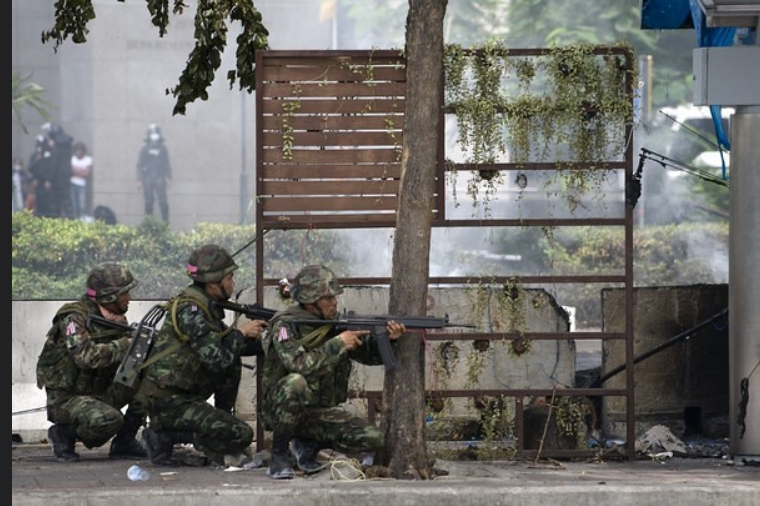
(Above: The Royal Thai Army suppreesed 2010 "Red Shirt" rallies.  Photo: Flickr Commons)

A brief political assessment about Thailand in the Australian business press has revealed widespread concern about a likely resurgence of opposition forces in one of the most important US-led centres for regional defence and security and trade. Thailand, historically, was and remains a major diplomatic player in South-east Asian affairs, including the ASEAN trade bloc. Any return to previous widespread opposition to the traditional centres of Thai power are likely to cause serious issues for the US and their allies across the wider region.

In mid-June, limited media coverage about Thailand carried an unambiguous warning that 'in reality, the South-east Asian constitutional monarchy is on the brink of another round of convulsive protests by young Thais who have had enough of the cheating and distorting of an ageing establishment that refuses to acknowledge its time may be coming to an end'. (1)

Thailand has maintained a shaky democratic facade for decades under the nominal control of a monarchy although it has also experienced thirteen military coups in the past ninety years.

Previous widespread opposition to the monarchy and political establishment took the form of supporters of Thaksin Shinawatra who wore red-shirts and demonstrated in their millions against perceived corruption and political chicanery. The supporters of the status quo wore yellow-shirts to identify their allegiance to the monarchy. There were violent clashes.

While the political divisions between the red and yellow shirts have officially been regarded as a problem of yesteryear, bitter divisions still exist beneath the surface of Thai political culture. Following the coup of 19 September 2006, which deposed Thaksin Shinawatra, he fled into exile, his political party was outlawed and he was banned from political activity in the country. Remnants of his supporters, nevertheless, re-grouped and continued to operate behind numerous front organisations.

Returning to Thailand on 22 August last year, Thaksin Shinawatra was able to prove he still retained huge popularity with ordinary Thai people. (2) He is now set on a collision course with the Monarchy and political establishment after being 'formally indicted for defaming the Monarchy while the failure of the current Prime Minister and main opposition hang in the balance'. (3)

While the legal status of Thailand's political opposition forces remains under legal consideration following months of court hearings, fears have been raised that a further round of banning opposition 'will not only mark the end of the country's shaky democracy, but trigger more political uncertainty'. (4) The centres of traditional Thai class and state power now appear increasingly vulnerable, being out-manoeuvred by opposition forces.

It has already raised serious concerns for Washington and the Pentagon's Indo-Pacific Strategy (IPS) whereby Japan has been elevated to the US-led diplomatic position of a global alliance, while other countries including Thailand, are linked as lower-level partners for 'US interests'. (5) Political upheaval in Thailand is, therefore, likely to have far-reaching implications for the IPS; effective intelligence-gathering rests upon political stability.

The US intelligence services regarded Thailand as an asset during the previous Cold War, and there is every reason to believe it continues to be so during the present Cold War; its close proximity with Cambodia and their close diplomatic relations with China is considered by the US as problematic. (6) Thailand also has a large Russian diaspora, most of whom settled in the country after the collapse of the former Soviet Union.

The political crisis in Thailand has also come at an unfortunate time for the US and their allies; moves by the US to attract support for their trade war with China have been seen to not be particularly well supported. In fact, while the US seeks to 'isolate Beijing on the global stage', numerous allies have been noticeably reluctant to follow suit. (7)

Meanwhile, China's foreign trade has increasingly focussed upon South-east Asia and elsewhere in the emerging economies, as exports to the US have dropped. (8)

Thailand, historically, has been a major player in traditional US-led hegemonic positions in South-east Asia. A founder member of the ASEAN trade bloc during the previous Cold War,
Thailand hosted one of the largest US diplomatic missions of anywhere in the world in Bangkok. As with other countries in the near region, however, its rapid economic expansion followed the emergence of China as a major diplomatic player. China's GDP, likewise, rose from $397 billion in 1990, to an estimated near $15 trillion by 2020. (9)

During the 2007 to 2014 period, for example, ASEAN nearly doubled its GDP ratings, as a result of closer links with China. (10)

Thailand, however, has entered into a period of economic uncertainty and decline in recent years; in 1960 it had a GDP rate of a little over five per cent, falling to slightly above two per cent during the early 2020's. (11) While its high-spot was the late 1980s, when Thai growth rates rose to over thirteen per cent, massive fluctuations followed together with a general decline to only 1.9 per cent last year, possibly rising to an optimistic projection of 2.2/3.2 for this year. (12) The optimism may sour with a political crisis.

Thailand, nevertheless, has remained a central player inside ASEAN, which collectively has continued to regard little benefit from siding totally with either the US or China. They gain benefits from both, using skilful diplomacy.

The Thai big bourgeoise has also positioned itself to make a killing from neighbouring Burma/Myanmar’s bloody suppression of anti-regime and ethnic liberation struggles. Thai banks have become the main supplier of cross-border financial services for Myanmar’s military government, enabling its purchases of arms and equipment despite sanctions against the regime. (13)

ASEAN, in which Thailand has a major influence also presents the US with a major problem: its status has grown to be a central player in regional diplomacy. Studies have noted the 'ASEAN and Chinese economies are becoming inseparably inter-twined'. (14) And, while ASEAN is navigating an increasingly challenging regional environment … China's surging influence raises concerns, as do US responses, which increase strategic tension and gives short shrift to economics and regional prosperity'. (15)

The extremely limited nature of coverage in pro-US media outlets would tend to indicate the sensitive nature of recent developments in Thailand! More, nevertheless, may follow in due course if the political tensions beneath the surface rise to the fore.

1.     Thailand bonfire waiting for match, Australian, 13 June 2024.
2.     See: Thaksin Shinawatra, BBC News, 22 August 2023.
3.     Political crisis grips Thailand, BBC News, 19 June 2024.
4.     Australian, op.cit., 13 June 2024.
5.     See: The reasons behind Washington's push for GSOMIA., Hankyoreh, 12 November 2019.
6.     See: From the Shadows – The ultimate insider's story, Robert M. Gates, (New York, 1996), page 312.
7.     US seeks EU's support in trade war, Australian, 22 May 2024; and, Europe takes new strategy to China Shock 2.0, Australian, 25 June 2024.
8.     China's export machine moves on, Australian, 14 June 2024.
9.     AUKUS a strong hand in a region under threat, Australian, 26 June 2024.
10.   What is ASEAN? The World Economic Forum, 9 May 2017.
11.   GDP Growth (annual percentage) Thailand, World Bank Group.
12.   Ibid., and, Executive Summary, Perspectives, Global Inflation Cools, Deloitte.
13.  Thai banks are the top suppliers of financial services to Myanmar’s military, UN expert says, Washington Times, 26 June 2024
14.   Towards an equal partnership, East Asia Forum, Volume 15, Number 3, September 2023, pp. 3.5.
15.   Japan as a diplomatic asset to ASEAN, East Asia Forum, Volume 15, Number 3, September 2023, pp. 6-8.


Monday, April 10, 2023

Thailand - A Changing Balance of Forces?


(Above: the anti-coup Red Shirts movement emerged in 2006 to support Thaksin.   Photo:  by Nate Robert is licensed under CC BY 2.0.)

Written by: (Contributed) on 10 April 2023

National elections in Thailand, scheduled for mid-May, may prove highly problematic for the US. The changing regional balance of forces has had a dramatic impact on the Asian kingdom which used to be central for US regional foreign policy. The country, in recent decades, has moved away from Washington and Pentagon traditional hegemonic positions. The forthcoming elections, therefore, look set to bring pressing matters to a head.

The unwieldy and tripartite volatile mix of class and state power together with the re-emergence of electoral popularism in Thailand is heading toward a major flashpoint.

Opinion polls across Thailand have shown the daughter of previous prime minister Thaksin Shinawatra, Paetongtarn Shinawatra, has amassed enough electoral support to win elections scheduled for 14 May. Thaksin Shinawatra fled Thailand over fifteen years ago following the 2006 coup which ousted his government. Nevertheless, he has remained a popular political figure with many Thai people.

Since the 2006 military coup Thailand has experienced elections which were heavily gerrymandered following the re-writing of the constitution drafted by the military to serve their interests. Reliable polls, however, have shown Paetongtarn Shinawatra has about 38 per cent of the vote, which is considered a wide enough margin to secure her success at leading the Pheu Thai party to establish a government majority. Present prime minister, Prayuth Chan-ocha, is polling in third place with only about fifteen per cent, behind the Move Forward party which is committed to changing the draconian Lese Majeste laws which are used to stifle any criticism of the King.   

Despite the stifling nature of class and state power, criticisms of the present government are becoming more audible. Thailand, for many opposition figures, is not regarded as a real democracy and Prayuth, a former General backed by the military, 'has not shown any real leadership or technical expertise'. (1) The Move Forward party has challenged class power, traditionally topped by King Maha Vajiralongkorn, who assumed office in 2016 following the death of his father. The present king, however, has not won the support or respect of many Thai people who regarded his father in a rather different light; in fact, calls for reform of the whole monarchy have become commonplace. (2)

To understand the present dilemmas facing Thailand, it is important to look at the legacy of  previous times: during the period from the 1960s to 1990s, the Thai economy was relatively sluggish. The period also coincided with the country becoming a central regional hub for 'US interests' during the Vietnam War. During the mid-1990s, however, the economy grew rapidly, unleashing new social and political forces. (3)  

It is interesting to note the Shinawatra grouping remain extremely popular in the north of the country, which was the area subject to US-led counter-insurgency and counter-intelligence during the Vietnam War period. The US feared insurgent forces in Vietnam would extend their reach into neighbouring areas, as they had in Cambodia and Laos. (4) It was noted by CIA sources, during the period that there was, 'widespread Communist support in north-east Thailand … with a … broad-base of society rebelling against years of repression'. (5) Thaksin Shinawatra successfully won the support of much of the northern part of the country and challenged traditional hegemonic positions from a popularist power-base.

Thailand has also remained important for the US: it is an important component of the Indo-Pacific Strategy of regional alliances which are noted as 'expanding US diplomatic presence in the Indo-Pacific, particularly south-east Asia and the Pacific Islands. (6)  

US diplomatic figures in their Bangkok embassy reveal a great deal about the nature of 'US interests': Ambassador Robert F. Godec, is also a deputy Commandant and International Affairs advisor at the National War College and State Department together with being a principal deputy co-ordinator of counter-terrorism, invariably linked to counter-intelligence.
His deputy chief of mission is Gwendolyn Cardino, a specialist in banking before joining the State Department. (7) Thailand has a long history of military involvement in civilian affairs and the Bangkok Stock Exchange is important for regional programs, including those linked to ASEAN.

Reliable commentary emerging from Thailand has noted the expected election results have left the present Prayuth government with two options: dissolving the Pheu Thai party or staging yet another coup. (8) To what extent the King will lend support to the Prayuth administration has yet to be established, although it has already been noted that, 'the Shinawatra family is loathed by the Royalist military establishment'. (9)

It has also been noted that 'by numbers alone Pheu Thai have won every election since 2001, though judicial rulings or military coups have prevented three Thaksin-backed governments, including one led by his sister Yingluck until the 2014 coup, from completing their term'. (10)

The forthcoming election in Thailand also takes place at a time of economic uncertainty: the economy grew rapidly in 2019, although it slumped 8.16 per cent the following year. More recent data has shown only a 1.25 per cent economic upturn. (11)

The US imperialists are also tiring of the present governmental system in Thailand, warning that it should not purchase Chinese military equipment, nor engage in continued human rights abuses and threats of coups. (12) 

While the US has become increasingly apprehensive about dealing with Thai governments, China has stepped into the vacuum. (13)

1.     It's make or break at crucial Thai poll, Australian, 22 March 2023.
2.     See: Thai king flies to Germany, The Guardian (U.K.), 13 November 2021.
3.     Thailand Economic Growth, 1960-2023, Macrotrends.
4.     See: Deadly Deceits, Ralph McGehee, (1983); and, Obituary, Ralph W. McGehee, The New York Times, 14 May 2020.
5.     Deadly Deceits, ibid.
6.     Fact Sheet: Indo-Pacific Strategy of the United States, The White House, 11 February 2022.
7.     Website: United States official diplomatic personnel.
8.     Australian, op.cit., 22 March 2023.
9.     Thailand, The Guardian, (U.K.), 20 March 2023.
10.   Australian, op.cit., 22 March 2023.
11.   Macrotrends, op.cit.
12.   Washington worries China is winning over Thailand, F.P., 17 June 2022.
13.   Ibid.