Showing posts with label Myanmar. Show all posts

Sunday, September 14, 2025

Message from the Central Committee of the Communist Party of Burma on the 86th anniversary of its founding

 Written by: Communist Party of Burma on 15 September 2025
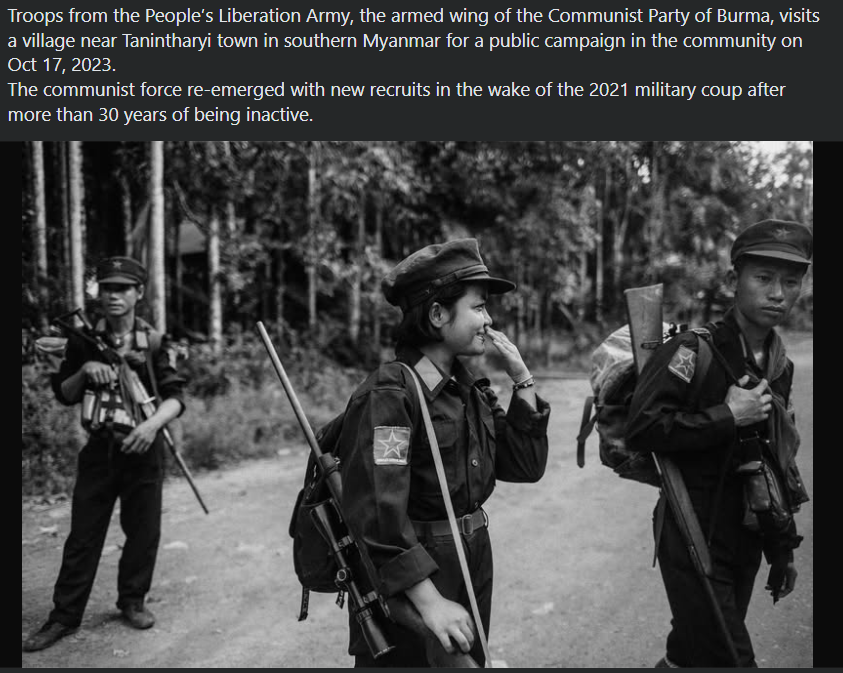
 

More information is coming to light about the people's war in Burma. Together with the Burmese People's Liberation Army under the leadership of the Communist Party of Burma, armies representing various minority nationalities are also confronting the Burmese miliary regime. The Communist Party of Burma celebrated its 86th anniversary on August 25 and the Central Committee released the following statement - eds.


Message from the Central Committee of the Communist Party of Burma on the 86th anniversary of its founding

 August 15, 2025

Today marks the 86th anniversary of the founding of the Communist Party of Burma.

Today, I am happy to join the commemoration with the commanders and soldiers of the People's Liberation Army who are fighting in armed struggle from various parts of the Communist Party of Burma. I pay tribute to all the comrades. I would like to say that I bow my head and pay my respects to all the comrades who have fallen in the struggle for the people and the party since the establishment of the party.

The party's history has seen ups and downs, both as an underground party and as an armed struggle party. Today, the party is struggling in both forms, both as an underground party and as an armed struggle party.

In 1990, the Communist Party of Burma (CBP) fought the People's Democratic Revolution in Burma as an underground party. While preparing for armed struggle as an underground party, it faced the rising tide of the popular anti-military revolution in 2021, known as the Spring Revolution.

With the tide of this revolution, the People's Liberation Army, the armed wing of the party, was able to re-establish itself and enter the struggle. This achievement will be recorded in history as a great event of great pride and joy in the history of the party.

We must honour and praise the comrades who have worked tirelessly to establish and fight as the People's Liberation Army, and we must also recognize and thank all the friends and allies who have worked hard and provided assistance in all aspects of our efforts to establish the People's Liberation Army.

The current situation in Burma is that it is still under the rule of the military junta, and the majority of the people, various political forces, and various ethnic armed groups are overwhelmingly engaged in armed struggle against this military junta's rule.

The people's democratic armed revolution that has been going on since 2021 has been going on for four years, and in these four years, we have gained a lot of revolutionary experience, both good and bad, and we have reached a certain maturity. During these four years, the armed resistance of the revolutionary forces has achieved great victories. Especially during the 1027 (One Zero Year) campaign, when the ethnic armed forces and the democratic revolutionary forces were able to fight together, we achieved many victories. The success of capturing some cities and many military positions and seizing a large amount of weapons and ammunition has brought great support and benefits to the democratic revolution. The People's Liberation Army has gained combat experience during the 1027 (One Zero Year) campaign, and has also acquired weapons and ammunition, expanded and built troops. The victory in the Battle of Kan Daung has already proven that we have the ability to expand and attack in many regions. We must continue to build on this foundation and strive to develop further.

Today, the enemy has been able to rebuild its strength and regain some territory. Since August 1, 2025, the new military junta of Min Aung Hlaing has been formed, continuing to hold elections under the 2008 constitution, and has been trying to establish a new government. On the one hand, it has expanded its military operations to gain territory where elections can be held, and on the other hand, it is trying to regain some towns through dialogue. However, due to the discontent of the generals who were removed due to new factions during the establishment of the new generation of military junta of Min Aung Hlaing, the unity within the military junta has been weakened. On the other hand, it has forcibly recruited young people who are dissatisfied with the military coup in 2021 and have anti-military junta sentiments, and since the enemy is conducting operations using troops composed of mostly new recruits, the enemy’s operations are inactive operations. We are in a situation where they are having poor operations and are using a lot of air support to capture a position.

So today's situation is that the enemy is attacking in some places, and the revolutionary forces are on the defensive in some places. Looking at the whole country, the war front is wide and the enemy is still attacking in some places and on the defensive in others. The revolutionary forces are still able to continue to fight battles that can capture enemy positions by combining guerrilla warfare and mobile warfare.

Although the progress of this armed revolution has been uneven and has fluctuated, the fighting spirit of the revolutionary forces in various places is high and they are striving to continue to achieve victories. I am also happy to see that they are trying to reduce the effectiveness of the enemy's air superiority and to make greater use of their powerful fighting methods to further destroy the enemy.

The People's Liberation Army is also fighting in these military conditions, so it can be said that they are facing and overcoming similar situations. I am also happy to see that they are trying to best prepare for these changes in the situation and respond to the enemy in the best possible way before entering the battle.

The 50th anniversary of the Communist Party of Burma was celebrated in 1989, when the North-Eastern Party Central Committee was dissolved and the Party Central Committee was based in the (101) Military Region. I remember that the Party Chairman Thakin Ba Thein Tin celebrated the Party’s birthday in Panwa, where he was, and Comrade Htun Ka Kan Paing Ti, who was with the newly formed troops, celebrated it. At that time, the Chairman gave a speech commemorating the (50) anniversary. I remember that in his speech, “The 50-year history of the Communist Party of Burma is a history of successive generations of marching and fighting in a system of one army and one army to raise the banner of the proletarian party and the flag of the people’s democratic armed struggle.” However, within the next (1) year, due to the need to act in accordance with the great changes in the situation, the Party’s branch was dissolved, and the Party Central Committee was transformed into an underground party. Our branch was not in a position to implement what the Chairman had said.

The current party's People's Liberation Army is now able to establish itself locally and has been able to gain and organize the support of the people in the areas where it is based. Therefore, I believe and hope that the next generation will be able to proudly raise the flag of the party's armed resistance, as Chairman Thakin Ba Thein Tin said, and will continue to raise it high, he concluded.

............................

See also our January 2025 report on developments in Burma.

Wednesday, January 29, 2025

For the defeat of the Burmese junta and a free and independent Burma!

Written by: Nick G. on 30 January 2025


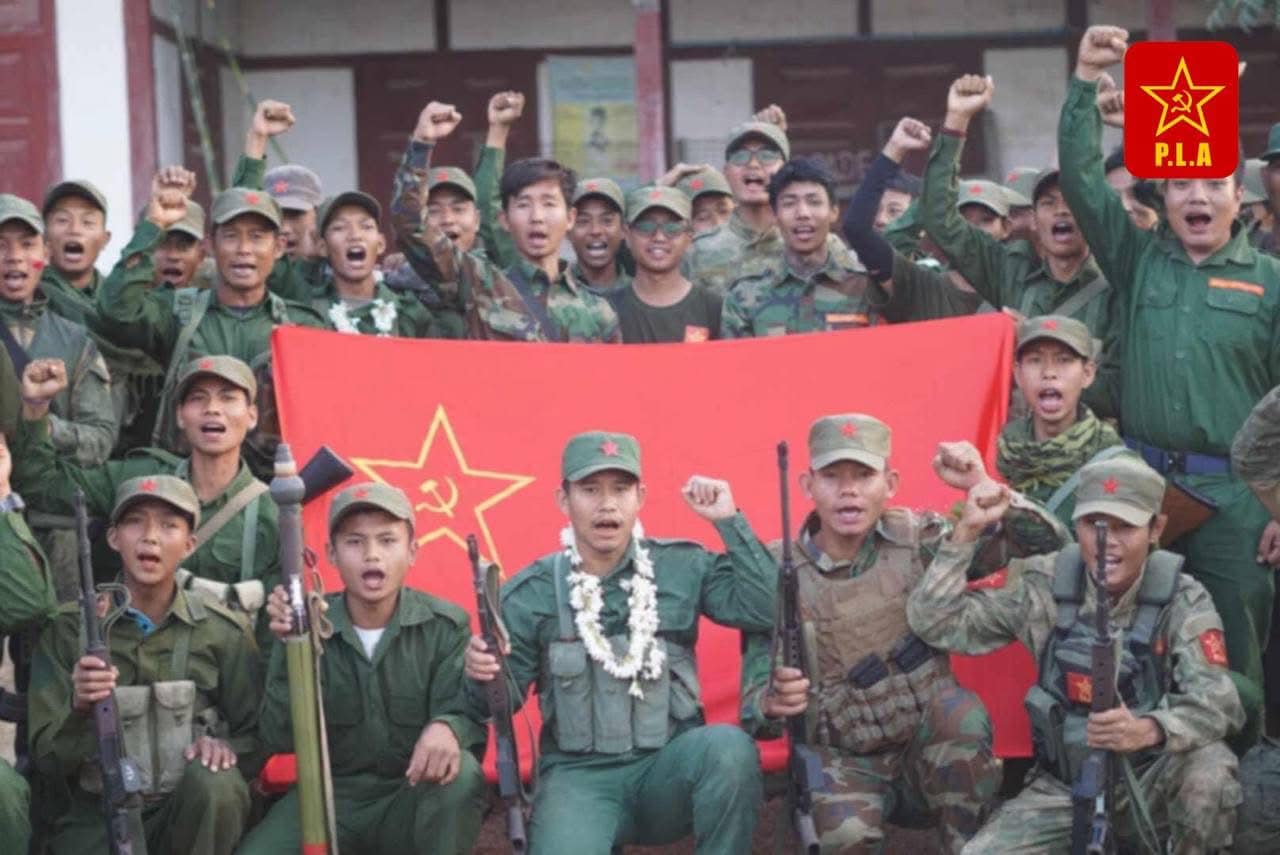
(Above: BurmesePLA celebrate their arrival in a liberated township)

Very little coverage is given to events in Burma (Myanmar) by the Australian mainstream media.

However, recent developments show the military regime is increasingly besieged by a coalition of anti-regime armed forces, and has to rely on Chinese interference to maintain itself in power.

The various ethnic rebel forces and the Communist Party of Burma’s People’s Liberation Army are increasingly developing a united front and providing each other with mutual support and training.

The regime is losing large swathes of territory outside the three main cities of the Burmese capital, Naypyidaw, and Rangoon and Mandalay.

Its ability to move its army by land corridors is restricted, and it is relying on airstrikes and long-range artillery bombardment of towns under rebel control. Air-dropped troop reinforcements often fall into the hands of anti-junta forces.

Superpowers and their rivalry over Burma

Both superpowers are keen to direct the outcome of struggles within Burma.

The US imperialists have applied sanctions to the military junta since its takeover, have few direct investments to protect, but are trying to win over the democratic bourgeoisie and landlord forces through an encouragement of a return to a “democracy” within which they can meddle. The 2022 US Burma Unified through Rigorous Military Accountability Act, known as the BURMA Act, mandates sanctions against the junta, and authorises substantial humanitarian aid to support the rival, US-backed National Unity Government (NUG), but not the ethnic armed organisations (EAOs) or the People’s Defence Forces (PDFs).

Chinese interests are more substantial. Among the most important is Kyaukpyu Deep-Sea Port, a crucial part of the China-Myanmar Economic Corridor (CMEC), which gives China direct access to the Indian Ocean, reducing reliance on the Malacca Strait from which it could be denied access in the event of war with the US. 

There are also the China-Myanmar oil and gas pipelines that run from the Bay of Bengal to China’s Yunnan province, providing Beijing with a shorter and strategically secure energy route, again bypassing the Straits of Malacca. China is financing and constructing key railway and road links to connect Myanmar with Yunnan province.

China has also invested in multiple hydroelectric dams, and built and operated several coal and gas power plants. It has a dominant presence in telecommunications and technology though Huawei and ZTE, and Alibaba and other Chinese platforms have expanded financial technology services in Burma. 

Chinese real estate companies are active in real estate projects, particularly in the junta-controlled cities of Yangon and Mandalay. China has developed industrial parks like the Kyaukpyu SEZ to attract Chinese and foreign businesses.

Imperialism, not proletarian internationalism

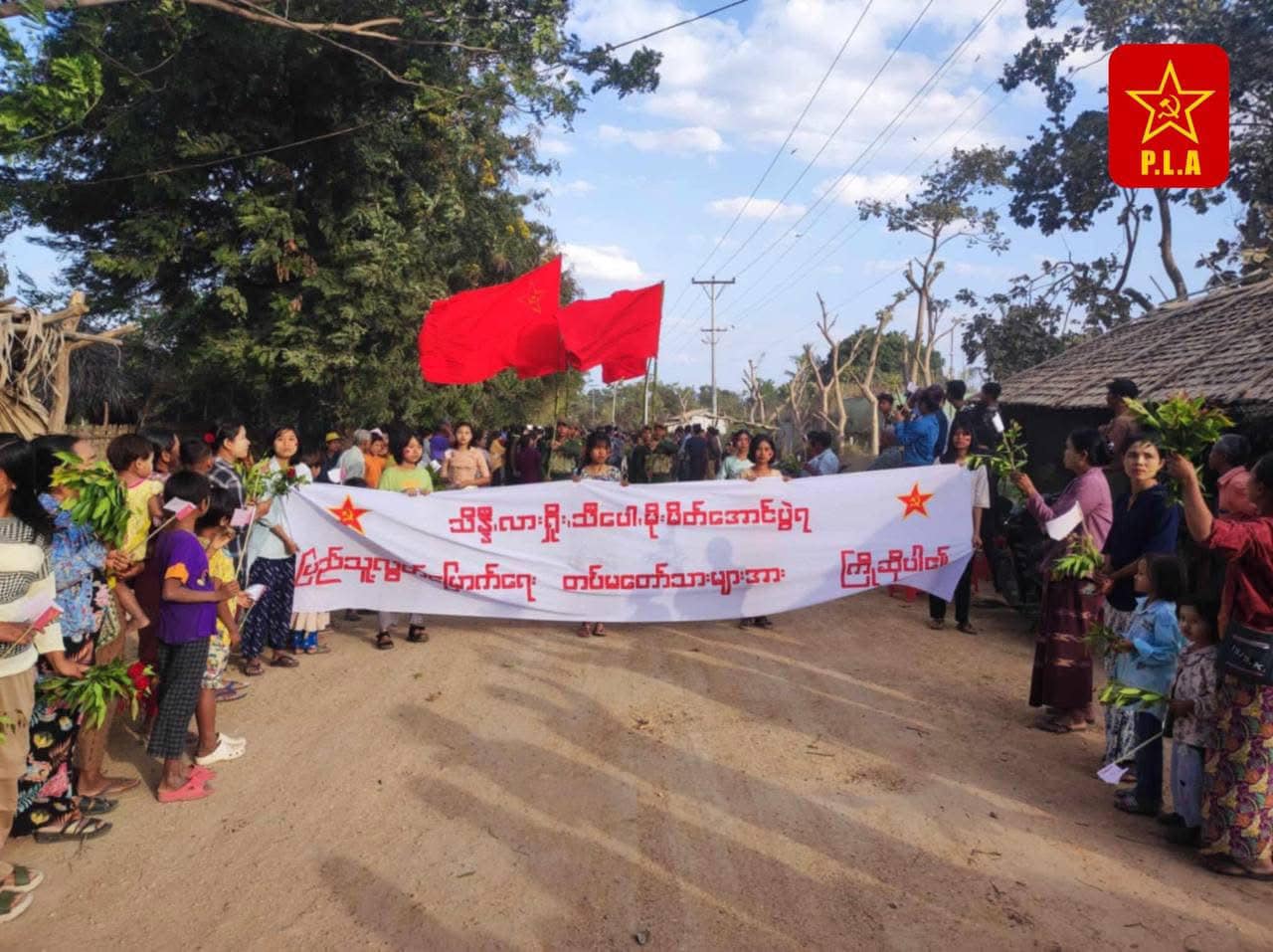
(Above: Villagers welcome the BPLA)

China claims that it is supporting Burmese sovereignty against threats of foreign (US) interference. A genuinely socialist country should support any state that is standing up to “outside pressure”, but it should not support a state that is oppressing its own people. 

In 2017, China supported Aung San Suu Kyi’s military offensive against the Rohingya. When she was overthrown by the junta in 2021, it flirted with support for the various anti-junta ethnic armies and allowed the return to Burma of members of the Burmese Communist Party’s People’s Liberation Army.

It has vacillated between maintaining relations with some of the ethnic anti-Junta armies and the regime, according to where it perceives its investments in Burma can be best protected.

For example, last September, fighters of the Kachin Independence Army, or KIA, seized control of a key military base from the junta at Chipwe township in Kachin State, close to a Chinese hydro-electric power station and a Chinese rare earth mine, prompting China to pressure insurgent forces along the countries' shared border to agree to halt their offensives against the junta, and closing border crossings through which medicines and food had flowed.

China’s Customs Department said that China imported more than US$1.4 billion worth of rare-earth minerals from Burma in 2023, underscoring the importance of “stability” in regions close to its investments.

On November 6, the head of Burma’s military junta, Senior Gen. Min Aung Hlaing, travelled to China, meeting with Chinese Premier Li Qiang in Kunming.  China signalled that it desires the bare minimum stability to protect its interests and it felt the junta is the horse to back to achieve this. China has said that it will support the junta’s electoral process later this year, a clear indication that it will work to keep the junta in power.

Meanwhile, ethnic armies and the BPLA continue to take territory from the regime. The Kachin and Ta’ang, as well as the Arakan Army in Rakhine, continue to resist China’s pressure. 

Hostilities between the junta regime forces and the Ta'ang National Liberation Army (TNLA) have recommenced as of January 9, 2025, following the initiation of a new military operation by the junta in Naungcho township. 

The Arakan Army (AA) stated on Monday January 26 that it had seized control of the Moehti hilltop outpost in Bago Region on the previous day - five days after it launched its attack. The military outpost is located in the Arakan Mountains, known as the Rakhine Yoma. 

Of passing interest to Australians is the role of Julie Bishop as the United Nations’ Special Envoy on Myanmar. The former Australian Foreign Minister will no doubt pursue US strategic interests in Burma. It should not be overlooked that in March 2017, the government of PM Malcolm Turnbull rejected a Senate vote calling for a United Nations commission of enquiry into the persecution of the Rohingya.  

Several weeks later, it reversed its position and co-sponsored a resolution at the UN human rights forum for the UN to send a fact-finding mission to Myanmar.  The change was partly fuelled by an upsurge of reported atrocities against the Rohingya on one hand, and Australia’s hypocritical push for membership of the UN Human Rights Council from 2018.

Bishop can be expected to try to do deals to facilitate China’s acceptance of the pro-US National Unity Government should the regime fall to the united resistance front.

For now, we can only support the fight of the combined Burmese resistance for national liberation, independence and democracy, and oppose all outside superpower interference that runs counter to the aspirations of the Burmese peoples.


Sunday, September 17, 2017

Strongly condemn the persecution of the Rohingya

Nick G.

The Rohingya refugee crisis requires the strongest condemnation of Myanmar and its leader Aung San Suu Kyi.

The Rohingya, originally from what is now Bangladesh, have lived for centuries in Myanmar, a Muslim minority in an overwhelmingly Buddhist country.

Always a persecuted minority, the Rohingya have suffered attempts over several years to drive them from their homes.  In this respect, the Buddhists are driven by a reactionary religious intolerance of other peoples that is no different to reactionary currents among Christians, Muslims, Zionist Jews and other religious belief systems.

The anti-Rohingya sentiment in Myanmar is also a legacy of British imperialism’s well-known policy of “divide and rule”.  Pushing the line of Buddhist purity and Buddhist exceptionalism, the reactionary Buddhist leaders are serving the interests of the imperialists and local Myanmar bourgeoisie by denying class contradictions within the Myanmar social structure.

Aung San Suu Kyi was embraced by global imperialism for demanding “democracy” and “independence” for Myanmar. She was awarded a Nobel Peace Prize and kept under house arrest by the military rulers.  Imperialism wanted to remove the military dictatorship’s obstacles to the free flow of trade and finance capital, and promoted Aung San Suu Kyi for their own ends, at the same time as her championing of an end to military dictatorship won her the support of wide sections of the Myanmar people.

Whatever she may have done for Myanmar Buddhists since her election as de facto head of state in 2015, she has not extended to Rohingya, referring to them as “Bengalis” and “terrorists”.  The reactionary Buddhists of Myanmar refuse to use the term “Rohingya” because it defines the Muslim minority as people of Rakhine state, a poverty-stricken part of Myanmar.  For the purposes of ethnic cleansing, it does not suit to imply any rights of residence in Rakhine for the Muslims.

Pathetic Australian government response

Australia has been well aware of the ethnic cleansing and persecution of Rohingya for several years.  It has provided authorities in Rakhine with small amounts of aid to “assist” the Rohingya.  However, it has prioritised Aung San Suu Kyi’s efforts to stabilise the murderous regime and “open” Myanmar ahead of the rights of the Rohingya. This was quite clearly the case in March 2017 when the Turnbull Government rejected a Senate vote calling for a United Nations commission of enquiry into the persecution of the Rohingya.  The Government said Myanmar should conduct its own investigation and referred to the “scale and complexity of the transition” that Myanmar is undergoing, and acknowledged “positive steps” taken by its government.

Several weeks later, it reversed its position and co-sponsored a resolution at the UN human rights forum for the UN to send a fact-finding mission to Myanmar.  The change was partly fuelled by an upsurge of reported atrocities against the Rohingya on one hand, and Australia’s hypocritical push for membership of the UN Human Rights Council from 2018.

China incites bourgeois nationalism at home to justify support for Myanmar

China is also well aware of the persecution of the Rohingya, but also prioritises its relations with Myanmar’s ruing circles above those of the Muslim minority. It has provided little coverage of the refugee crisis to its own people and the government online newspaper Global Times admits that Aung San Suu Kyi’s name could not be searched on Sina Weibo, the country’s main internet search engine.

Nevertheless, the paper yesterday (September 17) reported that the Myanmar leader had gained popularity with Chinese netizens, who praised her defiance against “outside pressure while safeguarding her people’s interest”.

Indeed, China should support any state that is standing up to “outside pressure”, but it should not support a state that is oppressing its own people.  Big power expedience and expansionist aims are driving Beijing’s response to the Rohingya crisis, not socialist ideals of proletarian internationalism.
This is clearly evident from the way Global Times has framed the debate: “Another reason for Suu Kyi’s rising popularity is her friendly policy on China which many did not expect. And since she has visited China twice, Chinese leaders might visit Myanmar in the near future, so the Chinese people and government don’t want to damage bilateral ties.”

Myanmar is a pivotal part of Beijing’s One Belt One Road initiative.  Chinese investments in the country include a cross-border oil and gas pipeline that is expected to become an alternative route for energy imports from the Middle East as it avoids the Malacca Strait, a shipping chokepoint in the disputed South China Sea.  Other projects include a port and industrial area in a Special Economic Zone in Rakhine which will expand China’s presence in the Indian Ocean.

No wonder Beijing has backed the military offensive in Rakhine. China’s Ambassador to Myanmar Hong Liang dismissed the issue as an “internal affair” for Myanmar.

The crimes by Myanmar’s army and government against the Rohingya are both a legacy of colonialism and an injustice overlooked by various imperialisms contending for influence and control in our region. At the very least we should demand a substantial aid package for the refugees now in Bangladesh and a rapid expansion of our intake of Rohingya refugees.

The Australian government, which to date has taken in only 37 Rohingya refugees since 2013, has no right to a seat on the UN Human Rights Council if its uses it merely to sit on its hands.