Showing posts with label Micronesia. Show all posts

Sunday, September 14, 2025

US-Chinese rivalry in Micronesia

 Written by: (Contributed) on 11 September 2025
 

(Source: www.deritszalkmaar.nl)

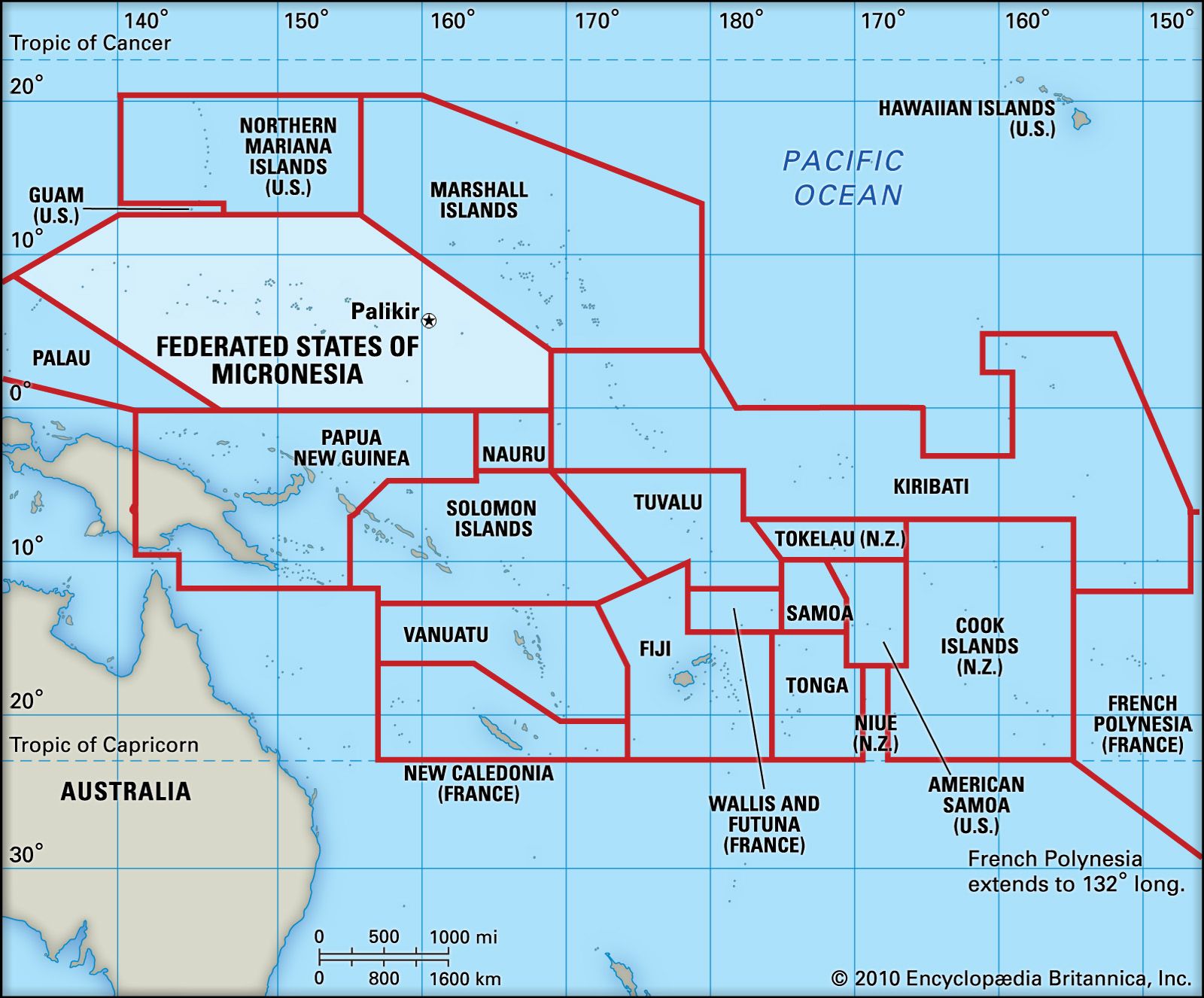
The vast Micronesian area of the Indo-Pacific region is rapidly becoming a potential flashpoint in Cold War hostilities between the US and China. As China has emerged as a serious competitor, the traditional regional hegemonic position of the US has been challenged. The US has responded with defensive positions and preparations for 'real war scenarios'. A number of defence and security considerations pushed by the US have also been played-out through regional proxies, including Taiwan.

A recent defence and security assessment issued by Canberra noted that Micronesia was an important consideration as 'it is an important strategic access where the interests of China, Japan, Taiwan and the US, as well as several South-east Asian countries, intersect. Micronesia's strategic significance is rising'. (1) Cold War diplomatic rivalries have also created serious considerations for the forthcoming Pacific Islands Forum (PIF) in Honiara where China has questioned the validity of a 33-year old communique 'granting Taiwan special development partner status'. (2)  

Following high-level diplomatic talks, the PIF chose to not invite all 21 dialogue partners to their September meeting as a means of resolving the impasse.

Behind the Cold War diplomatic stand-off between the US and China a few inconvenient matters continue to cause the US serious concern. It has been noted, for example, that the US, 'has only a small diplomatic footprint in the Pacific and relies on the PIF to build rapport with individual leaders'. (3) The US, as a PIF dialogue partner, has also been excluded from the forthcoming meeting, thereby reducing its regional diplomatic standing still further.

China, by contrast, now has ten embassies in the Pacific and it has been noted it 'doesn't need the PIF meeting … they are already in Honiara'. (4) The links between the Solomon Islands and China have been noted to be particularly strong.

The diplomatic status of Taiwan amongst Pacific Island nations has continued to haunt US regional considerations. To date, only three Pacific Island states now recognise Taipei: Tuvalu, the Marshall Islands and Palau.  

It is, however, the Micronesian area of the Pacific which has caused the US serious concerns; the vast area is composed of thousands of small islands and landmasses, some of which have been used to host sensitive US military facilities, including Guam which is a hub for 'US interests' and linked on an arc from Pine Gap swinging from Diego Garcia in the Indian Ocean to Micronesia. Many of the islands, furthermore, remain of strategic significance with the US Island Chain Theory, designed to restrict China's access and egress from the area.

Palau, likewise, remains of vital strategic significance to US-led regional defence and security provision; it hosts 'a high-frequency radar system … to detect air and surface targets'. (5) It is also highly strategic for regional US-led military planning with 'its place in the first island chain'. (6)

The Marshall Islands host the Ronald Reagan Ballistic Missile site which has a space surveillance system with a capacity to track satellites, primarily in low orbit. (7) Wake Island, which remains US territory north of the Marshall Islands, has hosted what is regarded as critical military bases for the A2AD system. (8)

In recent years the US have been quietly 'bolstering their defences and building infrastructure for more effective operations. This includes refurbishing World War Two airfields on Tinian near Saipan and Peleliu. It's expanding the airfield on Yap in the Federated States of Micronesia'. (9)

Many of the sensitive US military facilities rely upon Taiwan; the American Institute based in Taipei, has nearly five hundred US diplomatic personnel, on official temporary leave from the State Department in Washington. (10) It is, therefore, significant to note recent US defence budget allocations toward some of the countries still diplomatically recognising Taiwan.

Last year the US allocated $7.1 billion for defence and security facilities over the next two decades; the Federated States of Micronesia (FSM), the Marshall Islands and Palau were linked into a highly strategic US-led military agreement. (11) While the FSM recognises China, its links with Beijing have become increasingly strained and high-level diplomatic talks have taken place in Taipei in recent times about switching allegiance, 'following frustrations with China'. (12)

Palau was also provided with a separate defence and security allocation for new projects and various upgrades for existing facilities, including a 'tactical over-the-horizon radar' system; the $118 million facility swings on an arc to Taipei which then swings through Wake Island and the Marshall Islands covering the whole of Micronesia. (13) References to asymmetric warfare techniques and sophisticated US military equipment used in the recent annual Taiwanese Han Kuang military and civil defence exercises are best viewed in that light. (14)

The same arc also swings through northern Australia and may well also reveal links into the US-led network; three bases at Australia's 'top end' have facilities for rapid deployment elsewhere in the region. (15)  


1.     Micronesia's strategic significance is rising, The Weekend Australian, 23/24 August 2025.
2.     How Beijing turned Pacific forum into hot ticket, The Weekend Australian, 23/24 August 2025.
3.     Ibid.
4.     Ibid.
5.     US v. China, Japan Forward: Politics and Security, Rieko Hayakawa and Jennifer L. Anson, 14 February 2020.
6.     Agreement with Micronesia nations gives US military access, locks out China, Stars and Stripes, 21 March 2024.
7.     US v. China, op.cit., 14 February 2020.
8.     Ibid.
9.     Micronesia's strategic significance is rising, op.cit., Australian, 23/24 August 2025.
10.   Beijing keeps a wary eye on new US Taipei outpost, Australian, 18 June 2018.
11.   Stars and Stripes, op.cit., 21 March 2024.
12.   Pacific's Micronesia in talks to switch ties from Beijing to Taiwan, Reuters, 10 March 2023.
13.   US proposes new defence site in Palau, The Pacific Island Times, 21 May 2024.
14.   Taiwan launches largest drills, Australian, 10 July 2025.
15.   See Wikipedia: RAAF Base Scherger; and, 'Ghost' RAAF Base, Australian, 27 August 2017.

Tuesday, November 16, 2021

Micronesia: farewell Paradise, hello superpower rivalry


by: (Contributed) on 16 November 2021

A communique from the Australian Department of Defence has revealed US-led military planning to upgrade facilities for Micronesia as part of a regional militarisation program. The communique outlined clearly Australian military and intelligence involvement with the defence and security of 'US interests'.

Micronesia, historically, has been regarded as a strategic location for US-led regional military and security provision; a multitude of small islands, (“Micronesia” is Greek for “tiny islands”) many of which remain US territories and others with independent governments and neo-colonial relations with the West. The Micronesian sub-part of the vast Pacific Ocean would now appear to have been placed under the spotlight of the Pentagon as a potential theatre of war with China.

In late October the Australian newspaper published a Northern Territory Defence supplement using Australian Department of Defence media releases. It provided a useful insight into present day US-led military planning for the Indo-Pacific region. (1)

One part of the supplement, however, dealt specifically with Micronesia, a sub-part of the region resting to the north of the South and Western Pacific regions. It has always been regarded as important for US-led military and intelligence provision being centred upon Guam, a US-territory and regional Pacific military hub on the same arc from Pine Gap to Diego Garcia in the Indian Ocean. In recent years both Guam and Diego Garcia have been upgraded to hubs specifically for military operations, with Darwin as the support centre.

Other areas of Micronesia, likewise, remain important for the US: the Marshall Islands has been used extensively by US maritime facilities for flags of convenience for shipping vessels. The fact so many of the small islands remain under US control is evidence itself of their continued significance for US regional foreign policy: many host sensitive facilities.

The recent upgrade for fuel storage facilities at RAAF Base Darwin was conducted for long-range flights of military aircraft. It is not surprising to find elsewhere in the same supplement reference given to Australia's Triton program for regional surveillance and intelligence-gathering and the use of military facilities in Guam. (2)

Micronesia now looks set for a further upgrade to its existing military facilities.

The communique noted, for example, that 'spurred by growing perceptions of a rising Chinese threat … the AUKUS trilateral defence agreement … will see the transformation of the Top End … and will concentrate upon the … vital southern US defence anchor, linking Guam to the north and Hawaii to the east'. (1) Hawaii has been important for the US regional military presence for decades as the centre of their regional command facility.

An actual/real size regional map shows the triangular military plan to encompass Micronesia. (3) The arc from Darwin to Guam cuts directly through Manus Island and the Lombrum Naval base and South Pacific region, the Darwin to Hawaii arc cuts through the Rajik Group of Islands controlled by the US and the Marshall Islands also under US control. The arc from Guam to Hawaii, furthermore, cuts through Wake Island, also under US control, while also covering the Western Pacific.

The same communique also drew attention to the role of Darwin as having undergone a 'transformation of the Top End into an important defence springboard into the Indo-Pacific'. (4) An example of the use of the Top End would appear the potential use of Guam by RAAF Triton aircraft for 'patrolling to the north of Guam … for up to ten hours at a time'. (5) The flight time would indicate RAAF aircraft manoeuvring in highly sensitive areas of the region contested by China.

A further consideration when dealing with Micronesia, however, remains the problem of Taiwan, which has become a US-led preoccupation in recent years. Australia has also been closely drawn into the problem with recent high-level diplomatic meetings between Taipei and Canberra. It is not coincidental that the present ruling President Tsai Ing-wen administration in Taipei has directed much of its 'New Southbound Policy' (NSP) specifically at Micronesia where it still retains some limited official diplomatic presence. It has, however, been challenged by China in recent times, which has left most of the NSP foreign policy in tatters.  

Elsewhere, across the region China, likewise, has been able to establish far stronger diplomatic links and investment programs. They have seriously challenged traditional US-led hegemonic positions which historically included support from compliant governments to maintain neo-colonial relations with the West. It is, therefore, no coincidence the US military planning for Micronesia has taken place at the present time; China's increased role in the region has been assessed by the Pentagon as a serious challenge.

Most countries now, however, have full diplomatic relations with China and due to the United Nations One China policy, restrictions have been placed upon Taiwan. While Taipei has administrative offices in 112 countries, including four in Australia, they only have 17 official diplomatic missions worldwide. The recent diplomatic switch, by the Solomons Islands in the South Pacific and Kiribati in the central Pacific, from Taipei to Beijing in September 2019, for example, was a major blow to President Tsai Ing-wen.

Taiwan, as a means of projecting their neo-diplomatic presence elsewhere, has increasingly become reliant on a shadowy, out-sourced yet governmental-type body, the World League for Freedom and Democracy (WLFD), formerly the World Anti-Communist League (WACL). It was established by the US during the earliest days of the previous Cold War and consists of a conglomerate of right-wing and far-right political organisations which have been noted from reliable studies as consisting of 'a world of ideological fanaticism, racialism, ignorance and fear … and composed of … many people who are as much opposed to democracy as they are communism'. (6) It also has intelligence functions and involvement with the CIA and operations across all continents. (7)

The WLFD would appear to also have an extensive presence in Australia although members and affiliates lurk behind sealed websites to maintain a level of secrecy which would arouse suspicions with even the most gullible of observers. (8) It has been noted, for example, that senior Liberal and Coalition partners, including John Howard and those associated with him, have active involvement with the WACL/WLFD. (9) Others, including senior Australian Defence Force (ADF) officers, through involvement with the WACL/WLFD were able to build on their work with the CIA to continue operations in Australia through far-right networks of supporters and civil defence provision, including with reservists. (10)  

With developments such as these taking place, which draw Australia ever closer to a US-led limited war with China:

                                          We need an independent foreign policy!


1.     Security pact to boost US presence in the Top End, Northern Territory Defence supplement, The Weekend Australian, 30-31 October 2021.  
2.     $200m thrust for aircraft base to service Triton, Northern Territory Defence supplement, The Weekend Australian, 30-31 October 2021.
3.     Map of the World, Peters Projection, Actual Size.
4.     Security pact, op.cit., Australian, 30-31 October 2021.
5.     $200m thrust, op.cit., Australian, 30-31 October 2021.
6.     Inside the League, Scott Anderson and Jon Lee Anderson, (New York, 1988), Foreword.
7.     Ibid., pp. 55-56.
8.     Ibid., page 59.
9.     Website: WACL/WLFD, 9 January 1990; and, Ted Serong, Anne Blair, (Melbourne, 2002), pp. 183-91; and, Howard keeps link, The Age (Melbourne), 1 January 2007.  
10.   Ted Serong, ibid., Sleevenote, and, pp. 174-196.