
Written by: ICOR on 11 November 2026
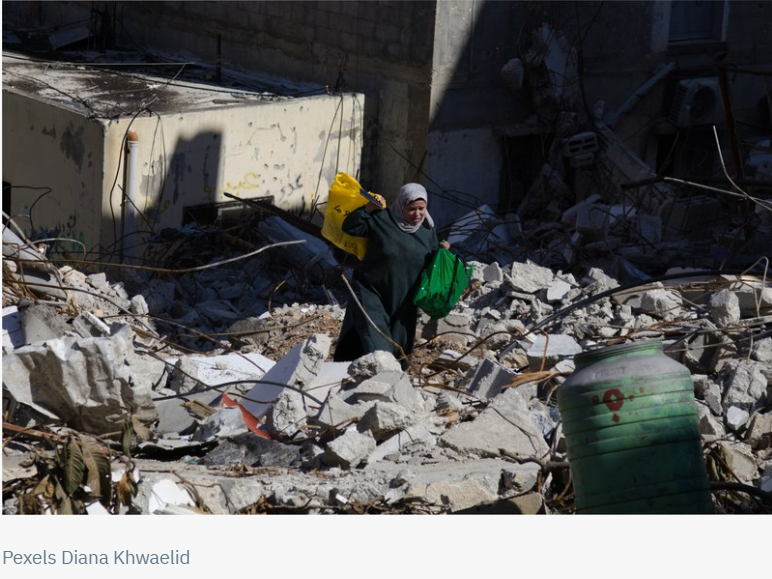
The following report on discussion by ICOR Main Coordinator Monika Gärtner-Engel and doctors from the Al-Awda Health and Community Association in the Gaza Strip has been made available. ICOR, the International Coordination of Revolutionary Parties and Organisations, is raising funds for the rebuilding of the Al-Awda facility - eds.
Report on a video call with Dr. Rafaat, Dr. Mhanna, and Jehan, the fundraising director of the Al-Awda Health and Community Association in the Gaza Strip.
A Conversation Across Language Barriers
On November 2, 26, ICOR Chief Coordinator Monika Gärtner-Engel met in a small, impromptu gathering with Dr. Rafaat, Dr. Ahmad Mhanna, and Fundraising Director Jehan from the Al-Awda Health and Community Association in the Gaza Strip. A meeting with numerous supporters from around the world had to be postponed several times due to dramatic events in Gaza. Monika Gärtner-Engel was therefore happy to accept the offer of a last-minute meeting: “We’re so curious to hear how you’re doing.”
Another spontaneous guest was Irtefaa from Yemen, an environmental and women’s rights activist currently visiting the German Council for Women’s Policy. She said: “Our hearts are in Gaza; we hope that peace will reign in all countries, including Palestine.” The doctors responded with solidarity: “Yemen, too, is suffering from an unprecedented war and a difficult humanitarian situation.”
The Health Care System: “There Is No Way Out”
Nearly 13 months after the ceasefire began, the doctors say: “The health situation is steadily deteriorating. There is currently no way for us to ensure health care.” Medications, supplies, and medical equipment are not reaching the hospitals; reconstruction is not taking place because building materials are either lacking or their import is being blocked. The doctors criticize the strict import bans on medical devices and equipment. For example, the import of catheters is on the list of “dual-use” goods that Israel cites to justify import bans. This implies the claim that these devices can also be used in the manufacture of weapons and therefore must not be imported. Her response: “What reasonable person would claim that a piece of fabric, a sheet, or a medical blanket could be used for hostile acts?” Cotton, sponges, solar panels, batteries, and medical devices are also on this list.
All 35 hospitals that were operational before the war have been completely or partially damaged. A large portion of the health centers has also been destroyed.
There is a shortage of medical professionals. Many have died, been detained, fled, or been poached by hospitals controlled by the Trump connection with exorbitant salaries. About 16 medical specialists, primarily orthopedic surgeons, have been held by the Israeli armed forces for more than two years. The consequences: “There are signs of misdiagnoses and botched surgical procedures.”
However, the Gaza Medical Association is not giving up; instead, it is training new specialists. Over the past 25 years or so, it has produced about 600 specialists; some of them have since been killed in military attacks or are currently in detention.
More than 20,000 patients are on waiting lists due to critical conditions. Over 60,000 people need treatment outside the Gaza Strip, about 21,000 of them urgently.
There is not a single MRI machine in the Gaza Strip. According to doctors, such a machine could prevent more than 6,000 evacuations.
300 to 400 laboratory supplies, medications, and medical consumables have not reached the Gaza Strip since October 7, 2023. A new shortage has emerged for insulin. At least 600 children with diabetes need it. Medications for heart disease and cancer are also in short supply.
Electricity and Fuel: Generators at Their Limit
The healthcare system in Gaza relies on solar panels and generators to remain self-sufficient. Doctors report that even the import of solar panels, batteries, oils, and spare parts from Israel is strictly restricted. The Gaza Strip’s power supply has been cut off since the start of the war and has not been restored.
Since the start of the war, Al-Awda has spent more than two million U.S. dollars on power generators, including over 650,000 dollars in the past two months. According to the doctors, the organization pays between 200,000 and 300,000 dollars a month for fuel. “This is unreasonable. This is unacceptable,” says one of the doctors. About a month ago, hospital operations came to a standstill for a week because the generators had failed. Their assessment: “Three months at most. Then there won’t be a single functioning power generator left in the Gaza Strip if these measures continue. And that is exactly the intention.” Al-Awda can no longer cover these costs next month or the month after.
As a countermeasure, the organization is seeking dialogue with the United Nations Relief and Works Agency for Palestine Refugees (UNRWA), the United Nations Office for the Coordination of Humanitarian Affairs (OCHA), and the World Health Organization (WHO). The U.S. is systematically attempting to dismantle and starve UNRWA. The network of civil society organizations, led by one of the doctors, has also agreed to a cumbersome documentation process imposed by the Israeli side for oil deliveries—“reluctantly, but we are forced to do so.” Otherwise, there is a risk of “a complete paralysis of the healthcare system.” By way of comparison: According to the doctors, the shortage of oil, spare parts, filters, and solar energy weighs even more heavily than the already deadly shortage of medical supplies.
Housing and Food: Winter Is Just Around the Corner
Of the roughly two million people in Gaza, about 1.5 million live in tents and emergency shelters. These are not tents like those found at campgrounds here, but rather makeshift shelters cobbled together from tarps, some of which are torn. According to the doctors’ tally, less than 8 percent of the needed shelter materials have reached the Gaza Strip since January 1, 2026. Their assessment: “The occupying forces are deliberately exacerbating the plight of the tent dwellers.”
They describe the conditions in the tents as follows: For women, living in such cramped quarters poses particular dangers. “Physical and sexual violence occur on a large scale,” say the doctors. There is no privacy; the tent has no door that can be closed.
In about 70 percent of the tents, several generations live in no more than ten square meters—often grandparents, parents, and five children.
There is neither electricity nor water, and no toilets in the tent. People walk 100 to 200 meters to communal toilets.
Rats and mice live in the tents. “You fall asleep and wake up alongside them,” says one of the doctors.
In the summer, the temperature inside the tent rises to 45 to 50 degrees; in the winter, it offers no protection from the cold or rain. Many tents are located on the coast and are flooded by seawater at high tide.
Most children do not attend school.
For many, their diet has shrunk to one meal a day, mostly from communal kitchens that offer only three or four dishes: rice, lentils, or beans. The World Food Program had to cut its aid by 30 percent, from providing meals for 1.5 million families to one million. As a result, around 500,000 people are losing their meals. Rations have been reduced to one meal per day. Eighty-five percent of the population cannot afford fresh fruits and vegetables; at the markets, they are sold—if at all—at exorbitant prices. Children don’t understand the word “apple” because they’ve never seen one, let alone eaten one! The doctor says, “I’m almost certain that more than 500,000 children in Gaza have never seen a tomato and don’t know what a cucumber or a banana looks like.”
As for water, according to the doctors, over 90 percent of the springs have been destroyed or are located in areas under Israeli control that are off-limits to the population. The Gaza Strip is increasingly coming under the control of the Israeli occupation due to the ever-expanding “yellow line.” The people of Gaza are dependent on just 10 percent of the resources. Filtration systems and desalination technology are not allowed into the country.
Economy and UNRWA
According to the doctors, unemployment stands at over 70 percent, and among young people and college graduates, it exceeds 80 percent. The private sector has been destroyed; even large companies such as the electricity and telecommunications companies no longer exist. “There is no longer a private sector in the Gaza Strip,” they say. The former so-called middle class has also slipped into poverty. About 50,000 employees of the administration formerly led by Hamas receive none or less than 10 percent of their former salaries. At the same time, black-market traders are making a fortune off the people’s misery.
At the UN relief agency UNRWA, which employs about 13,000 people in the Gaza Strip, more than 1,500 staff members have already been laid off. The U.S., in particular, has drastically cut or completely eliminated its funding for UN organizations. According to information from the doctors, another 3,000 layoffs are imminent. The doctors sharply criticize this: “We expect a UN agency to respect laws and workers’ rights and to take the human dimension into account.” UNRWA was founded in 1948 in the wake of the Nakba and provides education, health care, and emergency aid to over 70 percent of Gaza’s population, who are refugees or displaced persons. “This organization is on the verge of extinction,” say the doctors.
The Israeli government has repeatedly announced its intention to drive UNRWA out of Gaza.
Funding: Less Money, Difficult Challenges
Funding reaching the Gaza Strip has fallen by at least 35 percent in 2026 compared to 2025. The doctors note that donors are targeting their cuts specifically at medications, treatment costs, and medical supplies. Some donors require that these goods be purchased outside of Gaza. However, their import is blocked by Israel. “We are caught between the measures imposed by the donors and the sanctions imposed by the occupying power,” says one of the doctors. In their planning for 2027, some donors have reported budget shortfalls of up to 50 percent.
One of the doctors also offers an assessment of government development aid: Of every million dollars that large agencies such as USAID allocate for projects in the Gaza Strip, he states that 60 percent goes toward salaries, transportation, and administration outside the Gaza Strip. Only 40 percent actually reaches its destination. He bases this on a study by researcher Bassam Abu Hamad and acknowledges that exact figures are not yet available. Donations from civil society, such as those collected by the ICOR and SI, on the other hand, arrive without any deductions. The doctors repeatedly express their heartfelt and explicit gratitude for this.
Assessment of Politics
Regarding the elections in Israel, the doctors say: “The people in Gaza are hoping for an end to Netanyahu’s rule.” Nevertheless, they do not expect any fundamental change, as Netanyahu and opposition leader Eizenkot are “two sides of the same coin” representing Israel’s interests. Netanyahu has a coalition base of at least 53 members of parliament and can attempt to form governing majorities. A strong showing by the Arab lists in Israel could make them a strategic player. However, the doctors do not believe this will become a reality or that the situation in Gaza will change significantly under a new government in Israel. They anticipate either a grand coalition or new elections.
They call the demand for Hamas to disarm a pretext. Their statement: “The occupying power basically does not want Hamas to surrender its weapons at all. If it did, it would invent dozens of other justifications.” As examples of restrictions, they cite travel bans, the denial of education and internet access, frozen bank accounts, blocked money transfers, and the destruction of cash.
Their personal conclusion: “The real death and the real war began after the signing of the so-called ceasefire.” In the past, tanks and planes killed people directly; today, people are dying from hunger, thirst, a lack of medication, and denied medical evacuations. According to her, for more than two years, not even 5 percent of the healthcare system’s basic needs have been met.
Solidarity and Outlook
Monika Gärtner-Engel appeared shaken but determined: “You swing between tears and anger. We’re passing this information on immediately through every platform we have.” She reports that demonstrations worldwide have indeed declined since the so-called ceasefire, and in some cases it’s becoming more difficult to collect donations. However, she emphasizes how awareness of solidarity with Palestine remains alive and, in some cases, is even experiencing a significant upswing. As a sign of international solidarity, she pointed to the strike by dockworkers and seafarers in 113 ports across five continents last Friday, during which many explicitly opposed arms shipments to Israel and, in some cases, actively blocked them. In February, there were only six ports involved. Her message to her colleagues in Gaza: “You are not alone.”
The doctors replied: “We need support and genuine solidarity. We need real pressure on the occupying power.” And: “We are absolutely certain that this bleak reality will not last.” They are following the actions of dockworkers and unions in Europe and see a shift in public sentiment within American society as well.
In conclusion, Monika Gärtner-Engel suggests trying to set up the next live video call, if possible, during the volunteer meeting or the solidarity concert on December 5.
Time and again, our Palestinian friends express their appreciation for the work of ICOR and “Palestine Must Live”: “We deeply appreciate the time you devote to this, your ongoing solidarity, and your unwavering, steadfast support. We look forward to future collaboration and closer contact,” reads the email from Gaza following the conversation.


No comments:
Post a Comment