Showing posts with label Korea. Show all posts

Wednesday, August 26, 2026

US-ROK Freedom Shield and other tensions

Written by: (Contributed) on 26 August 2026


The decision by the Trump administration to reduce US involvement with ROK counterparts in annual military exercises is best viewed in the context of recent high-level diplomatic statements issued by Washington. They reveal a great deal: President Trump has shown a lack of diplomatic expertise, exposing the White House to other considerations which include continual dysfunctional behaviour, questionable competence and also possible connivance in a sensitive and controversial area of recent ROK history.

The ROK is a key diplomatic ally of the US in northern Asia, strategically positioned for the defence of Japan doctrine. In fact, there remains little ambiguity in the US regional defence and security provision. Canberra has long acknowledged that 'since the Korean war, the US's key interest in Korea has been the strategic security of Japan'. (1) With the US-Japan alliance being upgraded to a global alliance, the strategic significance of the ROK remains extremely important, particularly in light of the close proximity of the northern DPRK and their alliances with Russia and China. (2)

The ROK also hosts nearly 30,000 US military personnel, many of whom remain long-stay residents and involved in sensitive military and security positions. Their tenure has enabled the US to gain involvement inside the ROK political system for generations; the contentious matter has resulted in a widespread political polarisation inside the country. 

Cold War political tensions continue to run high on the Korean peninsula.

The ever-widening political cleavage in the ROK is based upon the fact and economic reality that closer trade relations with China has drawn the country closer to Beijing's sphere of influence. And, subsequently, closer to the northern DPRK.

Centre-left politics, which include the main trade union movement, favour moves away from the US toward a more independent foreign policy. The presidency of Lee Jae Myung in the Blue House in Seoul, for example, has become increasingly reluctant to be openly involved in US-led anti-China diplomacy; it is not in ROK sovereign interests. They tend to follow the line of continuing to be a US ally, while retaining a strategic co-operative partnership with Beijing, which is mutually beneficial. The centre-right, however, appear willing to accept any dictat from Washington and the Pentagon.

There is little common ground between the two competing sides, which continue to openly drift apart.

The position of the Trump administration would, therefore, appear quite clear. They are reluctant to be seen to openly support the present presidency of Lee Jae Myung and his ruling Democrat Party which was returned to office following an attempted parliamentary coup by previous president Yoon Suk Yeol in December, 2024. The Trump administration does not regard the presidential administration of Lee Jae Myung as being supportive of their Middle East foreign policy. (3) Or, at least, that was what was diplomatically stated by the White House. Questionable statements and policies are continually formulated in the White House, however, with the flourish of a pen; they change direction regularly like the wind.

In fact the exact position of the US toward the attempted parliamentary coup has never been accurately established; it would be almost inconceivable the White House and Pentagon did not know about the planning and implementation by Yoon Suk Yeol to seize power and unleash draconian measures to deal with the opposition. It was a classic Cold War drama, with alleged Fifth Columnists lurking in the shadows of the corridors of power in Seoul and other provincial centres. If the coup had proved successful it would have also served 'US interests', at basic face value. The fact that it failed has revealed a great deal about the changing balance of forces taking place across the ROK.

Much of the significance of the ROK for US foreign policy rests upon its annual Ulchi Freedom Shield joint military exercises, which involve massive mobilisations across South Korea, including civil defence. It is hugely symbolic. A decision by the Trump administration to 'substantially reduce joint military exercises with South Korea', can, therefore, be regarded as symptomatic of changing considerations. (4) Even an official statement issued by the ROK military noted the decision was considered 'unusual'. (5) The annual war games were cut at the final stages of preparation with only the first phase being used: the defence and security of the ROK against potential DPRK threats. (6) The second phase, running from 24-27 August, was postponed; it was focused upon a joint counter-offensive against the north. (7)
  
The moves, interestingly, have also been accompanied by a diplomatic statement that the US was planning to enhance 'fight tonight readiness, modernising the US-ROK alliance and shaping the security environment in North-east Asia'. (8) The diplomatically polite wording contained no details. It would, therefore, appear a convenient cover for something else.

That statement was also over-shadowed by an earlier diplomatic statement issued a few days beforehand which noted in a terse style that the US was 'seeking … to sustain a balance of power in the region … to secure their interests'. (9) It was accompanied with the matter-of-fact acknowledgement that the region 'is incredibly important, one of the most economic areas of the world. We need to take it seriously on its own terms'. (10)

The statement also included reference to the US not pursuing a foreign policy of fealty, but 'recalibrating … practical things: access, collaboration'. (11) But none would appear to be forthcoming. The US is experiencing difficulties accessing what it seeks0; it is not particularly difficult to assess the main factors of influence taking place.   

A pressing issue confronting the US remains one of the unintended outcomes of their bombing of Iran earlier in the year. The Iranian response was to close the Straits of Hormuz, with far-reaching implications for Asia. Japan, for example, relies on the straits for an estimated 93 per cent of its oil imports, the ROK, relies on 90 per cent. (12) South-east Asia, centred on the highly diplomatically influential ASEAN trade bloc, has also been 'exposed to the current crisis … affecting … 60 per cent of regional oil imports'. (13)

The US turf war with China in the region has hit a major obstacle with its attempt to reassert traditional regional hegemonic positions. China became ASEAN's largest trading partner in 2009, and has continued to dislodge US interests since that time. (14) The fact that China also extends its influential trade links into Iran has only compounded the present problem.

The Trump administration appears, nevertheless, quite desperate to resolve the Iran issue; the Iranians, however, have more to gain from the US strategic blunder to attack their country. They are no strangers to diplomatic intrigue; the Strait will remain closed, indefinitely.

Well-placed diplomatic sources have revealed that 'the White House administration has pressed South Korea and other countries that depend on oil that transits the Straits of Hormuz for months to contribute to its efforts around the waterway'. (15) In fact, the US has diplomatically isolated itself over its foreign policy toward the Middle East; and failed.

Amid the diplomatic impasse well-placed sources in Washington have noted that there was a 'growing belief in Asia and Europe that the US is becoming an unreliable ally'. (16) It would appear based upon a wealth of reliable information and open-source intelligence data.

Moves in Canberra to continue to follow the traditional defence of Japan doctrine, for example, have already taken place with high-level meetings with Japan's defence minister, Shinjiro Koizumi. They seek to retain the status quo: a diplomatic statement noted concerns had been raised about the Trump administration and their recent involvement in the Korean peninsula. (17) An official diplomatic statement from Japan about the issue, moreover, noted, 'co-operation between … Japan … the US and South Korea was critical'. (18)

Meanwhile the Trump administration has continued to follow its Cold War foreign policy position toward the ROK with an official statement issued on their behalf by the influential think-tank the so-called US Studies Centre, that, 'the left in Korea … including some of the current administration in Seoul', remain critical of the US. (19) Even if the position was formulated with intelligence assessments, their relevance would appear questionable. It would appear more likely to cast further light upon possible US connivance and the attempted coup by Yoon Suk Yeol and its obsession with Fifth Columnists and the changing balance of forces away from traditional US hegemonic positions.

The so-called alliance Australia has with the US has become extremely and openly problematic, and also very dangerous: We need an independent foreign policy!

1.     North Korea's behaviour could threaten Australian security, Robyn Lim, ONA / Canberra, Australian, 27 December 2002.
2.     The reasons behind Washington's push for GSOMIA., Hankyoreh, 12 November 2019.
3.     President restricts S Korean war games, Australian, 18 August 2026.
4.     Ibid.
5.     South Korean drills cut short 'at suggestion of the US', Australian, 20 August 2026.
6.     Ibid.
7.     Ibid.
8.     Australian, op.cit., 18 August 2026.
9.     US unveils its 'Art of the Deal' policy for access to South-east Asia, Australian, 14 August 2026.
10.   Ibid.
11.   Ibid.
12.   See: Hormuz crisis, DW., 21 April 2026.
13.   Strait of Hormuz crisis, IEA., 16 June 2026.
14.   Ibid.
15.   Australian, op.cit., 18 August 2026.
16.   Is Trump losing the strategic plot? Editorial, Australian, 19 August 2026, quoting the Wall Street Journal.
17.   Missiles ahead of melons for Japan, Australian, 19 August 2026.
18.   Trump upends S Korean alliance, Australian, 19 August 2026; and, Japan missile pact a good thing, Editorial, The Australian, 21 August 2026.
19.   Australian, ibid., 19 August 2026.


Saturday, January 4, 2025

South Korean instability a problem for US imperialism

 Written by: (Contributed) on 5 January 2025


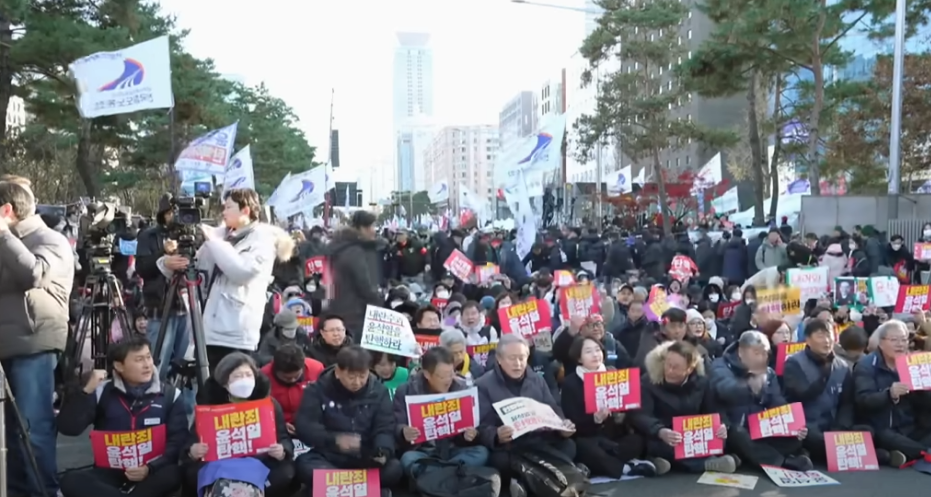
Above; December 2024 and South Koreans take to the streets to demand  Yoon Suk-yeol's resignation

While government investigators sift through piles of evidence for use by the South Korean Constitutional Court following the impeachment of President Yoon Suk-yeol, one outstanding matter will be his agenda for attempting to implement martial law in early December.

From available evidence it would appear Yoon Suk-yeon was likely to have been pursuing a longer-term agenda in order to buttress his highly unpopular conservative and business political position, against an increasingly assertive and popular and well organised opposition which have proved problematic for decades.

During his election campaign in 2022, Yoon Suk-yeol stated if elected president his administration would abandon the traditional Blue House for suitable premises elsewhere. The Blue House, however, has a highly symbolic place in the political culture of most South Koreans: having experienced political turmoil and upheaval, the presidential palace is the institution through which they have been governed since the establishment of the Republic of Korea in 1948. While other ROK political leaders have expressed concerns about the Blue House, none had ever managed to muster enough support to abandon the vast, sprawling estate.

After winning the presidency with a very small margin, Yoon Suk-yeol announced he was making the former Defence Ministry headquarters his new presidential residence. It was to prove highly unpopular with many South Koreans; during the earliest days of presidential administration a massive public petition of 3,600,000 signatures opposed the move. (1)

The choice by the Yoon Suk-yeol administration to use the Defence Ministry premises, likewise, were to prove unpopular with many South Koreans for reasons the presidential administration appear to not have even considered as relevant.
 
Most South Koreans, while expected to serve National Service in the country's vast military apparatus, have unhappy memories of military involvement in political and civilian affairs which are regarded as darker days in the country's history. It has been noted, for example, that 'military officers … are by now fully educated about the deep unpopularity of earlier decades of martial law … and that … South Koreans have a deep embrace of democratic values'. (2) The choice of Defence Ministry for the official presidential premises can, therefore perhaps, best be viewed as strangely incongruous; that is, if the choice is to be regarded as straightforward and above board.

What, however, proved a particular matter of concern for many South Koreans were the expensive upgrading of various facilities in the Defence Ministry premises. Security concerns had been raised although it has remained curious how such an important defence facility could be regarded as so vulnerable by those making the assessments. While upgrades were taking place Yoon Suk-yeol used his own home as the presidential premises.

With plummeting popularity ratings Yoon Suk-yeol appeared to have developed a bunker-like mentality even before moving into his Defence Ministry compound, seemingly oblivious to what was taking place in the country as a whole. Government investigators will, no doubt, have a field-day assessing the role of the country's intelligence services and their working relations with the presidential administration; the reliability and nature of the intelligence assessments and those providing the sensitive information, and whether the presidential administration took any notice of what they were being told, has yet to be established but will inevitably be called into question.  

Popularity ratings of President Yoon Suk-yeol continued to plummet to under twenty per cent of the population as his administration pursued policies of closer diplomatic involvement with the US and Japan. The US Indo-Pacific Strategy (IPS) rests upon its diplomatic relationship with Japan as part of a global alliance; co-ordinated involvement with all US regional allies, including the ROK, remain a US political and military obsession. (3)

The April elections saw the political opposition, centred around the Democratic Party, win 192 seats in the 300-seat parliament. While regarded as a landslide victory, it fell just short of a super majority although rendered the presidential administration as little other than a 'lame duck'. (4) Despite attempting to label his political opponents as being North Korean agents, Yoon Suk-yeol provided no credible evidence of any northern involvement in the growing dysfunctional nature of ROK political developments. They remain mere allegations.

The ROK, however, still has legislation from the previous Cold War concerning any relations and contact with the northern DPRK. It remains highly controversial and part of the US-Japan alliance of which the ROK is a component part, for rapid deployment elsewhere in time of crisis. (5) While unpopular, attempts by then President Roo Moo-hyun over twenty years ago to repeal the National Security Law proved highly controversial. (6)

The 1948 law has been seen 'as a legacy of the military dictatorships that dominated South Korea for most of the Cold War'. (7) Fears that President Yoon Suk-yeol would resort to using the draconian legislation against political opposition figures was to become a common concern following their April electoral success, until his demise with impeachment in December.

President Yoon Suk-yeol later announced his move into the new Defence Ministry premises in early November in a manner of being under siege, less than a month before attempting to implement martial law under cover of darkness on the night of 3 December. (8) Why it took those providing the required upgrade over two years to complete the construction and security work has yet to be established. The whole matter, however, looks suspicious and requires clarification, although attempting to implement martial law from inside facilities so closely associated with the ROK's darker history is revealing, in itself.

Nearly 300 ROK uniformed military personnel were subsequently directed by President Yoon Suk-yeol to seize control of the country's parliament, paving the way for full control of the political system; some arrived by helicopter on the roof of the parliamentary buildings.  

Opposition political figures barricaded themselves into the parliamentary building and sprayed fire extinguishers at the soldiers, while huge numbers of protesters lined the streets.

Government investigators later established Yoon Suk-yeol had actually authorised the military to 'fire their weapons' at those resisting the attempted coup, in a ten-page report. (9) The personnel concerned, however, refused to accept the order and the Defence Minister subsequently attempted to commit suicide, presumably from disgrace.

And the farce was all over in a mere six hours: the presidential administration appears to have completely misread both the mood of the people and those residing in the state and military apparatus over which they were supposed to have direct and total control.

As ROK government investigators collect legal evidence for forthcoming Constitutional Court proceedings, they will obviously have to consider the longer-term agenda of President Yoon Suk-yeol and his decision to use military force to deal with political opposition on 3 December. It is difficult to accept the decision was taken on the spur of the moment or a planned quick solution to a long-time problem affecting class and state relations in the ROK stretching back decades.

The subsequent impeachment of Yoon Suk-yeol's replacement, Acting President Han Duck-soo, for 'actively participating in the insurrection', likewise, has already revealed the deeper and close-knit nature of their conspiracy. (10)

The tentacles of the attempted coup conspiracy may reach very deep indeed.

1.     Explained: Why South Korea's president-elect wants to relocate the presidential palace, The Indian Express, 23 March 2022.
2.     Real-life political Squid Game offers compelling viewing, The Weekend Australian, 28-29 December 2024.
3.     The reasons behind Washington's push for GSOMIA., Hankyoreh, 12 November 2019.
4.     Weekend Australian, op.ci.t, 28-29 December 2024.  
5.     North Korea's behaviour could threaten Australian security, Australian, 27 December 2002.
6.     See: Uneasy Korea braced for America's big squeeze, The Guardian Weekly (U.K.), 10-16 December 2004.
7.     Ibid.
8.     See: Yoon moves into new presidential residence, The Korean Times, 8 November 2024.
9.     South Korea's Yoon authorised 'shooting' during martial law bid, prosecutors say,   ABC News, (and AFP), 28 December 2024.
10.   S. Korean acting leader impeached, The Weekend Australian, 28-29 December 2024.

Wednesday, August 21, 2024

US Indo-Pacific Strategy heightens Korean Peninsula tensions

Written by: (Contributed) on 21 August 2024


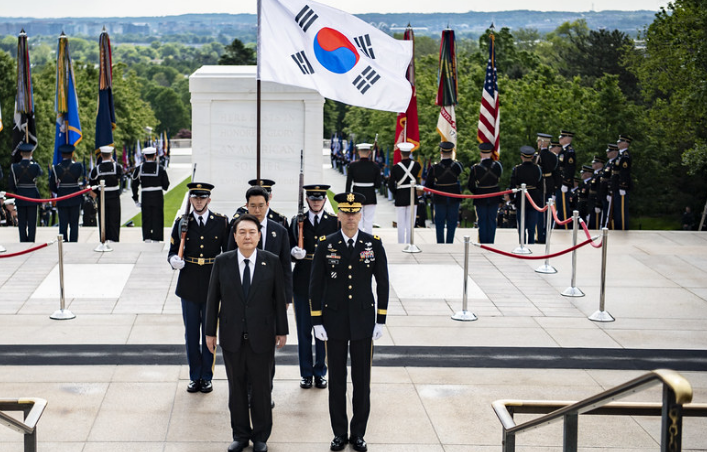
Yoon suk-Yeol at the US Tomb of the Unknown Soldier - Flickr

Relations between the two Koreas have reached their lowest diplomatic point in decades. The escalation of diplomatic tensions on the Korean peninsula, however, are best viewed in the context of the South Korean (ROK) presidential administration of Yoon Suk-yeol locking the country securely within the US-led Indo-Pacific Strategy (IPS). It has led a situation where the northern DPRK has responded by dropping their established doctrine of peaceful re-unification across the peninsula and subsequently increasing the likelihood of even greater hostilities.

In early August the northern DPRK began military initiatives which included the deployment of 250 ballistic missile launchers near to its border with the southern ROK. (1)

An official diplomatic statement issued by Pyongyang announced the move had been taken to defend its sovereignty, and that the country regarded the ROK as its 'principal enemy'. (2)
 
Behind the scenes, other initiatives, likewise, have included the suspension of government agencies linked to unification, and further questioning of the controversial maritime boundaries between the two countries. (3)
 
Both governments in Seoul and Pyongyang, historically, have had large departments staffed with civil servants employed for long-term planning where 'elaborate proposals were laid for unification, with co-operation leading to a loose federation and eventual merging of the two countries'. (4)
 
Secondly, the DPRK recognise the Military Demarcation Line, which was an extension of the 1953 armistice line, as the border between the two states. The ROK, to the contrary, claim the Northern Limit Line drawn up by the US, which deny the DPRK access to a twelve mile maritime boundary accepted under international law. It has always been a major diplomatic impasse; the ROK regularly use the disputed area to conduct US-led naval and related military exercises which the DPRK regard as a possible forerunner for a further military incursion into their sovereign territory.
 
The recent moves, therefore, depict a polarisation of diplomacy, away from a divided peninsula based upon kinship and a homogeneous peoples, toward a strained relationship between two countries. As many families have distant members in either country, the whole move away from a planned and eventual unification has some bearing upon political opinions of civil society.
 
It is important to note the official position of China toward the ROK during the period of the previous Moon Jae-in presidential administration was cordial; official diplomatic positions included reference to the previous government not 'following Washington's fanatical path … and … the Blue House's reluctance to be involved in anti-China campaigns'. (5) The same period was also marked by higher levels of constructive diplomacy between the two Koreas.
 
President Yoon Suk-yeol is not a popular political leader, he has faced numerous protests and mass demonstrations since taking office 'on the tightest of margins in South Korea's electoral history … President Yoon has been making good on his promises to the US, shaping, sculpting, and subordinating South Korea military, economic, and foreign interests to align with US policy and goals'. (6) While President Yoon Suk-yeon has played down recent diplomatic hostilities with the DPRK, he, and his supporters, have been held largely responsible for creating the conditions for the overturning of moves toward eventual unification.
 
It is no surprise to find the Yoon presidential administration has been conducting a witch-hunt of political opponents and threatened to use the ROK's repressive legislation from the previous Cold War, when the country was a military dictatorship, to stifle organised opposition. Articles 4, 7,8, and 10, of the notorious South Korean National Security Law aimed at curtailing pro-DPRK sentiments, has already been cited for possible use against those organising protests and demonstrations against the 'US militarisation of the country'. (7)
 
The presidential administration of Yoon Suk-yeon has also been responsible for placing the ROK firmly inside the US-led IPS; the US-led military agreement is regarded as establishing a 'united front against China', and, in effect, its allies, including the DPRK. (8) Over several years the US have placed Japan as a senior partner in their IPS global alliance, resting upon the so-called 'Quad' which has been designed to encircle and contain China's diplomatic influences. (9) The ROK, together with other Indo-Pacific countries, are regarded as lower-level partners in a regional intelligence framework. It is highly significant to note, furthermore, the changing nature of intelligence-gathering, from information about the DPRK's nuclear program, to the 'sharing of all military information'. (10)
 
The IPS, however, rests upon earlier US-led intelligence gathering networks established over a decade ago with a region-wide missile defence and radar systems designed for 'laying the foundations … to … combine US ballistic-missile defences with those of regional powers, particularly Japan, South Korea and Australia'. (11) Moves by the previous Moon Jae-in presidential administration in Seoul to establish cordial diplomatic relations with the DPRK, were regarded by the Pentagon as hindering their grand regional planning, despite it being regarded favourably by many South Korean people. (12)  
 
Evidence the IPS has now replaced earlier intelligence-gathering networks was illustrated in the recent official media release which included information about heavy rainfall in the northern part of the DPRK, which appear to have caused population movements; the US-led surveillance system has moved from a preoccupation solely with armaments to a general and wide-scale monitoring of the whole of the country. (13)
 
The upgrading of US-led surveillance systems targeting the DPRK has also coincided with the US Defence Intelligence Agency recruiting and training an estimated 1,600 intelligence-collectors inside systems marked by a 'convergence of the military and intelligence agencies that has blurred their once-distinct mission, capabilities and even their leadership ranks'. (14) The strained diplomatic relations are based on streams of intelligence assessments, which focus upon supposed threats to 'US interests'.
 
The DPRK has, under the circumstances, now lost interest in cultivating friendlier diplomatic relations with its southern neighbour; recent US-led developments run counter to previous ideals and interests. Whether the DPRK policy changes can be regarded as temporary or permanent depend largely upon political developments in the ROK.
 
It is not surprising, therefore, to note an official diplomatic statement from Pyongyang about the recent developments included a reference to 'a significant and strategic shift due to the transformation of the US-led alliances into nuclear-based military blocs'. (15) It has been marked by what the DPRK regard as suitable and appropriate defence and security precautions, aimed at sending 'an effective message to the US'. (16)
 
These same US-led regional foreign policies and the IPS have considerable bearing upon Australia:
 
                                         We need an independent foreign policy!
 
1. Kim moves missile launchers to border, Australian, 6 August 2024.
2.     Ibid.
3.     Ibid.; and, Kim stamps out dream of unification, Australian, 18 January 2024.
4.     Ibid., Australian, 18 January 2024.
5.     See: Seoul's balancing act between Beijing and Washington set to remain, The Global Times (Beijing), 27 May 2021.
6.     South Korean witch-hunt mounts against Yoon's opponents, The Asia Times, 23 January 2023.
7.     Ibid.
8.     See: The reasons behind Washington's push for GSOMIA., Hankyoreh, 12 November 2019.
9.     Ibid.
10.   Ibid.
11.   See: US seeks new Asia defences, The Wall Street Journal, 24-26 August 2012.
12.   Hankyoreh, op.cit., 12 November 2019.
13.   Australian, op.cit., 6 August 2024.
14.   Pentagon plays the spy game, The Guardian Weekly (U.K.), 7 December 2012.
15.   Ibid.
16.   Ibid.


Print Version - new window Email article

-----

Sunday, July 2, 2023

The Republic of Korea: Back in the US Fold


Written by: (Contributed) on 3 July 2023

The decision by the South Korean (ROK) government to activate a sensitive US-THAAD system has placed the presidential administration of Yoon Suk-yeol closer to the Pentagon; the ROK is now a major player in the US-led Indo-Pacific Strategy.

The previous presidential administration of Moon Jae-in, however, was more reluctant to actively side with the US, to prevent a confrontational diplomatic position with China.

The ROK, subsequently, has become increasingly divided, between those who want a more conciliatory diplomatic position toward the northern DPRK and China, and those who support the present US-led Cold War on the Korean peninsula.

The announcement from the Blue House in Seoul that the US THAAD missile defence system had been given the all-clear for activation next year has raised diplomatic tensions on the Korean peninsula. It had been initially put into position in May, 2017, shortly before Moon Jae-in took the presidency, although never activated due to health and safety and environmental considerations held by local people. The radar system had sufficient range to reach into the northern DPRK together with China and Russia. (1)


China, specifically, had raised criticism that the radar of the THAAD system could be used for surveillance of China. (2)

The THAAD system is a component part of the US Indo-Pacific Strategy (IPS), based on the US-Japan diplomatic alliance being upgraded to a global alliance. The ROK, which hosts 28,500 US military personnel as part of their Defence of Japan doctrine for rapid deployment in time of war, had been subsequently downgraded to the diplomatic position of a lower-level partner alongside Taiwan, Singapore, Vietnam and others. (3) The ROK was also initially reluctant to provide the US with unconditional guarantees about their participation in the IPS, and the Moon Jae-in administration had sought clarification in writing.

The activation of the US-THAAD system has also formed part of a region-wide missile-defence network, with Australia and Japan as regional hubs for 'US interests'. The foundations of the network were being laid over a decade ago, with a primary responsibility for intelligence-gathering and surveillance. (4)

Further concerns raised by the Moon Jae-in presidential administration included fears of economic retaliation by China, which still remains the ROK's biggest trading partner. It was noted during the period that, 'anti-THAAD sentiment by Chinese consumers affected everything from South-Korean-owned retailers and car-makers to K-pop concerts. Chinese tourism to South Korea plummeted'. (5) The fact that the ROK is reliant upon China for semi-conductors, batteries and rare earths, has meant the Blue House has historically taken a measured stance toward Beijing, as a matter of political expediency. (6)

The Yoon Suk-yeol presidential administration, nevertheless, has proved to be openly pro-US, without acknowledging the likely consequences. While it has been noted that Yoon Suk-yeol 'centred his foreign policy around tighter collaboration with the US and envisioned a relationship with China based on mutual respect', the ROK has become increasingly divided since he took office in March last year. The Yoon Suk-yeol administration has become very unpopular: many ROK people want a more conciliatory diplomatic position toward the DPRK, where they have family members.

It is also important to note a major diplomatic statement about the practicalities of ROK diplomatic relations with China, from Moon Jae-in special advisor, Moon Chung-in. It officially noted that while, 'South Korea is an American ally, and we maintain a strategic co-operative partnership with China … alliance is more important strategic partner … but … we are structurally dependent on China'. (7) The Yoon Suk-yeon presidential administration, however, appear to have rejected the assessment, and all which that entails.


1.     Missile defence gets the all clear, Australian, 23 June 2023.  
2.     South Korea, China clash over US missile shield, Reuters, 12 August 2022.
3.     The reasons behind Washington's push for GSOMIA., Hankyoreh, 12 November 2019.
4.     See: US seeks new Asia defences, The Wall Street Journal, 24-26 August 2012.
5.     Australian, op.cit., 23 June 2023.
6.     South Korea and the THAAD dilemma, DEFENCE.info., 6 July 2022.
7.     Seoul's balancing act between Beijing and Washington set to remain, The Global Times, 27 May 2021.  

Monday, March 20, 2023

US pushes Japan and South Korea into unwelcome relationship


Written by: (Contributed) on 20 March 2023

Those who follow how influence is brought to bear in diplomatic relations will have found recent US-led initiatives toward South Korea (ROK) particularly interesting. The Biden presidential administration has successfully pushed their ROK counterparts in the Blue House in Seoul toward a pro-US defence and security position, away from the more independent diplomatic line of the previous Moon Jae-in presidency.

Serious implications for South Korea’s domestic politics have arisen following the US formally placing the ROK inside the new Indo-Pacific Strategy.

The address by President Yoon Suk-yeol at the ROK annual celebration of their independence movement on 1 March was met with widespread criticism and condemnation by many citizens. The address included the statement that 'Japan has transformed from a militaristic aggressor of the past into a partner that shares the same universal values with us … and … co-operation between South Korea and Japan is incredibly important on all fronts, including diplomacy, economy and defence'. (1) Diplomatic relations between the two countries have historically been tense, following the controversial occupation of the Korean peninsula from 1910-45 by Imperial Japan; the period was marked by horrific human rights abuses, atrocities and repression.

Several years ago, the two countries reached an agreement whereby Tokyo agreed to contribute to a fund to pay compensation to Korean women forced to have sex with Japanese soldiers. The deal, however, fell apart. Subsequent legal rulings in Seoul re-opened the whole issue of compensation, although Japan refused to accept the legal decision and forward any compensation.

The legal verdicts proved particularly controversial as they overrode a 1965 treaty where Tokyo had paid hundreds of millions of dollars in grants and loans to the South Korean government of the time. Threats by the previous Moon Jae-in presidency, to enforce payments through liquidation of assets of Japanese companies resulted in tense diplomatic stand-offs.

The Yoon Suk-yeol administration also used the 1 March public holiday to announce that 'a South Korean fund will compensate Koreans forced to work for the Japanese in Japan during World War Two … as … part of an arrangement that will boost efforts to counter China and North Korea'. (2) The political announcement overrode legal decisions.

Behind the scenes influence has been brought to bear by the US upon the ROK: the US has imposed their Indo-Pacific Strategy (IPS) upon allies throughout the wider region. (3) The Yoon Suk-yeol presidential administration has been keen to follow the US-led initiatives: on 13 March, for example, the ROK embarked upon their largest joint military exercise with the US for five years, with the ten-day 'Freedom Shield' war-games. The exercise followed an earlier joint exercise, Teak Knife, which included Special Forces conducting simulations for strategic precision missile strikes on North Korean (DPRK) key facilities. (4) The two joint military exercises have also included a statement from President Yoon Suk-yeol that the DPRK was 'an enemy'. (5)

On March 13, hundreds of peace activists gathered near the presidential office in central Seoul to demand stopping the Freedom Shield joint military exercise.

Holding banners and placards with the slogans of "Stop the Korea-U.S. joint exercise that brings on war" and "What we want is peace" in their hands, the participants shouted, "We want to live. Stop the war exercise."

The previous Moon Jae-in administration sought a more conciliatory diplomatic relations with the DPRK, which caused noticeable diplomatic tensions between the ROK and US.

The main stumbling block during the Moon Jae-in presidential period was the US implementation of the General Security of Military Information Agreement (GSOMIA). The intelligence agreement was responsible for elevating Japan to a major hub for 'US interests', and a major player in the new IPS alongside Australia as the two regional 'linchpins'. (6)

It replaced a previous US strategy primarily for East Asia, marked by the ROK and Japan being fundamentally on an equal footing: US forces were stationed in the ROK for rapid deployment with the Defence of Japan doctrine. The IPS has downgraded the ROK alongside other participants including Taiwan, Singapore, Vietnam and other allies. (7)

While the US demanded the Moon Jae-in administration declare its full participation in the Indo-Pacific Strategy, a diplomatic statement from Seoul noted, 'South Korea needs to first demand a concrete list from the US in terms of how it is supposed to participate in the Indo-Pacific Strategy, examining it closely and choosing only those areas that are acceptable'. (8)

The ending of the Moon Jae-in presidential period subsequently allowed the US new openings with the more conservative and pro-US administration of President Yoon Suk-yeol, which has proved more accommodating of Japanese counterparts, particularly in the domestic political arena when dealing with demands for compensation.

While the US has succeeded in winning over the ROK government to their side, the country itself is increasingly polarised between supporters of the previous presidential administration and that of the present administration. The victory for the US may well prove temporary and impossible to maintain in future years. Reliable commentary from Seoul has noted 'relations between the two Koreas are at one of their worst points in decades'. (9)

And diplomatic relations between the ROK and Japan remain decidedly volatile as the US prepares for 'real-war scenarios'.

1.     Deal on forced labour reached, Australian, 7 March 2023.
2.     Ibid.
3.     The Reasons behind Washington's push for GSOMIA., Hankyoreh, 12 November 2019; and, Change your ways or else, Beijing warns US., Australian, 8 March 2023.
4.     US, South Korea kick off largest drills in five years, Australian, 14 March 2023; and, N Korea calls for end to drills, Australian, 6 March 2023; and, Kim prepared to turn Pacific into 'firing range', Australian, 21 February 2023.
5.     South Korea labels North the 'enemy', Australian, 17 February 2023.
6.     Australian, op.cit., 8 March 2023.
7.     See: Hankyoreh, op.cit., 12 November 2019.
8.     Ibid.
9.     Kim orders 'real war' drills, puts soldiers on mission notice, The Weekend Australian, 11-12 March 2023.

Tuesday, January 17, 2023

South Korea and the US – an alliance under strain


 Written by: (Contributed) on 18 January 2023

A recent curt exchange between South Korea (ROK) and the US revealed some pressing considerations about their diplomacy and the changing nature of their relations and military alliance. The right-wing presidential administration of Yoon Suk-yeol in the Blue House in Seoul had expected to receive a favourable response from Biden about proposals for strengthening relations between the two countries. They were noticeably disappointed with the stated outcome. Elsewhere, evidence emerging about other US diplomatic relations across the Indo-Pacific, has shown traditional hegemonic positions also under strain, raising serious questions about the planning and implementation of the US-led Indo-Pacific Strategy.

In early January ROK President Yoon Suk-yeol stated in an interview with leading newspaper Chosun Ilbo that the defence and security of the country had been threatened by the northern DPRK and 'America's existing nuclear umbrella and extended deterrence were no longer enough to reassure South Koreans'. (1) Matters would appear to have come to a head following the ROK military failing to deal effectively with an incursion of five drones from the DPRK in late December. While the military leadership officially apologised for matter, the hawkish presidential administration appears to have seized upon concerns and 'followed ... a … call for war preparation … to deter attacks on American allies'. (2)

There is no shortage of military hawks around President Yoon Suk-yeol: in fact, it has been noted, that, 'under the hawkish leadership of Mr Yoon, South Korea has beefed up joint military drills with the US, which had been scaled back during the pandemic or paused … with the North under his predecessor'. (3) They would appear keen to use hostilities with the DPRK to instil nationalist and far-right sentiments across the ROK to serve their interests.

Diplomatic tensions remain a continual problem on the Korean peninsula where the ROK and DPRK, technically, remain in a perpetual state of war since the civil war over seventy years ago. For the residents of the peninsula, the present Cold War has merely merged with the previous one. The ROK is relatively heavily politicised and the last presidential elections were only narrowly won by Yoon Suk-yeol who still lacks a strong support base in the face of younger generations which favour more contact with the DPRK. Rapid economic growth in the ROK has tended to produced new social forces which compete with older, traditional social, economic and political considerations: in 1961, for example, per capita income was $93.8 and the country was 91st in world leagues; in 2020, the ROK had expanded over four hundred times, to rise to 9th in world leagues. (4)

The response from the Biden presidential administration in Washington over the recent diplomatic spat was both brief and succinct; within hours of the Chosun Ilbo article being published an official statement from the White House noted 'the US president had been left with no options but to answer NO when directly asked … without any context'. (5) The matter, however, would appear unresolved: a later statement from the ROK presidential office clarified the two countries were 'discussing joint planning and exercises involving US nuclear assets … even … after US President Joe Biden said there would be no such joint drills'. (6)

Behind the scenes, however, the most important issue arising has been the new US-led Indo-Pacific Strategy; it has elevated the US-Japan alliance as central to both regional and global defence and security provision. (7) The previous US regional strategy consisted of the US at the centre with South Korea, Japan and Australia 'acting as spokes'. (8) Within the Indo-Pacific Strategy, South Korea has now been grouped with Taiwan, Singapore, Vietnam and others, 'as lower-level partners'. (9) The moves would appear to have had some far-reaching implications for the military hawks associated with the present Yoon Suk-yeol presidential administration. They have, in reality, been demoted by the Pentagon, in favour of their Japanese counterparts, although they have difficulty accepting the matter.

An official statement issued before the last presidential elections, for example, noted the country was 'embracing a broader role in regional affairs', with reference to the changing balance of forces with China. (10) Its role, now however, would appear conspicuously narrower.
    
The matter arising has, therefore, also thrown light upon interpretations of the Indo-Pacific Strategy; while explicit reference has been given in the context of Japan to 'allowing it to act when the US or countries US forces are defending are threatened', it does not automatically follow for the ROK, if challenged by DPRK drones. (11) The new Indo-Pacific Strategy, furthermore, has replaced previous guidelines 'with new rules that eliminate any geographical restriction', for Japan's defence forces. (12) And diplomatic relations between the ROK and Japan have, historically, been problematic due to war-time atrocities by the Imperial Japanese forces; any attempt at a Japanese troop deployment in the ROK would raise serious issues and be likely to be counter-productive.  

The US-led Indo-Pacific Strategy would also appear under strain, elsewhere: Vietnam, which has been drawn into the strategy due to considerations arising in the South China Seas, is seeking a peaceful diplomatic solution with China through ASEAN, despite the US wanting a permanent naval base on Vietnamese territory. The Vietnamese government in Hanoi also have no wish to participate in the endless string of US allegations that their counterparts in neighbouring Cambodia are considering hosting a Chinese maritime facility which would provide rapid access for deployment in the South China Seas.

In conclusion, previous US military planning of regional alliances to encircle and contain China's rising influences, including the Indo-Pacific Strategy, appear to have run into serious practical difficulties; they were poorly planned and preoccupied only with 'US interests', and with their cronies and puppets.


1.     Seoul says talks under way over joint nuke exercises, Australian, 4 January 2023.
2.     Biden says US not discussing nuclear exercises with South Korea, Malay Mail., 3 January 2023.
3.     Australian, op.cit., 4 January 2023.
4.     A new look at the Korea – US alliance, CSIS., 27 April 2021.
5.     Australian, op.cit., 4 January 2023.
6.     Ibid.
7.     The reasons behind Washington's push for GSOMIA., Hankyoreh, 12 November 2019.
8.     Ibid.
9.     Ibid.
10.   A new chapter in US – South Korea relations, CAP., 25 June 2021.
11.   See: Japan to extend military reach beyond self-defence, The Age (Melbourne), 29 April 2015.
12.   Ibid.


Friday, November 4, 2022

US plans to keep the two Koreas apart


(South Korean Missiles      Photo by danielfoster437 CC BY-NC-SA 2.0.)

Written by: (Contributed) on 5 November 2022

The US-led war-drive across the Indo-Pacific has raised diplomatic tensions in several sensitive areas of the region, including the Korean peninsula in recent weeks. What was officially reported as a relatively minor incident was, in fact, a major diplomatic incident between South Korea (ROK) and North Korea (DPRK), revealing a dramatic return to the darkest days of the Cold War, as the US seeks to reassert traditional hegemonic positions in the face of a changing balance of forces with China.

In late October media coverage of warning shots being fired between ROK and DPRK shipping vessels received scant attention. (1) It, nevertheless, highlighted the problem of effective and mutually agreed maritime boundaries between the two states. The incident also followed three earlier related matters in the Indo-Pacific: from 22 August to 1 September, US-led Ulchi Freedom Shield military exercises with ROK and Japanese forces were conducted off Hawaii; a senior former Pentagon official and defence analyst Elbridge Colby, called for the US, Australia and Japan to mobilise 'for potential war with China … as … Beijing intended to seize Taiwan'; Australia and Japan formally signed an upgraded security agreement which included stronger 'intelligence sharing and to enhance the interoperability of military capabilities', in what is essentially a US-led triangular diplomatic relationship. (2)

The three matters were responsible for raising diplomatic tensions in several sensitive areas of the Indo-Pacific, most notably the Korean peninsula.

In mid-October a DPRK merchant vessel crossed the so-called Northern Limit Line (NLL) and received warning shots from the ROK navy; after the vessel departed the area, the DPRK military also fired a number of warning shots into the area. (3)

The serious diplomatic incident then would appear to have petered out. It, nevertheless, highlighted controversy over the maritime boundaries and the legitimacy of the NLL which ‘remains a serious flashpoint for conflict with fears that a relatively small incident could escalate into a larger more violent conflagration'. (4)

Established by US Naval Commander General Mark Clarke on 30 August 1953, the NLL
was regarded 'as a military control line in the West Sea', although no specific military or diplomatic documents ever appear to have existed. (5) The matter remains further complicated by the sovereignty of five Korean islands and agreed international definitions of territorial waters. (6) And the matter remains one of contention to the present day. The DPRK continue to regard the NLL as 'bogus', and it is questionable whether they ever accepted the boundary; then US Secretary of State, Henry Kissinger, in February 1975, in a subsequently declassified cable stated that 'the NLL does not have international legal status'. (7) The controversy surrounding the NLL became a source of major discontent between the ROK and DPRK during the 1970s period, eventually escalating into open military hostilities in 1999, 2002, and 2009, resulting in loss of life.

The fact the ROK navy, historically, used the disputed area for regular military exercises has also remained a matter of concern for the DPRK. (8)

US regional policy has continued to be conducted in this manner for over seventy years, with perceived adversaries used to justify huge defence budgets with the military-industrial complex used to artificially prop up their domestic economy. It has been marked by a swash-buckling bravado and a mentality that 'might is right'. The problem is now, furthermore, even more serious: the use of Australia and Japan as major hubs for 'US interests' has drawn allies into the forefront of regional diplomatic rivalry with large-scale troop rotations and preparations for 'real war scenarios'. As one US-led military exercise ends, another starts.

In recent years major diplomatic initiatives on the Korean Peninsula in favour of dialogue between the ROK and DPRK were not greeted with enthusiasm by the US. While cordial meetings took place and both sides openly aired their grievances, the US did not take kindly to the ROK being, on occasions, reticent to slavishly follow US directives but to consider alternatives and their own national interests. (9) It is also important to note, for example, that behind the scenes the rise of China has already altered the balance of forces across the peninsula, being the largest trading partner of both Koreas.

The presidential elections in the ROK last May, therefore, showed a power-play between pro-US players, and those who had supported outgoing President Moon Jae-in who had taken a more assertive and progressive role when dealing with Washington and the Pentagon. The election of pro-US Yoon Suk-yeol of the People Power Party, narrowly beating Lee Jae-myung of the Democratic Party, however, resulted in many of the previous diplomatic initiatives being discarded in favour of a 'normalisation' of ROK-US military relations; previously a down-sizing and halting of exercises and other war-games had taken in recent years. (8)

The situation on the Korean peninsula now remains tense, with all the hallmarks of Cold War diplomacy: recent developments have shown how the US regional war-drive has had serious implications for allies, particularly Australia, which is linked through military alliances and agreements to automatically side with the Pentagon and to provide a logistic hub for US regional military operations elsewhere:

                                         We need an independent foreign policy!


1.     Korean foes swap 'warning shots' across maritime border,  Australian, 25 October 2022; and, North Korea fires, Chosun Ilbo, 19 October 2022; and, North Korea Fires, The Korean Times, 19 October 2022.

2.     The US and South Korea to begin large-scale military drills,  ABC News, 16 August 2022; and, 'Mobilise for war before it's too late', Australian, 20 October 2022; and,  Australia, Japan to reinforce military tie, Australian, 20 October 2022; and, Beijing warns PM over Japan alliance,  Australian, 25 October 2022.  

3.     Australian, op.cit., 25 October 2022; and, Chosun Ilbo, op.cit., 19 October 2022, and, Korean Times, op.cit., 19 October 2022.

4.     The Northern Limit Line, The National Committee on North Korea (NCNK), September 2011.

5.     Ibid., and, Website: Military Wiki, The NLL.   

6.     Ibid.

7.     Website: Wikipedia, The NLL.

8.     Blocking peace on the Korean Peninsula,  People's Voice (Canada), 1-5 March 2011.

9.     See: The reasons behind Washington's push for GSOMIA, Hankyoreh, 12 November 2019; and, Seoul's balancing act between Beijing and Washington set to remain, The Global Times, 27 May 2021.

10.   ABC News, op.cit., 16 August 2022.