Monday, August 25, 2025

Foreign ownership of Australian dairy industry to intensify

Written by: Duncan B. on 25 August 2025


The degree of the concentration of foreign ownership of the Australian dairy processing industry is about to intensify with the announcement by New Zealand-owned Fonterra that they are to sell their Australian operations to the giant French dairy company Lactalis in a $3.5 billion deal.

This will leave Lactalis and the Canadian-owned Saputo in control of a large section of the Australian dairy processing industry.

A bid by Australian-owned Bega was not enough to win the race for Fonterra. The ACCC has already indicated that it will not oppose the deal, but dairy farmers are worried that the combination of the two biggest players in the industry will reduce competition at the farm gate for their milk.

This comes as it was recently announced that total Australian milk production has fallen again. Australia’s total milk production in 2024-25 was 8.315 billion litres. This is predicted to fall to 8.147 billion litres this season. Reasons for this fall include droughts and floods in dairying areas, and more dairy farmers changing to other types of farming, or leaving farming altogether because of the  increasing costs of inputs, and farm-gate prices for their milk that are not enough to cover production costs.

As many Australian farmers are abandoning dairying, Canadian pension fund PSP is becoming a major player in Australian dairying through their subsidiary Aurora Dairy. They have 450 employees and 48000 cows producing 280 million litres of milk on 54 farms.

We must oppose the continuing take -over of Australian agriculture by foreign interests which is an  attack on Australian Independence. 

Australian people march for Palestine


Written by: Alice M and Bill F on 25 August 2025


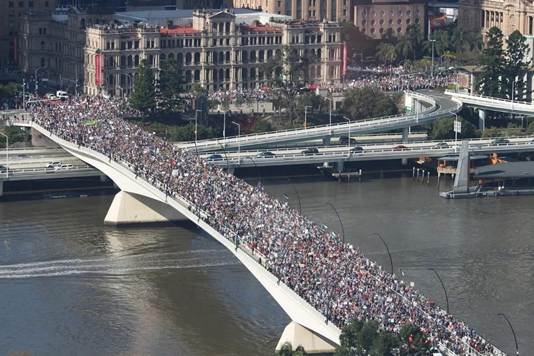
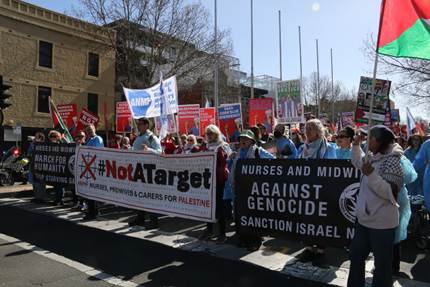
On the 24th August in a National Day of Action for Palestine, massive crowds of over 350,000 marched in Australian cities and regional towns, with growing demands for strong government action against Israel.

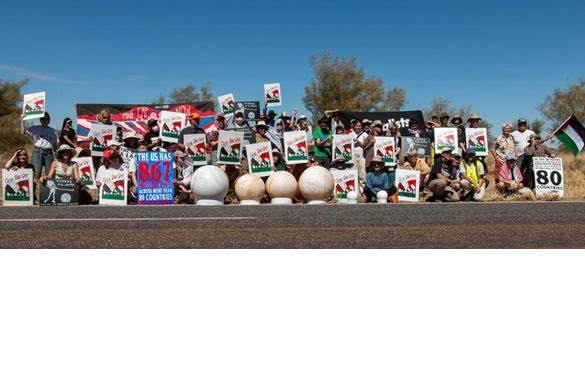
In Melbourne and Sydney each 100,000, Brisbane 50,000, Perth and Hobart each 25,000, Adelaide 15,000 and Canberra 2,000.  Thousands more rallied, protested and marched in regional towns and communities across the country. Protests were held outside Pine Gap, the US military intelligence base. 

In Melbourne, many migrant and community groups marched with their banners demanding freedom and justice for Palestinians.  A large Unions for Peace contingent of over 1,000 unionists, led by health workers’ unions, marched from the Victorian Trades Hall under their unions’ banners, joining the main rally outside the State Library at 12 pm.

Gary Foley, a veteran First People’s warrior for self-determination and liberation of his people and the Palestinians, spoke briefly to 100,000 clapping and cheering crowd.  To thundering applause and cheering he told the protesters “In last 2 weeks I had a heart surgery, but I’m here because my heart is with Palestine. …They may have killed a few resistance fighters, but they will never kill resistance,” he told the cheering and applauding protesters.

Palestinian speakers angrily dismissed the Albanese government’s call for the recognition of Palestinian state as a deliberate diversion from Israel’s genocide, occupation and ethnic cleansing.  Speaker after speaker called for the government to implement sanctions against Israel, stop exporting arms and F35 parts used in Israel’s genocide.  They called for self-determination and liberation of Palestine.

As the march of 100,000 blocked the centre of Melbourne, chanting broke out “Hey, hey Israel, USA, how many kids did you kill today!” 

While Israeli genocide policy was condemned in speeches and on banners, the supporting role of US imperialism was also noted by many rally participants. 
US imperialism is the great enabler and sustainer of Israeli oppression – a well-armed base in the Middle East to coordinate and impose policies in line with US economic and military interests. It provides the enormous supply of weapons, political cover and UN veto protection, while generating profits for US arms companies. It denigrates the rightful and justified Palestinian resistance as “terrorists” and does nothing to even acknowledge the existence of Palestinian people. 

The “Two state solution” is not viable – a mirage to distract opposition to the Zionist agenda which has always been to take possession and occupy all of the territory for “Greater Israel” from “the Jordan River to the Mediterranean”. The two-state mirage has been further sustained by the complacent Abbas bloc in Ramallah, while the West Bank territory is being gobbled up by “settler” Zionist thugs with open assistance by the IDF and Israel government. East Jerusalem is under similar attack, with Palestinian homes seized or destroyed by “settler” mobs, family members beaten, jailed or shot.

These self-called “Settlers” are terrorists! With protection from the IDF, they steal land and water, rob houses, destroy crops and olive groves and kill any Palestinian who defends themselves, resists or objects. They operate in the tradition of the infamous Irgun and Hagenah terror gangs that murdered and expelled Palestinians from their towns and villages in 1948.

In spite of all the oppression and tremendous odds, the Palestinian people have persevered in their 77 years long struggle and have won overwhelming support from people around the world.

In Australia, more people are demanding that the Albanese government imposes strong sanctions against the Israeli government, demand an immediate end to the assault on Gaza, cut off the supply of weapons parts for the F35 jet fighter, and organise massive aid and medical supplies to Gaza and the West Bank.

These honest demands of the Australian people come up against the interests of US imperialism, and Albo and Marles will duck out every time. They will not risk being “Trumped”! That is Australia’s problem – how to get rid of US imperialist domination and make our contribution to the liberation of peoples of the world.

End the US-Australia alliance!
Close Pine Gap!
Fight for Australia’s anti-imperialist independence and socialism!  


Australia and Japan pushed by US to further fund its Indo-Pacific ‘interests’

Written by: (Contributed) on 25 August 2025


(Above  Source: www.drishtiias.com )

Proposals by the Pentagon to expand the defence and security provision of their Indo-Pacific Strategy (IPS), have far-reaching implications for Australia. The hidden agenda behind the proposals is particularly revealing; if implemented, it is likely to foist a huge financial burden with increased diplomatic and military responsibilities upon Australia at the behest of the United States.


Throughout August a series of media releases pushed for closer diplomatic relations between Australia and Japan. It included proposals for the two countries to establish a 'formal security alliance', between the two regional hubs in the IPS for 'US interests'. (1)

The matter has entered discussion stage in Canberra, with policy considerations taking place in due course.

The moves, however, reflect the Pentagon's regional planning and their IPS: implemented over recent decades, it has placed the US-Japan alliance as an upgraded global alliance. (2)

Australia, likewise, remains an important consideration for US regional foreign policy, hosting a number of highly sensitive military and intelligence facilities which include Pine Gap.

Recent political and economic turmoil in Japan has caused the US disquiet; recent elections saw the ruling Liberal Democratic Party (LDP) lose its majority. Japan, for the US, ‘for decades, has been the pillar of pro-western, democratic stability in our region'. (3) Its position is now shaky, with the ruling elite fearing opposition groups.

The Japanese economy has also not been performing well in recent decades. In fact, after reaching a peak in 2010, it has entered a period of prolonged decline. Projections for future years offer a dismal scenario whereby it has failed to even reach one per cent growth rates each year to 2030. (4) Viewed in comparison to a global average of 3.25 per cent, Japan's economic performance could be quite accurately regarded as mediocre. Official economic assessments have noted it remains in a ‘technical recession danger zone'. (5)

The US historically, however, has used Japan to maintain a ‘formidable economic presence in South-east Asia since the late 1960s'. (6) The presence, however, did not last forever.

In fact, the problem confronting the US is that ASEAN has now virtually replaced Japan as the regional economic powerhouse with serious defence and security considerations.

In 2022, for example, ASEAN members had already established a combined GDP of $3.6 trillion, 85 per cent of that of Japan. (7) Two years later the ASEAN group drew level with Japan, which proved a turning point with a $4 trillion total. (8) Projections now assess ASEAN as surpassing Japan with a nearly $6 trillion economic base by 2030. (9)  

Studies of the changing balance of forces have noted 'ASEAN and the Chinese economies are becoming inseparably intertwined'. (10) The proposals for a formal security alliance between Australia and Japan are best viewed in that light. The agenda is quite clear.

Its proposers, in fact, have already stated such as security alliance 'would help keep the Americans in the region'. (11)

The US Defence Department have also elaborated on the grand plan with a request that Australia should 'integrate … with … other Asian allies into a stronger defence framework focused on deterring Beijing'. (12) The US agenda is, however, far from straightforward.

It has begun with a demand from the White House that Australia increase its defence budgets; much of the increased expenditure has already been allocated for equipment which has facilities for 'inter-operability' with US-led mainframe equipment. The Trump administration appears to be openly pushing for increased defence budgets in preparation for 'real-war scenarios', and keeping Wall Street and the military-industrial complex afloat.

As 1,600 personnel from the Australian Defence Forces joined Philippine counterparts for Exercise Alon 25 in August, the official media release from Canberra contained much of the same dreary commentary initially presented by the Pentagon. One of the biggest ADF war-games for 2025, it was publicised along the lines that 'this is a strategy of collective deterrence against Chinese aggression … the ADF was not in the Philippines by happenstance of coincidence', as stated by Strategic Analysis Australia in Canberra. (13)

As ASEAN increases it viability over and above that of Japan, we are likely to see more and more demands on Australia to pay for the US, as the balance of forces continues to turn against it.  

By December, for example, Canberra will already have paid A$3 billion to the US-based shipbuilding industry for submarine production. (14) The AUKUS agreement is also likely, furthermore, to cost far more and be very, very expensive:

                                         We need an independent foreign policy!

1.     It's time we formalise the Australia-Japan defence compact, Australian, 8 August 2025; and, Australia should push for alliance treaty with Japan, Strategic Analysis Australia, 10 August 2025.
2.     The reasons behind Washington's push for GSOMIA., Hankyoreh, 12 November 2019.
3.     Japanese election harms region, Editorial, Australian, 22 July 2025.
4.     GDP Japan, 1960-2024, World Bank Group; and, Japan: Economic Growth Forecast, The Global Economy.
5.     Japan records modest growth, Australian, 19 August 2025.
6.     Towards an equal partnership, East Asia Forum, Volume 15, Number 3, September 2023, pp. 3-5.
7.     Ibid.
8.     GDP Japan, World Bank Group.
9.     GDP of the ASEAN countries from 2020 to 2030, Statista, 27 May 2025.
10.   Towards an equal partnership, op.cit., 2023.
11.   Australia should push for alliance treaty with Japan, op.cit., 10 August 2025.
12.   No free ride in defence of free world, Australian, 14 August 2025.
13.   Philippines exercise ADF's 'biggest for year', The Weekend Australian, 16-17 August 2025.
14.   Australia quietly pays US., The Sydney Morning Herald, 23 July 2025.

Thursday, August 21, 2025

Demand for Australian independence grows as US is increasingly isolated

Written by: Central Committee, CPA (M-L) on 22 August 2025


(Above: source ABC News)

The meeting in Anchorage, Alaska, between Presidents Trump and Putin was a setback for the arrogant and boastful US leader.

It came just 9 days after a 10-day deadline for a ceasefire by the Russians, demanded by Trump, had expired without any cessation of hostilities.

In what little we do know of the discussion between the two leaders, it appears that Trump gained nothing, and Putin gave nothing up. Indeed, for many observers, it would seem that Trump’s greatest achievement was getting Zelensky to wear something approximating a suit at their meeting a few days ago, given the criticism of his dress sense the last time the two met.

Putin was able to tell reporters after the Anchorage meeting that the war would only end when the conditions that caused it had been removed. Those conditions, including NATO’s eastwards expansion, the existence of Nazis in Ukraine, and complaints about the treatment of Russian-speakers in the Donbass, were the justification for Putin’s “special military operation” against Ukraine. Putin has made it clear that they will only be removed with a Russian victory over Ukraine.

Much was made of the symbolism of Anchorage as the venue. The closeness of this US city to Russia, just across the narrow Bering Strait, was said to typify the closeness of the Putin-Trump personal relationship.

What was more symbolic was the fact that Alaska had once been Russian territory, bought from the Czar in 1867 for US$7.2 million, equivalent to $162 million in 2024. It is reflective of Trump’s imperialist mindset that international conflicts can be settled by “deals” over territory. Hence his support for a French Riviera-style development of an ethnically cleansed Gaza, and his “deal” for the end of the Ukrainian war which involves recognition of Russian control of the Crimea and Donbass regions of Ukraine.

At least in the case of Crimea, there is some historical basis for its reabsorption into Russia, although not by the aggression used by Putin. When the US imperialists forced a regime change via the Maidan coup in Ukraine in 2014, Putin drew on the justifications of “protection” for ethnic Russians to retake the Crimea. It had been part of Russia since 1783 when it was seized from the Ottoman Turks. Khrushchev had gifted it to the Ukrainian Soviet Socialist Republic in 1954 in a move seen as trying to win allies for his usurpation of power following Stalin’s death. It remained populated by a majority of Russian-speakers who are believed to have welcomed its seizure back by Putin in 2014.

Now, we are watching to see what plays out in the meetings between Zelensky and Trump, and between Trump and the Europeans. The contradictions between the US and Europe over both Ukraine and Palestine are growing and resulting in a significant diplomatic and political isolation of US imperialism and a weakening of its international influence. 

The US now has a significant economic stake in Ukraine. On April 30, 2025, the United States and Ukraine signed a deal to establish a joint investment fund for the reconstruction of Ukraine. The focus of the deal is access by the US to Ukraine’s mineral deposits. 

However, the indications are that Trump wants the US to disengage militarily from Europe and settle the conflict with Russia, if need be, at Ukraine’s territorial expense, so that it can continue its focus on war preparations with China.  

Those preparations directly involve Australia as a US proxy in a war with China. The AUKUS arrangements ($30 million a day for 30 years for a handful of submarines to be deployed interoperably with the US Navy), the Force Posture Agreement which cedes Australian territory to US forces, Pine Gap, and US intelligence agents embedded within Australia’s – all point to US intentions towards our region.

In effect, Australia’s acquiescence embeds our country in US preparations for war with China. 

For years we have been conned with the lie that ANZUS guarantees that the US will protect us if we are ever attacked.  That is not what ANZUS actually says, nor should it be believed given US vacillation and lack of principle in relation to the ending of Russian aggression against Ukraine.

In World War Two, Britain abandoned Australia to Japanese aggression, while our troops were fighting in north Africa. History must not repeat itself.  

If there are lessons in Ukraine for Australia, they are that we must have genuine independence from imperialism, meaning control over our economy, removal of all foreign bases from our territory, and political control vested in the people, not in the puppets of US vested interests.

We stand for an independent, socialist Australia with a peaceful foreign policy.

We must end the US stranglehold of Australia.

"Productivity" for workers means job losses and higher workloads

Written by: Ned K. on 21 August 2025


(Above: There's not so much to laugh about out in the real world   Image: ABC News)

This week the federal government held its Productivity Round Table talkfest in Canberra.

In the same week the second largest stevedoring multinational DP World announced it intended automating its port operations in Australia to "lower running costs". The result will be greater profits and hundreds more MUA members out of work. The MUA members will fight this all the way. Stevedoring jobs are full time and relatively well paid "blue collar" jobs.

At the other end of the employment spectrum, some contract cleaners employed by a multinational cleaning company in an isolated outer suburban government-owned worksite started off as a cleaning team of 15 a couple of years ago. Two years later there are only 10 cleaners doing the work of 15. The multinational is in a public private partnership with a state government. These cleaners grimace when they hear the word "productivity". They experience it daily in the form of higher workloads.


Let Palestinians decide!

 Written by: Central Committee, CPA (M-L) on 21 August 2025


\Various proposals are circulating in relation to the recognition of a Palestinian state.

On the one hand, the Australian government’s decision is a welcome break from the slavish following of US protection of Israel at the United Nations where the US has used its Security Council veto 49 times to block resolutions critical of Israel. That veto, together with billions of dollars of arms and cooperation between the US and Israel governments and the CIA and Mossad, has been the principal source of Israel’s existence and its genocide of Palestinians.

The Australian government’s decision is an attempt to appease the growing opposition within Australian public to the genocide in Gaza.

However, the so-called democracies which have followed France’s lead in deciding to recognise Palestine as a state, have imposed impossibly anti-democratic conditions on their recognition. They include disarming Hamas and barring it from any presence in a new Palestine, and insisting that the West Bank-based Palestinian Authority be authorised to administer the combined West Bank and Gazan state of Palestine.

This is a blatant denial of the right of Palestinians to self-determine their own future.

No such prohibitions have been placed on Israel as a condition for its acceptance of a Palestinian state which presumably must be a factor in the two-state “solution” being proposed.

The governing party in Israel is Netanyahu’s Likud, supported by other far right parties. 

The 1977 original platform of the Likud Party began with the heading The Right of the Jewish People to the Land of Israel (Eretz Israel) and continued with the two following points:

a. The right of the Jewish people to the land of Israel is eternal and indisputable and is linked with the right to security and peace; therefore, Judea and Samaria will not be handed to any foreign administration; between the Sea and the Jordan there will only be Israeli sovereignty.

b. A plan which relinquishes parts of western Eretz Israel, undermines our right to the country, unavoidably leads to the establishment of a "Palestinian State," jeopardizes the security of the Jewish population, endangers the existence of the State of Israel. and frustrates any prospect of peace…

The term “Eretz Israel” originated in the Torah and was adopted by Zionists to refer to the Mandated Territory of Palestine, that is, to the entire area from the River Jordan to the Mediterranean Sea. Judea and Samaria specifically refer to the area designated today as the occupied West Bank.

Continuing Israel’s expansion and occupation of the West Bank by over 800,000 violent and heavily armed Israeli settlers, backed by the IDF and Israel’s government, is intended to make the reality of a Palestinian state unviable.

It is inconceivable that conditions can be placed on the Palestinians which are not applied to the Israelis. Under these circumstances, a two-state “solution” is doomed to failure, and the only long-term basis for peace and justice from the river to the sea is a single secular state in which the rights of Jews, Muslims, Christians and people of no faith are protected by law.

For its own reasons of using Israel as a guarantor of US hegemony in the Middle East, US imperialism will never relinquish its connection with and support for the genocidal apartheid Israeli state. 

Despite the “recognition” rhetoric, Australia remains complicit in Israel’s genocide against the Palestinians so long as we refuse to apply sanctions against the Zionists, and continue to allow the export of arms and armament components either directly to Israel or through a third country.

A number of Palestinians have warned that the Australian government’s recognition of Palestine without ending the military trade with Israel, without condemning Israel’s apartheid, genocide and occupation, and without imposing sanctions against Israel, is a political fig leaf.

We must continue to exert pressure for the rights of Palestinians, such as the continuing rallies and great events like the Sydney Bridge march, but we must also target US imperialism in our own country and our own region. 

US imperialism dominates Australia economically, militarily, politically and culturally. It takes our subservience for granted. When US Ambassador to Israel, Mike Huckabee’s stated that the Australian decision to recognise Palestine was greeted within the Administration “with an enormous level of disappointment and some disgust”, he was not speaking of us as an independent nation, but as a disobedient puppet which had the temerity to try pulling its own strings.

We must fight harder to achieve anti-imperialist independence and our sovereign right to assert our own views and policies in matters of foreign policy.

The Australian people freed from the grip of imperialism and able to make our own decisions will finally be able to really support the rights of Palestinians to make their own decisions.


Wednesday, August 13, 2025

AUKUS and the Australian American Leadership Dialogue

 Written by: Nick G. on 14 August 2025


The Australian American Leadership Dialogue (AALD) currently meeting in Adelaide has brought two US congressmen to Australia to try and breathe life into the ailing AUKUS arrangements.

The AALD was established in 1992 by comprador capitalist Phil Scanlon as a “private diplomatic initiative” bringing together Australian and US leaders from a range of backgrounds.

Scanlon is currently working as adviser to London-based Greater Pacific Capital and New York-based P3 Global Management. From 2009 to 2013, he held the role of Australian Consul General in New York. He has been on the Business Council of Australia and spent more than three decades as a Governor of the Australia-Israel Chamber of Commerce.

Although promoting itself as an NGO, the AALD’s principal partner is the Australian Government’s Department of Defence. Other principal partners are multinational arms manufacturers Thales, Raytheon, Lockheed Martin, as well as Deakin and Adelaide Universities, BHP and Doordash.

The two congressmen are both tied to US military expansion. The first, Republican Trent Kelly is the House Seapower and Projection Forces sub-committee chairperson.  His electorate includes a shipyard, as does the electorate of his Democrat partner in crime Joe Courtney. In his case it is a nuclear submarine shipyard at Groton, Connecticut.

Accompanied by SA Premier Malin-AUKUS, the two toured the Osborne shipyards 

Courtney, who is also a member of the Seapower and Projection Forces sub-committee of Congress, waxed lyrical about the “eye-watering investment that is going on in the shipbuilding sector here in Australia.”

It was not reported whether he also praised the eye-watering and non-refundable hundreds of millions of dollars that Australia has gifted the US for the sake of pump-priming shipyards like Groton which have labour shortages, supply chain problems and are currently running well behind schedule to produce enough nuclear submarines for the US, let alone fulfilling the AUKUS requirement to supply up to three US nuclear-powered submarines to Australia.

Courtney praised the collaboration between Adelaide and Connecticut universities on “cutting-edge work for the US Navy in terms of submarines and unmanned vessels…all kinds of stuff we can’t really talk about publicly.”

Malin-AUKUS parroted the pro-AUKUS spin emanating from the two congressmen, ignoring the Australian people’s wish for greater independence from US imperialism, and boasting that SA was “positioning itself as a security and technology partner of choice” for the US war machine.

The only bilateral US-Australian partnership that should be pursued is that between the two peoples, based on non-interference in each other’s affairs and a common commitment to opposing imperialism and building socialist unity. Both peoples would much prefer that eye-watering amounts were spent on education, health, housing and infrastructure.


Monday, August 11, 2025

Toe to toe with fossil fuel induced global warming

 Written by: Nick G. on 12 August 2025


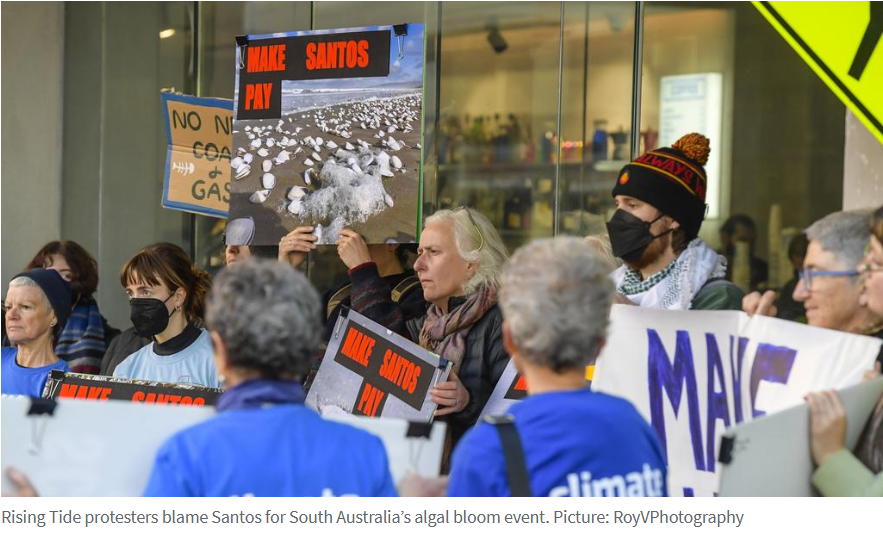
(July 30 protest against global warming at Santos offices in Adelaide. - source NT News)

Last week I went for a short walk along Seacliff Beach, one part of the unbroken stretch of suburban Adelaide beaches just kilometres form the CBD.

Every step of the way was littered with the washed-up bodies of dead marine life.

Most were benthic (bottom-feeding) species including masses of flathead, blue-swimmer crabs, abalone (with its much sought-after flesh still attached), mussels, razor fish, sea slugs, snails and worms.  There were lesser number of other species including trumpeters, toad fish, weedy whiting and red mullet.

And a dead swan.

Running parallel with the sea shore was a 50-metre width strip of brown murky water, part of the algal bloom which has turned much of Adelaide’s coastal waters to a marine graveyard.

The algal bloom first came to notice in March. Warmer waters and an absence of sea water disturbance during SA’s prolonged drought led to an explosion in the population of the toxic Karenia mikimotoi algae. We have reported several times on this.

In the immediate sense, nothing can be done until the bloom dissipates through natural means.

However, the SA algal bloom is a symptom of a sick ocean system that extends well beyond SA. On the day of my walk, news came through of a massive clean-up by volunteers of the beaches of Algiers where another algae native to the Pacific Ocean, Rugulopteryx okamurae, has found its way into the Mediterranean.  While the beach clean-up was underway on the southern side of the Mediterranean, on the northern side France and Greece were engulfed in massive wildfires that had caused loss of life.

The rise in global warming, brought on by carbon emissions from the use of fossil fuels, continues to endanger Australian coral reefs. 

The Great Barrier Reef has suffered mass bleaching in 2002, 2016, 2017, 2020, 2022, 2024 and now 2025. In the latest event, the Reef has suffered some of the most widespread coral loss ever seen and scientists warn that we’re approaching a moment where the coral may no longer be able to recover.

For the first time Ningaloo Reef on the opposite side of the continent suffered a bleaching event simultaneous with that of the Great Barrier Reef.  Once again, the word “unprecedented” has been used. 

Politicians ignore it at our peril.

Labor continues to wave through new coal and gas projects. The Nationals want to abandon net zero entirely. And the Liberals offer nothing. Australia remains the second-largest global exporter of fossil fuels.

Global warming is a part of capitalism’s destructive war on nature.

Capital must continue to accumulate by recreating its own value over and over again. In the process it exploits, ruins and diminishes the only two sources of that surplus value, human labour power and nature. The first can be kept alive and recreated at minimal cost to capital but the second can only be degraded and destroyed.

Biodiversity matters to the working class. Capitalism is the enemy of biodiversity and of workers. 

We must shutdown fossil fuel extraction, use and export.

We can only do that in an anti-imperialist independent and socialist Australia.

(On August 1, seven Extinction Rebellion members holding a marine life ‘die-in” were arrested at Santos offices in Adelaide.)


Taiwan: internal divisions as tensions rise

 Written by: (Contributed) on 10 August 2025


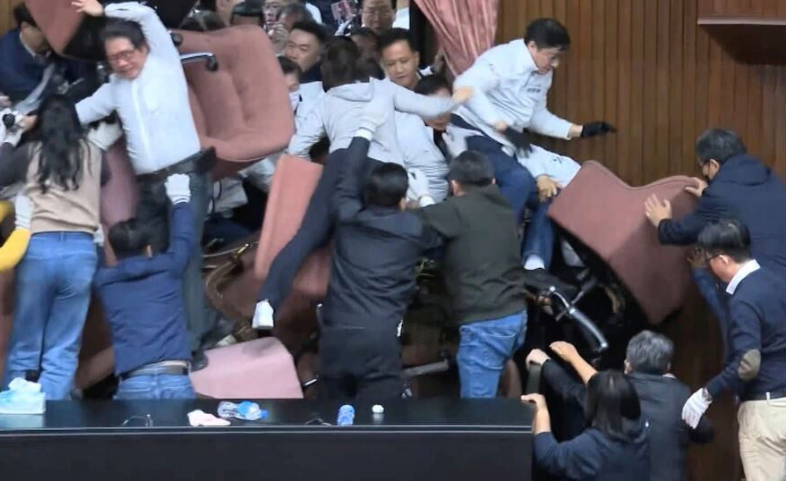
(Above: Parliamentary brawls are not uncommon in Taiwan)


Political controversy between the two major parties in Taiwan has carried all the hallmarks of classic US-led Cold War rivalries. The ruling Democratic Progressive Party (DPP), which managed to form a minority government following presidential elections last year, has recently attempted to challenge the main opposition nationalist Kuomintang (KMT). 

Constitutional attempts by the DPP to deal with the political stalemate, however, have to date failed to achieve objectives in a spectacular fashion and defeat. A further DPP-led round is, nevertheless, scheduled for late August, where another smaller group of KMT politicians will be targeted.

A recent DPP political initiative to oust 24 KMT M.P.s failed and has led to a heightening of tensions between the two major parties. (1) The electorate voted against the DPP move to overcome the stalemate: the DPP is, at present, faced with holding a minority government with 51 seats, while the rival KMT hold 52 seats. Neither party has overall control of the Taiwanese parliament; the DPP require at least six further seats at present held by the KMT to form a majority government.

Behind the scenes, however, a classic US-led Cold War scenario is being played-out. The DPP, being in line with pro-independence positions, is strongly backed by the US, the Pentagon, the US military industrial complex: the relationship is along lines of a puppet-master pulling strings over a puppet which dances and sings when required. The KMT retains a more conciliatory position toward China, and is, therefore, subject to US-led scrutiny.

The Taiwan Straits remains one of the potential flashpoints for US-China diplomatic hostilities; the Cold War is being played-out across a narrow strip of water separating China with Taiwan. The US also has a large presence in Taiwan, while officially and diplomatically recognising China, in line with the One China policy.

It is no surprise, therefore, to find the DPP regularly launching witch-hunts against the KMT, with allegations of pro-China espionage. They note, for example, that China 'has frequent contacts with the main opposition national party', implying connivance and influence with China's front organisations. (2) Another piece of supposed investigative journalism recently conducted on behalf of the DPP alleged that China had control of more than 5,000 spies in Taiwan. (3) It was designed to serve a deeper purpose than mere newsprint for casual readership.

Taiwan's spy agencies are based in the National Security Bureau (NSB), based in the Yang Ming Mountain district of Taipei. Its main focus is monitoring China. Its six divisions include: International Intelligence, China – Internal Security, Strategic Intelligence Analysis, Technological Intelligence, Telecommunications Security. (4) It permeates all level of Taiwanese society. The NSB is also authorised to 'integrate, co-ordinate and support national security-related intelligence operations conducted by various functional services within the intelligence and law enforcement community. Effectively it can act as a Joint Intelligence Organisation'. (5)

There remains little ambiguity about which foreign intelligence services the NSB retains strong links with.

The US State Department has about five hundred intelligence personnel based in Taipei; they are officially noted as being on 'temporary leave' from their employer. (6) They, nevertheless, conduct Cold War operations for the Pentagon, and push Taiwanese diplomacy into the wider Indo-Pacific region through the DPP-led New Southbound Policy. (7)

Washington is currently conducting a review 'of its military deployments worldwide – the expectation is it will lead to drawdowns in Europe'. (8) With the official position stated by Defence Secretary Pete Hegseth while addressing the Senate Armed Forces committee in June, that 'Beijing is preparing for war in the Indo-Pacific and the US is laser focused on strengthening deterrence across the region', there would appear little ambiguity about into which region the Pentagon is planning to deploy further personnel. (9)

In fact, it has been noted that 'Trump's view, also conveyed by Hegseth, is that the US is shifting its global priorities away from Europe and NATO to the American continental homeland and the Indo-Pacific region'. (10) Once it takes place, the strategic importance of Taiwan will be correspondingly enhanced still further.

The US intelligence presence in Taiwan is also directly linked to military arms sales and defence budgets. While the budgets vary with different US presidential administrations, they remain very large indeed when viewed with the geographical size of Taiwan.

                                               US ARMS SALES TO TAIWAN

                                                     1977-81  -  $548.7 million
                                                     1981-89  -  $1579.64
                                                     1989-93  -  $6847
                                                     1993-01  -  $17,070.6
                                                     2001-09  -  $29,938
                                                     2009-17  -  $14,070
                                                     2017-21  -  $18,047.86
                                                     2021-25  -  $7,727.4          
                                                Grand Total = $83,159.2 million     (11)

It is interesting to note, therefore, the recent heightening of political rivalries taking place in Taiwan took place after the DPP alleged that 'the KMT and its allies … blocked … key legislation, especially the defence budget, and passing controversial changes seen as diminishing the power of the executive and favouring China'. (12) The official statements are invariably timed alongside the circulation of bizarre conspiracy theories on-line which allege the KMT has been hollowed out by the Chinese intelligence services to serve the interests of Beijing.

In effect, the KMT while blocking the Taiwanese defence budget has been held responsible for challenging the US military-industrial complex. And, Taiwanese 'diplomacy', for the US, is big business. It is known, for example, that the US has 'been hoarding missiles for several years to strengthen its position in the Pacific region against China'. (13)

It was no great surprise, therefore, to find the Pentagon, with their compliant Taiwanese personnel, organised a major military exercise immediately prior to the attempt by the DPP to oust KMT M.P.s. The 2025 Annual Han Kuang exercises, run in conjunction with civilian drills, included 22,000 reservists, and were extended to ten days duration. The exercises the previous year were only of five days duration. (14) The 2025 exercises also included extensive simulations which included 'grey zone' provision, composed of tactical manoeuvres falling short of 'real-war scenarios'. (15)  

It is also highly significant to note that US intelligence assessments have predicted China will attempt to invade Taiwan in 2027. Their evidence, however, is not available in the public domain and would appear highly speculative. It, nevertheless, serves the military-industrial agenda, pursued along the lines of preserving the importance of Wall Street.

Despite influence being brought to bear upon the Taiwanese electorate to support the DPP minority government for ousting 24 KMT M.P.s, they voted to reject the plan, signifying a substantial shift has already taken place in popular opinion. It would appear the electorate favour a more conciliatory approach to dealing with China and favour closer relations.

Beijing, meanwhile, refuse to even deal with the DPP.

A statement from DPP Secretary-General Lin Yu-chang clearly reflected their disappointment at not winning the vote. He clarified their position as 'humbly accepting the results … and they had … responsibility to reflect on public sentiments more cautiously and adjust its approach to meet people’s expectations'. (16)  They had misread the electorate.

The next round of the DPP plan, however, is scheduled for 23 August, where they will target a further 7 KMT M.P.s. The influence brought to bear, this time, is that if the DPP plan fails again, the President Lai Ching-te administration will face 'strong resistance within the legislature before elections expected in 2028', the year after US predictions of China's plan to invade. (17) Whether an official presidential statement referring to the 'national direction of resisting communists and protecting Taiwan', carries any credibility with Taiwanese voters this time round remains to be seen. (18)

Is the DPP presidential administration merely clutching at straws to serve 'US interests'?

1.     Taiwan rejects bid to oust pro-China bloc, Australian, 28 July 2025.
2.     Taiwan's spy agency, AP., 12 January 2025.
3.     China might have more than 5,000 spies in Taiwan, Website: 1945 – 1 May 2025.
4.     Taiwan: Espionage, Spies and Secrets, Richard M. Bennett, (London, 2002), pp. 305-06.
5.     Ibid.
6.     Beijing keeps a wary eye on new US Taipei outpost, The Age, 18 June 2018.
7.     Ibid.
8.     Europe hopeful on troop numbers, Australian, 29 July 2025.
9.     US is carved into the landscape, The Weekend Australian, 12-13 July 2025.
10.   Trump's strategic blunders threaten US authority, Australian, 26 February 2025.
11.   Wikipedia: List of US arms sales to Taiwan, which has provided details of each individual arms sale with dates.
12.   Australian, op.cit., 28 July 2025.
13.   Missiles demand lifts US makers, The Weekend Australian, 26-27 July 2025.
14.   Taiwan launches largest drills, Australian, 10 July 2025.
15.   Ibid.
16.   Australian, op.cit., 28 July 2025.
17.   Ibid.
18.   Ibid.

Productivity: of what? from whom? for whom?

Written by: Humphrey McQueen on 11 August 2025
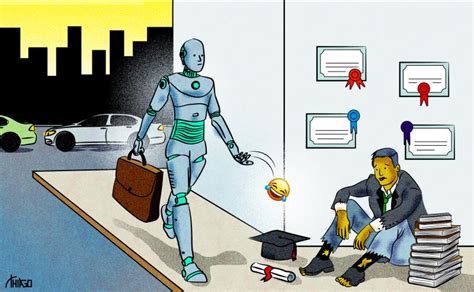
 

The Anti-labour Party administration is holding a Productivity gabfest in Canberra 19-21 August. Humphrey McQueen sets ‘productivity’ as a driver for the structured dynamics of how the exploitation of every wage-slave must be intensified if the rule of capital is to persist. 

Productivity: of what? from whom? for whom?


The drive for so-called productivity raises a central aspect of Marxism, namely, surplus-value. Militants need to understand the ramifications of that key to capitalism if we are to push back the current offensives. 

Labour-time

To win the battle of ideas in the latest contest over productivity, we should go back to what WorkChoices aimed to do for the expansion of capital. The ALP and most unions ran the line that WorkChoices combined a nasty man and wrong thinking with a fondness for wage-cuts.  Howard remains a nasty liar. However, his policies were more than another personality defect. Nor was he driven by bad ideas. Every social practice carries an ideological aspect. Neo-liberalism, for example, was more than a bad idea in the heads of nasty people. Like WorkChoices, it expressed the needs of capital, which is why we branded it WorstChoices. The needs of capital go beyond cutting wages. 

Neo-liberalism was a splendid idea for most sectors of global capital. Like Keynesianism and Monetarism, its days were numbered. How next to serve the interests of rival corporates, and their supporting nation-market-states, is being hammered out in Trump’s trade-wars.

WorkChoices was about the disciplining of labour-time. Capital buys our labour-power in units of labour-time. The productivity of capital is measured by how much value the boss-class can extract from those units.  Capital, therefore, drives up the rate of output per unit of labour-time that it subsumes as variable-capital. Managers do this through intensifying the discipline over us as their wage-slaves who embody the capacity to add value. 

Capitalists struggle to get rid of every obstacle to their freedom to have value added at any hour and under any condition. Even weak unions are a brake on the rate of exploitation of our labour. Hence, WorkChoices set out to universalize ABNs and individual contracts as barriers to our collective strength. 
Firms stand down workers without pay if there is a break in the reproduction or circulation of surplus-value. Bosses want to be free to call us in for random and/or broken shifts. That control over hours delivers a double advantage to capital. First, it pays for our labour-power only when we wage-slaves are adding value. Secondly, the uncertainty of shifts bullies unorganized employees into doing whatever they are told for fear of not getting enough shifts to eke out a living. The bosses lie that flexibility makes life easier for single mums.

Wages

On average, the personifications of capital pay us in full for the socially-necessary costs of reproducing our labour-power. That is what bosses mean by a fair day’s pay. Of course, they battle to keep all the value that is surplus to that amount. On top of enduring exploitation in spite of an equal exchange, workers know only too well how much swindling goes on. In practice, the bosses do everything they can to pay below that socially-necessary average. They will not pay super or penalty rates unless we are organised enough to force them. Here is one of the reasons why WorstChoices set out to disorganize working-people.

Of course, firms would rather pay us no wage at all, but then they would have no living-labour to exploit or buyers for those producing consumer goods, and, in the longer term, no orders would be placed with the firms that make the machines on which we make both kinds of commodities. 

Capitals are not just involved in a race to the bottom on wages. There is no point in paying a dollar a day for one pair of shoes if a worker with a machine can make ten pairs in an hour. The low-wage factories, here and abroad, combine longer hours, more intense discipline and hazardous conditions. Factory disasters in Bangladesh are driven by deadlines for foreign orders. Deadlines indeed!

The rate of our exploitation is not measured by wage-scales. A skilled worker on $130,000 a year can deliver more surplus-value than a peasant trained to snap parts together. Hence, the best-rewarded employees can be more exploited than the worst paid. 

Absolute surplus-value

Two ways to extend the length of the working-day are unpaid overtime and abolishing smokos. Bosses are also notorious for owning clocks which run fast in the morning and slow in the afternoon. Women at call centers in the U.S. of A. are forced to wear diapers instead of going to the lavatory. Stepping up exploitation by a longer day is becoming more pervasive now with mobiles, i-pads and home computers which keep workers on call 24/7. 

Capital increases its take of surplus-value by extending the number of hours we work. Its owners can benefit even if these extra hours are paid for at overtime rates. This is possible because equipment is not idle and so the overhead for each unit of output is lowered. Best of all for capital is unpaid overtime, and there is plenty of that. 

The greater the value of the plant, the more pressures on the agents of capital never to let it stand idle. Mining is a prime example, with twelve-hour shifts. Computer-controlled equipment sees RioTinto operating around the clock in the Pilbara.

Relative surplus-value

At the same time, the agents of capital try to extract more surplus-value during the standard hours. They strive to do this through piece-rates, speed-ups, and bullying.  

Occupational health and safety fall victim to productivity drives. Through speed-ups, capital passes the cost onto the worker through injury and death. The law backs them up. As Marx puts it: killing is not murder when done for profit. Year in and year out, supermarket-chains drive truckies to drugs and death to meet delivery schedules. Rio is pushing to cut sick-leave entitlements from forty-five to fifteen days a year.

Because capitalists install machines to extract more surplus-value, they invest in new technologies if they promise to lift the rate of exploitation, or to ward off rivals. The bosses favour innovation only when it protects profit. Labourers with picks and shovels produced as much surplus-value as the driver of a front-end loader when those navvies were on the dole in the 1930s.   

‘Your prize for saving time at work with AI is more work,’ declares a headline in The Wall Street Journal, July 7, 2025. Who ‘owns’ the time saved? Labour or capital? The answer depends on whether we are working for wages, or are on piece-rates. If we have exchanged timed units of our labour-power for an agreed wage, all the time saved still belongs to the buyer of our capacities to add value. If you are on piece-rates, the time is yours. The catch is that the agents of capital will force down the price they pay per unit so that you will need to work longer to take home the same weekly income. By wages or by piece? Same difference.

Accumulation

Under the rule of capital, the only way to add value is through our exploitation to fund expansion. To do so, the personifications of capital first has to exploit labour to extract surplus-value; secondly, their agents has to sell the goods and services we supply so that as much surplus-value as possible can be realised as profit; thirdly, they have to invest much of that profit in resources for reproduction to hold off competitors. Only then can capital go on to extract ever more surplus-value. … and so on …. until the next crisis.

Profit-taking is not an end in itself, just as exploitation is but one step towards the expansion of capital. ‘Accumulate! Accumulate!’ Marx writes. ‘That is Moses and the Prophets.’ A capitalist who puts self-indulgence above re-investment soon ceases to be a capitalist.

Marx explains how money-capital goes into the production of commodities, which must be sold to secure a greater sum of money-capital to re-invest. The most important component in these new commodities is that they carry more value than went into their production. That extra comes from our labour. 

Excess capacity
 
Each capital strives to get a bigger share of its market. To do so, it produces more units to sell at a lower price per item. Each commodity unit therefore carries less surplus-value. That smaller portion means less potential for profit-taking out of each sale. To make up for that shrinkage, each firm tries to sell a larger number of units. The result is overproduction. Hence, capitalism is inherently wasteful.  In addition, the more goods that the system produces the more unstable it becomes. 
 
Workers are the largest group of potential buyers of consumer goods but, because of exploitation, we cannot afford to buy all that we produce. After the 1940s, the agents of capital sought to bridge that gap by hire-purchase and credit cards. The 2006- economic implosion was delayed by pushing up debt-levels among working- people. The sub-prime crisis in the U.S. of A. was the froth on a tsunami of mass-marketing. The so-called Global Financial Crisis (GFC) crashed out of over-production.
 
By then, the capacity to make autos in North America was greater than the effective demand across the world. The closure of all the car-makers in Australia was one more backwash from that excess capacity. Crises from over-production lead to the destruction of physical capital. With that loss comes the destruction of people’s lives. 
 
In 2008, Central Banks again rode to the rescue of the entire system upon which depends on its financial sector for flows of money-capital and credit.
 
Unproductive?
 
Productive and unproductive are scientific terms. To say that some kinds of labour are unproductive is not just a moral judgement. For capital, ‘productive’ means labour that is productive of surplus value. As Marx puts it: ‘To be a productive worker is therefore not a piece of luck, but a misfortune.’ (Capital, I: 644)
 
Take the example of an operative painter. When she goes to her paid work, she sells her capacity to add value to capital. Its agents discipline the application of her labour-power at work to extract as much surplus-value as possible. 
 
Now contrast that situation with one where she helps to repaint her friend’s house. She uses the same skills as she does at paid work, but she produces no surplus-value. Why not? Because she has not sold her labour-power to capital. According to the needs of capital, that labour is unproductive. At work, she produces a use value and an exchange value. At her friend’s home, she produces only use-values. 
 
Service sector
 
We often hear that the service sector has displaced manufacturing. White-and pink-collar jobs for public servants, bank clerks, nurses, teachers, shop assistants and barristas are our future. It is truer to say that many service workers have moved from what for capital is unproductive across to productive labour. A hundred years ago, Australia had 150,000 domestic servants. They were known as ‘slavies,’ on call round the clock with perhaps one day off a month. Nonetheless, they were unproductive. None of them added surplus-value. Rather, they were paid out of the surplus-value extracted from wage-slaves elsewhere in the system.
 
What has changed is that most service-workers now produce surplus- value. In 1913, domestics worked for an allowance and their keep in return for putting a roast chicken on the dinner table. In 2025, people sell their labour-power to KFC to put chicken nuggets into take-away cartons. They service capital, not households. Putting less labour-time into each meal is the spice in capital’s finger-lickin’ recipe for profit.
 
Quality service 
 
To boost labour productivity, capital has to measure output which is difficult for the service sector. Human services have a twofold character: one is quantitative while the other is qualitative. Take the example of a library. Some of its tasks are like process-work, for example, the restacking of books. Here, it is possible to set targets as a manager would do on an assembly-line. However, libraries have a second function. Some users seek help to understand what a resource offers them. These inquiries can take two minutes - or two hours. The call for quality overtakes the drive for quantity.
 
That rule applies more broadly. For instance, it is madness to say that placing a stent into an artery should take forty-seven minutes and not one second more. Similar complications arise for teachers. Each child has individual needs but providing that level of attention is costly. Budget-cutting governments, therefore, drive schools into rote-learning and Gillard’s standardized NAPLAN tests are serial child-abuse.  Education is reverting to instruction which undermines creativity in adulthood.
 
Self-servicing capital
 
Capital shifts costs onto customers by making us pay with our time. We see that tactic in supermarkets with self-checkouts, while banks installed ATMs and on-line transactions. Or we are made to queue for longer because Coles and Westpac employ fewer staff.
 
As a result, we customers provide our time for free to replace the counter-staff. We are told how convenient the new arrangements are for us as customers. We are not told how much of our time we give to the corporates as unpaid labour.  Self-service thereby boosts profit. Banks take their billions from interest rates, fees and from sending work off-shore. They also coin more money through treating us as unpaid hands.
 
Practical theory
 
Communists show why capital is driven to boost its rate of exploitation. Marx’s account of exploitation applies in every workplace. Nonetheless, exactly how surplus-value is extracted and circulates is peculiar to each hour and location. Militants enrich Marx’s scientific discoveries by investigating how surplus-value is produced in millions of situations.
 
Communists work out ways to relate the truth about productivity to hour-by-hour issues around the job. Hence, our twin tasks are to study Marx’s critical analysis of the political economy of the capitalist mode of reproduction and exchange on expanding scales, while attending to everyday conflicts in each workplace. We learn from our collective study and from the shared experience of struggle. Organising becomes an education for agitators as much as for the rank-and-file in a living unity of theory and practice.
 
One task is to discover how the buzzword ‘productivity’ strikes other workers. Some will already see through it as propaganda for more exploitation. Militants can spread those insights. Among some of the rank-and-file, however, there will be uncertainty. Some will assume they ‘unproductive’ applies to others. Some might see positive features in the rhetoric. ‘Shouldn’t we all contribute?,’ they’ll wonder. Yes, and our class does so, but the bosses are forever on the take, and give only when we force them to do so. 
 
Self-deception
 
Confusion about the substance of ‘productivity’ exists on both sides of the class divide. Because the boss-class dare not own up to the fact that the expansion of capital depends on our exploitation, they need to believe in their own propaganda.
 
The hired-pens of capital are no longer game to admit the truth even among themselves. Before the 1820s, bourgeois political economists - Adam Smith and David Ricardo - owned up to exploitation. Once workers got organised, the promoters of capital had to mask that truth. Yet bourgeois economists still had to advise capitalists on how to expand, and so marginalized production to focus on consumption. 
 
Smith and Ricardo accepted that only living-labour added value. The current crop of apologists claim that value is decided by consumer preference. They reject the law of value in favour of their so-called law of supply and demand. They deny that prices gyrate around the value of the labour-power that goes into commodities. One side-effect is that many believe that selling shares to the greater fool is productive of value.


Market-value

If productivity is down, how is it that the ASX is going gang-busters through all previous records? And why is that happening if price/earning ratios on shares are also through the roof?

When capitalists are not rabbiting on about ‘productivity’ as if it were a universal good, they babble about ‘adding value’, blurring the one into the other. Accountants have long grappled with how to put a monetary value on businesses. One rule is to deduct liabilities from assets. But what counts as an asset? Should auditors embrace goodwill and brand recognition? If so, how to put a number of those intangibles? Nowadays, they are paid to accept whatever a corporation’s Chief Information and Financial Officers claim their ‘values’ are, and paint the bullseye around the arrow.

Piero Sraffa’s 1926 “The Laws of Return under Competitive Conditions” pondered how to measure the value of capital? In terms of its profit? If so, how to measure profit? If it is measured as a percentage of the value of capital, the process is circular. The professoriate abandoned attempts to resolve the paradox. Economics undergrads will never hear of Sraffa’s article, and most of their lecturers won’t have either. Ignorance is bliss.

Upon the announcement of China’s Deepseek in late January, the media reported that billions had been wiped off NVIDIA’s value with. Most of those billions never existed, but were one form of fictitious capital. Such figures are arrived at by multiplying the price of the last share traded by the total number of shares. Speculators erect Babel Towers of marked cards.

No sector in recent capitalism has been more innovative in this regard than finance. Yet, the world’s most successful investor, Warren Buffett, refused to buy into derivatives or collateralized-debt obligations because he could not understand them. The crash of 2007-8 suggests that traders did not understand them either. What they did understand was they had invented new ways to collar cash without going through the tiresome and risky business of making and selling commodities. Most of these financial instruments are parasitical on the capitalists engaged in exploiting us directly do so.

And so are all rent-takers, of whom two-dollar Rinehart is the exemplar. Until recently, she did not exploit mine-workers directly. Instead, she had lived off the rents that Rio paid her for the whack of leases nicked by her father from his partner Peter Wright. She had been unproductive in the worst sense. 

Producing barbarism

Under capitalism, even the most destructive enterprises are deemed productive so long as they add surplus-value. Wars and drugs are prime examples.
It is easy to see how war is productive of profit for individual corporations from Haliburton to Boeing. But war can also be productive for the whole capitalist system. The biggest example is how military expenditures kicked the U.S. out of its 1930s deflationary cycle. 

Drugs also benefit more than Big Pharma. Western imperialists used opium in the nineteenth-century as a weapon against the Chinese people to open China up to unequal ‘free-trade’ treaties. Today’s drug trade is productive of profit with cocaine and heroin just other commodities, like Coca-Cola and Holden cars. In addition, more drug money goes through the banks and other casinos than governments ever confiscate as the proceeds of crime. 

Producing communism

Within capitalism, unproductive labour is morally superior to productive labour since the latter is grounded on exploitation. Under communism, all labour will become unproductive in the sense that there will no longer be exploitation.

Communists raise tough questions about productivity: what kind of society is produced? We draw a line between what is productive under the rule of capital and what should be produced to serve the needs of working people. For capital, productivity means the addition of surplus-value. Workers struggle to produce a world without the want, the wars and the waste that capitalism over-produces.

Boosting ‘productivity’ under capitalism has landed the world with a super-abundance of material goods. Their over-production plunders the wealth of nature, leaving mountains of garbage and oceans polluted with islands of plastic waste. 

Surplus-value comes from the collective efforts of working people everywhere. Hence, no individual is responsible for all of the value that he or she adds. A lone craftsperson depends on workers in transport and power supply. Under socialism, all workers will be paid the full cost of reproducing our labour power. Some of that reward will come to us as money-wages. The closer we move towards communism, the more of our needs will be supplied as social goods, such as free public-transport, education, health and housing. 

When communists speak of boosting productivity, we hold to a vision about the kind of society that we can build together. Our collective efforts promise to enrich individual creativity, protect the wealth of nature, and meet our collective needs. Engels explained the part played by labour in the transition from ape to man. Putting the highest social value onto the productivity of social labour will make us more human.

 Appendix on the Productivity Commission

Abbott pledged in 2013 not to bring back WorkChoices. Capital had less need for its attacks on our conditions since the Rudd-Gillard Anti-labour Party (ALP) had kept most of its teeth as un-Fair Work Australia. ‘Protected Acton’ protects the bosses from our taking action.
 
They followed from Keating who, late in 1993, had invited the CEOs of the biggest corporates to a slap-up at Canberra’s Hyatt Hotel where he assured them that he would remove all ‘impediments’ to their productivity – that is, all the protections our class had won across 150 years and which the Anti-labour Party’s deforms had not abolished during the previous decade. 
 
Moreover, the boss-class has other laws to use against us. Their aim is to corner unions into being able to do next-to-nothing. The ones that do stick up for their members will be placed under ‘Administration,’ as with the CFMEU. 
 
But, in 2013, Abbott referred ‘industrial relations’ to the Productivity Commission which is stuffed with votaries of ‘the Market’s’ going around the globe doing good, in practice, exercising the market power of global oligopolizers. Even when a couple of its 200 staff do first-rate research, the Commissioners rewrite the conclusions to prove that ‘the Market’ knows better. 
 
Calling on the Commission for ‘expert’ advice is a fraud. Its recommendations are predicable since its econo-meretricious models never stray far from what the Business Council struggles to enforce around the jobs.
 
The Commission put out a paper in 2013 arguing that disadvantaged students are genetically disabled so that implementing Gonski would be a waste of taxes. Professor Ian Morgan’s “No evidence for ‘Rich Genes’ “ accessible on the Save-Our-Schools website saw off this viciousness. (July 26, 2013)
 
Even the Commission’s name is a blind. The organisation had its origins in the Tariff Board. When Whitlam slashed tariffs by 25 percent in 1973, he replaced the Board with an Industries Assistance Commission. That body soon became known as the Industries ‘Destruction’ Commission when it removed protection. In 1998, Howard rebadged the Commission with ‘Productivity.’ 
 
Two recent manifestations of its faith in ‘market forces’ are its attack on the government’s plan for industry interventions as an act of sacrilege.
 
In the lead-up to the Productivity gab-fest in Canberra on 19-21 August, the Commissioners are railing against copyright protection for the Australian workers whose creativity surely will contribute to improvements in productivity.
 
The Commissioners know next-to-nothing about what it labels ‘AI,’ proceeding as if there were no distinction between generative AI and Artificial General Intelligence. They have swallowed the media hype from venture capitalists to the extent that they suppose that a seventy-year-old technology is ‘new,’ when what is changing is the sprawl of its applications. Sam Altman did not invent the algorithm, nor had a NVIDIA gamster.
 
Abstracting from the abracadabra of its algebraic models, the Report confabulated that some undifferentiated AI will add $168bn to the Australian economy in the coming decade. Should that turn out to be the case, the question for our class remains: whose coffers will swell with the profits from the growth in the relative surplus-value that we shall be forced to supply?