Showing posts with label space warfare. Show all posts

Wednesday, July 22, 2026

The frenzied race for Space


On Tuesday July 21, the federal government released a new Statement on Space.

Space, and particularly cislunar Space or the area between the earth and the moon, is an economic and military place of growing importance featuring a race for its domination and control between the major imperialist blocs of the United States, the European Union, Russia and China.

The global space economy is estimated to have already surpassed half a trillion dollars in annual value and could approach or exceed US$1 trillion within a decade. Few sectors can point to a similar growth trajectory.

There are now more than 30,000 human-made objects in Space, many in constellations of satellite groups tied to terrestrial observation and communication. Leon Musk’s Starlink currently consists of 10,413 satellites in Low Earth Orbit (LEO) providing broadband Internet service in approximately 160 countries and territories. Meanwhile, China has submitted proposals for or two constellations, the first dubbed CTC-1 with 96,714 satellites alongside a second, creatively called CTC-2, having 96,714 spacecraft too, for an insane total of 193,428 satellites across the two networks (far more than Starlink’s proposed 42,000). The submission states that the satellites will focus “on technologies such as detection and inspection in the field of low-altitude electromagnetic space security, integrated security defense systems, electromagnetic space security assessment of airspace, and low-altitude airspace safety supervision services”.

Companies such as the US Marvel Space Communications, the US-French E - SPACE, and Canada’s Kepler Communications have applied for LEO satellite network data for 170,000, 110,000, and 110,000 satellites respectively.

This reflects that the competition in the current satellite field, especially in low - orbit satellite constellations, is becoming increasingly fierce.

The amount of space junk – debris left from abandoned launch rockets and decommissioned satellites – is already a major concern as the potential for space junk-satellite collisions grows. It is the idiot side of the commercial frenzy behind satellite placements.

What is also a concern alongside the commercialisation of Space is its militarisation.

The Chinese statement above refers to “integrated security defense systems”, and the US has created a Space arm of its Department of War (SPACECOM) with plans for armed humans (“Space Guardians”) to be placed in orbit to ensure US control of Space by military means.

Following the lead of its US masters, the Australian government earlier this year released the 2026 Defence Strategy which referred to the new five domains of warfare: land, sea, air, space and cyber. According to the Australian Space Agency, “Space command is now recognised as an important defence domain alongside air, land, sea and cyber operations.”

Tuesday’s release of the Statement on Space identifies five areas of Australian space capability:

Trusted space services 
Spaceflight ecosystem 
Space platforms 
Microgravity ecosystem 
Exploration technologies  

It makes little mention of the military objective of Space command knowing that Australian support for the US militarisation of Space will be controversial. However, there are nine references in the document to defence, and it notes that further reference to the military use of Space is kept separate from the Statement:

The Statement on Space complements, but remains distinct from, ongoing work and dedicated arrangements on space technology development, adoption and use by Australia’s national security, defence, intelligence and law enforcement agencies.

A government committed to independent and peaceful relations with the global community would have no hesitation in declaring that Australia will not participate in the militarisation of Space. It would require our representatives at the United Nations to recommend the Outer Space Treaty be updated and tightened to include a prohibition on the deployment of all types of weapons in Space and to prevent the use of Space for directing warfare on the Earth.

Until we have a genuinely anti-imperialist Australian independence, we will never have such a government.

Wednesday, July 1, 2026

“We must ensure the next war is won, not lost, in space” says retired US Air Force general

Written by: Nick G. on July 1, 2026


Retired General Jim Slife, former USAF Vice Chief of Staff, has criticised current space warfare planning, saying that obsolete acquisition programs need to be urgently replaced to enable the US to catch up with China in the race for domination of Space.

In a June 24, 2026 opinion piece, he said “Space is now the ultimate high ground in warfighting. Whoever dominates space has a decisive advantage over our adversaries. The recent combat operations in Iran, Ukraine, and Venezuela, where space operations were vital to each and every movement of military forces, have shattered any remaining illusions about space having a secondary role in modern conflict.”

In case anyone took that to mean only the use of satellites to direct ground fighting, he explained that “True space superiority requires systems capable of active orbital mobility that can maneuver on demand, inspect anomalies in real time, and actively service or physically safeguard our critical infrastructure under fire by firing back.”

Unlike objects in geostationary location (for example, a satellite positioned to be directly over Melbourne at all times), the US Space Force is now embracing the concept of satellites with the ability to move freely on orbit over long periods of time as a foundation for orbital warfare (see: Shifting gears: Space Force moves to embrace space mobility for orbital warfare - Breaking Defense ).

Slife says the US has the twin advantages of the world’s largest pools of venture capital and an innovation culture rooted in start-ups, and calls for funding to move away from prime contractors like Raytheon and Northrop Grumman. 

Slife himself now works for venture capitalist Scout Ventures, the FTG & Co. Investment Bank and as strategic advisor for a number of defence technology and aerospace firms. He exemplifies the military-finance capital complex that is advocating for the military control of Space by US imperialism.

Pointing to the need to catch up with China in the race for Space, he said “In 2024, the Space Force publicly confirmed five Chinese satellites conducted coordinated proximity maneuvers in low-Earth orbit, described by Space Force Gen. Mike Guetlein as satellite “dogfighting.” Beijing has since demonstrated on-orbit satellite refueling in geostationary orbit, extending the operational life of assets we cannot currently match.”

Meanwhile, on June 23rd and 24th, space agency heads and senior officials from the ten BRICS nations gathered in Bengaluru, India, to attend their latest high-level discussions on outer space. The group considered the idea of a Space Council that has been primarily advocated for by Russia since 2024 as an entity that can facilitate more complex and costly cooperation between the member states.

Inter-imperialist rivalry over Space runs counter to the UN Outer Space Treaty (OSP) which defines Outer Space as being “for the benefit and in the interests of all countries and shall be the province of all mankind”.

The UN OSP is already being violated by imperialist interests. The commercial colonisation and militarisation of Space must be condemned by all of humanity. 


Tuesday, June 2, 2026

EOS builds its own military-industrial complex

Written by: Nick G. on 2 June 2026


Australian company EOS has just announced the appointment of Air Vice-Marshal (Ret’d) Catherine Roberts AO, CSC and Major General (Ret’d) Kathryn Toohey AM, CSC as Non-Executive Directors, effective 1 June 2026.

Roberts was Australia’s inaugural Commander of Defence Space Command, led the establishment and operational delivery of Australia’s military space capability and has worked extensively with allied defence and government organisations across North America, Europe and the Indo-Pacific.

Toohey has worked in sovereign defence capability, infrastructure, digital systems and national security environments. She is on the board of right-wing opinion maker Australian Strategic Policy Institute Ltd.

The following excerpt from our recent publication “Fight the Militarisation of Space” may help to understand the significance of this merging of industrial and military interests and their application to the military domain of Space:

On November 30, 2023, the Australian Defence Magazine hosted a Space Summit in Canberra. If the various imperialist blocs actually honoured the UN Outer Space Treaty there would never have been such a Summit. 

This was made clear by the contribution to the Summit of Australian company Electro Optic Systems (EOS). The company began operating more than 40 years ago in the civilian arena, but has increasingly focussed on the following: 

• space domain intelligence and control services 
• laser, remote weapon system and counter-drone technologies 
• high-performance naval satellite communications products 

2022 was a disastrous year for the company financially, and it lost many staff. Its Chairman and CEO told shareholders in the 2022 annual report that they were cutting back so “we are focused on core business areas where we have genuine technological advantages over competitors. Current examples include our family of remote weapon systems (RWS); our long-established expertise in space domain awareness and other space services”. The presentation it made at the Summit was basically to sell its services to US imperialism in its contention with Chinese social-imperialism over the seeking of military superiority in Space. 

It claimed that Australia is one of just two countries with the capabilities to neutralise large numbers of satellites passing over its territory. EOS spokesperson Dr Ben Greene said Australian Space Domain Awareness (SDA) covered around one sixth of the sky, delivered by, among others, EOS with its laser tracking facility in Canberra, the RAAF’s space telescope in WA and the new US-owned LeoLabs Australia space radar, also in WA. 

“We could intercept and interdict the satellite operations of any country on earth, if we chose to. That’s a really powerful platform for us,” he said. “It’s quite feasible now to talk about taking out hundreds of satellites a day if that was necessary.”

The US imperialist drive for control of Space, aided and abetted by the likes of EOS, was revealed on May 29 by the US SPACECOM’s Chief Scientist who said that “Developing capabilities for operations in cislunar space, including offensive space control, is among the top new science and technology (S&T) priorities for US Space Command (SPACECOM)”. This was reported in the US online journal Breaking Defense (see: SPACECOM exploring tech for future offensive cislunar ops: Chief Scientist - Breaking Defense ).

He added, “…we want to exploit that space from an offensive sort of space control perspective.” 

Both SPACECOM and the Space Force have been expressing increased interest in future operations in the vast volumes of space between Earth’s outer orbit and that of the moon as an outgrowth of President Donald Trump’s December Executive Order on space superiority.

A SPACECOM spokesperson said the aim was that the US, “working alongside its allies and partners, has the freedom of action to operate in space and the ability to project power when and where required.”

EOS’s appointments of senior retired military personnel to its board indicates that it will seek to profit from the US militarisation of Space.

We must stop Australia’s involvement in the US military’s colonisation of Space.

Wednesday, May 27, 2026

Contradictions and conflicts in the race for Space

Written by: Nick G. on 27 May 2026


The contest for the domination of Space between China and the US is reflected in yesterday’s (May 26) announcement by NASA that it plans to inhabit the Moon. However, the hawks pushing for a militarised Space are demanding to be included in the action.

Since Trump’s appointment of Jared Isaacman as NASA Administrator last December, NASA has released various announcements about US objectives, particularly in relation to the Artemis II circumnavigation of the Moon. Isaacman in his private capacity has flown in Space aboard Elon Musk’s SpaceX Inspiration4. He is a billionaire whose wealth came from a credit card processing company he founded, and he has a private fleet of jet fighters to train the U.S. military for aerial combat.

Yesterday’s announcement packaged previous statements into a plan for a permanent lunar outpost, involving robotic landers, moon buggies and hopping drones before the expiry of Trump’s presidency. Placing astronauts on the Moon by this date will also give the US a jump on China, which currently has four astronauts (Taikonauts) on permanent rotation aboard its Tiangong space station. It has announced plans to land two astronauts on the Moon before 2030.

The threat of lunar colonisation 

The 1967 UN Outer Space Treaty (OST) defines the Moon and all outer space as the "province of all mankind". It says that outer space is “not subject to national appropriation by claim of sovereignty, by means of use or occupation, or by any other means”. 

Despite this, the US is commercialising its work in Space and speaks of the Moon as its property.

On 24 March, Isaacman said that “NASA is committed to achieving the near impossible once again, to return to the Moon before the end of President Trump’s term, build a Moon base, establish an enduring presence, and do the other things needed to ensure American leadership in space… This time, the goal is not flags and footprints. This time, the goal is to stay. America will never again give up the moon.” 

The White House’s official X account released a graphic with Isaacman’s pledge.

Military muscling in 

Belligerent and hawkish opinion makers in the military are demanding their cut of the action.

They point out that China’s space program is “completely military-led” whereas “the United State has long maintained separation between its military and civilian space enterprises.” 

This, claims Col. Kyle Pumroy (Ret.) writing in the Mitchell Institute for Aerospace Studies’ paper “Military Human Spaceflight: A Key Component to US Space Superiority”, places the US at a disadvantage in the race with China for control of Space.

Sounding like something out of science fiction, Pumroy argues that “now is the time to begin placing Guardians in space to develop the skills, tools, and concepts to build a future capacity to defend core US interests…”

“Guardians”?  The term was adopted by the US Space Force in 2020 for its service members, analogous to “soldiers” in the Army or “sailors” in the Navy. So “Guardians in Space” means actual Space Force personnel physically operating in orbit, on space stations, or potentially on the Moon, rather than controlling satellites remotely from Earth.   

As a branch of the military, Pumroy argues, the Guardians need the legal protection of the US Congress’ Title 10 of the US Code which authorises all aspects of military organisation and operation. 

“While upholding the OST should be the United States’ desire and priority, pragmatically, it must prepare otherwise,” writes Pumroy. “Only Guardians can ensure human spaceflight dominance and maintain the strategic flexibility to conduct Title 10 operations in defence of US interests in space.”

In the Communist Manifesto, Marx and Engels made the observation that “The need of a constantly expanding market for its products chases the bourgeoisie over the entire surface of the globe. It must nestle everywhere, settle everywhere, establish connexions everywhere.”

Now, with Isaacman, the logic of colonial exploitation reemerges with this commercial imperative: “The Artemis program will live on past any one launch vehicle, and at some point in the future, transition to commercial pathways with crewed missions as often as every six months to ensure we never give up the Moon again…. stimulates a lunar economy…(and) Ignite the orbital economy – launch frequent astronaut missions to the Space Station, prioritize high ‘commercial potential’ science, work to stimulate more private astronaut missions and support a transition to one or more commercial space stations.”

Stop the militarisation of Space!
No to the colonisation of the Moon!
End the US-China Space race!

Sunday, May 24, 2026

Fight the militarisation of Space


A new Party publication focuses on Australian involvement in the militarisation of Space. Wars of the past were fought in three domains: land, sea and air. Two new domains have now been added, cyber and Space, the later in violation of the UN Outer Space Treaty. The booklet “Fight the Militarisation of Space” can be downloaded here: https://www.cpaml.org/web/uploads2/Stop+the+militarisation+of+space.pdf #auspol

Wednesday, December 10, 2025

Dangers in multinational corporations’ drive to establish Space-based data centres

 Written by: (Contributed) on 9 December 2025


The dividing line between legitimate intelligence-gathering and the accumulation of vast troves of personal data accessed through questionable means has always been blurred. The problem now, however, is set to escalate, if recently announced plans are ever implemented: western intelligence services, and their associates, will be able to operate in a totally non-regulated and unaccountable manner. Further considerations also arise about spurious tax-payer funded research programs designed, specifically, for other purposes and other agendas.

A seemingly innocent looking article in the Australian business press in November has thrown light upon defence and security planning to 'build gigantic data centres to run artificial-intelligence models among the stars'. (1) Those concerned are, presumably, planning satellite-systems specifically for the purpose. The use of AI is generally considered to also provide spooks with increased opportunities for data-mining and profiling of whole populations.

Declassified documents from the previous Cold War reveal a great deal about the power of the state to profile a general population. There is no reason to think the same procedures are not now taking place with the present Cold War. (2)

Australia, however, has some limited regulations to prevent cyber-crime, and also some accountability through declining freedom of information legislation. While problems arise, the regulations provide some restrictions to most data-mining practices, which can be very unpleasant, particularly when they occur under the guise of respectable correspondence with links which can be used to let unwanted intruders into computerised systems. Once they are in it is often difficult to get them to leave. Recent publicity about cyber-crime in Australia, for example, has noted the following problems have become increasingly commonplace: email compromise, ransom-ware extortion, remote access scams, phishing, cyber-enabled investment scams, identity theft and sextortion. (3)

Revelations that AI platforms can be hacked within minutes have provided a highly probable nightmare scenario, more likely sooner rather than later. (4)

Attention was drawn to some possible scenarios by a top cyber-security former advisor to the US National Security Agency (NSA) recently, when he acknowledged areas of concern included 'privileged communications with a lawyer or human resources regarding an employee matter or even a customer'. (5) Our civil liberties hang by a thread.

Revelations that Australian Super funds have already been hacked into have sent warning signals to the general public; while law enforcement agencies have issued official press releases, the matter has been given little publicity. (6)

The Australian cyber-crime legislation and the restrictions it presents, however, have been duly noted by the cyber-spooks; the article about data-centres in outer space, for example noted, 'there aren't those pesky regulations that executives like to complain about ... to meet data-centre needs'. (7) The law means nothing to such people. Making a fast buck is all that really matters. When their research is subsidised with government support they really do get enthusiastic. 

The article then noted the new Project Suncatcher aimed 'to scale machine learning in space. It plans to launch two satellites by early 2027 to test its hardware in orbit'. (8) Planning would appear well under-way to implement data-centres in outer space within a few years.

The procedure for circumventing civil liberties through advanced telecommunications is not, however, anything new. In fact, the US-led Echelon system became operational decades ago. While based in the NSA, at Fort Meade in Maryland, it effectively uses networks of computers which intercept telecommunications and relay the information to another Five Eyes partner to avoid detection and unwanted publicity.

The NSA, for example, can monitor all Australian telecommunications without a warrant to authorise data-mining and intelligence-gathering; Australians might think they are protected by Canberra, in reality, however, they have no control over US facilities and their satellite systems, even though they are routed through Pine Gap in Central Australia. (9)

Studies of the Echelon system have noted it has also 'created an awesome spying capacity for the USA, allowing it to monitor continuously most of the world's communications targeting civilian as well as military traffic'. (10) Based on data-collection activated by trigger words, vast troves of personal information are systematically gathered for analysis and profiling. Those pursuing the data-collection remain totally unaccountable.

The system has been systematically updated and is now beginning to experiment with AI.

And there is no jurisdiction; outer space is out-of-bounds for law enforcement agencies.

Just how much of the massive allocation of official funding for space research, from Australian tax-payers money, has been directed toward these projects designed specifically to systematically enhance class and state power remains a question of which there have been no answers. Nor are any expected. The proportion of the funding allocations specifically directed toward US defence and security considerations, likewise, will of course, be subject to official diplomatic silence. They have too much to hide from making open statements.

The 'accidents' and 'mistakes' which are highly likely to have serious implications for ordinary Australian people, are just waiting to happen. Many already occur through use of older technology and a multitude of problems pursued by those holding questionable agendas in decision-making positions. The recruitment to elite government departments is hardly representative of the population at large; it is filled largely by elite patronage systems to serve elites and those in control, who do not like opposition or those who ask questions and present a challenge. Government departments usually display a fortress mentality.

Peering through the seemingly opaque fortress mentality is difficult, but recent statements from Canberra have offered an indication that preparations are well under-way for the data-centres in outer space. A present review of the ADF, for example, has revealed senior commanders possessing 'complex new roles, including space and cyber positions'. (11)   

There are implications of those 'complex new roles'. Ever wondered, for example, about that job you were well qualified to hold which never materialised, or those strange coincidences of mistaken identity, or continually being accused to fictitious matters, often totally ridiculous although seemingly taken very seriously by supervisors and managers. They, and numerous other everyday examples, can be sensibly taken as symptomatic of identity theft and incorrect profiling techniques.

The problems are now set to escalate, silently and without opposition, in outer space. The shadowy Urban-Spacemen/women in control, however, will remain with feet firmly on the ground after out-sourcing any liability into orbit: 

We need an independent foreign policy!


1.     Tech moguls want to build data centres on the moon, Australian, 18 November 2025.
2.     See: The Army Foreign Intelligence Assistance Program,  Army Regulation 381-20, declassified 15 November 1993; and, Army's Project X had wider audience, The Washington Post, 6 March 1997; and, The CIA cleanses itself, The New York Times, 4 March 1997.
3.     'Most cyber-crime tracking ineffective', Australian, 18 November 2025.
4.     See: AI platforms 'hacked within minutes', Australian, 2 December 2025.
5.     Ibid.
6.     See: Super funds vulnerable as thieves still at large after $500k heist, Australian, 3 December 2025.
7.     Tech moguls, Australian, op.cit., 18 November 2025.
8.     Ibid.
9.     Echelon, Espionage, Spies and Secrets, Richard M. Bennett, (London, 2002), pp. 89-93; and, The Falcon and the Snowman, Robert Lindsay, (London, 1980).
10.   Ibid., Echelon, Espionage, Spies and Secrets.
11.   US subs based here 'could carry nukes', Australian, 4 December 2025.

Tuesday, November 11, 2025

Stop the militarisation of Space

 Written by: Nick G. on 12 November 2025


Not content with their domination of the surface of the Earth, imperialist powers are determined to seek domination of cislunar Space – the area of space between the Earth and the moon.

True to form, US Empire loyalists in Australian political and military circles are determined to spend billions of dollars to ingratiate themselves with their masters and develop military interoperability across their respective Space Commands.

All of this flies in the face of the UN Declaration on Principles Governing the Activities of States in the Exploration and Use of Outer Space in 1963, subsequently ratified as the Outer Space Treaty in 1967.

The Treaty was a response by the nations of the world to US and Russian nuclear weapons tests in Space.

Amongst its provisions were:

• outer space shall be free for exploration and use by all States;
• outer space is not subject to national appropriation by claim of sovereignty, by means of use or occupation, or by any other means;
• States shall not place nuclear weapons or other weapons of mass destruction in orbit or on celestial bodies or station them in outer space in any other manner

At the time, the emphasis was on blocking the use of Space for nuclear weapons. It implied that Space should be used for peaceful purposes but did not explicitly ban all weapons.

US-EU contradictions over Space domain

Inter-imperialist rivalry for domination of the Space domain is in full swing. The fear among US military circles is that the Chinese are currently winning the race for Space.

The US is also concerned that the European Union is not as compliant as Australia.

A draft EU Space Act, released in June, has three key pillars: safety, resilience and sustainability.

At the beginning of November, the US State department made a stinging attack on the draft EU Act, claiming it would establish restrictive market barriers, impose costly environmental protection requirements, and create regulatory hurdles for US commercial firms.

According to the State Department, “The United States does not believe the provisions are sufficient to protect national security equities, assets, and operations because the Act threatens U.S. and EU development of commercial space capabilities, introducing doubt about interoperability of systems and the ability to use collaboratively developed or owned space assets for national security purposes.”

“Such unfair and unwarranted regulations are unacceptable to the United States and must be removed,” the document states.

The online US Breaking Defense website notes that the contradictions between the US and the EU reflect “widespread European government concerns about the direction of US policy, ranging from the Trump administration’s about-face on Ukraine support in war with Russia to the president’s punitive tariffs on European imports. The push for EU security independence includes the planned move by the European Space Agency, for the first time in its 50-year existence, to take on projects in support of European defense ministries.” 

Australia to bolster Space ties with US

With US-EU relations not working out as the US would wish, more will be expected from its Australian lackeys. 

The Defence Department last November made a commitment to invest $9 to $12 billion over the next decade to military space programs.

The Australian Defence Force (ADF) last year put together Concept SELENE, a framework for space operations, the details of which have not been made public. However, passing reference to it in online military journals reveal that it seeks to “enable freedom of action by temporally assuring access and disrupting or denying an adversary’s use of the space domain, as required.”

On October 8, Army Brig. Gen. Christopher Gardiner, space and cyber attaché at the Australian Embassy in Washington, said “...we don’t have enough resources to build that resilient architecture in a sovereign sense, we need to partner and we need to cooperate to generate the resiliency effect.”

In other words, Australia will fall in behind US efforts to dominate Space. “Thus,” he said, “Australian Space Command is taking a page from the US Space Force’s approach to acquisition by first focusing on what commercial activities it can leverage, then looking to partners for capabilities it can share, and only lastly building its own space systems.”

In an article selected by the Australian Commander Space Command as the winner of a writing competition, Royal Australian Army Signals officer Chris Maclean wrote that “RA Sigs personnel should be embedded with allied space commands and commercial satellite operators acting as the conduit to facilitate coordination, threat response, and best-practice sharing.”

He defined Space as a “as a contested, congested, and competitive domain” and said that “to fully prepare for the unique challenges of space warfare, RA Sigs must incorporate emerging space-specific training content into its existing courses.”

These and similar ideas about how best to become part of US imperialism’s drive to dominate and control Space will inform the update of the Defence Department’s 2024 National Defence Strategy. 

According to Brig. Gen. Christopher Gardiner, “the country’s Space Command is considering its options for gaining ‘space control’ capabilities” as part of the update. “With space control, looking at … how do we as Australia best contribute not only to the defence of Australia and our immediate region, but then also a credible capability, cooperatively within a partnership?”

All of this violates both the letter and the spirit of the UN Outer Space Treaty to which Australia is a signatory.

We must demand that all weapons are banned from Space and that any developments there are done for purposes other than “colonisation” by any state or nation on earth.


Tuesday, April 15, 2025

No weapons for Outer Space

Written by: Nick G. on 15 April 2025


When the revisionists and capitalist roaders in the USSR formally ended the socialist era and reverted to capitalism, the US imperialists rejoiced. They entered nearly two decades in which they were undoubtedly the world hegemon, a sole superpower, and were able to declare that their aim was to achieve “full spectrum domination”.

Together with the traditional areas of domination – land, sea and air – special attention was devoted to outer space and in particular to cislunar space, the vast area between the earth’s atmosphere and the orbit of the moon.
 
It was not the first time that imperialism had looked to this area.
 
In February 1957, US Major General Bernard Schriever declared: “In the long haul, our safety as a nation may depend upon achieving ‘space superiority’. Several decades from now, the important battles may not be sea battles or air battles, but space battles, and we should be spending a certain fraction of our national resources to ensure that we do not lag in obtaining space supremacy.”
 
Beginning in the mid-to late 1950s, the US conducted five high-altitude nuclear weapons test explosions in outer space. They increased in size with the last one, on July 9, 1962, being the largest.
 
Opposition to the tests was widespread and led to the signing of the UN Declaration on Principles Governing the Activities of States in the Exploration and Use of Outer Space in 1963, subsequently ratified as the Outer Space Treaty in 1967.
 
The Treaty included the following principles:
 
the exploration and use of outer space shall be carried out for the benefit and in the interests of all countries and shall be the province of all mankind;
outer space shall be free for exploration and use by all States;
outer space is not subject to national appropriation by claim of sovereignty, by means of use or occupation, or by any other means;
States shall not place nuclear weapons or other weapons of mass destruction in orbit or on celestial bodies or station them in outer space in any other manner;
the Moon and other celestial bodies shall be used exclusively for peaceful purposes;
astronauts shall be regarded as the envoys of mankind;
States shall be responsible for national space activities whether carried out by governmental or non-governmental entities;
States shall be liable for damage caused by their space objects; and
States shall avoid harmful contamination of space and celestial bodies.
 
At the time, the emphasis was on blocking the use of Space for nuclear weapons. It implied that Space should be used for peaceful purposes but did not explicitly ban all weapons.
 
US military space forces satellites first participated in combat operations during the Vietnam War, providing communications and targeting. They were also used extensively by US imperialism in the 1991 Persian Gulf War of aggression against Iraq which has been referred to as the "first space war." The use of Space for military use had been revived by Reagan in March 1983, but his Strategic Defense Initiative (aka Star Wars) was controversial and scrapped in 1993.
 
In 2019, during Trump’s first Presidency, US domination of Space was revived with the formation of the Space Force which has equal standing alongside the five other branches of the US armed forces. Its vaguely worded responsibilities are:
 
1. Provide freedom of operation for the United States in, from, and to space;
2. Conduct space operations; and
3. Protect the interests of the United States in space.
 
Lunar colonization protected by “space  fires”
 
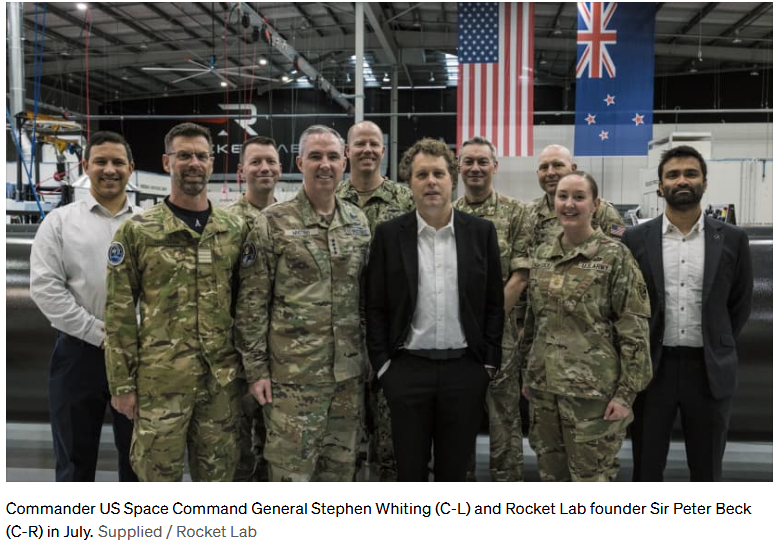
Its current head is Gen. Stephen Whiting. Last August, he upped the ante, declaring that the US Space Command’s top priorities for fiscal 2027 include “space fires” to enable “space superiority” and “enhanced battlespace awareness” capabilities. 
 
The US Breaking Defense website observed that “For many years, Pentagon officials have been wary of discussing even the possibility of utilizing “offensive” space weapons due to political sensitivities and classification issues.”
 
It added that “Capabilities to operate in cislunar space, the vast swath of the heavens lying between the Earth and the Moon, further will become a SPACECOM mission as NASA and commercial firms pursue lunar “colonization” and other related activities.”
 
In March, Whiting was even more explicit about the meaning of the euphemistic “space fires”.
 
“It’s time that we can clearly say that we need ‘space fires’, and we need weapon systems. We need orbital interceptors. And what do we call these? We call these weapons, and we need them to deter a space conflict and to be successful if we end up in such a fight,” Whiting told the annual Space Foundation Space Symposium in Colorado.
 
“Weapons in space used to be considered inconceivable, but now space-based interceptors are a key component of how we win,” he elaborated. “We are a combatant command, and like all other combatant commands, we must be dominant at war, fighting and war winning. And dominant warfighting in space requires credible, acknowledged, kinetic and non-kinetic capabilities, fires and weapons.” 
 
“We can no longer assume that a war that starts in or extends into space will be short. We must prepare for a protracted conflict to be successful,” he said. “To win in a protracted conflict, we must maintain space capabilities beyond the initial stages of when the war starts. This longevity depends on our ability to deploy, regenerate and reconstitute space forces.”
 
Australian involvement
 
Whiting singled out collaboration between the Space Command and private US firm Leo Labs deploying a next-generation Seeker-class ultra-high frequency radar site in the IndoPacific region.
 
Leo Labs sees Australia as a forward post for the US military’s domination of Space.  It has a space radar site near Bunbury, WA and is involved in the Aussie Space Radar Project (ASRP), a A$240M international collaboration between Australia and the United States, with A$160M of direct investment by LeoLabs Incorporated. 
 
Under the ASRP, LeoLabs Australia will manufacture and license LeoLabs’ next-generation modular space radar system in Australia. LeoLabs Australia, should it be successful under the Modern Manufacturing Initiative, will build LeoLabs’ first next-generation Low Earth Orbit (LEO) modular space radar in the Northern Territory; and then build the world’s first commercial Deep Space Radar in northern Western Australia.
 
There is no doubt that even in the absence of rivals for “colonization” activities in cislunar space, US imperialism would make militarisation of Space one of its aims in pursuit of “full spectrum domination”.
 
But they do have rivals, and both the Russian imperialists and Chinese social-imperialists are just as active in vying for control of Space.
 
The fear among US military circles is that the Chinese are currently winning the race for Space. Afraid of falling behind, US imperialist armed forces heads like Whiting are increasingly jettisoning the euphemisms and trying to marshal public opinion behind the need to station weapons in Space.
 
The Outer Space Treaty allows this and needs to be tightened to include a prohibition on the deployment of all weapons in Space.
 
An independent and peaceful Australia would initiate such a move through the United Nations.
 
An Australia led by an Albanese or a Dutton will never do this, but only further place Australia at the disposal of US imperialism.
 
We must demand that all weapons are banned from Space and that any developments there are done for purposes other than “colonization” by any state or nation on earth.


Tuesday, December 3, 2024

The strange case of the replacement for the JP9102 satellite system: who made that decision?

 Written by: (Contributed) on 4 December 2024


(Source: www.news.satnews.com)

Those observing the unfolding drama of the replacement for the Australian Defence Force JP9102 satellite system, which was cancelled by Canberra during early November, may have noticed the seemingly contradictory nature of official statements and explanations from government departments.

Serious questions would appear to have arisen about decision-making at the highest levels in Canberra; accuracy and authenticity of media releases remain a matter in question. That is, if the actors in senior positions in Canberra want to be regarded as straightforward and taken at face value.

Satellite systems are invariably about defence and security provision and intelligence-gathering; secrecy surrounding their very existence is inevitable. The stated range of the JP9102 satellite system, nevertheless, revealed areas of interest for Australian-based facilities, operating under US tutelage. With a range from US intelligence facilities on Diego Garcia in the Indian Ocean to the Solomon Islands, and the Artic to Antarctica, the JP9102 was designed to be the pride and joy of the ADF. (1) It was noted that the JP9102 satellite system had been designed to provide 'an uncrackable data network across the ADF, providing communications and data links for its advanced fighter jets, naval assets and the army's land forces'. (2)

With the US pushing their Indo-Pacific Strategy (IPS) to contain and encircle China it is perhaps no surprise to find the Solomon Islands was geo-strategic point of interest for the JP9102 satellite system; Cold War military hawks based in Canberra have already assessed the past and present government along lines of 'the trenchantly pro-CCP clique in Honiara surrounding Solomons leader Jeremiah Manele and his predecessor as prime minister, Manasseh Sogavara, China's main man who, as Finance Minister, holds the purse strings'. (3)

US-led Cold War hawks are particularly concerned at the Solomon Islands establishing a security agreement with China 'that allows Chinese forces into the Pacific nation in exchange for significant investment from Beijing'. (4) Assessments from Cold War military intelligence are, therefore, not ambiguous; it has been noted, for example, that 'the US recognises China's attempts to expand its network of dependent vassal states into a quasi-military security pact designed to foil US-led alliances and existing multi-lateral security frameworks'. (5) The US fear, furthermore, that the Solomon Islands will be drawn closer to the 'Dark Quad', composed of Russia, Iran and North Korea through closer diplomatic relations with China, which may also eventually include Venezuela. (6)
 
While the proposed JP9102 satellite system was subsequently cancelled in early November, following five years of military planning, its replacement was shot into space within days.

No doubt the residents of the Solomon Islands now await increased surveillance of their everyday lives, with vast amounts of personal data being used by US and Australian intelligence analysts to profile the whole population to identify supposed 'Chinese interests'.

With the minimum of publicity, SpaceX sent an Optus satellite system into orbit using Falcon 9 rockets; described as 'a secretive military communications satellite … headed into geostationary orbit some 36,000 kms above earth … with a payload that has been shrouded in secrecy to the point of not disclosing any specifics of the mission'. (7)

The event was hardly accompanied by straightforward media releases; in fact, they appeared confused and downright misleading. Or was that the intention?

Following the cancellation of the initial JP9102 system a brief statement from Canberra concluded 'there was no word on when the alternative system would be delivered or how much it would cost … it claimed … the ADF would continue with its current satellite system, which involves purchasing bandwidth from the US military and a commercial provider'. (8)

Even the best made secrets, however, can be difficult to keep under wraps, particularly when the label JP9102 proved to be the name of the project, not the actual satellite system.

An official media release noted, for example, 'Defence confirmed that it will use the Optus-X satellite launched by SpaceX on Monday morning Australian time … and … it will complement our future multi-orbit satellite capabilities to be delivered under project JP9102'. (9) The stated satellite co-ordinates presumably remain the same, across at least 89 ADF military facilities and various ground stations; its geo-stationary orbit, furthermore, are stated as 87.75 degrees. (10)

Publicity surrounding the cancellation of the JP9102 satellite system, nevertheless, proved particularly interesting, following lines highly critical of the federal government from opposition figures only too pleased to push the US Cold War political and military line. They noted 'the looming cancellation is yet another blow to the government's plans to re-arm the ADF to prepare for a potential war with China'. (11) And, the decision is 'a seriously blow to Australia's credibility with the US and other strategic partners'. (12) Another stated 'Labor scrapping the satellites takes sovereign risk to a new level. It will also undermine Australia's defence credibility, just as the US and Britain were relying on Australia to boost Indo-Pacific surveillance'. (13)

Nothing, however, would appear further from the truth!

What has not been so well acknowledged, for example, is that the Pentagon got exactly what they wanted from the new JP9102 replacement satellite system: complete control and inter-operability between the Pentagon and Australia:

                                         We need an independent foreign policy!


1.     Satellites out: defence $7bn hit, Australian, 4 November 2024.
2.     Ibid.
3.     Beijing's Solomons strategy has outflanked Canberra, Lead Editorial, Australian, 12 November 2024.
4.     Pacific leader's rejection queried, Australian, 12 November 2024.
5.     'Dark Quad' threat demands urgent action, Defence Report Supplement, Australian, 31 October 2024.
6.     Ibid.
7.     Secrecy over Musk launch for ADF., Australian, 20 November 2024.
8.     Diggers get $40,000 to hang about, Australian, 5 November 2024.
9.     Defence to use 'Optus-X satellite launched earlier this week, itnews, 20 November 2024.
10    Australian, op.cit., 4 November 2024; and, SpaceX launches secretive 'OptusX' spacecraft, Space Connect, 18 November 2024.
11.   Australian, ibid., 4 November 2024.
12.   Ibid.
13.   Satellite cancellation shows Labor's priorities are wrong, Lead Editorial, Australian, 5 November 2024.