Showing posts with label Russia. Show all posts

Sunday, November 30, 2025

Criminalising Lenin - Putin’s attempts to stifle dissent

Written by: Nick G. on 1 December 2025


(Above- members of the Ufa Marxist study group)

On 25 November2025, Russian state prosecutors surprised no-one by demanding 20 to 24 years in a high-security penal colony for the members of a Marxist study circle in the city of Ufa, accusing them of “terrorism” and “conspiracy to overthrow the government.”

Ufa is the capital of the Republic of Bashkortostan, part of the Russian Federation, located between the Volga river and the Ural Mountains in Eastern Europe. 
Bashkortostan has a large minority nationality which formerly enjoyed autonomous rights in Lenin and Stalin’s Soviet Union when it was known as the Bashkir Autonomous Soviet Socialist Republic.

It is now a scene of ethnic and political unrest.

In 2024, local Bashkir activist Fail Alsynov was sentenced to four years in a penal colony following a speech he delivered in 2023 as locals opposed plans for the development of a gold mine. Supporters said the verdict was delayed revenge for his role in protests in previous years when activists successfully blocked plans to mine for soda on a hill considered sacred by locals.

His jailing led to fresh protests by thousands of people, at which a further four people were arrested on charges carry a potential sentence of 15 years.
Alsynov had previously been fined for criticising Russia’s invasion of Ukraine online, saying the war was not in Bashkortostan’s interests.

He heads Bashkort, a grassroots movement working to preserve the culture, language and ethnic identity of the region’s people that was banned as an “extremist organisation” in 2020.

In February 2022, five persons were detained in Ufa on charges of terrorism, but really for participating in a Marxist study group. They were part of a larger group of fifteen whose houses were searched. Security forces claimed to have found two grenades at one of the houses – those arrested said they had been planted by the security police – and this was used as the basis of terrorism charges. However, the indictment also accused the defendants of reading the works of Karl Marx, Friedrich Engels and Vladimir Lenin.

The arrests came a month after the “special military operation” directed at Ukraine. 

One of its members, Sergei Shapozhnikov — a former fighter in the armed formations of the so-called “Donetsk People’s Republic” — informed the security forces that the circle was supposedly “waiting for an unstable situation to seize power and kill police officers and politicians.” No material evidence was ever provided to support these claims.

The court instructed a panel of “experts” to evaluate whether the group’s lectures and reading material could be considered “terrorist activity.” Their conclusion was that Lenin’s foundational work “State and Revolution” was a “terrorist manual.”

Putin’s regime, which claims to have inherited the anti-fascist mantle of the War Against Fascism, is itself a fascist state.  

It is criminalising the works of human emancipation and freedom and equating the study of Marxism with terrorism. Such draconian moves surely indicate that Putin’s government is beset with more troubles than he knows how to deal with – without resorting to open repression.

Sunday, July 7, 2024

Report on Russia by Russian Maoists


Written by: Union of Maoists of the Urals on 7 July 2024


Last May we published an analysis of conditions In Russia by our comrades in the Union of Maoists of the Urals. Today, they have sent us the following update which will be of interest to Australian anti-imperialists. Long live the proletarian friendship between the workers of Russia and Australia-eds. 

Hello, dear Australian comrades!

Dear comrades, we would like to inform you about the situation in the economy of our country in order to better show the prospects for the imperialist war waged by Russia and the likelihood of revolutionary changes. 

Until relatively recently, sanctions worked extremely poorly. Everything was on the shelves and regularly arrived at industrial enterprises for various purposes: both civilian and military. In fact, Western products prohibited by sanctions are imported into Russia from Turkey and Kazakhstan. This happens extremely freely and without serious problems. This primarily concerns industrial electronics and a number of food products. What cannot be imported through them is imported from China (cheap industrial goods) or has been replaced by Russian production. However, in recent months, due to the threat of sanctions against Chinese banks, it has become much more difficult for Russian enterprises to purchase products from China. Deliveries of many types of goods from China are severely delayed. However, we cannot yet say that this is somehow affecting Russian industry or consumers, and therefore we cannot assume that this is what will revolutionize Russian society or create a strong crisis in industrial production.

The 2022 mobilization and continuous Nazi pogroms against migrant workers have led to a huge labor shortage in Russia. Highly skilled workers are constantly leaving Russia after the start of the war - we are talking about hundreds of thousands of anti-war Russians. Capitalists don't like this very much. Bourgeois politicians talk about a shortage of 5-10 million workers. Officials regularly discuss programs for the return of specialists with anti-war views, and anti-abortion initiatives are also promoted with the emphasis that there is no one to work in Russia. 

The massive involvement of prisoners in military service also plays a role in the labor shortage. Russian prisons are engaged in industrial production and now there is no one to produce prison products either - mass repressions in Russia do not keep pace with the physical extermination of criminals. 

The labor shortage is leading to rapidly rising wages for Russian workers. We are talking about a doubling of wages over the past year. The growth of the military industry due to the war plays a role. As a result of this, Russian workers are now happy with their situation, they enjoy the fruits of imperialist policies and prosperity from the blood of their more unfortunate dead fellow citizens. They change jobs as soon as necessary, it is common for capitalists to lure workers away from each other, and bonuses for workers bringing new workers to fill vacancies are extremely common. There is no unemployment.

The Russian army is holding on because of the forced involvement of migrant workers in it and because it pays wages 10-15 times higher than in other areas of employment. Huge military spending, a social sector for the military, the growth of the military industry - all this is paid for from a deficit state budget. There are expert estimates that there will be enough money in the budget for a year and a half (including the state reserve accumulated before the war is now being wasted; Russia did not spend it during the Covid epidemic), after which the country, if the war continues, will begin an economic crisis and today’s prosperity will end a very rapid decline in living standards, indignation of the popular masses and the rapid growth of revolutionary sentiments. However, forecasts for the duration of the economic crisis may not take into account Russia's ability to inflate public debt.

In any case, it is extremely dangerous for the Russian imperialists to prolong the war; they need peace on their terms, and therefore they are trying in various ways to push through an agreement to suspend the war until Russia again accumulates reserves. Or they immediately propose recognition of Russia’s military claims in Ukraine and the withdrawal of Ukrainian troops from a number of Ukrainian regions, the population of which will then be assimilated by the Russians.
Under these conditions, we are trying to analyze the situation, carry out organizational work among the masses and promote Marxism-Leninism.

With revolutionary proletarian greetings from Russia,

International Department of the Union of Maoists of the Urals

Monday, May 13, 2024

The legacy of Soviet revisionism: the view from Russia today.

 Written by: (Contributed) on 13 May 2024


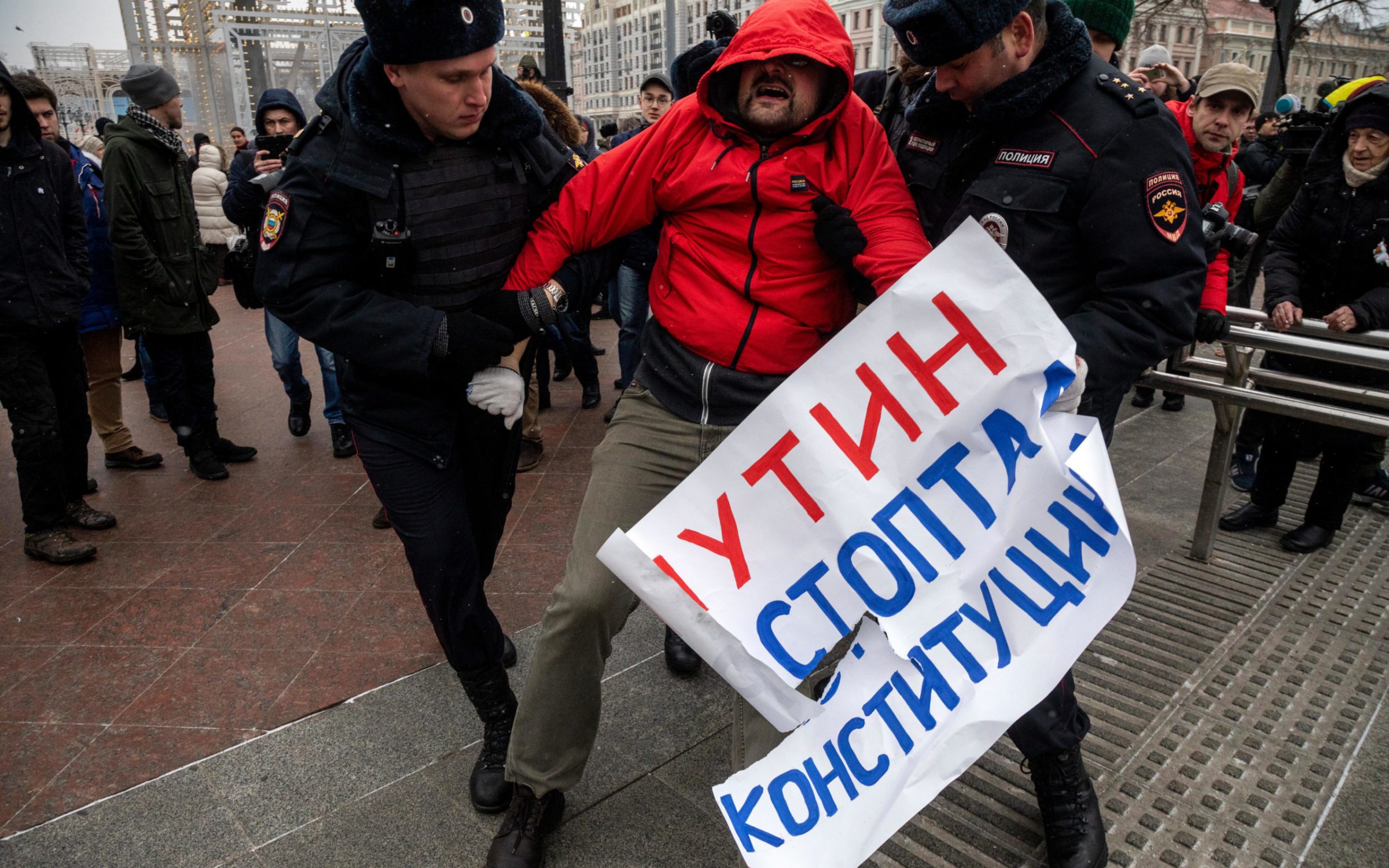
Above: Anti-Putin protester dragged away by Moscow cops. Photo: www.reaction.life 

Our Party has good relations with several groups of comrades in Russia. We won’t identify the source of the following description of conditions in Russia because of the danger its authors are in under the rule of the Russian imperialist bourgeosie and Putin’s government. Unfortunately, there are some on the Left in Australia who praise Putin for his rivalry with US imperialism and the NATO bloc. There are no grounds fordoing so. All imperialism is bad and must be overthrown – eds

The legacy of Soviet revisionism and social-imperialism, which completely permeates society and bourgeois power, causes great harm to party building in our country. On the one hand, this completely discredits the ideas of communism in society, equating them with Soviet capitalism. On the other hand, the bourgeois government and the bourgeois “opposition” demagogically use images of the Soviet past for chauvinist propaganda. 

Many people in our country know about Mao Zedong from the fascist tales that were promoted by Soviet propaganda and which are enshrined in official academic discourse in books and the Internet. All this complicates the work of Marxists-Leninists in Russia. Moreover, after the strengthening of the fascist regime and the start of the genocidal war against the Ukrainian people, great-power chauvinism, racism and spy mania dominate in society. 

There is information that about 116 thousand people were subjected to Putin’s repressions. There are many neo-Nazis in the FSB and the police who torture people, and after a recent terrorist attack, neo-Nazis in police uniform festooned with swastikas publicly cut off the ear of one of the suspects on camera and forced him to eat his ear. 

Instructions from the police and army on how to properly torture people with electric shock are being actively distributed online. 

Police and Nazis organize attacks on migrants in factories and commercial establishments, inducing them to go to war. In this way, the Russian army is replenished and at the same time terror is waged against the non-Russian workers remaining at the enterprises. 

Moreover, after the failure of the military opposition in June 2023 and after Putin’s victory in the elections, the fascist regime began to fight with redoubled force against political opponents. Our organization suffers greatly from these repressions. At the same time, all street protests are now prohibited in our country and any unflattering word about the war and the Russian army faces criminal liability, freedom of speech and freedom of assembly have been destroyed. 

In our country, trade unions are subordinate to the ruling far-right United Russia party, on which President Putin relies. Because of this, the economic struggle in our country is seriously complicated.

The left forces in our country are poisoned by Soviet revisionism. The majority of Russian "communists" support Putin, the fascist war against Ukraine and external expansion into European countries. Chauvinist Russian idealist philosophers and various bourgeois concepts, such as the “civilizational approach” or “world-system analysis,” are highly respected among them. Almost all Russian communists and social democrats are sexists and homophobes, supporters of traditional family values and the death penalty.

At the moment, Russian imperialism is merging in foreign policy with revisionist regimes. First of all, with social-imperialist China and the DPRK, which most pseudo-communists perceive as a socialist turn and “anti-imperialism.”

Russian imperialists are attacking feminism, women's right to abortion, and any protection against domestic violence. We are trying to fight this by developing a feminist movement in Russia. LGBT people in Russia are recognized as terrorists, as are Jehovah's Witnesses and many other religious and social forces. Many oppositionists are labeled as “foreign agents”, after which they are deprived of economic and remaining political rights.

May 2024

Wednesday, August 9, 2023

The crisis in Russia

 Written by: Union of Maoists of the Urals on 8 August 2023

We continue our series of reports from ICOR’s webinar on the United front Against Imperialism and Fascism. This report is from the Union of Maoists of the Urals – eds.

The crisis in Russia

The Russian Federation is going through a severe political crisis. After the almost complete defeat of all opposition forces at the beginning of 2022, the ruling group of the imperialist bourgeoisie achieved a complete monopoly on power and complete domination in all spheres of society. However, the hopes of this group for a quick victory in the war with Ukraine and large economic gains did not materialize. The corruption-riddled army failed to win the war quickly, and the failed diplomacy of Russian imperialism led to international isolation. Competent economists were able to save the economy for almost a year, but they were not omnipotent, and in recent months the economic situation began to deteriorate. Contradictions between nations are growing in Russia. The protests of migrants and non-Russians in large cities have become more frequent, they are fighting against the lawlessness of the police and Russian nationalists.

Against the backdrop of military defeats, the struggle between the two lines among the grouping of the bourgeoisie that had completely seized power became sharper and sharper. Finally, towards the end of last year, against the background of failed mobilization and resounding defeats at the front, Putin's grouping of the imperialist bourgeoisie split into two parts. The first part of it is trying to accumulate political forces for military success and not greatly disturb the masses, hiding their cannibalism behind initiatives distracted from the population. The main slogan of this group of imperialists was expressed by a deputy from the Communist Party of the Russian Federation with the words “Please look like the people!”, said during a debate in the State Duma. 

The second group, on the contrary, is trying, out of ideological motives, to carry out the most anti-people initiatives without regard to public opinion. From these people, calls are regularly heard for the massacres of opposition-minded citizens, for the prohibition of all other ideologies and for the recognition of any non-Putin movements as terrorists. These groups are non-partisan and a split permeates all the ruling parties in Russia. They are now fighting within the authorities, sabotaging each other's initiatives. On the other hand, the Russian army is seriously decomposed, which is why the Russian imperialists are starting to run away from the front and from Russia. The most striking example is Prigozhin's pseudo-rebellion, which was aimed at the Wagner PMC escaping from the Russian-Ukrainian war. This example is not the only one. We are witnessing a serious crisis and the actual collapse of the statehood of Russia as an imperialist state.

Russia's main contradiction is war. This is a contradiction between the entirely narrowed ruling class and all other classes of Russian society, except for the labour aristocracy. One side of this contradiction is the crisis. The other side of this contradiction is a number of repressive laws and initiatives that are constantly introduced and regularly adopted. We consider the question of which side is the main one in the main contradiction still open and we are conducting further analysis. In practice, we believe that the main side of the contradiction is precisely the crisis, and the non-main side is repression. However, at the same time, we are preparing for the worst scenario, where the main side of the contradiction will be repression and the regime will stand.

About repressions and other measures to support the ruling regime. In Russia, laws against "foreign agents" were again tightened, which are used in our country for mass repressions against citizens and public organizations. Against the backdrop of last year's failed mobilization, the penalties for failing to appear at the military registration and enlistment office for conscription and mobilization have now been seriously increased, total restrictions have been introduced for draft evaders for military service, and the boundaries of those subject to conscription have been expanded. Previously, they promised to raise the lower limit of conscription from 18 to 21 years old, but did not raise it and now everyone is called up from 18 to 30 years old. 

The militarization of schools is growing, the school subject of the Basics of Safe Life has been renamed the Basics of Protecting the State. Previously, special subjects were introduced at school with state propaganda, the so-called "Conversations about the important". Under the new laws, a police officer can be “scared” because someone threatens his acquaintance and this will be a crime against a police officer. Independent psychiatry has been abolished, and conversion therapy for homosexual people has been introduced. All conditions have been created for the return of political punitive psychiatry. New restrictions on women's reproductive rights are constantly being introduced, abortions are being gradually banned in the regions, and a fight has begun against emergency contraception and the distribution of abortion drugs. All this is happening along with spy mania and calls for rallying under the state ideology of combating "Western values". The authorities have entered under "Western values" absolutely everything that prevents the fascist regime from continuing to exist.

In our daily work, we try to follow the line of the masses and create all the prerequisites for the imminent fall of the fascist Putin regime and the creation of prerequisites for the creation of a large Marxist-Leninist party. Our main enemies today are the Putin regime and the heirs of Soviet revisionism.


Wednesday, June 28, 2023

Contradictions within the Russian imperialist camp


 Written by: Revolutionary Youth Communist League (Bolshevik) on 28 June 2023

The extraordinary events surrounding private military contractor Prigozhin’s march on Moscow, and subsequent intervention by Belarus, are best explained by Russians themselves.  Here we reprint a statement from the Central Committee of the Revolutionary Youth Communist League (Bolsheviks) written during the march on Moscow, with an update following the Belarus deal - eds.

Statement of the Central Committee of RKSM(b) on the rebellion of PMC Wagner
 25.06.2023

On June 23, 2023, the owner of the Wagner private military company, Yevgeny Prigozhin, declared a rebellion and moved his troops into the territory of the Russian Federation. The Russian President Vladimir Putin called these actions «a treason» and «a stab in the back», while drawing analogies with the actions of the Bolsheviks in 1917. On the morning of June 24, the Wagner troops controlled key facilities in Rostov-on-Don and Voronezh. Fighting is already under way near Voronezh, there are casualties. A counter-terrorist operation regime has been declared in Moscow and a number of other regions of Russia. The situation is changing very quickly.

Background

1. What happened, regardless of the outcome, is a natural consequence of a deep political crisis that has developed within the Russian ruling class amid a stalemate in the war in Ukraine.

2. As we have often emphasised (https://rksmb.org/rksmb/official/revkomsomol-protiv-imperialisticheskogo-peredela-ukrainy/), the war in Ukraine is not the defence of the Ukrainian people from the «Moscow barbarians» and is not the defence of the people of Donbass from the «Ukrofascists», but the clash of the imperialist interests of the West, on the one hand, and Russia, on the other. Russia gets tacit support in this confrontation from a group of countries united behind Chinese capital – a fact which proves the global rather than regional nature of this conflict.

3. From the very beginning, the so-called «special military operation» did not run as was planned by the Russian leaders. Russia has entered the war weakened.

A particular reason for the weakness of Russia is the inconsistency of the Russian bourgeoisie, which until recently tried to negotiate with its «Western partners» on the division of the spheres of influence at the expense of Donbass inhabitants’ lives. We must remember that it was Russia that stopped the offensive of the Donbass militias against the reactionary regime that arose as a result of a right-wing coup in Kiev in 2014.

was Russia that pushed through the Minsk agreements, which left the Donbass defenceless against the Armed Forces of Ukraine. As a result, the ruling elite of Russia itself allowed Western imperialism to prepare its Ukrainian puppets for war as best as possible. The price of such Kremlin’s policy is thousands and thousands of ruined lives of working people on both sides.

The fundamental reason for the weakness of Russia is the economic and social policy that the Russian bourgeoisie has been steadily pursuing for all the decades since the fall of the USSR. The Yeltsin and Putin eras differ from each other significantly in the external features (rhetoric, symbols, foreign policy statements, etc.).

Since the beginning of the 21st century, the ruling class of Russia has tried and is still trying to cover its goals up with patriotic rhetoric and references to the Great Patriotic War – sacred to the Soviet people. However, at its core, this is the same power of capital that parasitises on the natural and human resources of Russia.

The bourgeoisie under Putin is the same class that was formed as a result of the controlled dismantling of the Soviet economy, which is a symbiosis of the repressive machine created by Yeltsin and the oligarchy. Under both Yeltsin and Putin the impoverishment and even extinction of the Russian people, the degradation of the education system, the plunder of natural resources, and the destruction of industry (including the military) – all continue.

Suffice it to say that even in 2023, the bankruptcy of Russian military enterprises continued. The Kremlin propagandists are trying to drape the real state of affairs with bravura rhetoric, but the fact remains: Putin is Yeltsin’s faithful disciple in the robbery and destruction of our Motherland. And this, of course, could not but lead to the deplorable state of most public institutions, including the Armed Forces.

4. The Wagner private military company emerged as a tool of Russian imperialism that effectively serves its foreign interests in cases where the official use of military force would be impossible. The basis of Wagner was the Slavic Corps PMC, created in 2013 by Russian businessmen allegedly to «protect fields and oil pipelines» in Syria, in fact – to participate in the war in this country.

Later, PMC Wagner defended the interests of Russian imperialism in Libya and the Central African Republic. PMC Wagner consists of the well-equipped and trained mercenaries. Consequently, when the course of the war has revealed the weakness and low motivation of the Russian military personnel, the ruling regime was forced to resort to professional mercenaries.

PMC Wagner has become one of the most combat-ready units on the Russian side, which fuelled the ambitions of its owner. It is worth noting that the very name of this PMC, its «Blood, Honour, Motherland» motto, the repeated public statements of their representatives testify to the ultra-right views of the founders and many common soldiers.

We emphasise that PMC Wagner was created by the Russian ruling class and was its tool for a long time, while Yevgeny Prigozhin himself is a big businessman who personally knows Vladimir Putin and has certain privileges thanks to this acquaintance.

5. Getting involved in a military adventure, the Russian bourgeoisie still showed inconsistency, tried to manoeuvre and looked for ways to reach “an agreement”. This can be evidenced by the numerous statements about «red lines» that did not entail any consequences and the absence of strikes against the military-political leadership of the enemy. The price of such a policy is fruitless sacrifices. All this did not go unnoticed.

Conclusions

1. The unfortunate course of the war in Ukraine for Russia has strengthened the centrifugal tendencies within the ruling class. One part of the Russian oligarchs hastened to gain distance from the Kremlin and show loyalty to the West. The other part still follows the president. The third part is dissatisfied with the Kremlin’s cautious, half-hearted policy and wants to see drastic measures.

2. The rebellion of Prigozhin’s PMC reflects the interests of a certain group of the bourgeoisie, which is aimed at emergency measures for the sake of a decisive turning point in the war. This requires the immediate establishment of a fascist dictatorship, i.e. direct terrorist dictatorship of the most chauvinistic and reactionary group of big financial capital.

3. At the same time, the behaviour of Prigozhin himself, his criticism of the goals and methods of the so-called “special operation” make us suggest that this group is also ready to participate in bargaining with the West and perhaps offer them more favourable terms for a compromise. It is significant that the rebellion is taking place amid an unprecedented increase of NATO military presence along the western border of Russia and amid constant threats to use the nuclear weapons.

4. However, the current ruling regime in Russia is also moving towards fascism, which we have repeatedly warned about. In other words, both sides are interested in establishing a fascist dictatorship. The only difference is who, when and by what means will lead Russia to the final establishment of fascism – be it fascism «from above» established by the current regime, clumsy and burdened by a corrupt bureaucratic apparatus, or fascism with the elements of anarchy performed by PMC thugs.

5. Thus, the military conflict that has begun in Russia is neither a «civil war» nor a «revolution», but rather a struggle between two reactionary groups of the Russian bourgeoisie striving for fascism. Both sides of this conflict bring suffering and death to the working people. Both sides, with all their contradictions, are much closer to each other than to the peoples of Russia.

6. The labour movement in the country is still weak. The communists are also weak and fragmented. That ideological, political, organisational work on consolidation, which is carried out by the RKSM(b) together with other communist groups, is still far from complete.

7. The key tasks to the communists in these conditions are:

In any case, do not support any of the groupings of the bourgeoisie that have grappled with each other. To explain the pernicious effects of such support to the workers and the youth. To explain that, regardless of the winner in this fight, the result for ordinary citizens will be worsening social security and further crackdown.

To strengthen the ties with the working class and with the military on an everyday basis. To spread the propaganda among them tirelessly, to explain the class goals and the meaning of what is happening. In the course of the propaganda work, to exercise caution, taking into account that now, more than ever, the Russian Federation is very close to the conditions of a fascist dictatorship.

To promote self-organisation of the workers in factories, to promote the creation of newly-made workers’ organisations before they are outlawed.
In the areas that are in the war zone or nearby, to encourage the workers to form self-defence units to maintain order.

The crucial class battles are yet to come.

The Central Committee of the RKSM(b)
24.06.2023

Update as for the evening of June 24, 2023

The media report that the Kremlin and PMC Wagner have reached an agreement through the mediation of Alexander Lukashenko, President of Belarus. Prigozhin retroactively called his actions a «march of justice» and announced that he would turn troops back. The rocket attack on the Wagner camps, which allegedly took place on the evening of June 23, has already been forgotten.

Does this ever mean that the story is over? No. The contradictions that became the source of this rebellion have not been eliminated. The reached agreements are only a fragile truce before a new struggle between various factions of the ruling class of Russia. When and in what form they will proceed – we do not know, but the reasons for what happened we have stated above.

The only way to put an end to Russia’s slide into a national catastrophe is a socialist revolution led by a strong, organised, ideologically armed working class.


Saturday, October 15, 2022

Russia’s Ukraine War Enters Dangerous New Phase


Written by: Nick G. on 3 October 2022

Russia’s invasion of Ukraine has entered a dangerous new phase.

Putin’s decision to formally incorporate parts of eastern Ukraine into the Russian Federation following the holding of referenda under condition of military occupation has ratcheted up tensions and hastened the counter-formality of Ukraine’s application to join NATO.

Both sides appear to have ruled out continuing with talks aimed at resolving the crisis.

If Ukraine joins NATO, then there is every possibility that NATO will not only continue to arm Ukraine, but according to its Charter, may well decide to send in NATO troops.

Meanwhile, Putin has renewed threats to use nuclear weapons.

Putin’s nuclear threat is being encouraged by prominent right-wing forces in and around Russia.

On September 29, Putin met with the heads of eight former Soviet republics, members of the so-called Commonwealth of Independent States. He stated that his aim was the creation of a New World Order. His hand-picked puppet at the head of the Chechen Republic (not part of the CIS), Ramzan Kadyrov, whom he made a lieutenant-general of the Russian Armed Forces on March 28, 2022, said just days ago: "We must carry out NWO in the full sense of the word, and not flirt. Use every opportunity and every weapon to defend OUR territory. Donetsk is still being shelled. Residents of the joined 4 territories want to be protected."

A comrade from the Russian Maoist Party warned on August 8 that “the internal propagandists of the Russian Federation are extolling the idea of a complete obliteration of western countries with atomic weapons in all possible forms. Russian propaganda in Russia is actively promoting the idea of an atomic war of aggression. Russia is calling for us to be proud of every new military development, actively promoting new missiles on television, while boasting about how many are enough to destroy a certain country. Or boasting about how many seconds it takes for a new missile to reach important cities in western countries.”

This warning cannot be easily dismissed.

Once upon a time, the two superpowers believed that the more nuclear weapons they each possessed the better: matching each other’s nuclear weapons stockpiles would ensure that nuclear weapons would never be used. This became the theory of Mutually Assured Destruction (MAD), acceptance of which encouraged Reagan and Gorbachev to speak of détente and nuclear disarmament.

In fact, the nuclear powers remain armed to the teeth, and Putin has put the final nails in the coffin of the theory of MAD. 

There is the real danger that Putin will use nuclear weapons to pre-empt the entry of NATO troops to Ukraine, or respond to their entry with nuclear weapons to stave off defeat and avoid being driven out of that part of Ukraine he has incorporated into Russia.

All these dangers stem from imperialism. Russia, the aggressor, is imperialist. The United States, which undoubtedly provoked Russia’s aggression by expanding NATO eastwards in defiance of an undertaking given by Reagan to Gorbachev, is imperialist and the main source of war dangers globally.

At the beginning of this conflict, we raised the slogan “Russia out! US and NATO stay out!”

To those slogans we now need to add: “No nuclear weapons in the Ukrainian conflict!” 

Sunday, October 2, 2022

Information on the current state of events in Russia


 Written by: Russian Maoist Party on 3 October 2022

Russia started its imperialist aggression against Ukraine hoping for a short victorious war but failed. Before the mobilisation Russia has gone through several defeats on the frontline. Russian imperialism instead of initial plans of assimilating Ukrainians and annexing the whole Ukraine, attempts now to save at least some positions. For the purpose of this, the 'referendums' on the occupied territories were held and then those territories were annexed.

Peculiarities of the Russian military legislation should also be taken into consideration: according to the Russian law, soldiers conscripted for military service cannot fight abroad. The law says that Russia can send on wars only contractees (those who serve on the contract basis). In case occupied territories are declared Russian and Ukraine continues counter-offensive attacks, Russia may assess it as aggression against its own territories and send conscriptees to the frontline. This scenario would give Russia a free hand in passing laws allowing the use of mass destruction weapons.

The Russian Maoist Party opposes referendums on the occupied territories of Ukraine because one principle will be followed there: “It is more important WHO will count votes rather than HOW it is voted”. Referendum results are already known, authorities of the occupied territories make their political statements and plans, saying they are already a part of the Russian Federation with overwhelming results – 80-90% FOR. Knocking each door for recording a vote did happen during the referendum and accompanying Russian armed forces obviously created additional pressure. We consider these referendums a flagrant violation of nations’ right to self-determination as, firstly, these are territories where the majority of the population is Ukrainians and, secondly, it is an outrageous abuse of democracy.

On the 21st of September the Russian government announced a “partial military mobilisation”. Citizens mobilised along with it are equated to the contractees and will be sent to Ukraine. It soon became painfully clear that mobilisation is not 'partial', but total, or will be total in the coming months. The mobilisation has divided the Russian society into two groups: the first ones wholly disapprove of the news (and try to escape abroad, protest on actions and no longer support the regime), the others think mobilisation will not concern them and their communication circle (they believe only veterans with combat experience will be recruited, as the bourgeois propaganda says).

The poor protest culture in Russia adds to this: a range of factors (the influence of Soviet revisionism on the generation of the 1950-1980s; almost complete cleansing of the political playing field; the active support by the formal opposition of Russian imperialism and Putins’ policy, have led to the small number of participants on protest actions and political demands often finding weak expression. At the same time any criticism of the war and the government is forbidden by laws, any tiniest protest action or a careless word may lead to enormous fines, arrests and imprisonment. The 21st of September is marked by multiple cases when those arrested were handed mobilisation subpoenas.

The protests going on now cannot change the situation in Russia and on the frontline, although they did influence the scale of mobilisation and in some regions it was soon cancelled (for now). The broad masses are still captivated by the military frenzy and fascist propaganda of Putin’s regime. Huge work awaits the Russian Marxist-Leninists, all peaceful and democratic forces in Russia.

Our plans are to help the mobilised escape the draft, agitate among them by explaining the essence of events and work with those who have not managed to escape in order to create military councils to fight collectively against the criminal orders of the officers. Demobilised soldiers are in our interests as well.

We emphasize that, unlike the Russian liberals, who consider all soldiers of the Russian army to be criminals and whom Russian liberals threaten with prison terms, or, at best, offer them to simply leave the front or surrender, we, Maoists, do not count soldiers as outcasts of the Russian army, we understand that some of them entered Ukraine under pressure from officers, while others simply believe that they are doing a good deed. Our work is to explain to the soldiers the essence of this war, and also help them organise against their commanders. And only in the event that the agitation does not go on, if other soldiers threaten our agitator, only then will we help him leave the front.


Friday, July 1, 2022

Towards Understanding Russian Imperialism.


Written by: John S on 2 July 2022

Russian imperialism is certainly on the march, determinedly challenging the “unipolar” hegemony of the US and NATO.

The book “Russian Grand Strategy, in the Era of Global Power Competition” (ed. by Andrew Monaghan), is written by, and from the perspective of, western military strategists, and purports to understand Russia as a rival to the supposedly legitimate moral, political and military authority of the US/NATO. However, it still provides valuable information about Russian planning and thinking. And it does get behind the simplistic propaganda that explains all Russian aggressive actions as caused solely by the megalomanic arrogance of one man, Putin.

The authors all operate from assumptions about US/NATO legitimacy and superiority. One uses the trite cliche of the world “rules-based order”, which is just code for the legitimacy of continuing western domination. What rules? Who has made the rules, especially since 1945? In whose interests do the World Bank, the International Monetary Fund and the World Trade Organisation operate?

The hypocrisy of these assumptions was starkly exposed at a recent WTO meeting where the participants refused to end government subsidies for illegal fishing. Capitalist governments continue to subsidise commercial activities that they themselves have deemed illegal- so much for rules! This is in reality the anarchy of capitalism.

Overall Russian Strategy

Russia (and the book’s authors) recognise the world’s increasing instability and volatility, and the intensification of rivalry between the previously dominant US/NATO, and rising powers such as Russia and China. Russia recognises the threats to itself and China posed by NATO’s expansion of its self-declared remit. NATO has been expanding its scope beyond the North Atlantic; NATO forces helped to invade Afghanistan and to bomb Libya. The recent NATO meeting in Madrid included government leaders from Japan, South Korea, Australia and New Zealand.

Russia sees the necessity of increasing its economic and politico/military strength, in order to protect its own frontiers, including its self-declared Exclusive Economic Zones, and to forward its economic and expansionist interests, across the whole globe. It has developed, and continues to develop, a range of economic, military and diplomatic strategies to further these aims.

It seeks not only economic and military strength and security, but also to establish itself as a recognised Great Power.

Economic Strategy

Russia has greatly expanded its internal exploitation of natural resources, especially hydrocarbons and of grains, and their export, particularly since around 2000. It has identified trade in strategically important goods as a key to profitability and strategic advantage. Russia is the largest exporter, or one of the largest exporters, of hydrocarbons, grain, armaments and nuclear power equipment.

Despite western sanctions (pre-Ukraine), Russia’s share of world trade in these strategically-important goods grew between 2010 and 2020.

Since about 2010, Russia has been shifting its trading priorities in these goods away from Europe, toward Asia, the MENA (the Middle East and North Africa) and Africa, in particular to China, India, the Stans and the Middle East. Its purpose is to

- get around US/NATO sanctions and economic blackmail

- enhance its political and economic independence

- access new markets in the face of increased US oil and gas production and predicted reductions in hydrocarbon demand in Europe because of its climate change strategies

- exploit the anticipated continuing and increasing reliance on fossil fuels in Asia, and

- feed off the economic growth of China.

Russia has a target of ½ of its energy exports going to Asia by 2035.

Russia’s role and influence as a gas and oil exporter has increased since 2000. Its exportable surplus (ie that available for export after internal needs are met) has increased over the past decade, while that of several competitors has fallen. It has coordinated with OPEC to avoid oil gluts and keep prices high. The dramatic increase in US shale oil production has complicated the world market, but US shale oil production costs are much higher than for Russian oil, so Russia is likely to outperform the US.

There is intense competition in the world gas market with Australia, Qatar and the US rivalling Russia. However, again Russian production costs are lower, and transport is easier through the system of pipelines to Europe. How this plays out during and after the Ukraine war remains to be seen. Russian Arctic gas production is in the process of ramping up dramatically, and Russia will be able to readily access growing Asian markets.

Russia has similar aims for its export of all parts of the nuclear fuel cycle, from involvement in uranium extraction through to reprocessing and disposal of spent nuclear fuel, targeting the same types of countries.

Armaments are exported, often on very favourable terms, to make money but also to cultivate friendly relations and influence with foreign governments. Despite sanctions, Russia is the world’s second-largest exporter after the USA, particularly to Asia (China, India and Vietnam are major customers), with MENA the second-largest area customer (especially Algeria, Egypt and Iran). This trade is likely to become more contested as rivals such as China, Turkey and India grow.

Russian policy is to maximise both its agricultural autarky(self-reliance) and the export of grains. In 2019, Russian food exports surpassed the value of all other Russian exports, excluding hydrocarbons. The main recipients were Saudi Arabia, Vietnam, India, Indonesia, the Philippines and North Africa. The diversification of trading partners is well underway. Russia is now the world’s largest wheat exporter. Russian wheat is cheaper to produce than its major competitors. Wheat exports overtook those of the US and Canada in 2017. With Australian wheat yields estimated to be falling due to the extra heat caused by climate change (by 27% between 1990 and 2017, according to the CSIRO as cited in this book) and US production flatlining, Russia is moving into new markets especially in South-East Asia. The objective of dramatically increasing grain exports (planned to double between 2017 and 2024) is specifically to make money and to exercise political influence and power.

State Monopoly Capitalism

After the collapse of the Soviet Union, there was a feeding frenzy of (mainly) ex-officials grabbing and privatising as much public property as possible. While public services collapsed and the population sank into greater and greater poverty, a few oligarchs, employing mafiosi extortion, ran a chaotic economy that saw Russian national wealth and power decline.

Since 2005, the state has adopted a strategy of nominating “national champions”, singling out leading enterprises in each industry for nationalisation or close governmental control. These are privileged with complete or largely monopoly status in their industry. These include:

- The oil companies Yukos and Sibneft amalgamated into the Rosneft oil and Gazprom gas monopolies

- Rostec, which owns some 700 military equipment enterprises

- United Shipbuilding Corp which owns most Russian shipyards

- Rosatom, which has a virtual monopoly over all nuclear power, weapons and exports

- The VTB bank, which took control of most Russian grain marketing and transport in 2019.

This monopolisation provides massive profits to a very narrow ruling capitalist class and their bureaucrat partners. It also represents a marriage between economic and political power.

This state of state monopoly capitalism has enabled Russia to set, and make progress in, planned strategic economic, political and military objectives.

In the 1990’s, Russia was weak, chaotic and on the defensive.

Since 2000, Russia has been attempting to integrate its security and economic objectives and actions. Despite many ups and downs, Russia has made some progress, especially since 2015, in developing coherent strategies for coordinated economic and military development.

This progress has been rather stymied by the inertia of existing power and institutional structures, a degree of economic stagnation (despite export successes) falling living standards and decreasing popular support for, and trust in, people’s material prospects.

Overall, Russia has progressed its integrated strategic outlook and planning, with some successful implementation, (probably with greater effect than western nations) but is also restricted by the typical vagaries and chaos that are essential characteristics of a capitalist system.

Military and Geographical Strategies

Mapping

Russia has invested heavily in mapping, especially the world’s oceans and sea routes.

It developed its own satellite mapping system in advance of the US, with receiving stations in Brazil, Nicaragua, South Africa and Antarctica. The information and detailed cartography are to be utilised for commercial and military purposes. It has recently been utilised in military activities in Syria, for example.
The Northern Sea Route

Russia is attaching huge importance to securing control of the Northern Sea Route (NSR), between the Russian mainland and the Arctic.

It has been angling for complete and exclusive control for security reasons. Since 2014, it has increasingly restricted access to other nations’ shipping and requires escort by Russian ice-breakers, despite US and NATO objections. It has constructed huge dual-purpose ports across the NSR- ports that double as naval bases and export points particularly for gas.

It sees the NSR as a key export corridor to Asia. It has built a huge ice-breaker fleet, including the most powerful ship in the world (with more of them to come). Production has begun on even bigger ones. These, and the impact of ocean-warming and the melting of the Arctic ice, are predicted to make the NSR navigable all year round, hugely increasing Russia’s export capacity to Asia.

Militarisation

Russia, like other imperialist powers, is engaged in frantic expansion and development of its military capacities.

It has analysed the continuing development of military technology, which, over thousands of years, has gone through several technological stages:

- Edged weapons

 - Gunpowder

- Rifled weapons

- Automatic weaponry

- Nuclear

The current sixth stage comprises precision-guided weapons, the weaponisation of information technology (cyber warfare), including propaganda and psychological warfare, and the supposedly decreasing importance of ground forces. This stage is evidenced by the facts that, in World War 2, it typically took 4,000 air sorties and 9,000 bombs to destroy a bridge; in Vietnam the US used 200 bombs; but in Yugoslavia in 1999, it took one aircraft firing one cruise missile. Drones have since taken this process further (though with frequently imprecise killings of innocent civilians). The current imperialist military orthodoxy assumes that the mass destruction of enemy infrastructure makes the taking and occupation of enemy territory unnecessary as a primary strategy.

The imperialists envisage a seventh generation of “ecological” weapons disrupting natural ecosystems, involving, for example, public health, environment, and water supplies, becoming operational sometime around 2050 - yet another reason to get rid of imperialism ASAP.

Current Russian military technology is constantly developing, and in some cases, is well ahead of the US/NATO, eg the S400 surface-to-air missile system, currently being purchased by NATO member, Turkey.

Russia’s emphasis on the importance of trade necessitates a focus on the world’s oceans, trade routes and factors affecting shipping.

Naval power has assumed top importance.

In 2015, Russia determined to develop a presence in all oceans, as a key part of its “geo-economic” rivalry with other powers. It prioritised the “near seas” -the Atlantic, Baltic, Mediterranean, Black and Caspian Seas; and, of course, the Arctic. It is also projecting itself into the South Atlantic, the Indian, and even the Antarctic Oceans.

The Russian navy has shown the flag in countries such as India, Indonesia and the Philippines, which are all target countries for increased Russian exports, especially hydrocarbons.

Planning documents cite the intensification of “great power” rivalries, and Russia intends to maintain and increase its access to resources and markets, and to protect its trade routes across the whole globe. It has embarked on a program of naval modernisation, modernisation of naval and merchant ports (often the same thing), huge increases in naval and merchant shipping capacities, and the development of human capital, in areas of training, safety and salaries. A 2019 document identified weaknesses to be overcome:

- An inadequate industrial base

- An outdated civilian nuclear fleet

- Low levels of maritime transportation

- The poor state of the civilian fishing fleet

In 2019, Russia adopted a whole-of -government approach to advance its maritime strength, involving the ministries of Defence, Economic Development, Transportation, Natural Resources, Foreign Affairs, Education and Agriculture.

Since 2008, port capacity has doubled, and turnover is increasing, often at the expense of neighbouring rivals. In the Baltic, gas pipelines and new transportation hubs for oil, fertiliser, coal and grain have taken much business from the ports of the Baltic states. Similarly, Russian ports in the Crimea have undermined business in Georgian and Ukrainian ports.

Russian imperialist expansion and aggressiveness has all the hallmarks of any imperialist power. It ploughs huge resources into constantly expanding economic and military capacity and activity, in order to advance and protect its access to resources and markets, and to contest any threat or competition. It endeavours to plan and act strategically, but is always hamstrung by the vagaries and chaos of capitalist financing, economic ups and downs, and internal ecopolitical rivalry.

When it acts, it is typically brutal and clumsy. Witness the attack on the Ukraine, designed to warn and intimidate the US/NATO from extending its reach east toward and around Russia. It has shot itself in the foot, as Sweden and Finland have now opted to join NATO, and Ukraine and Moldova are being fast-tracked for EU membership, and Georgia’s chances of the same appear to be improving.

How the attack on Ukraine will play out, economically and militarily, remains to be seen. It has certainly revealed weaknesses in Russian military effectiveness. It also exposed the typical callous brutality of imperialist powers as they bomb indiscriminately to try to cower a population into submission. Also problematic will be how and how much Russia can get around US/EU sanctions, continue to export massive amounts of gas and oil to Europe, and develop and access Asian markets.

Russia’s banking on Asian markets for hydrocarbons holding up as climate change forces all, but especially, European markets to transition away from fossil fuels, may also prove either completely illusory, or of only short-term benefit.

The intensification of world imperialist rivalry, of which Russian eco-military policy and development is an important part, is leading to more, and more dangerous, conflict, often via proxies such as Ukraine. The US is desperate to maintain its sole superpower status and its position as the world’s prime exploiter. It is lining up its allies and minions like Australia to back it militarily. Many other nations are breaking through and away from this control and are carving out their own slices of economic activity and exploitation. The drums of war are beating more and more loudly.