Showing posts with label Australian armed forces. Show all posts

Sunday, September 14, 2025

US company to profit from Ghost Shark contract

Written by: Nick G. on 15 September 2025
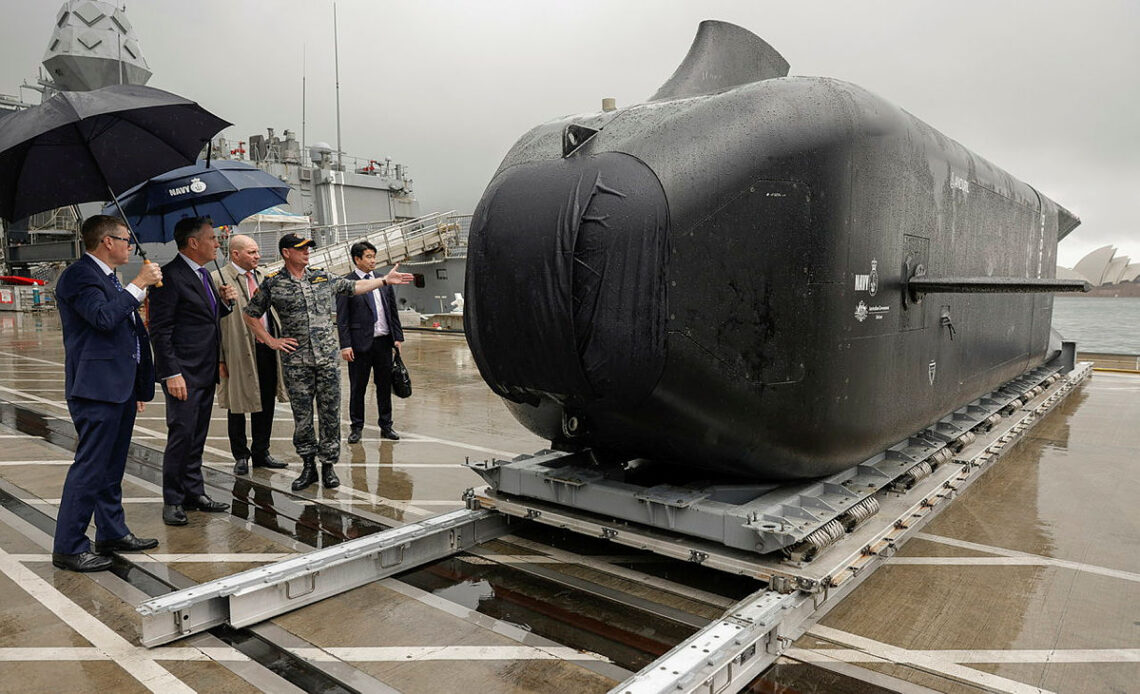
 

(US Navy telling Conroy and Marles all about the Ghost Shark.  Credit: www.sofx.com) 

On September 10, US agents of influence Richard Marles and Pat Conroy announced a $1.7 billion spend on extra-large autonomous undersea vehicles – known as the Ghost Shark – for the Royal Australian Navy.

The government’s announcement emphasised that the prime contractor, Anduril Australia, was part of “Australia’s defence industry” and that the investment reflected “the Albanese Government’s unwavering commitment to supporting Australian innovation, backing Australian workers and building a defence future made in Australia.”

It also sounded very patriotic and a triumph for Australia.

What it didn’t say is that Anduril is a private US company, unlisted on the Australian Stock Exchange, and that the profits from its operations here will go straight into the pockets of its US owners.

Anduril was created in 2017 with seed funding from the venture capitalist Founders Fund whose leader is the far-right activist Peter Thiel. Thiel was also one of the founders of the notorious data mining company Palantir, which provides software support for government surveillance technologies including facial recognition tools used by militaries and police forces. 

Anduril opened a wholly-owned Australian subsidiary in 2022, poaching David Goodrich, a key Defence Department advisor on Australian Defence Force contracts. He had led and negotiated 35 major transactions over an eight-year period for the ADF with multinational armaments companies including Boeing, Raytheon, Lockheed Martin, Northrop Grumman and Airbus. 

In 2024 it recruited Rear Admiral Peter Quinn as its vice-President of Strategy. Quinn was the Head of Navy Capability for five years. His responsibility in that role was to identify the needs and requirements of Navy’s future capabilities and to plan for, develop and deliver them to the fleet.

It is true that the Ghost Shark is Australian-designed and will be built by Australian workers. 

Compared to the nuclear-powered Virginnia class submarines designed to sit off the coast of China, it is also more suited to Australia’s coastal defence - or perhaps, more accurately, to supporting US aggression in our immediate region.

In the words of Anduril’s US CEO, Brian Schimpf, “The Australian Defence Force has long punched above its weight and been in the vanguard of regional security in the Indo-Pacific region, a role they will be asked to play more and more in the coming decades.”

“Asked to play…told to play,” it all depends on how you view the US stranglehold on Australia, and the subservience of our political leaders.

But the Ghost Shark also has limited endurance and is reliant on guidance by ultra-low frequency radio waves of the type sent out from the North West Cape base. This base can be easily destroyed in the event of a conflict. 

Former submariner and SA Senator Rex Patrick has questioned the price of the contract, describing it as “Ghost money - where there’s more stealth in the budget than there is in the capability. But the $1.7B deal will be music to Trump’s ears.”

This announcement, together with 12 billion to be spent on upgrading the Henderson naval facility in WA for Us and UK submarines, represents the theft of better schools, a functioning health care system, improved regional roads and many other basic services needed by our communities.

Louder voices need to be raised for genuine anti-imperialist independence and socialism.


Tuesday, February 27, 2024

Cancel the Elbit contract!

Above - the Hanwha Redback   PHOTO Andrew Green via Australian Ministry of Defence

 Written by: Nick G. on 28 February 2024

Israel’s Elbit Systems announced yesterday that it had been awarded a $600 million contract by the Australian Department of Defence for the supply of systems to South Korean company Hanwha. 

Hanwha is to produce 129 Redback Infantry Fighting Vehicles (IFVs) for the DoD at Geelong. 

Hanwha and Elbit last year signed an agreement to cooperate on the manufacture of the IFVs which already include the Redback Turret, which is based on the latest generation of Elbit’s 30 mm manned turret with the COAPS gunner sight, additional electro-optic systems, Iron Fist active protection system, Elbit's Iron-Vision advanced situational awareness head mounted display system, and Elbit's ELAWS laser warning system.

The contract for the IFVs is worth $7 billion AUD ($4.6 billion USD), of which will go to Elbit, in addition to the additional $600 million. 

All of this was negotiated by the DoD last year after the Zionist army attacked Gaza, and is a totally unwarranted reward for Israeli genocide against the Palestinian people.

The significance of the contract was omitted from today’s online Australian Defence Magazine’s announcement, but was prominent in yesterday’s US online Breaking Defense report.

The US report said that the contract ‘expands Elbit’s role in Australia. It is also the largest contract announced by the Israeli firm since the Hamas attack on Israel on Oct. 7, 2023.’

The Australian report did not say why we needed the IFVs, but the US report was less coy, quoting the DoD as saying that ‘The acquisition of these infantry fighting vehicles is part of the Government’s drive to modernise the Australian Army to ensure it can respond to the most demanding land challenges in our region.’

What ‘land challenges’ there might be ‘in our region’ were not specified, although it strongly suggests preparation on the part of the DoD for military action in other people’s countries in the South Pacific.

This contract must be cancelled. There should be no purchases of military equipment from the genocidal Zionists, nor should there be any arms sales to them.
By way of a postscript, the Wikipedia page on Elbit documents other countries that have taken a moral stand against dealing with the company.

Ethical concerns and divestment

A number of financial and investment organizations have divested their interests in Elbit.

On September 3, 2009, the Government Pension Fund of Norway's ethical council decided to sell the fund's stocks in Elbit due to the company's supply of surveillance systems for the Israeli West Bank barrier. At a press conference to announce the decision, Minister of Finance Kristin Halvorsen said "We do not wish to fund companies that so directly contribute to violations of international humanitarian law". The Norwegian Ambassador to Israel, Hans Jacob Biørn Lian, was called to a meeting at the Israeli Foreign Ministry where the decision was protested.

In January 2010, Danske Bank added Elbit to the list of companies that fail its Socially Responsible Investment policy. A bank spokesman noted that it was acting in the interests of its customers by not "placing their money in companies that violate international standards". The Danish financial watchdog DanWatch placed Elbit on its ethical blacklist in 2011. In 2014, one of Denmark's largest pension fund administrators PKA Ltd announced it will no longer consider investing in Elbit, stating "The ICJ stated that the barrier only serves military purposes and violates Palestinian human rights. Therefore we have looked at whether companies produce custom-designed products to the wall and thus has a particular involvement in repressive activities."

In March 2010, a Swedish pension fund, not wanting to be associated with companies violating international treaties, boycotted Elbit Systems for its involvement in the construction of Israel's West Bank barrier wall.

In December 2018, HSBC divested from Elbit following Elbit's acquisition of IMI Systems. HSBC cited IMI's manufacturing of cluster bombs, which violated the bank's ethics policy of not investing in companies linked to the manufacturing or marketing of cluster munition.

In 2019, Axa partially disinvested from Elbit Systems following pressure from the Boycott, Divestment and Sanctions movement. The move followed several years of campaigning by NGOs, including an April 2018 petition launched by SumOfUs that received 140,000 signatures. Axa "quietly reduce" its investments in Elbit and Israeli banks. Axa remains indirectly invested in Elbit and Israeli banks through a non-controlling interest in its former subsidiary Alliance Bernstein.


Sunday, February 11, 2024

ADF in trouble as personnel leave in droves

 Written by: (Contributed) on 12 February 2024

The ADF beset with recruitment and retention problems    PHOTO: defenceconnect.com.au 

Cold War US-led diplomatic hostilities and sabre-rattling continue to escalate across the Indo-Pacific region on the daily basis. An official statement from Duntroon has, therefore, proved particularly revealing when placed in the context of developments in the Western Pacific. While the statement was primarily concerned with training provision and serious shortages of personnel, it revealed the sense of urgency taking place within military planning circles inside the corridors of power, for Australia to be prepared for 'real-war scenarios' at the behest of the US in the next few years.

In early February the Royal Military Training College at Duntroon issued an official media release announcing the beginning of a two-year trial for army officer training provision whereby their standard 18-month courses would be shortened to 12-months. (1) While the stated reason for the shortening of the training provision was 'recruiting and retention problems', a sense of urgency would appear to have taken priority. (2) The present course structure of six separate modules has also been altered to enable students to take each stage separately and not in the usual sequence. The statement also quoted a Lieutenant General Stuart noting that 'officer cadets were keen to get out there and apply what they have learned'. (3)  

During the next two years Duntroon will be providing training provision for between 500-600 military officers who, after graduation, will then form part of the command led by the Pentagon for largely regional defence and security provision and military operations.

Following the re-organisation of the elite US Defence Intelligence Agency (DIA) over a decade ago, the Pentagon now receives a regular stream of regional military assessments from various locations in the Indo-Pacific; the region has seen the US experience a serious challenge to traditional hegemonic positions with the rise of China and is regarded as a potential theatre of war. (4)

The US military assessments have already provided the Pentagon with what they regard as a serious problem.

Serious problems face US imperialism

Assessments of the Western Pacific region, for example, have revealed the US is no longer the dominant power. (5) The recent attempt by China to win over the government of Nauru for diplomatic recognition away from Taiwan has heightened tensions still further; it has been noted that 'Nauru could not have been unaware how the timing of its announcement would put the region again on the geo-political frontline'. (6)  

Taiwanese diplomatic recognition elsewhere in the region is also under threat with serious concerns about Tuvalu and Palau, the last two countries in Micronesia which support Taipei.  (7)

A major US concern is that China has been able to win support from Pacific island countries enabling them to gain access to their huge exclusive economic zones (EEZs); some of the EEZs are used by the US to host sensitive military and intelligence facilities. (8)

North of the Marshall Islands, for example, the small US territory of Wake Island together with the Japanese territory of Minami-Torishima both host highly sensitive facilities for US-led military facilities. (9)

Many of the small Pacific islands also mark sensitive areas of the US-led Island Chain Theory, used for demarcation of the region; they have already been used to host defence and security provision against China. (10)

ADF to recruit footsloggers and commanders from the Pacific

The changes to training procedures reflect government and ADF concern about the numbers of people leaving the ADF. The military recorded a separation rate of 11.2% in 2022/23, falling short of its retention targets. For several years, the right-wing ASPI and similar groups have called for a relaxation of ADF screening of recruits, believing too may are turned away.

In early January, then-acting Defence Minister Keogh announced the ADF was looking to island nations in the Pacific for recruits. At the same time, Pacific military leaders are being given command positions in the ADF.  In a first for the ADF, Colonel Boniface Aruma from Papua New Guinea and Fiji's Colonel Penioni Naliva have been appointed deputy commanders of Australian Defence Force brigades. In Naliva’s case, the screening could not have been that thorough – Amnesty International wants him investigated for human rights abuses following the 2006 coup in Fiji

What seems to have been more important to the government and the ADF is the way the appointments would be perceived: “…as strategic responses to China's increasing influence in the Pacific…This region is traditionally considered within the sphere of influence of Australia and the United States. The ripple effect of these appointments is expected to have vast geopolitical implications, altering the balance of power in the Pacific region.”

Black Hawks darken our skies…

What is also particularly significant about the recent statement issued by Duntroon is their emphasis upon helicopters, in fact about half of the statement was focussed upon the US providing Australia with Black Hawk utility helicopters following the phasing out of existing Taipans together with provision of a Black Hawk training simulator. (See our recent comment Heads must roll to clear Defence of US loyalists).

It was noted Australia will eventually be acquiring forty Black Hawks together with a further 29 AH-64E combat helicopters. (11)

Helicopters have traditionally been associated with rapid deployment in and out of difficult terrain. Small and remote landmasses are, no doubt, already in mind!

The new helicopters have been accompanied by upgrades to sensitive military facilities in Queensland, facing the western Pacific.

The time-line from defence and security provision into likely military operations, therefore, would appear to be shortening:

                                         We need an independent foreign policy!


1.     Army officers on fast track to command, Australian, 7 February 2024.
2..     Ibid.
3.     Ibid.
4.     Pentagon plays the spy game, The Guardian Weekly (U.K.), 7 December 2012.
5.     See: Study – US no longer dominant power in the Pacific, Paul D. Shinkman, Information Clearing House, 22 August 2019.  
6.     Island recruits a win-win solution for ADF shortfall, Australian, 18 January 2024.
7.     Pact with Tuvalu in the balance, Editorial, Australian, 30 January 2024; and,
        Tuvalu security pact in jeopardy, Australian, 29 January 2024.
8.     See: US v. China, Japan Forward, Politics and Security, Dr. Rieko Hayakawa and Jennifer L. Anson, 14 February 2020.
9.     Ibid.
10.   See: US to build anti-China missile network along first island chain, Nikkei, 5 March 2021; and, US Indo-Pacific Command proposes new missile capabilities to deter China, RFA., 5 March 2021.
11.   Australian, op.cit., 7 February 2024.

Thursday, February 8, 2024

Heads must roll to clear Defence of US loyalists

 Written by: Nick G. on 9 February

Senior figures within the Australian Department of Defence are agents of influence for US imperialism and must be removed if we are ever to have the capacity for independent decision-making in matters of foreign policy.

They have tied defence procurement exclusively to the needs of US arms manufacturers, and their concept of “interoperability” is that the moment the US creates an excuse for war with China, Australia will automatically take part.
 
These senior figures are protected by like-minded US loyalists in both the Labor and Liberal parties.
 
This group was complicit in reviving a 2013 proposal by the US that Australia lease and operate ten or twelve Virginia-class nuclear submarines. PM Morrison subsequently scrapped the submarine contract with the French, and, via the AUKUS arrangements, announced that we would purchase, not lease, several second-hand US nuclear-powered subs and have others manufactured on the same model at an estimated cost of $368 billion. That was in addition to the $835 million settlement with Naval Group for the dumped $90 billion French submarine program.
 
Tanks for nothing…
 
The same group of US empire loyalists were responsible for a controversial decision to replace the army’s 59 Abrams M1A1 tanks, which were bought in 2007 but have not seen combat.
 
Abrams tanks are made by the former US car manufacturer Chrysler Corporation, now operating as General Dynamics Ground Systems. The existing tanks will be replaced by 75 M1A2 main battle tanks, which feature some minor upgrades on the previous model, as well as some other armoured vehicles, at a cost of $3.5 billion. The decision was controversial because Australian tanks have not been used for over half a century, in the Vietnam War; their huge weight (70 tonnes) makes them difficult to transport either within or outside the country; and the small differences between the M1A2 and the earlier M1A1 do not justify the increase in numbers nor the huge cost.
 
But the decision did show the willingness of the US loyalist clique to feather the bed of US arms manufacturers, earning brownie points with their US masters.
 
Australian Defence Review cuts out Australian manufacturers
 
Australian manufacturers are angered that the Smith-Houston Australian Defence Review, commissioned by the Albanese government, firmly prioritised purchases of US military equipment over that which could be suppled locally. They cited the example of a decision to spend over $307 million to buy towed array sonar systems that could be made locally from Australian industries already supplying the equipment to the US, UK and French Navies. Instead, Defence opted to purchase US-made sonar systems.
 
According to the online Australia Pacific Defence Reporter magazine’s editor Kym Bergmann, “the pro-U.S. faction only want things with the stars and stripes plastered on them – and AUKUS will make that mentality even worse”.
 
This matches continuing uncertainty about the Arafura-class offshore patrol vessel (OPV) program. Originally, a contract for 20 OPVs was let to the German company Luerssen Australia and building the vessels has begun in South Australia and Western Australia. Then the loyalists started a campaign against the German build, and had the number reduced to 12. One option under consideration by the government is to halt production, transfer any completed vessels to the Australian Border Force, or possibly Papua New Guinea, and instead relet the contract to the US for a fleet of missile-armed corvettes.
 
Which leads us to the current controversy over the disposal of Australia’s NH90 Taipan helicopter fleet. The Taipans were manufactured by a European consortium of French, Italian and German arms manufacturers headed by France’s Airbus. They are operated by a number of countries, but were involved in several accidents here in Australia which led to the whole fleet being labelled “unsafe”. The US loyalists in Defence were behind this campaign to call for the replacement of the Taipans, and were successful, with the announcement that the Taipans would be jettisoned in favour of US-manufactured Black Hawk, Apache and Chinook helicopters.
 
Rather than offering the Taipans for sale to other countries, including those currently operating them, or gifting them to the Ukrainians to assist their fight against the Russians, Defence hastily arranged for the Taipans to be broken up – destroyed – and buried.
 
According to Bergmann, this was done because “senior officers in the Army would be highly embarrassed if another nation was able to safely and effectively operate Taipans when they have so mismanaged the program.”
 
This means that $3.7 billion, the estimated cost of the Taipans according to the National Audit Office in 2021, is being deliberately poured into a hole in the ground by the US loyalists – both those in Defence and those in the Albanese government.
 
The 40 Black Hawk helicopters, manufactured by Lockheed Martin subsidiary Sikorsky, will set Australia back an estimated $2.8 billion plus blowouts.
 
Additionally, the following payments will be made:
 
$340 million to Lockheed Martin Australia for support and maintenance of the UH 60M Black Hawk fleet.
$306 million to Boeing Defence Australia for a seven-year Initial Support Contract for the Apache helicopter for maintenance, engineering, training and logistics services.
A $184 million contract awarded to Boeing Defence Australia to extend the Chinook Integrated Support Services Contract to August 2028.
 
Why Defence and the government would trust Boeing with a maintenance contract when its civilian 737 MAX passenger airliner has been grounded worldwide following crashes and the loss of hundreds of lives, caused by poor design and maintenance, is anyone’s guess.
 
Australia’s armed force are being reshaped to have no role outside that of supporting the declining US empire. 
 
To understand a nation’s foreign policy you need to look at its economy, and Australia’s is dominated by imperialist finance capital of which the substantial portion is US capital.
 
To have an independent and peaceful foreign policy means the revolutionary overthrow of the political structures that serve US economic domination of Australia.
 
Such a fundamental change must be led by the working class acting according to its own independent class agenda.
 
Out with the US loyalists!

Sunday, January 29, 2023

Australia’s submarines a US secret

 
(Photo: The USS Georgia.   Photo: Columbia 107 Creative Commons Flickr)

Written by: (Contributed) on 30 January 2023


The continued stalling of Australia's submarine program and contradictory statements issued by US government officials have revealed security concerns with reliable allies. The statements, furthermore, have raised serious implications for the Australian ruling class’s own defence and security, which is supposed to be primarily focussed upon national considerations and sovereignty. To the contrary, Australia's foreign policies have quite clearly been shown to focus upon 'US interests'.

Several years ago, widespread political agitation, led primarily by trade-unions in South Australia, led to a long-term commitment to build submarines at Port Adelaide. The entire submarine program was planned to last about forty years, from initial planning to the final stages. It was supposed to have provided thousands of jobs, including apprenticeships and traineeships, in the direct and indirect employment chain, in an area of South Australia where unemployment and vulnerable work has been commonplace for decades.

The submarine program was also supposed to provide the much-needed boost for the local TAFE, an area of educational provision aimed primarily for working-class school-leavers and the established trades, which has been systematically undermined or destroyed.  

The whole submarine program was publicised, at the time, as being about Australia's need to update its defence and security provision.

To date, however, the entire program has been stalled, with numerous bureaucratic means, first by the Steven Marshall SA state government and their cronies in federal government in Canberra, and later by decisions taken in the US. Collusion would be an understatement.

Two recent contradictory statements from official sources close to the Biden administration, for example, have now revealed the Cold War-like lack of trust by the US government toward its Australian collaborators.

In early January it was noted by a senior Democrat, Adam Smith, who is a member of the House of Representatives Armed Services Committee, that concerns had arisen with the US not being willing to share 'top secret military technology with Australia'. (1) The AUKUS security pact which was established by the then Morrison coalition government in Canberra,
included secret negotiations with both the US and UK which 'also promised greater sharing of advanced technology to integrate the military-industrial bases of the three nations'. (2)

The US, however, has strict rules about the sharing of sensitive technology and intelligence equipment, despite the military jargon of 'interoperability' being used by senior government officials. The Pentagon has no wish to cede control of their military facilities which remain fundamental to its imperialist global ambition.

Moves by Australia to secure access at the bilateral AUSMIN meetings in Washington last December failed to have the US 'pare back rules that prohibit US technology export'. (3) They have no wish to do so. The position of the US closely followed Cold War concerns about their own defence and security being compromised by allies. In recent times Australia has been subjected to Cold War allegations, in numerous US media outlets, about Chinese spies, although there is rarely, if ever, any evidence provided by so-called journalists.

Shortly after the US government made its position clear at the AUSMIN meeting, a move to shift attention and not attract unnecessary publicity took place; it was announced, for example, from a rising Republican, Kevin Kiley, that 'the US should put its own submarine program ahead of Australia's following concern that American shipyards would struggle to build enough new submarines to satisfy both the Pentagon and Australia's expectations under the AUKUS security pact'. (4)   

The statement followed a leaked letter from two US senators to President Biden early this year which 'revealed concerns that the US might not be able to supply Australia with nuclear-powered submarines as envisaged under the 2021 AUKUS agreement without jeopardising the US Navy's requirements of at least two new submarines a year'. (5)

A diplomatic statement from the US Ambassador to Australia, Caroline Kennedy, noted, nevertheless, 'the US was aware of the problem and was working to reform the rules', reverting to the previous position. (6) Considering the nature of US regulations about the exporting of sensitive military technology, however, the matter may well drag on into another age, continuing the stalling process. Changing US government regulations will require extensive committee procedures and bipartisan agreement in both Washington and the Pentagon in an age when the whole US political system remains bitterly divided. There would appear to be little common ground.

Some serious questions, therefore, arise and include:

          if Australia's submarine program was so important why has this matter now arisen;
          
          just what type of security vetting is the US intending imposing upon the Australian workforce, their family and friends, and the trade-union movement;

In conclusion:

                                        We need an independent foreign policy!

1.     US secrecy rules over military tech 'could scuttle AUKUS', Australian, 13 January 2023.
2.     Ibid.
3.     Ibid.
4.     US 'needs first before any subs to Australia', Australian, 19 January 2023.
5.     Ibid.
6.     Australian, op.cit., 13 January 2023.

Friday, January 6, 2023

Australian Defence “obsessed with buying US equipment” - critics


(Above: Test firing a HIMARS missile     Photo from Creative Commons Flickr)

Written by: Nick G. on 6 January 2023

On January 5, 2023 Defence Minister Richard Marles and Defence Industry Minister Pat Conroy made a joint announcement about an Australian purchase of US-made long-range missiles and Norwegian-made naval strike missiles.

The announcement has left some associated with the defence forces angry at the secrecy associated with the purchases, and with the Defence Department’s obsession with purchasing US equipment.

The announcement came with glowing reports of the efficiency of the US High Mobility Artillery Rocket (HIMARS) system which the Ukrainians have happily tested on the hapless Russian invasion forces.

Writing in the online Asia Pacific Defence Reporter on January 6, editor Kym Bergmann described as Theatre of the Absurd a Defence Department claim that it could not reveal the precise cost of the systems for reasons of “national security”. He referred to the “obsessive and pointless secrecy that has become the hallmark of how the Defence Department deals with everything”. Using readily available information, he then calculated the costs, saying “security analysts in Beijing, Moscow and Pyongyang are more than capable of figuring out the cost of things for themselves”.

Bergmann’s concern with the lack of transparency matches Australia’s dramatic drop in the annual Transparency International’s corruption index. Overall, Australia had dropped 12 points by 2021 (the year for which latest figures are available) on the index since 2012, more than any OECD country apart from Hungary, which also fell 12 points.

Australia was ranked seventh in the world in 2012, level with Norway. By 2021, Australia had fallen to 18th out of 180 countries. In contrast, Norway’s global standing had improved, climbing from seventh to fourth on the index.

Australian ruling circles are getting such a reputation overseas for lack of transparency that the New York Times, on June 5, 2019 ran an article with the heading, “Australia May Well Be The World’s Most Secretive Democracy”.

A lack of transparency is often the first indication that corrupt practices may be occurring.

The greater corruption in this case is the Defence Department’s slavish purchase of US equipment when alternatives are available that are both cheaper and can be more quickly delivered. South Korea has technology that would have enabled Australia’s defence forces to break out of reliance on US supply chains by building its own missiles.

In response to comments by readers on his article, Bergmann wrote, “As I have written previously, (South Korea’s) Hanwha has offered to transfer all of the technology – including the guided rockets – meaning that Australia could be producing endless quantities of weapons rather than relying on overseas supply chains”.

Another reader responds: “Exactly my point. It is amazing that so many opportunities go begging because of the slavish obsession to buy US equipment to the detriment of our strategic needs all because of politics.”

These are not the views of anti-imperialists. They come from a community that readily accepts the so-called “US-Australia Alliance” (really Australian subordination to US imperialism). But even within that community are people who are reserved in their support for the “Alliance”, people who have concerns about Australian independence and sovereignty. 

Careful mass work should aim at winning some from this group of reserved supporters of the “alliance” to the category of sceptics, of people who are not convinced that the “Alliance”, in its current form, is necessarily benefiting Australia’s security and would like to see significant change; whilst we must strengthen our voice as outright opponents of the “Alliance” who aim for genuine anti-imperialist independence and socialism.

Tuesday, July 12, 2022

Australian soldiers training for civil conflicts


Written by: Nick G. on 12 July 2022

Two recent training exercises for Australian soldiers, focusing on urban warfare and civilian “protection and control”, serve as a reminder of the centrality of the armed forces to the state power exercised by the capitalist class.

Operating under the name of the Australian Defence Force, the impression is given that the armed forces exist for the protection of the sovereignty of the Australian nation and the defence of its population.

With the sole exception of the fight for the defence of Australia from the threat posed by the expansionist Japanese militarism of World War 2, this has never been true of the deployments of Australians in military uniform.

Every other conflict in which Australian troops have been sent overseas has been for the service of empires (British pre-WW2, US post-WW2) that have dominated the Australian economy and controlled the political discourse.

Some might point to peace-keeping interventions in East Timor, various African countries and parts of the Pacific, but these are often legitimised under United Nations authority and are more often in the nature of a policing operation than an extended military conflict.

As a special body of organised men and women, inculcated with obedience to orders, and steeped in a culture that emphasises their remoteness from civilian life, the armed forces are an essential stand-by for occasions when working class militancy and strike actions threaten the economy of the capitalists.  The same heroes that fought the Japanese were sent in to the coal mines in 1949 as scabs in order to break the miners’ strike. In 1989, the RAAF was used to break the strike by the Pilots’ Federation. Both strike-breaking actions by the armed forces were implemented by Labor governments.

If the armed forces are held in reserve as strike-breakers, they are also held in reserve for any large-scale civil disturbance that might threaten the capitalist class’s hold on power.

It has always been the view of Marxists that the armed forces are one of the “chief instruments of state power” (Lenin). Our founding Chairperson, E.F. Hill, wrote in chapter 5 of Revolution and the Australian State (1974), that “The central purpose of these armed forces is to maintain internal order, i.e. in the final analysis to suppress any revolt by the people against the ownership of Australia by the monopoly capitalists” (p. 27).

A military definition of “protection”

Throughout May and June, soldiers of the 3rd Brigade’s 3rd Battalion, Royal Australian Regiment (3 RAR) conducted “population protection and control” exercises at a simulated urban environment at Townsville’s Line Creek Junction. 

“Population protection” sounds fine, even if “control” doesn’t.  But it must be kept in mind that “population protection” originated in the Spanish–Cuban Ten Years' War (1868-1878) when Spanish forces detained Cuban civilians in camps in order to more easily combat guerrilla forces. Over the following decades the British during the Second Boer War (1899-1902) and the Americans during the Philippine–American War (also 1899-1902) used concentration camps to “protect” civilian populations. 

The concept of “population protection” had an established military meaning before the Nazis issued the Presidential Emergency Decree of 28 February 1933 which was the basis for "Schutzhaft", that is, "protective custody" -- the power of the Gestapo to imprison people without judicial proceedings.

During the so-called “Malayan Emergency”, the defeat of the Communist guerrillas was closely linked with the re-location by the British of ethnic Chinese in new villages where they were brought under Government control and “protection”. 

During the US war of aggression against Vietnam, the US imperialists and the South Vietnamese authorities established “protected hamlets” to intern peasant villagers in an attempt to break their support for the National Liberation Front. 

The racist Northern Territory “Intervention” in Aboriginal communities was justified as a measure to “protect” children from sexual and physical abuse. It was carried out by the Army following the suspension of the Racial Discrimination Act.

So, we need to remember the military definition of “protection” when we read reports of ADF personnel practicing its implementation.


Practicing population control

“Molotov cocktails, rowdy crowds and canines chomping at the bit set the scene for population protection and control (PPC) training in Townsville”, read an army media release.

The release continues, “The infantry sections integrated closely with military police assets, which provided critical arrest teams, detainee processing capabilities and working dogs to enhance security, crowd dispersion and high-value target extraction… Keeping the crowds at bay, military working dogs provide PPC teams with an additional layer of defence.’

At the same time, soldiers from 8th/9th Battalion, Royal Australian Regiment (8/9 RAR), have been training to prepare for operations in densely populated cities and urban centres. The training was conducted at Queensland’s Wide Bay Training Area, an open terrain environment (and recognised for its valuable environment and biodiversity) which also includes an urban operations training facility that simulated a small township “populated by an enemy force”. 

In a report on the training exercise, Warrant Officer Class 2 Phil Brown said 8/9 RAR had increased its focus on urban operations training in recent times, and it differed from other types of training.

“8/9 RAR has been increasing the priority of urban operations training as more training facilities become available, and as doctrine is being rewritten for the contemporary environment,” Warrant Officer Brown said.

The rewriting of military doctrine for the “contemporary environment”, and increased focus on urban operations including population “protection” and control, should serve as a warning against complacency for Australians seeking changes of substance to the inequalities and injustices of capitalism, and the subordination of Australia to imperialist dictate and influence.


Monday, October 18, 2021

Interoperability comes at a cost


 Written by: Nick G. on 19 October 2021

The Australian Navy is set to dump six European-made helicopters for twelve made in the US. 

Following on from the decision to scrap French-made submarines for the nuclear-powered US submarines, it looks to be part of a trend to replace European-sourced military hardware with that from the US so that “interoperability” is further enhanced. 

The MRH 90 Taipan helicopters, manufactured by France’s Airbus, were purchased in 2006 at a cost of $3.7 billion. It is alleged that the MRH 90s have “suffered from poor availability since entering service”.  Specifically, it is claimed that door on the MRH-90 was too narrow to allow its gun to fire while troops were descending, and that three rounds of remedial work have had to be carried out on the fleet.
 
The plan is to replace the six MRH 90s with 12 Sikorsky Romeo Seahawk helicopters in a deal worth around $1.3 billion. Sikorsky is a US Lockheed Martin company.
 
Australia's navy already operates 24 MH-60R Seahawks based at HMAS Albatross, near Nowra, and this next purchase would mean a common fleet of 36 aircraft.
 
The ditching of a MH-60R Seahawk helicopter in the Philippine Sea during a routine flight last week has, meanwhile, been kept relatively quiet. No-one wants questions raised about the Seahawks at such a sensitive time. The cause of the incident, in which the crew conducted an emergency landing in the water, is still being investigated. 
 
The decision on the Seahawk purchase follows one earlier this year when Minister for Defense Linda Reynolds announced that the government would replace the French Airbus Tiger with 29 AH-64E Apache gunships to the tune of $3.5 billion as its new Armed Reconnaissance Helicopter (ARH). 
 
The U.S. Defense Security Cooperation Agency, which approved the sale of the Apaches, manufactured by Lockheed Martin and Boeing, said “The proposed sale will improve Australia’s capability to meet current and future threats, and will enhance interoperability with U.S. forces and other allied forces.”
 
Australia is being required by its US masters to engage in massive spending as a military outpost of the US empire. 
 
The billions spent on further embedding us into the US military-industrial complex are billions that will not be spent on:
 
Ambulance ramping - a chronic problem in all states
Filtered air-conditioning for classrooms - a major worry of epidemiologists as states open up after lock-downs
School nurses – common in some countries but mostly unavailable for Australian public schools
Improvements to country roads
Low-cost housing
 
These are just the tip of a social iceberg of the Australian people’s needs that are being ignored as we are forced into gearing up for war with China.
 
Our subservience to US imperialism directly undermines our ability to survive under capitalism.
 
We must strengthen our resolve to develop the fight for anti-imperialist independence and socialism.

Thursday, August 20, 2020

Military spending is an obscenity that must stop!

 Written by: Nick G. on 21 August 2020

 Imperialism, the modern system of threat and counter-threat, is depriving people all around the world of funds that could alleviate poverty, provide for better heath and education, and help save the planet from global warming and environmental destruction.

Threats and counter-threats are the stuff of holding onto spheres of influence, of areas for investment, of markets for goods and for the cheapest sources of available labour. They are also the stuff of the struggle to redivide those spheres of influence according to the relative strengths at any given time of the of those powers in a position to exercise control, bullying and domination.

US imperialism is still the world’s wealthiest and most powerful nation.  It survived the threat from its superpower rival, Soviet social-imperialism when the latter imploded at the beginning of the 1990s.  Puffed with arrogance, US imperialism boasted that it would seek “full spectrum domination” – that it would control everything, everywhere. 

It hasn’t.  

It has failed to impose itself militarily on Afghanistan, Iraq, Iran, Syria. 

Although smaller and weaker Russian imperialism has contributed to its failure to dominate the Middle East, its most significant challenge now comes from the social-imperialism (“socialism in words, imperialism in deeds”) of China following that country’s restoration of capitalism.

Data from the globalfirepower.com website on military spending (they call it “defense” spending) of the ten leading nations, and their numbers of military personnel (they call it “man” power) are provided in the graphs below.


They show that US imperialism outspends China 3 to 1 in US dollar terms; China, however, leads the US in military personnel.  

The data also shows that the top ten countries globally control a military spending of $1.4 trillion as of 2020. That’s better written as $1,400,000,000,000!

That figure is a colossal act of social theft since its only purpose is to threaten and counter-threaten rivals for the control and plunder of the vast majority of us who do not want and do not need imperialism.

Where does Australia fit into this?  

The Australian ruling class long ago attached itself to its “great and powerful friend” – US imperialism. It had little choice in the matter as the Australian economy was penetrated by US capital and came under its near-complete control.

Part of that attachment is the humiliating exercise of proving our “loyalty” to US imperialism by blindly following it into whatever act of aggression it undertakes. What the Gurkhas were for the British Empire, Australia has become for the US Empire.

Not only do we send troops whenever and wherever US imperialism wants them, we spend enormous sums of money to keep ourselves ready to serve Uncle Sam.  Most of that money goes to the major multinational armaments manufacturers based in Australia (Raytheon, BAE, Thales etc), but a growing proportion is allocated to small local manufacturers slotted into the military value chain. Hardly a day goes by without some contract or other being awarded to local companies -  a great way to buy off the small national bourgeoisie and tie it into US domination of this country.

Australia stands in 13th place in terms of military spending. Yet our population is relatively small. When military spending is converted to per capita US dollars (see below), we suddenly sky-rocket from 13th place to second place, behind only the US imperialists themselves!


This is not a silver medal we can be proud of!

This level of military spending is an intolerable burden and we must end it.

Australia should be respected as a nation, peaceful and independent; instead we are viewed as little Americans, as US imperialism’s deputy-sheriff, as its latter-day Gurkhas.

Join the movement against war and against imperialism.

Support good organisations like the Independent and Peaceful Australia Network (IPAN).

Condemn the obscenity of military spending.