
Written by: (Contributed) on 17 August 2026
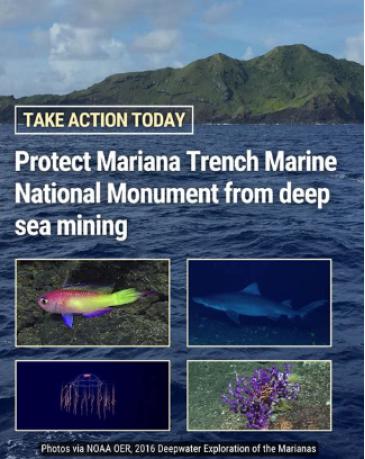
(For more than a decade, people have struggled to stop deep-sea mining in the Marian Trench)
Diplomatic tensions between key Pacific islands and the Trump administration over the role of US mining companies seeking to exploit mineral rich deposits look set to escalate. The position taken by the Trump administration has cast further light upon the dysfunctional nature of their foreign policy.
It has, moreover, far-reaching implications for US hegemony across the wider Indo-Pacific region, already the focus of diplomatic concerns about China and the future prospects of Taiwan. On 15 February 2025 China and Cook Islands signed a memorandum of understanding (MoU) in which they agreed to collaborate to research and potentially extract the latter’s seabed critical minerals.
In early August, a major diplomatic statement issued by the Commonwealth of Northern Marianas Islands Governor, David Apatang, noted the Trump administration had made plans to allow mining companies access to deep-sea mining exploration, despite strong opposition from local people. (1) Concerns have also arisen about similar planning in the close proximity of Samoa.
The Marianas Islands and Samoa both rely upon the US for their defence and security provision. The Pentagon also regard the two countries as 'strategic assets', forming part of island chains used to restrict access and egress by China, into the wider Oceania area of the Pacific.
The Marianas Islands are regarded as particularly sensitive for two reasons: the southern island of Guam hosts military intelligence facilities which swing on an arc from Pine Gap to Diego Garcia in the Indian Ocean and their Pacific counterparts. (2) The Pacific is also used by the US to host other sensitive military and intelligence facilities. (3) The Pentagon has also installed radar and missile systems on remote parts of island chains. (4)
The Western Pacific has also become a potential flashpoint for real-war scenarios between the US and China. A US Congressional Commission, for example, issued an official statement nearly a decade ago that 'the US is no longer clearly superior … and that it would struggle to win wars against China or Russia'. (5) The balance of forces has continued to swing still further during the past decade. And it continues to do so.
In fact, the commission recommended that the US should respond by 'further relying on traditional allies, including Japan and Australia'. (6) Recent high-level diplomacy between Canberra and Tokyo, therefore, is best assessed in that light. The controversy surrounding the 'melons' affair has been a convenient way of concealing other, more pressing, agendas.
Secondly, environmental concerns, including marine life and oceanic migrations, remain important for local Pacific islanders. Many local residents live subsistence lifestyles and any move to interfere with the environment potentially has far-reaching implications for whole communities.
What remains an important matter for consideration is that the Trump administration has been noted for not having undertaken any consultation about its Pacific foreign policy initiative. Swashbuckling bravado, instead of standard diplomacy, was the order of the day.
A diplomatic statement issued by the governments of the Marianas Islands, Guam and Samoa, has stated that they want a 'temporary ban on deep-sea mining in their territorial waters'. (7) All three, however, acknowledge that they 'have little say'. (8)
The moves would appear, therefore, highly likely to prove counter-productive for the White House. The powerful Pacific Islands Forum (PIF), for example, has been diplomatically silent over the matter. No doubt, however, its members have watched over the moves.
The Trump administration, nevertheless, appears ready to begin auctions of underwater terrain as early as November. Neo-colonial agendas for polymetallic nodules have taken priority over traditional foreign policy positions. (9)
A particularly worrying sign of the nature of the strained diplomacy between the US and the Pacific islands concerned has been their total failure of to consider the importance and significance of their exclusive economic zones. (10) The large zones carry considerable diplomatic significance inside region forums, including the PIF.
The moves by the Trump administration will also have considerable bearing upon Taiwan. For nearly a decade Taipei has pursued a 'New Southbound Policy', with attempts to foster closer links with regional countries for its own defence and security provision. While it has faced a reduced number of official diplomatic links due to the One China policy, its role within regional forums and think-tanks should not be overlooked. (11) Taiwan maintains a regional presence.
Successive governments in Taipei, nevertheless, rely upon US support, and the moves by the Trump administration toward the Marianas Islands and Samoa can hardly be seen to enhance that position or inspire a sense of confidence that the White House remains supportive of smaller countries increasingly placed in front-line positions with emerging China. Rather, the Trump administration appears oblivious to counter-productive policies.
In fact, when assessed in light of recent developments in trouble-spots elsewhere, commentary includes opinions that 'while no doubt informed by credible assessment of available intelligence … the US … now risks handing a further propaganda tool', to adversaries. (12) The intelligence assessments obviously exist, there is little evidence, however, the Trump administration even reads them, let alone studies them in the context of maintaining workable foreign policy initiatives. Dysfunctional remains an apt explanation.
Meanwhile, Canberra has remained diplomatically tied to Washington and the Pentagon with the so-called 'alliance'.
It is a diplomatic relationship fraught with very real dangers with the threat of real-war scenarios looming on the horizon:
We need an independent foreign policy!
1. Deep-sea mining ban push, Australian, 7 August 2026.
2. Map of the World, Peters Projection, Actual Size; and, US intensifies military presence in the Indo-Pacific, The Global Times, 24 July 2018.
Jennifer L. Anson, 14 February 2020.
4. See: US Indo-Pacific Command proposes new missile capabilities to deter China, RFA., 5 March 2021; and, US to build anti-China missile network along first island chain, Nikkei, 5 March 2021.
5. Study: US no longer dominant power in the Pacific, Information Clearing House, 22 August 2019.
6. Ibid.
7. Pacific islands alarmed, MSN / AFP., 6 August 2026.
8. Ibid.
9. Australian, op.cit., 7 August 2026.
10. US v. China, op.cit., 14 February 2020.
11. See: Beijing keeps a wary eye on new Taipei outpost, Australian, 18 June 2018.
12. Trump's secret catering cart switch over threats, Australian, 12 August 2026.


No comments:
Post a Comment