Written by: Humphrey McQueen on 30 January 2026
To understand ‘capital-within-capitalism’ is to conceptualize ‘value,’ a coupling approached through a trio of questions and answers:
Q. What is capital within capitalism?
A. The accumulation of values.
Q. From where do those values come?
A. From our labour as wage-slaves.
Q. What happens to the values we add?
A. Some are accumulated to expand reproduction and exchange, while some maintain the personifications of capital and their agents.
From these starting points, it is necessary to take a broader and deeper look into how Marx conceptualizes labour-value. This missile explodes three lies about his critical analysis of political economy. Their perpetrators serve as ‘teachers by negative example,’ to quote Mao. Their thinking is not ‘wrong’ from the standpoint of the needs of social capital, but expresses the daily doings of its personifications and agents in corporations and the state.
1. Mud pies
It would have no more importance for theoretical analysis than does the exchange of toys between two children in the nursery, an exchange which is fundamentally different in character from the purchases made by their fathers at the toy shop.
Rudolf Hilferding, Finance Capital (1910). (1)
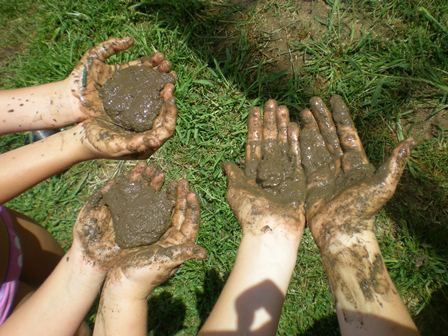
The first lie is about mud pies. Student comrades at the Australian National University report that this blather is taught in what passes for economics in academe. The mud-pie story is supposed to show how silly Marx is. It goes like this: a child makes mud pies in her backyard. To do so, she must expend labour. In doing that, she transfers her labour to the dirt and water. Mud pies, thereby, acquire an economic ‘value.’
One version stops here. Students are supposed to see how childish are Marx’s ideas. A more advanced version is that the mud pies will not have a price, which neo-Classical economists equate with value. Marx is again exposed as a fool.
Let’s not dwell on the ignorance and stupidity of the professors pushing this lie. Instead, let us turn to what Marx would have said if asked about mud pies.
First, he would accept that the child has added value to the dirt and water. She has made a use-value. Of what use is a mud-pie? The use is that it amuses its maker, fulfilling what Marx calls a ‘fancy,’ her need for play. We could go further and point out that her act of shaping the mud teaches her something about form. In addition, when the mud dries, its consistency will be different. In brief, her making mud pies has psychological and pedagogical uses. Another use, since she is bound to ingest some dirt, will be to strengthen her gut.
But use-value is not the same as exchange value. The presence of exchange-value is crucial to Marx’s concept of labour-value. In the case of a child’s making mud pies for fun, two essential exchanges are absent. First, she has not sold her capacity to make mud pies – i.e. her labour-power – for money wages, as some children are still forced to do to make bricks. Secondly, she has not exchanged the product of her labour for any other commodity. In short, her labour is not part of the capitalist mode of reproduction and exchange. Indeed, it is not part of any mode of production, as Hilferding has it. Her parents will have to be part of some mode of production in order to keep her alive so that she can play in the dirt.
The ANU academics dispose of Marx’s analysis of capitalism by making up an example from which capitalism is absent.
Before leaving these frauds behind, we might give the thumbscrew one more turn by relocating mud pies from backyards into the capitalism where mud is used as a cosmetic. The customer pays money to have mud applied to her face. The use-value is to improve the quality of the skin. The exchange-value is in the money she pays the Beauty Parlour to supply this service. The exchange-value is also present in the sale of labour-power by the persons who mix, apply and remove the mud. Finally, someone has had to earn the money that pays for the treatment.
Why not give the thumbscrew yet another twist? In The Wealth of Nations, Adam Smith writes of poor folk who collect and sell pebbles. Picking up pretty stones, is another form of child’s play. But, like the sale of mud-packs, the Scottish paupers performed that labour to earn money. The use-value to the people who buy the pebbles is to fulfill a fancy, not to fill their stomachs. We can bet Paris to a peanut that few of the mud-pie scholars will not have read beyond the first three chapters of The Wealth of Nations. Their ignorance extends beyond Marx to their own master-mind.
2. Mona Lisa
At the other extreme is the labour of Leonardo. Should a child’s mud pie ever happen to have an exchange-value, its sale price would be no more than a dollar or two – unless recognised as a Work of Art, which is by no means impossible in an era when an artist’s faeces entered a state collection.
Mona Lisa on the other hand is deemed ‘priceless,’ which it is, in part, because it is in the Louvre and unlikely to come onto the market. Were it to be stolen again and enter the Dark Web, bidding would start at well above a billion Euros.
In the case of Leonardo, Marx’s critics do not deny that the artist added ‘value’ to the paints, canvas and brushes. Rather, their accusation is that the price that the masterpiece would fetch today bears no relation to the cost of the labour that went into its production. That qualification holds even when the cost of materials are added to the cost of the labour-power that went into making them. Hence, like the mud pie, the Mona Lisa refutes the concept of labour-value.
How would Marx respond? The first thing he might point out is the Mona Lisa was produced in 1500, more than 250 years before the capitalist mode of reproduction and exchange became dominant. The second point is that the price that Leonardo put on his creation had been related to the costs of its production at the time. The third, and more important point concerns the nature of those costs.
Here, we need to spotlight a crucial element in Marx’s concept of labour-value: what is ‘socially necessary’?
Marx writes about a wage-slave selling her labour-power to this or that personification of capital. Such simplifying assumptions introduce how social capital exploits social labour. Hence, the concept of labour-value applies only to such products of labour as are reproducible. You cannot mass produce works of genius. (2)
A fourth aspect makes that point clearer. Leonardo could have made an exact copy of the Mona Lisa. Many portrait painters did that after being commissioned to provide one for the family to keep, and the other to be sent to a suitor hundreds of miles away. An ocean separates copies by the artist from the mass production of postcards. The social labour of factory hands who produce millions of mementoes confirms Marx’s conceptualizing of labour-value in terms of the socially-necessary costs of its reproduction. The market-price of their product is also subject to competition. The demand for postcards of Mona Lisa has dropped off in an era when gallery-goers jostle each other out of the way to take selfies in front of masterpieces other than themselves.
3. The wealth of nature
A third fib about the concept of labour value afflicts some environmentalists. They overhear that Marx argues that only labour can add value. From this correct report, they conclude that he ‘devalues’ nature, a confusion which bedevils many a discussion.
The word ‘value’ has several connotations. We use it in a moral sense, in an aesthetic sense and in an economic sense. Only confusion can result from not distinguishing them. Marx fully recognises the value of nature in the ethical and aesthetic senses, but his concept of labour-value is not about our feelings.
In 1875, two factions of German socialists published a draft programme for a unity conference at Gotha. Marx sent his thoughts to his comrades about the first part of their Programme, which had proclaimed:
1. Labour is the source of all wealth and all culture ….
He is scathing about a phrase which could be
found in all children’s primers when one task of the labour movement is to enrich the understanding of working people: ‘But a socialist programme cannot allow such bourgeois phrases to pass over in silence the conditions that alone give them meaning.
He lays down the law about why the opening ten words in the Programme are misguided:
Labour is not the source of all wealth. Nature is just as much the source of use-values (and it is surely of such that material wealth consists!) as labour.
Nor was Marx happy with the use of the word ‘labour.’ The draft would still have been wrong had it said that labour and nature are the sources of all wealth and culture. Marx had put a lot of his brainpower into conceptualizing the difference between labour and labour-power. Labour ‘itself is only the manifestation of a force of nature, human labour-power.’ To correct these errors, the draft should read: ‘human labour-power and nature are the sources of all wealth and culture.’ (3)
A further distinction is telling. Marx did not confuse wealth with value. He demonstrates that labour-power, with or without tools or machines, is the source of all the values that could be added to nature. Nature will never add economic value – but neither can money nor machines.
These differences allow Marx to develop his concepts of surplus-value and the kind of exploitation peculiar to capitalism. His formulations are miles away from the Gotha Programme’s kindergarten belief that ‘labour is the source of all wealth and culture.’
To repeat, nature is ‘just as much the source’ of wealth as is labour.
Marx draws a line between wealth and value as economic categories. In short, only labour can add value to the wealth of the use-values supplied by or taken from nature. When he calls them a ‘free gift,’ he means that no labour has been expended on them – as with virgin forests. Solar power, however, requires outlays of labour-power at every step, from mine-sites to repairing panels.
Corporates are in favour of putting a market-price on nature the better to exploit its wealth. They expect to be rewarded with subsidies, off-sets and tax-exemptions for doing their dirty business somewhere else and not fouling our nest.
Why must the hired-pens of capital peddle their porkies? The answer is as simple as it is complex. Marx’s concept of labour-value explains how the exploitation of wage-slaves is the life-blood of vampire capitalism. Scholars are paid to fail students who use naughty words like wage-slave or exploitation. Could Marx have had them in mind when he quipped that ‘conscience, honour’ can have their market-price but no value? (4)
(1) Rudolf Hilferding, Finance Capital A study of the latest phase of capitalist development (London: Routledge, 1981), 28.
(2) Karl Marx, Capital, III (London: Penguin, 1981), 772.
(3) Karl Marx, “Critique of ‘The Gotha Programme’,” M-ECW, vol. 24 (London: Lawrence & Wishart, 1989), 81-3.
(4) Karl Marx, Capital, 1 (London: Penguin, 1976), 197.